

Illustration by ArchitectureCourses.org. A simplified Gothic structure diagram showing arches, vaulting, and buttressing working together as one system.
Gothic architecture did not become Gothic because of ornament alone.
It changed because the structure changed.
Pointed arches, ribbed vaults, and buttressing let builders push masonry further than earlier heavy wall systems could manage. Buildings could rise higher. Interiors could open up. Walls could carry less of the burden by themselves. That is the real story behind Gothic structure.
This page stays on that one job: how the system works, how the loads move, and why Gothic buildings feel lighter and taller even when they are still built in heavy masonry.
Read This Next: Introduction to Gothic Architecture for the broad starter page, Characteristics of Gothic Architecture for the fast recognition page, and Gothic Architecture Style for the larger design language.
What Gothic Structure Changed
Earlier heavy masonry traditions often relied on thick walls, smaller openings, and heavier roof logic.
Gothic building did not abandon masonry. It reorganized it.
The structure stopped depending so completely on one continuous block of wall. Loads could be directed more precisely. Ceilings could be framed more clearly. Outward thrust could be managed better. Openings could grow larger without turning the whole building unstable.
That is why Gothic structure matters. It is not just a list of famous features. It is a coordinated system.
| Structural Change | What It Did | What You See |
|---|---|---|
| Pointed arches | Handled loads more flexibly than round arches | Sharper openings and stronger upward pull |
| Ribbed vaults | Organized ceiling loads through a visible framework | Ceilings read as structure, not just mass |
| Buttressing | Moved thrust away from the wall line | More open wall zones and taller elevations |
| Lighter wall role | Reduced dependence on one thick load-bearing surface | More window area and less blank masonry |
The Core Structural System
If you strip the style down to its structural backbone, three parts do most of the work.
Pointed arches handle openings and spans.
Ribbed vaults organize the ceiling.
Buttressing manages thrust and helps keep the wall from doing everything alone.
Those parts are not isolated tricks. They reinforce each other. That is why Gothic buildings feel coherent when they are working well. The structure is visible enough to shape the architecture, but controlled enough to avoid looking chaotic.
Pointed Arches
The pointed arch is not only a visual sign. It is a structural decision.
Compared with a rounded arch, it allows more flexibility in height and span. It also changes how force is directed through the opening and into the supports below.
That is one reason Gothic buildings could grow taller without feeling as blunt or heavy as earlier masonry work. The openings themselves begin participating in the upward movement of the whole building.
Pointed arches show up in windows, portals, arcades, vaults, and galleries. Once they repeat across the structure, they stop being an accent and start becoming part of the building’s main logic.
For the support page, go to Pointed Arch.

Illustration by ArchitectureCourses.org. Round and pointed arch geometry compared.
Ribbed Vaults
Ribbed vaults make the ceiling readable.
Instead of one continuous heavy shell doing all the work in a hidden way, ribs organize the vault into a more legible framework. The ribs carry the logic of the span. The surfaces between them can stay lighter.
This changes both engineering and spatial experience. Structurally, the ceiling becomes more controlled. Visually, the room begins to show how it is held together.
That is one reason Gothic interiors feel so different from heavier earlier vaulting. The ceiling does not just cap the space. It shapes the space.
For the support page, go to Rib Vaults.

Illustration by ArchitectureCourses.org. A ribbed vault with intersecting ribs carrying the logic of the ceiling.
Buttressing And Thrust
Once roofs and vaults push outward, the structure has to answer that force.
Buttressing is one of the main answers. Instead of asking the wall to absorb everything by thickness alone, Gothic builders move support outward and make it more explicit.
That matters because it frees the wall. Larger openings become possible. More light becomes possible. Taller elevations become possible. The facade can carry less dead weight and more articulation.
This is one of the biggest structural turns in Gothic architecture. The support system becomes more distributed, and the visual result changes with it.
How The Load Path Works
If you want the fast structural read, follow the load.
The roof or vault pushes down and outward.
The ribs help organize that load across the ceiling.
The arches direct force into piers and supports.
Buttressing deals with the lateral thrust that would otherwise push the wall out.
The ground takes the final load.
That sequence is why Gothic buildings can feel lighter than they are. The structure is still carrying massive weight. It is just carrying it with more precision.
The Wall Stops Doing Everything Alone
This is one of the clearest structural differences between Gothic and earlier heavy masonry systems.
The wall does not disappear. It still matters. But it stops acting like one blunt continuous mass responsible for every problem at once.
Once support is handled more strategically, the wall can open up. More of the facade becomes frame, opening, tracery, and depth instead of solid enclosure.
That is why Gothic structure changes the visual language so strongly. Engineering and appearance are moving together.
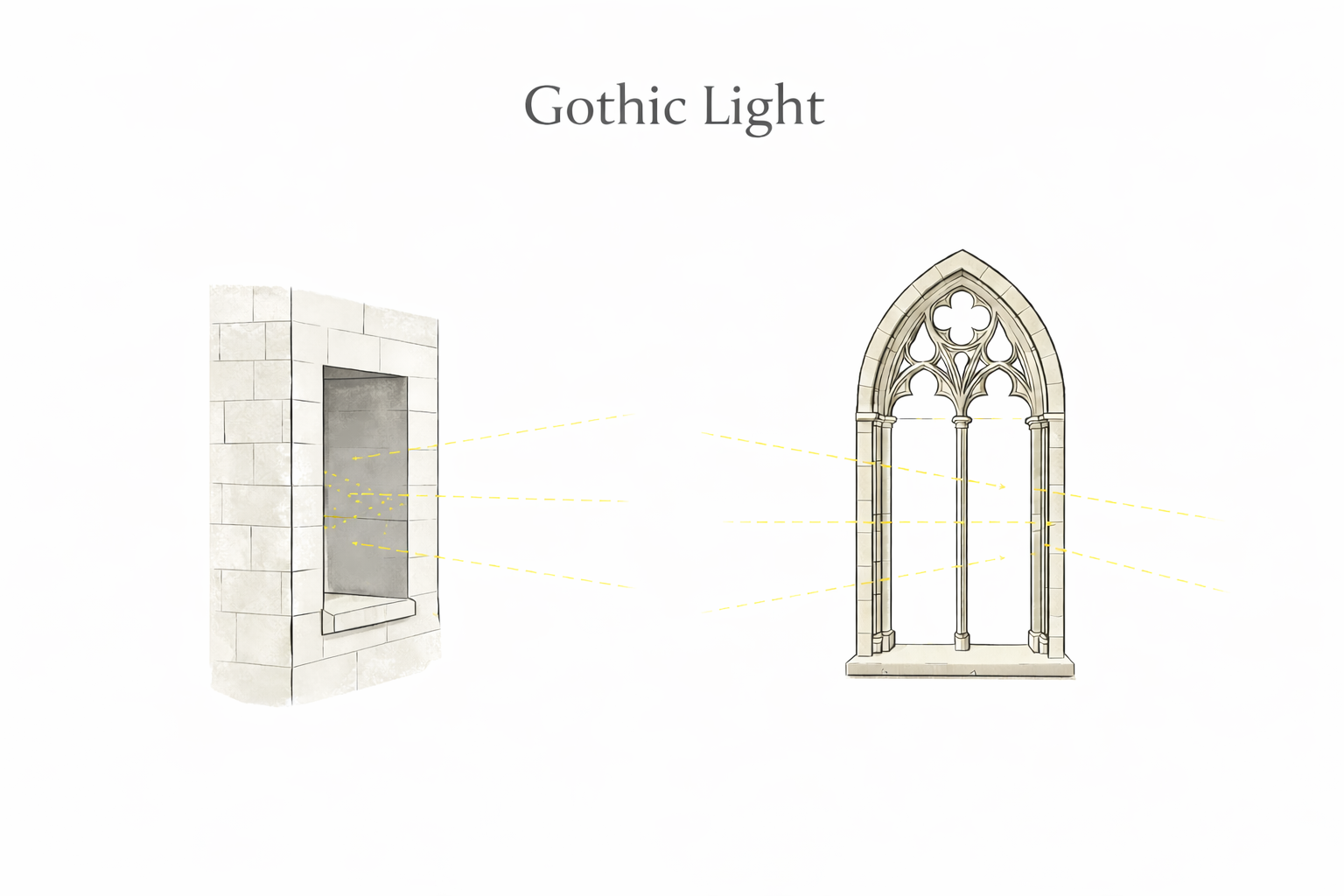
Illustration by ArchitectureCourses.org. A plain opening compared with a Gothic tracery opening.
Why Gothic Buildings Feel Tall
Height in Gothic architecture is not just a taste choice. It is tied to structure.
Pointed openings reinforce vertical movement. Ribbed ceilings push the eye along the span and upward. Buttressing helps keep the building stable while elevations rise higher and wall zones open more.
That combination is why a Gothic building often feels taller than its dimensions alone would suggest. Structure, silhouette, and proportion are all reinforcing the same effect.
Secular Examples Make The Structural Logic Easier To Read
This matters because structure often reads more clearly in secular buildings than people expect.
Town halls, palaces, castles, colleges, guild halls, and urban houses all used Gothic structural logic in different ways.
Lübeck Town Hall is useful because civic architecture makes the structural language feel public and legible. Heidelberg Castle and Albrechtsburg Castle show how Gothic systems could work in fortified and princely settings. The Doge’s Palace in Venice pushes the logic toward a lighter and more open urban result. Ca’ d’Oro shows the same language working at domestic scale.
These are not side examples. They prove Gothic structure was flexible enough to move beyond one building type.
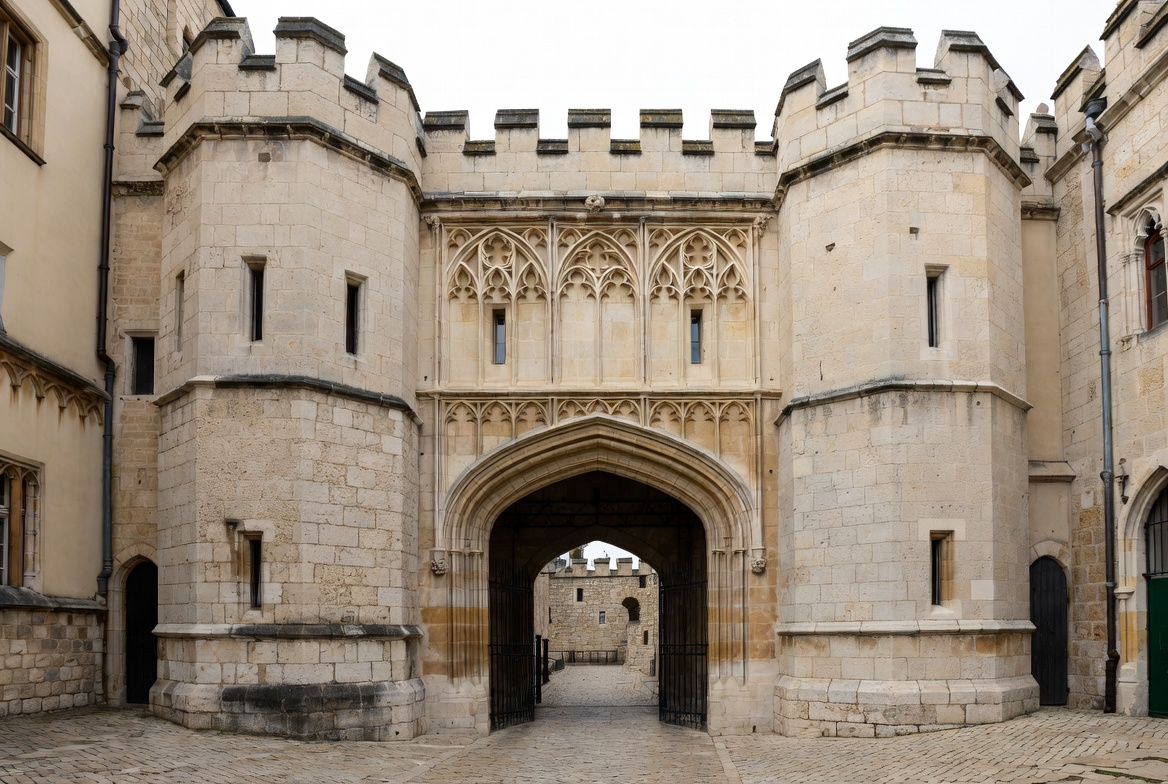
Image by ArchitectureCourses.org. A secular Gothic gatehouse with a pointed entry, towers, and strong stone massing.

Image by ArchitectureCourses.org. A Gothic interior with pointed arches and vaulting.
What Gothic Structures Are Not
They are not random decoration attached to heavy walls.
They are not only about “soaring beauty” or romance.
They are not one miraculous invention appearing from nowhere in finished form.
Gothic structures are a disciplined development in masonry building, one that refines earlier knowledge and pushes it toward greater height, clearer load paths, and more open spatial effects.
Why The System Still Matters
Because it shows what happens when structural logic and architectural expression are aligned.
The building does not hide how it works completely. The support system becomes part of the design language. The ceiling becomes legible. The openings become part of the structural story. Height stops feeling like dumb bulk and starts feeling controlled.
That is why Gothic structure still matters now. Not because modern buildings copy the system literally, but because the basic lesson still holds: when load path, enclosure, and visual effect are working together, architecture gets stronger.
Quick Structural Checklist
If you need a fast on-site read, check these in order:
- Are the main openings pointed rather than rounded?
- Does the ceiling show ribs or a clear vault framework?
- Does the wall feel opened up rather than massively solid?
- Is there visible buttressing or evidence that thrust is being managed beyond the wall line?
- Do the proportions and supports reinforce vertical pull instead of broad heaviness?
If the answer is yes across most of those, you are looking at Gothic structural logic, not just Gothic decoration.
FAQ
What Are The Main Structural Features Of Gothic Architecture?
Pointed arches, ribbed vaults, and buttressing do most of the structural work people associate with Gothic architecture.
Why Were Pointed Arches Important?
They allowed more flexibility in span and proportion and helped reinforce the vertical character of the building.
What Do Ribbed Vaults Do?
They organize the ceiling into a more legible framework and help distribute loads more clearly across the span.
Why Do Gothic Walls Feel Lighter?
Because the structure is no longer relying on one continuous thick wall to handle every load by itself.
Were Gothic Structural Ideas Used In Secular Buildings?
Yes. Town halls, palaces, castles, colleges, and urban houses all used Gothic structural logic in different ways.
Why Do Gothic Structures Still Matter?
Because they show how structural logic can shape space, light, height, and architectural expression at the same time.