

The Parthenon’s Architecture and Deisgn: Why It Wasn’t Built as a Temple
The Parthenon’s True Purpose: Architectural Insights
The Parthenon’s architecture tells a story of art and innovation. Find out why experts believe it was never intended as a temple.
The Parthenon is often celebrated as a temple dedicated to Athena, but a closer look tells a much more fascinating story. Scholars and architects have debated its purpose for years, and there’s strong evidence suggesting it wasn’t a temple at all. Instead, it may have served as a symbol of civic pride or even a treasury, designed to showcase Athens' wealth and power rather than function as a place of worship.

Having spent years studying and working with ancient architecture around the world, I’ve been fortunate to see the Parthenon up close. Its design, layout, and features make one thing clear: this was not built as a traditional temple. Its proportions and details align with what many scholars now believe—it was a civic monument, not a religious one.
Let’s explore what makes the Parthenon such a remarkable structure and how its architecture reveals the truth about its purpose.
The Historical and Cultural Context of the Parthenon

The Parthenon is often thought of as a temple dedicated to Athena, but this is a common misconception. Its design, features, and purpose suggest something entirely different.
It wasn’t built for worship—it was a showcase of Athens' power and a secure place to store treasures. To understand why, we need to look at the cultural and historical background of ancient Athens.
Ancient Athens and the Acropolis

IMAGE: Close-up of the Parthenon’s ancient columns in Athens, Greece, highlighting classical Doric design and weathered marble details.
In the 5th century BCE, Athens was thriving. This was a time when art, politics, and architecture flourished, and the city became a symbol of innovation and leadership in the Greek world. Under Pericles’ guidance, Athens rebuilt the Acropolis, a rocky hill that dominated the city’s skyline and became a symbol of its identity.
The Acropolis Athens architecture wasn’t just about religion; it reflected civic pride and ambition. Alongside the Parthenon, the Erechtheion and Propylaea were constructed as part of a larger vision. These structures were designed to celebrate Athens’ dominance after its victory over the Persian Empire and to impress both citizens and visitors.

The Parthenon architecture and design stood out not because it was a religious center but because of its sheer scale, precision, and artistic detail. It wasn’t about worship—it was about showcasing Athens as a leader in culture, innovation, and wealth.
Why the Parthenon Was Really Built (Not What You Think)

Most people assume the Parthenon was just another temple. But look closer, and you’ll see that this iconic structure wasn’t built for worship—it was built for power, politics, and pride.
Athens After the Wars: A City Rebranding Itself
The Parthenon rose during Athens’ Golden Age, right after its victory over the Persian Empire. Pericles, the city’s leading statesman, wasn’t just rebuilding what had been destroyed—he was redefining Athens as the cultural and political center of the Greek world.
He commissioned a monumental structure to do that. Something permanent. Something unforgettable.
Not a Typical Temple—No Central Altar, No Major Ritual Use
Here’s the strange part: no main altar has ever been found near the Parthenon. That alone breaks with traditional temple design, which centered worship around a visible altar for public sacrifices.
Instead, the Parthenon includes features like the opisthodomos—a secured rear chamber used for storing vast amounts of wealth, possibly the treasury of the Delian League (a wartime alliance led by Athens).
A Civic Monument in Disguise
The architecture tells the story too:
-
✔ Extreme focus on symmetry and proportion → more artistic perfection than sacred utility
-
✔ Detailed friezes and pediments → celebrating Athenian victories and mythology, not religious rituals
-
✔ Scale and visibility → built to impress allies, intimidate rivals, and awe citizens
The message was loud and clear: Athens is powerful, refined, and here to stay.
Built for the People
In a way, the Parthenon is an early example of nation branding—a high-budget PR campaign in marble. It didn't just glorify Athena; it glorified the Athenians themselves.
It’s a monument to democracy, empire, and civic identity. And that’s what makes it so important. It shifted the purpose of monumental architecture—from ritual to representation.
Bottom Line: More Treasury Than Temple
The Parthenon was built to serve Athens’ political vision, and to house its wealth.
And in that, it succeeded. Over 2,400 years later, we’re still talking about it.
Why Scholars Argue It Wasn’t a Temple

The Parthenon architecture and design strongly suggest that it wasn’t built as a traditional temple. By examining its features and historical role, many scholars agree it served a civic purpose, highlighting Athens’ power and cultural identity more than religious devotion.
Functional Layout

The layout of the Parthenon lacks essential elements found in Greek temples, raising doubts about its religious function.
- No Primary Altar: Typical Greek temples had an altar positioned prominently outside for sacrifices and worship. The absence of such an altar near the Parthenon is a major clue that it wasn’t designed for regular religious rituals.
- Limited Cult Activity: Unlike other temples dedicated to deities, there’s no evidence of ongoing cult practices or rituals taking place within or around the Parthenon.
- Treasury Features: The interior design resembles a secure space for storing treasures, including the Delian League’s wealth. The opisthodomos, or rear chamber, housed valuable offerings, reinforcing its role as a repository rather than a worship center.
These practical elements suggest a focus on storage and display over spirituality.
Design Emphasis on Civic Pride
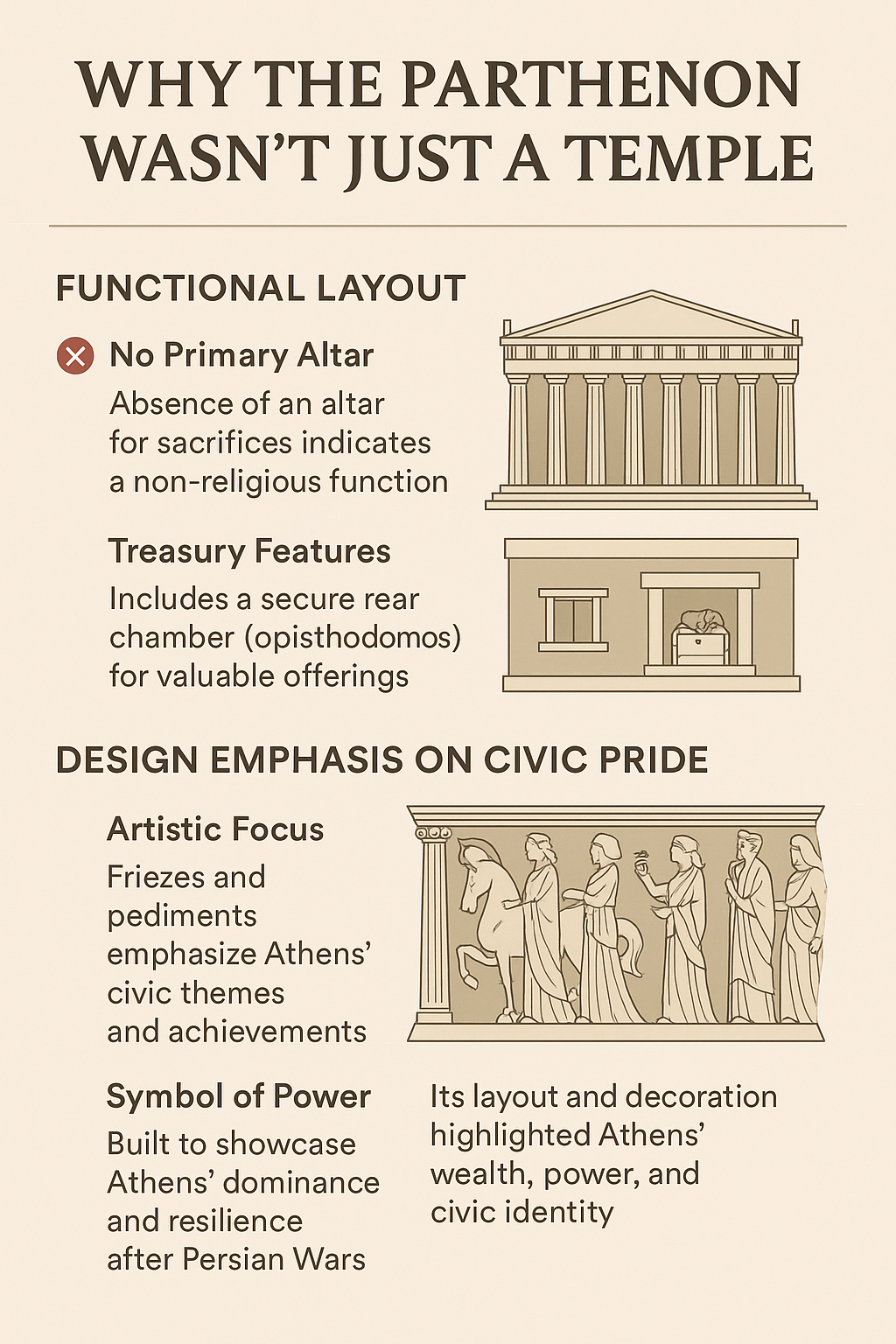
The Parthenon design goes beyond the functional needs of a temple, showcasing a broader purpose that celebrated Athens itself.
- Symbol of Power: Built after Athens’ victory over Persia, the Parthenon was part of a larger rebuilding effort to display the city’s strength and resilience. Its scale and intricacy would have left no doubt about Athens’ dominance in the Greek world.
The structure’s grandeur wasn’t limited to its design; it reflected Athens’ ambition and confidence during its Golden Age.
It’s fascinating to think about how the Parthenon wasn’t just another temple. Its layout, its intricate details, and even its purpose challenge what many of us assume about ancient structures.
Overview of Parthenon Architecture and Design

The Parthenon is more than a symbol of classical architecture. Discover its design, unique features, and the evidence behind its original purpose.
The Parthenon’s Design and Features Explained by an Architect
The Parthenon architecture and design are often seen as one of the greatest achievements of classical Greek architecture. Its structure wasn’t just about looking impressive; it demonstrated an extraordinary level of precision, innovation, and understanding of visual perception. Here’s a closer look at its key architectural features.
Classical Proportions

IMAGE: An illustration of the Acropolis featuring the Parthenon’s interior, highlighting civic architecture and urban activity rather than religious use.
One of the most striking aspects of the Parthenon classical architecture is its perfect balance and harmony. The architects used the 4:9 ratio consistently throughout its design, creating proportional relationships that are pleasing to the eye. This ratio can be seen in the spacing of the Doric columns, as well as in the building’s overall width and height.
These proportions weren’t just about making the building look good—they helped create a sense of cohesion and unity. Every part of the Parthenon feels connected, reinforcing Athens' reputation for precision and sophistication in design.
Optical Refinements

The Parthenon design also includes subtle adjustments to counteract optical illusions and ensure it looked perfect to the human eye. These refinements show just how much thought the architects put into every detail:
- Entasis: The columns are slightly curved outward to correct the illusion that straight columns appear concave.
- Curved Stylobate: The platform on which the Parthenon stands is gently curved upwards in the center. This prevents it from looking like it sags in the middle when viewed from a distance.
- Column Spacing: The corner columns are slightly thicker and placed closer together to maintain a sense of visual balance.
These adjustments reflect a deep understanding of how people perceive structures and ensured that the Parthenon appeared flawless, no matter where it was viewed.
Mixed Architectural Orders

The Parthenon is primarily a Doric structure, but it also incorporates Ionic elements, blending two architectural styles seamlessly. While the sturdy Doric columns dominate the exterior, the inner frieze—an Ionic frieze—adds intricate detail. This frieze, running along the inner walls, depicts the Panathenaic Procession, a major festival in honor of Athena.
This mix of styles was not only innovative but also elevated the Parthenon above other buildings of its time. The sturdy Doric design symbolized strength, while the delicate Ionic details added elegance and sophistication. The combination reflects the architects' ambition to create something new and unparalleled.
The architectural style of the Parthenon is a perfect example of ancient Greek ingenuity. Its proportions, optical refinements, and unique blend of styles come together to create a building that continues to captivate architects and historians today.
Architectural Features and Details
The Parthenon: Inside and Out — A Practical Look at Its Design

Interior Layout and Architectural Features
The Parthenon was built with purpose, precision, and clever details—both inside and out. Here’s a breakdown of what really matters.
Outside Design: Built for Strength and Image
Doric Columns

- There are 46 columns total.
- They look straight but actually swell a bit in the middle (this is called entasis).
- That curve fixes how our eyes see lines from far away.
Friezes and Pediments
- These are carved scenes that run across the top.
- They show stories from Athens, also everyday citizens and festivals.
Floor (Stylobate)
- It’s not flat. The center is raised slightly.
- That’s another visual trick to make the building look balanced.
Roof and Cornice
- The roof was made from marble tiles.
- Light would reflect off the tiles to make the building glow.
Related: Ancient Greek Columns
Inside the Parthenon: A Walkthrough from an Architect’s Eye
Inside Layout: More Like a Vault Than a Temple
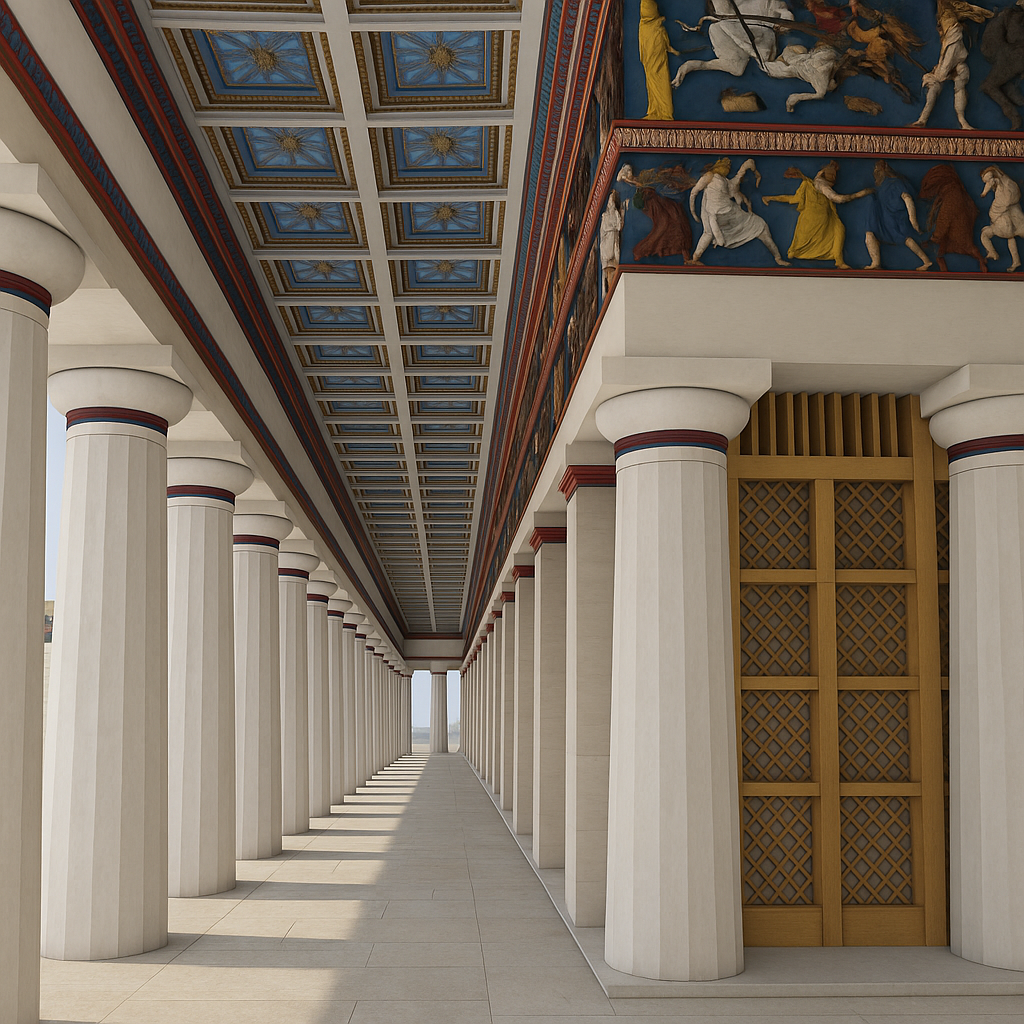
IMAGE: Artistic render of the Parthenon’s interior, featuring the statue of Athena and detailed classical elements.
Main Room (Naos)
- Long and narrow, built to showcase a huge statue of Athena.
- Had two levels of columns around the statue—not for support, just for looks.
- It’s not a space meant for worship or large gatherings.
Back Room (Opisthodomos)
- This was a storage room.
- It held treasures, like payments from other Greek cities.
- It used a different column style (Ionic) to show the room had a special function.
- No altars, no ritual signs—it was about money, not prayers.
Smart Design Choices You’d Notice in Person
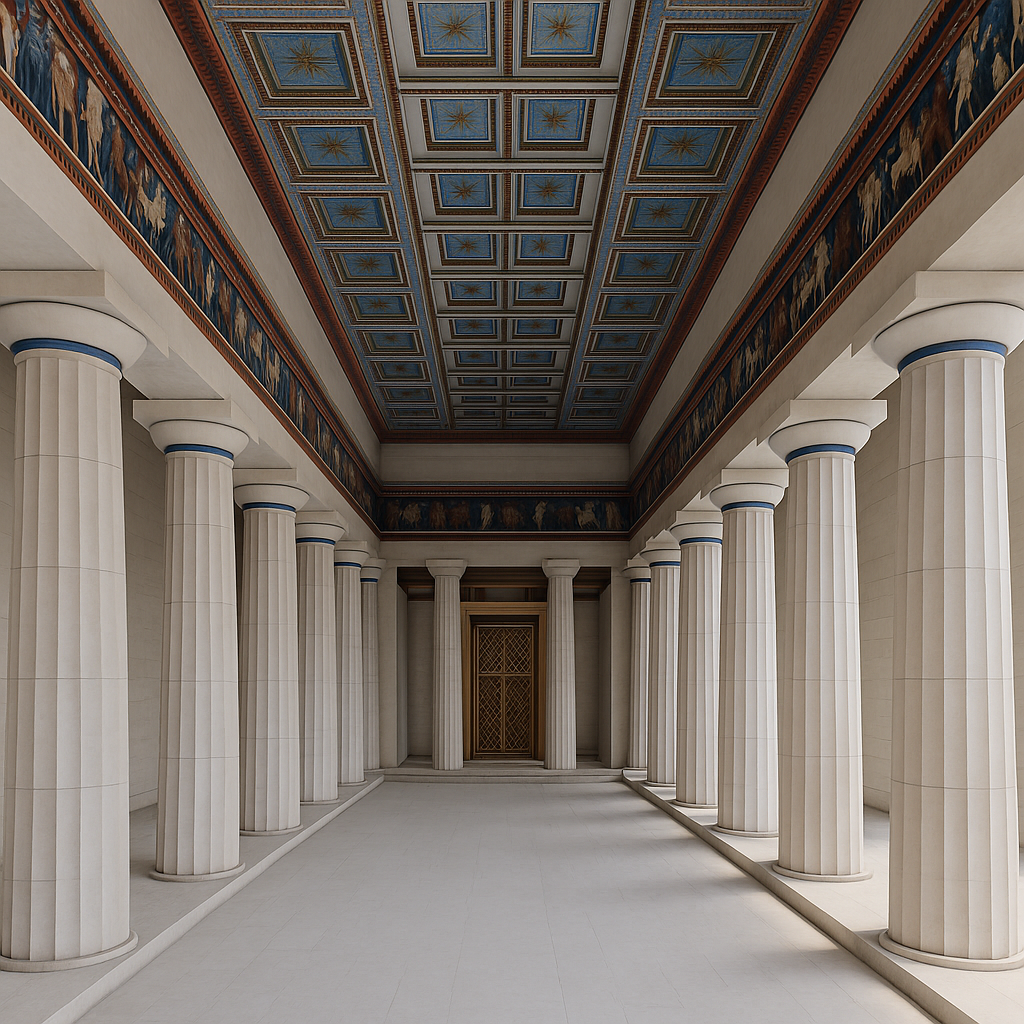
- The columns aren’t all the same—they change shape to look “right” to the human eye.
- The floor rises in the middle, so from far away it looks flat.
- Light was used to draw your eyes to the statue and main features.
Why It Matters
The Parthenon wasn’t just for religion. It was built to show Athens’ power, wealth, and skill.
As someone who’s studied architecture and visited the site myself, I can tell you—it’s not about size. It’s about control. Every shape, every line, every detail was put there to make the building feel stable, proud, and smart.
It’s not a temple in the usual way. It’s a statement.
Simple takeaway:
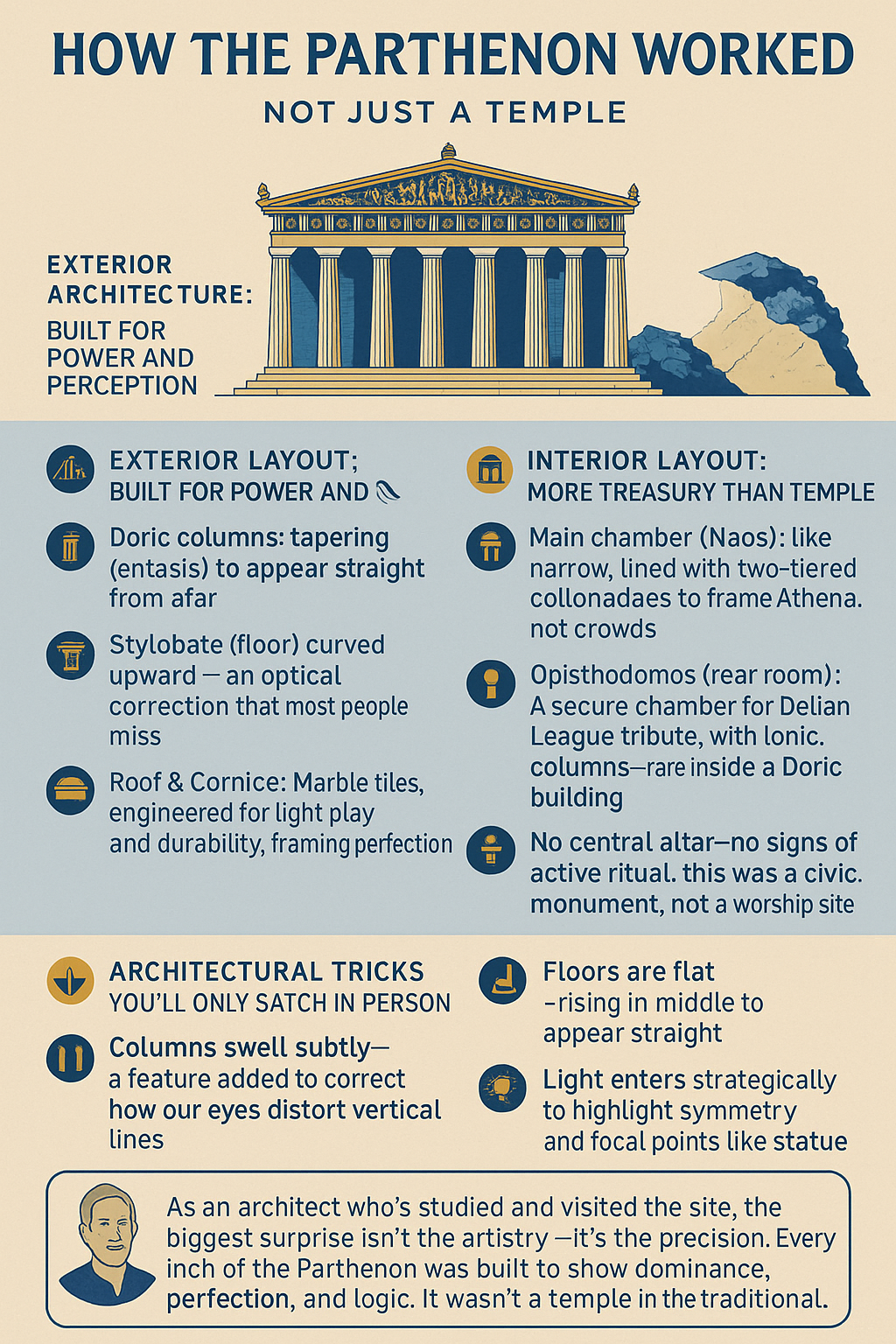
- It looks beautiful, but it was made with real goals in mind.
- It stored money. It made Athens look strong. It was designed to impress.
Advanced Structural Design Techniques
The Parthenon architecture and design showcase the advanced engineering skills of ancient Greece, blending artistry with structural ingenuity. Its ability to stand the test of time is due to the innovative techniques and materials employed by its creators.
Materials Used
One of the Parthenon’s defining features is its use of Pentelic marble, a material chosen for both its durability and aesthetic qualities.
- Durability: Pentelic marble is exceptionally strong, allowing the Parthenon to endure for centuries despite weathering and seismic activity.
- Iconic Glow: The marble contains a high concentration of calcite, which gives it a slightly reflective quality. Under sunlight, the Parthenon appears to glow, adding to its grandeur and making it a striking symbol of Athenian pride.
This choice of material was as much about practical considerations as it was about visual impact, ensuring the Parthenon would be both functional and awe-inspiring.
Engineering Marvels
The construction techniques used in the Parthenon reveal a deep understanding of physics and material behavior, showcasing the ingenuity of its architects.
- Dry-Stone Construction: The Parthenon was built without the use of mortar, relying on precisely cut stones that fit together seamlessly. This technique allowed the structure to maintain its integrity over time by providing flexibility during natural shifts.
- Precision Cutting: Each block of marble was cut and shaped with remarkable accuracy, ensuring a snug fit. This precision reduced the risk of structural weaknesses and enhanced the building’s stability.
These techniques demonstrate an advanced understanding of construction that rivaled, and in some cases exceeded, modern practices.
Seismic Resilience
The Parthenon’s ability to survive earthquakes is a testament to the foresight of its architects, who designed the structure to handle the natural challenges of the region.
- Interlocking Stones: The marble blocks were connected using a system of interlocking grooves and dowels, which allowed them to move slightly during seismic activity. This flexibility absorbed shocks and prevented the structure from collapsing.
- Distributed Weight: The weight of the roof and columns was carefully distributed across the building, reducing stress points and increasing stability.
These features highlight how the Parthenon design was not only focused on aesthetics but also on creating a durable structure capable of enduring natural disasters.
The Parthenon’s design shows just how skilled and innovative its creators were. Using marble that catches the light beautifully and clever techniques to handle earthquakes, they built something truly impressive. Even today, it’s a reminder of what’s possible when design and engineering come together perfectly.
The Architects Behind the Parthenon
The Parthenon architecture and design were not the work of a single mind but the result of collaboration between some of the greatest creative and technical minds of ancient Greece. Each contributor brought their expertise, ensuring the structure’s enduring brilliance.
Ictinus and Callicrates
The primary architects, Ictinus and Callicrates, were tasked with translating Athens' vision of grandeur into reality. Their work reflected a balance of innovation and practicality.
- Structural Genius: Ictinus and Callicrates were responsible for the Parthenon’s structural design, creating a building that could handle the immense weight of its marble construction. They incorporated subtle adjustments, such as curved stylobates and precise column spacing, to ensure both stability and visual perfection.
- Mathematical Precision: They applied mathematical ratios, like the 4:9 proportion, to achieve harmony and balance in every part of the structure. This meticulous attention to detail ensured that even the smallest components contributed to the overall aesthetic.
- Durability: Their engineering solutions ensured the Parthenon could withstand time and environmental factors, solidifying its place as an architectural marvel.
These architects didn’t just build a structure—they created a symbol of Athenian pride that would resonate through history.
Phidias’ Sculptural Influence
While Ictinus and Callicrates focused on the structure, Phidias, one of Greece’s most celebrated sculptors, oversaw the artistic elements that elevated the Parthenon to a work of art.
- The Statue of Athena: Phidias was responsible for the colossal chryselephantine statue of Athena, made of gold and ivory. Standing inside the Parthenon, it symbolized Athens’ power and wealth. This statue wasn’t merely decorative—it was a political statement meant to impress and inspire.
- Sculptural Embellishments: Phidias also directed the creation of the intricate friezes and pediments that adorned the Parthenon. These sculptures, depicting mythological scenes and civic celebrations, showcased a level of craftsmanship that continues to captivate viewers today.
Phidias’ contributions ensured the Parthenon was not only an architectural triumph but also a masterpiece of visual storytelling.
Together, Ictinus, Callicrates, and Phidias transformed the Parthenon from a grand idea into a reality. Their combined efforts resulted in a building that was as much about artistry as it was about engineering, leaving behind a legacy that continues to influence architects and artists across the globe.
Why Architects Still Look to the Parthenon

IMAGE: Visual comparison between the Parthenon and modern architecture, highlighting symmetry, proportion, and column spacing as shared design principles.
The Parthenon wasn’t just built to impress—it was built right. And that’s why nearly 2,500 years later, architects are still borrowing from it. Not to copy columns, but to understand how timeless design actually works.
Simple Geometry That Still Works
You’ve seen its influence, even if you didn’t notice it. Government buildings, museums, libraries—many of them use the same tricks: clean symmetry, solid proportions, and visual clarity. They feel stable. Purposeful. That’s no accident.
● It’s in the details: Balanced facades, repeatable elements, and natural rhythms that make a structure feel “just right” without shouting.
● It’s in the message: These shapes say something—trust, order, permanence. That’s why the U.S. Capitol or the British Museum feel like they matter, before you even walk in.
Not Just the Past: Modern Takes
The Parthenon didn’t invent good design—but it nailed the fundamentals. And today’s architects still use those same ideas:
● Proportions over decoration – Modern homes, offices, even museums often skip the ornament and focus on balance. That’s straight from Athens.
● Structure that speaks – Concrete walls, steel beams, long uninterrupted lines—these may look new, but the principle’s ancient: let the form do the talking.
● Simplicity with intent – The Parthenon wasn’t flashy. It was refined. A lot of modern architecture—minimalist homes, clean civic buildings—follows that same lead.
It Still Matters
Design fads come and go. But what makes the Parthenon stand out is this: it never relied on trends. It used proportion, clarity, and presence to do what every great building should—say something about the people who built it.
That’s why architects keep coming back to it. Not out of nostalgia—but because it still works.
The Parthenon in Art and Popular Culture
The Parthenon has transcended its original purpose to become a global symbol of beauty, history, and human achievement. Its impact extends far beyond architecture, influencing art, tourism, and ongoing preservation efforts.
Artistic Depictions
Artists throughout history have been captivated by the Parthenon’s design and cultural significance.
- Renaissance Inspiration: During the Renaissance, painters and architects admired the Parthenon’s balance and symmetry, often depicting it in idealized landscapes or using its proportions in their own works.
- Modern Interpretations: Contemporary artists continue to reinterpret the Parthenon, using it as a metaphor for themes like resilience, decay, and the passage of time. Sculptures, paintings, and even digital art pay homage to its iconic form.
These artistic tributes highlight how the Parthenon has remained a source of inspiration across centuries, symbolizing both timeless beauty and enduring strength.
Tourism and Preservation
The Parthenon is one of the most visited landmarks in the world, but balancing its accessibility with preservation has been an ongoing challenge.
- Millions of Visitors: Tourists flock to Athens every year to see the Parthenon, drawn by its history and grandeur. This popularity, however, poses risks to its structural integrity.
- Restoration Efforts: Extensive restoration projects have been undertaken to protect the Parthenon from pollution, erosion, and the wear and tear of time. These efforts focus on preserving original materials while ensuring the structure can withstand future generations of visitors.
The Parthenon’s role in art and culture shows how it’s much more than just a historical structure. It keeps inspiring artists, architects, and millions of visitors every year.
Modern Research and Discoveries
The Parthenon remains a subject of fascination for researchers and historians, with ongoing studies shedding new light on its construction, purpose, and evolution. These efforts not only help us understand its past but also ensure its legacy is preserved for the future.
Architectural Drawings and Reconstructions
Modern technology and meticulous studies have brought the Parthenon’s original design into sharper focus.
- Detailed Drawings: Researchers have created highly accurate Parthenon architecture drawings based on measurements and fragments, allowing us to better visualize how it was constructed. These drawings highlight the precision and complexity of its design, from the layout of the columns to the intricate friezes.
- Digital Reconstructions: Advances in 3D modeling and virtual reality enable scholars to digitally rebuild the Parthenon, offering a glimpse into what it may have looked like at its peak. These tools are invaluable for education, research, and even restoration projects.
These reconstructions reveal not only how the Parthenon was built but also the incredible skill and foresight of its architects.
Ongoing Debates
Despite its fame, the Parthenon’s true purpose and design choices remain topics of lively academic discussion.
- Purpose Revisited: While traditionally considered a temple, ongoing research suggests it was more likely a treasury or civic monument. New evidence, like the absence of a primary altar, continues to challenge earlier interpretations.
- Design Choices: Scholars are also exploring why the architects combined Doric and Ionic elements, an unusual choice that may have reflected political or cultural ambitions.
These debates show that even after centuries of study, the Parthenon still has more to teach us about ancient Greece’s culture and architecture.
Modern research continues to uncover fascinating details about the Parthenon, showing that its story is far from fully told. Every discovery brings fresh insights into its design and purpose.
Final Takeaway: The Parthenon Was Never a Temple
After closely studying its design, layout, and purpose, one thing is clear: the Parthenon wasn’t built as a place of worship. It was a carefully engineered structure built to project Athenian power, store wealth, and show off civic pride. Every line, column, and proportion had a message—Athens was smart, rich, and in control.
No altar. No ritual use. Just bold design, political function, and architectural precision.
FAQ
- What makes the Parthenon unique?
Its combination of Doric columns, Ionic details, and optical refinements creates unmatched harmony. - Why wasn’t it built as a temple?
Scholars cite the lack of an altar and religious rituals, pointing to its civic or treasury functions. - What are the key features of the Parthenon?
Architectural features include Doric columns, friezes, pediments, and an advanced structural design. - Who were the architects of the Parthenon?
Ictinus and Callicrates, guided by Phidias’ artistic direction. - What is the Parthenon’s impact on modern architecture?
Its principles of balance and proportion inspire neoclassical and contemporary designs.
Related
Parthenon Architecture and Design
- Greek Architecture: Styles, Techniques, and Influence on Modern Design
- Greek Architecture Style Essentials: History, Design, and Modern Appeal
- Ancient Greek Architecture: Foundations, Features, and Influence
- Greek Revival Architecture Style: Insights, Tips, and Modern Applications
- Ancient Greek Columnss: Types, History, and Design Tips
The Parthenon, located on the Acropolis in Athens, is one of the most iconic examples of ancient Greek architecture, celebrated for its classical design and intricate details.
- Overview of Parthenon Architecture
Highlighting the architectural significance and style of the Parthenon.- Parthenon architecture: A masterpiece of classical Greek architecture, known for its proportionality and symmetry.
- Parthenon design: Incorporates Doric columns and intricate sculptures that reflect ancient Greek aesthetics.
- Architectural style of the Parthenon: The Parthenon represents the Doric order with Ionic influences.
- Parthenon classical architecture: A prime example of classical architectural principles emphasizing harmony and balance.
- Parthenon type of architecture: A blend of Doric and Ionic architectural orders.
- Architectural Features and Details
Focus on the structural elements and artistic details of the Parthenon.- Architectural features of Parthenon: Includes Doric columns, sculpted friezes, and a triangular pediment.
- Parthenon architectural details: The use of entasis (column curvature) and precise proportions.
- Parthenon column style: Primarily Doric columns with subtle Ionic features.
- Parthenon columns type: Doric-style columns with slight tapering for visual perfection.
- Parthenon cornice: A decorative, horizontal feature framing the roofline.
- Parthenon portico: The grand entrance with rows of columns leading to the interior.
- Parthenon roof design: Featured a sloped roof with intricately designed pediments.
- Historical and Analytical Aspects
Deep dives into the design process and historical context.- Parthenon architecture analysis: Examines the mathematical precision and optical corrections in its design.
- Parthenon architecture facts: Highlights historical and cultural aspects of its construction.
- Parthenon architecture drawing: Detailed drawings that depict its structural elegance.
- Parthenon design and architecture: Explores the integration of art and architecture in its construction.
- The architect of the Parthenon: The primary architects were Ictinus and Callicrates, under the supervision of Phidias.
- The architects of the Parthenon were: Ictinus and Callicrates, contributing to the building’s structural and aesthetic elements.
Ancient Athens Architecture
Ancient Athens was the cradle of classical architecture, with monumental structures that shaped Western architectural traditions.
- Key Structures and City Design
Focusing on the architectural heritage of ancient Athens.- Ancient Athens architecture: Features iconic structures like the Parthenon, Erechtheion, and the Temple of Hephaestus.
- Athens Greece ancient buildings: Home to historical landmarks that embody ancient Greek design.
- Classical building Parthenon: A quintessential example of classical Greek design principles.
- Architectural Elements
Specific architectural techniques and styles used in ancient Athens.- Doric columns Parthenon: The Parthenon showcases the Doric order, characterized by simple, sturdy columns.
- Parthenon Corinthian columns: Although primarily Doric, Corinthian styles influenced later Greek and Roman buildings.
Modern and Contemporary Architecture in Athens
Athens combines ancient heritage with contemporary innovation, attracting world-renowned architects and studios.
- Contemporary Architecture and Firms
Showcases modern architectural contributions to Athens.- Athens modern architecture: Modern designs blend with the city’s historical context, creating a unique architectural landscape.
- Renzo Piano Athens: Renzo Piano designed the Stavros Niarchos Foundation Cultural Center, a modern landmark in Athens.
- Bernard Tschumi Athens Museum: The architect designed the Acropolis Museum, integrating modernity with historical elements.
- Divercity Architects Athens: A leading firm known for innovative designs in Athens and abroad.
- Block 722 Architects Athens: Renowned for blending modern aesthetics with local influences.
- ISV Architects Athens: Specializes in contemporary and sustainable architecture.
- Brutalist architecture Athens: Features bold, geometric structures emphasizing raw materials.
- Architectural Research and Education
Focusing on Athens as a hub for architectural study and innovation.- Architecture museum Athens: Houses exhibits showcasing both ancient and modern architectural achievements.
- Athens architecture museum: Dedicated to preserving and celebrating Athens' architectural legacy.
- Area Architecture Research Athens: A hub for exploring architectural advancements and historical studies.
Athens Art and Architecture
The fusion of art and architecture defines Athens, from its ancient roots to contemporary structures.
- Athens art and architecture: The city’s rich cultural heritage includes iconic monuments and modern installations.
- Athens contemporary architecture: Combines modern styles with historical context, redefining urban spaces.
- The Architect Show Athens: A prominent event showcasing innovative architectural designs and ideas.
- Acropolis Athens architecture: Features ancient structures like the Parthenon, Propylaea, and Erechtheion.
- Athens Greece Architects: Includes both ancient designers and modern architects contributing to the city’s landscape.