

An online M.Arch can be a real professional route. It can also be the wrong degree wrapped in a convenient schedule.
The trouble starts with the word online. One program may mean remote lectures. Another may mean a hybrid professional degree with studio reviews, campus visits, portfolio pressure, travel weeks, and fixed critique times.
Those are different decisions.
If the goal is architect licensure in the United States, the first question is not whether the program is convenient. The first question is whether the specific degree is a NAAB-accredited professional M.Arch and whether it fits the state where you plan to become licensed.
Check the Degree
Start with the exact degree name.
A professional M.Arch is not the same as an MA in Architecture, MS in Architecture, Master of Architectural Studies, preservation degree, design research degree, or post-professional master’s. Those programs can be valuable. They do not all do the same job.
Check the school’s official NAAB listing, not only the program page. Marketing pages can blur words. Accreditation listings are harder to misunderstand.
| Program type | What it can do | What to check |
|---|---|---|
| NAAB-accredited professional M.Arch | Can satisfy the professional education part of the licensure route in many U.S. jurisdictions | Current accreditation status, degree name, studio format, program length, and state board rules |
| Hybrid professional M.Arch | Can support the licensure route if the professional degree is properly accredited | Campus visits, residency weeks, live reviews, travel costs, and exact accreditation wording |
| Post-professional master’s | Advanced study after a professional architecture degree | Do not use it as a first professional licensure degree |
| Online architecture studies master’s | Research, theory, design studies, history, preservation, or academic work | Whether the program is professional, pre-professional, or non-professional |
| Certificate or short online program | Drafting, BIM, software, portfolio support, or specialization | Not a substitute for a professional architecture degree |
Online Means Different Things
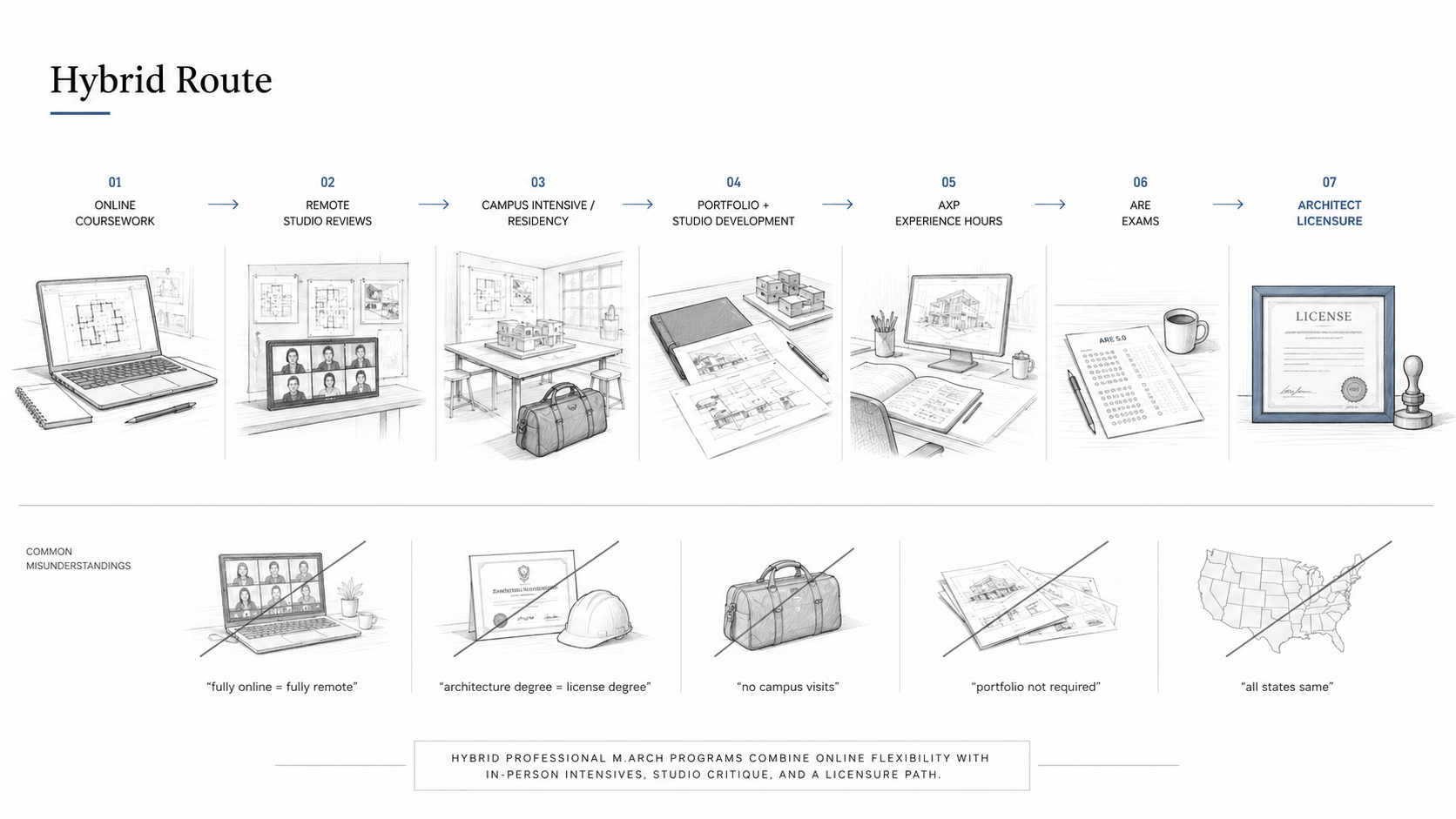
A serious professional M.Arch usually carries studio, critique, technical courses, professional practice, portfolio development, and repeated design revision.
That is why many online M.Arch programs are really hybrid programs. Lectures may happen online. Some reviews may happen by video. But the program may still require campus intensives, residency weeks, in-person pin-ups, model work, or fixed studio sessions.
That can be a good structure. It may be the part that keeps the degree serious.
But it is not the same as a fully remote lecture program. A student needs to plan for travel, work conflicts, review deadlines, model work, and the pressure of studio.
What Counts
The degree is one part of the path. It is not the license.
In the common U.S. route, a candidate completes the required professional education, documents professional experience through AXP, passes ARE, and meets state board requirements. Some jurisdictions offer alternate paths, but those paths are not universal.
A school page that says “online architecture master’s” is not enough. Look for the professional degree status, the accrediting body, and the rules in the state where you expect to seek licensure.
Studio Is the Test
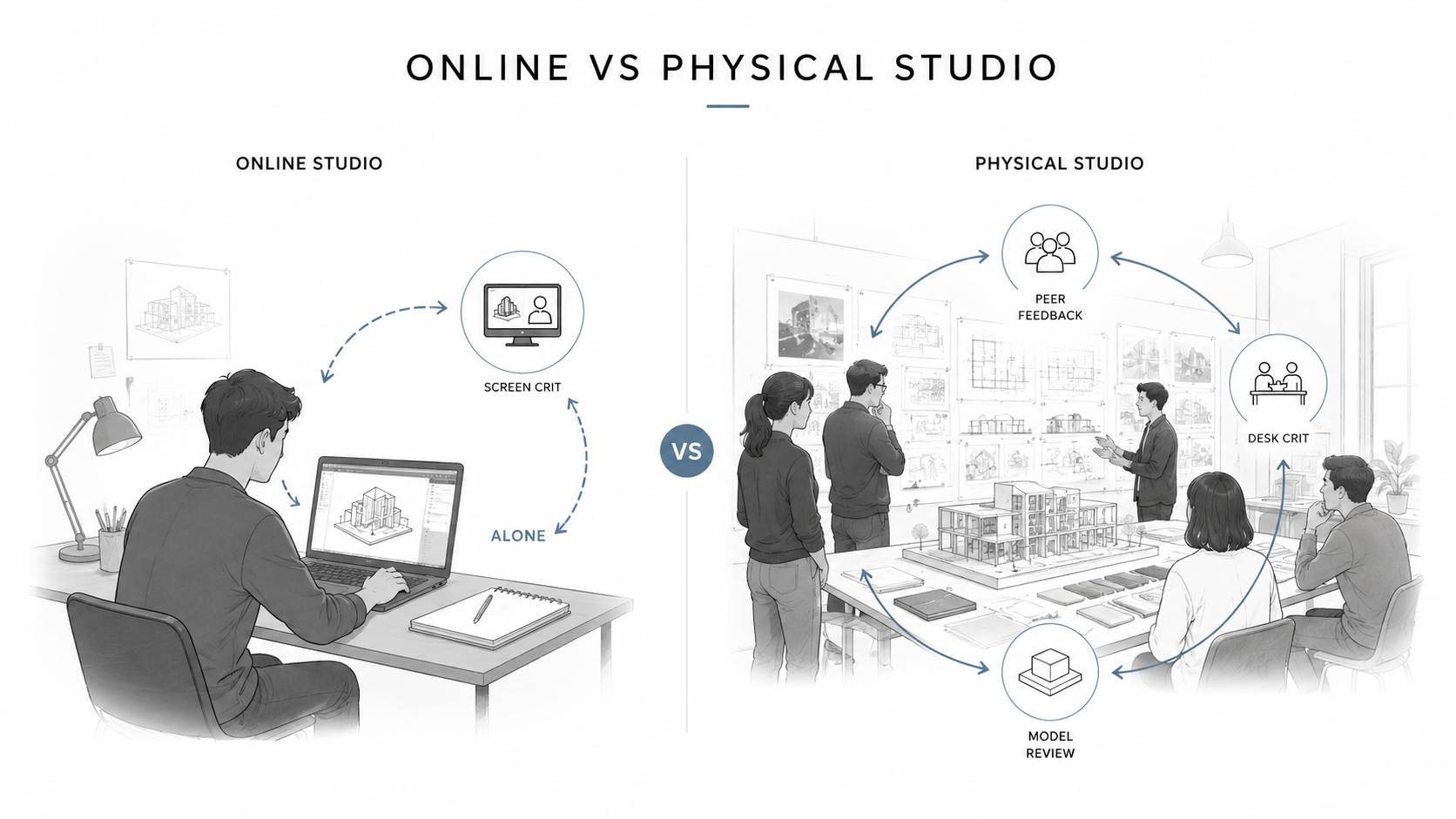
The weak point in online architecture study is usually feedback.
A professional M.Arch should teach a student how to work through plans, sections, structure, site, materials, code pressure, and public presentation. That takes critique. Drawings get marked up. Models fail. Weak sections expose weak ideas. A review forces the student to explain the work.
Online critique can work, but it has to be real.
Ask whether studio reviews are live. Ask whether students see each other’s work. Ask whether there are desk crits, pin-ups, model reviews, and portfolio reviews. Ask how often faculty respond before the final submission.
If studio means uploading PDFs once a week and waiting for comments, be careful.
The Common Trap
Students get hurt when they think the degree name does more than it really does.
| Assumption | What can go wrong | Better question |
|---|---|---|
| “It says architecture, so it leads to licensure.” | The student may spend years in a non-professional degree | Is this exact program a NAAB-accredited professional M.Arch? |
| “Online means no campus travel.” | Residency weeks can add flights, lodging, childcare, and missed work | How many in-person sessions are required? |
| “A master’s is automatically a professional degree.” | A post-professional or research degree may not satisfy the education route | Is this first professional, post-professional, or academic? |
| “I can check licensure later.” | Credits may not transfer cleanly, and the student may need another degree | What does my target state board require? |
| “Studio is just another class.” | The portfolio may come out thin | How does critique and revision actually work? |
Travel Changes Cost
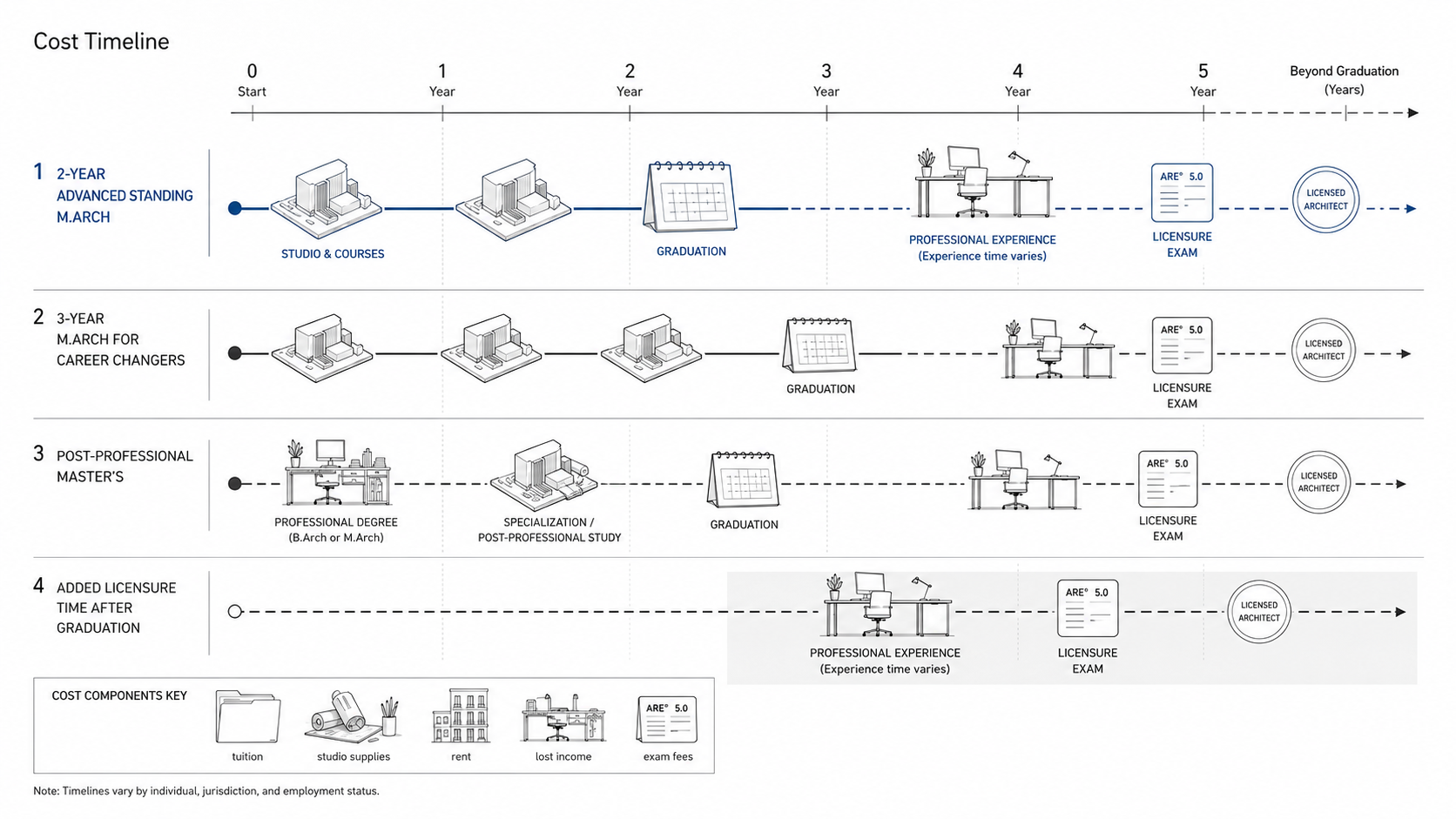
A short residency can change the price of an online M.Arch.
The student may need airfare, lodging, transportation, meals, time away from work, childcare, model shipping, or supplies bought near campus. A program with several visits can still be worth it, but those costs belong in the decision from the start.
Lost income is easy to ignore. A five-day intensive may cost more than the hotel bill if it means unpaid time off, missed freelance work, or childcare coverage.
Do not compare online tuition against campus tuition until you add travel, equipment, supplies, software, printing, portfolio costs, and lost work time.
AXP and ARE Come Later
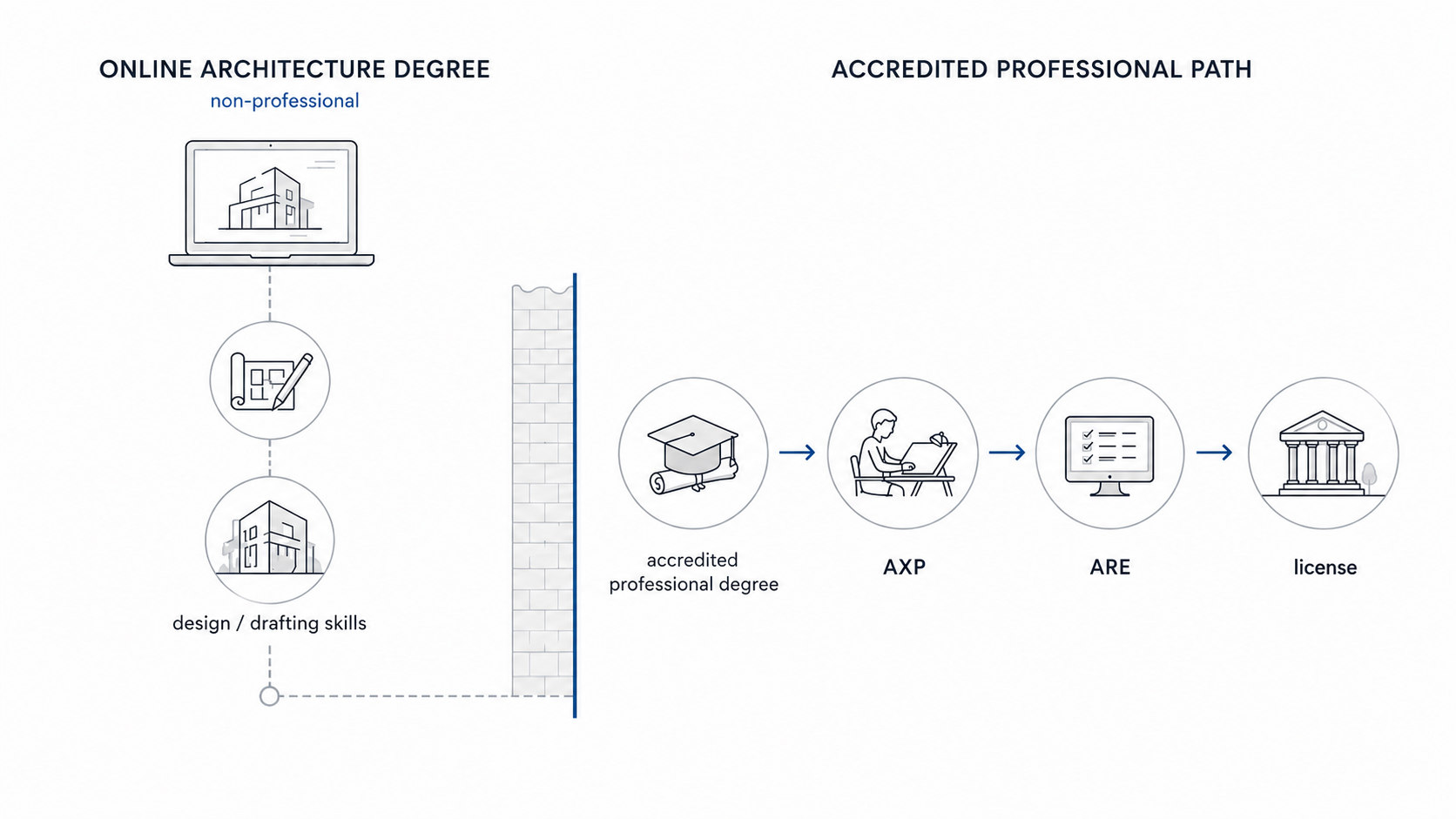
A professional degree can support the education part of the path. It does not erase the rest.
AXP is documented experience. ARE is the licensing exam sequence. State boards still matter. The safer programs explain this clearly instead of making the degree sound like the finish line.
If a program talks about flexibility, design leadership, and career growth but avoids AXP, ARE, and state requirements, slow down.
Portfolio Still Counts
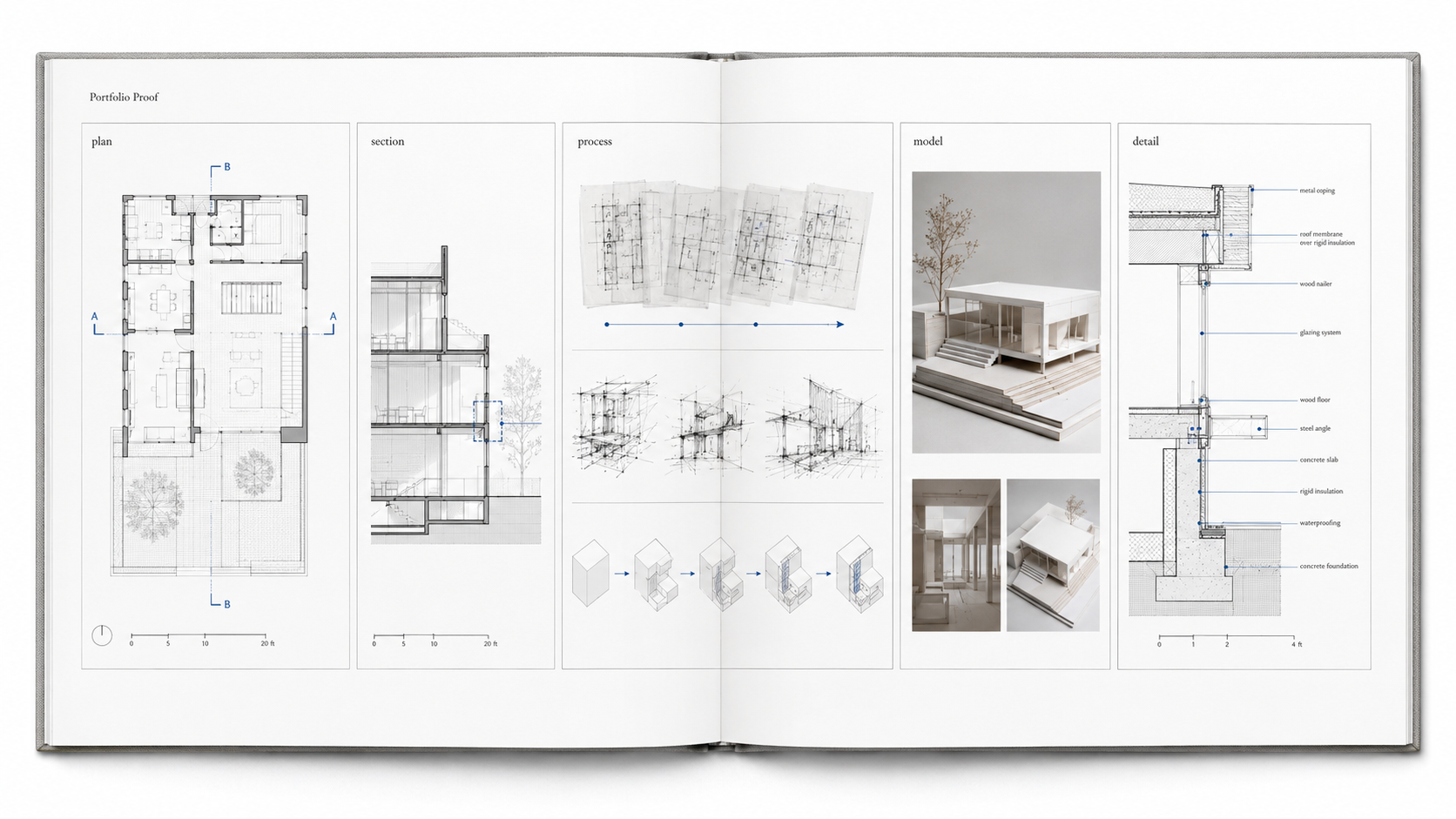
Online format does not remove portfolio pressure.
A strong M.Arch applicant usually needs work that shows process, plans, sections, models, drawing control, and design judgment. A clean image is not enough. Schools need to see how the applicant thinks.
Career changers should ask what kind of portfolio is expected. Advanced-standing applicants should ask what prior studio work is required. That answer affects admission, placement, time, and cost.
Costs That Stay Hidden
Online programs can look cheaper because the student does not move to campus full time. Sometimes that is true.
Architecture costs still show up at home. Students may need a strong computer, modeling software, printing, scanning, model materials, drawing tools, camera setup, storage, portfolio hosting, and a proper work area.
The bigger cost is choosing the wrong category of degree. A cheaper non-professional master’s becomes expensive if the student later discovers it does not satisfy the licensure path and still needs a professional M.Arch.
Who It Fits
A hybrid online M.Arch can work for a disciplined student who already understands the workload.
It may fit someone with a pre-professional architecture background, a strong portfolio, work or family constraints, and enough focus to handle studio outside a daily campus culture.
It may also work for a career changer who cannot relocate but can manage scheduled reviews, travel periods, model work, and serious weekly deadlines.
Who Should Pause
Pause if the program cannot explain its licensure position clearly.
Be careful if your portfolio is weak, your schedule is overloaded, your home workspace is poor, or you are choosing the program mainly because it sounds easier than a campus degree.
Convenience is not the same as fit.
Ask These First
- Is this exact program a NAAB-accredited professional M.Arch?
- Where is the program listed officially?
- If accreditation is pending, which graduating classes are covered?
- Is the program fully online, hybrid, low-residency, or campus-intensive?
- How many campus visits are required?
- How does studio critique work each week?
- Are reviews live, recorded, asynchronous, or in person?
- What portfolio level is expected for admission?
- Does the program explain AXP planning?
- What states do graduates usually seek licensure in?
- What costs should students expect beyond tuition?
Red Flags
- The program says “licensure path” but does not clearly show NAAB status.
- The school uses M.Arch language loosely beside other architecture master’s degrees.
- The admissions page avoids the phrase professional degree.
- Studio critique sounds optional or vague.
- Campus visits are hidden deep in the program details.
- Portfolio expectations are unclear.
- Graduate outcomes talk about design careers but not licensure steps.
- The program promises flexibility without explaining workload.
- No one can explain what graduates do after the degree.
Professional or Post-Professional?
This is the distinction that saves money.
A professional M.Arch is usually for students who still need the professional architecture education route. A post-professional master’s is usually for people who already have a professional architecture degree and want advanced study, research, teaching preparation, design specialization, or a focused subject area.
A post-professional degree can be excellent. It is still the wrong degree if the student needs a first professional architecture credential.
M.Arch or Online Architecture Degree?
An online architecture degree can mean many things. It might be technical, pre-professional, historical, design-studies based, or preservation-focused.
An online or hybrid professional M.Arch has a narrower job. It has to answer the licensure question. It has to carry studio. It has to prepare the student for the professional route, not just provide architecture content.
If you are still comparing basic online architecture paths, read Online Architecture Degree first.
FAQ
Can an online M.Arch lead to architect licensure?
Yes, if the program fits the professional licensure route required by the jurisdiction. In the United States, many students need a NAAB-accredited professional architecture degree, followed by experience, exams, and state board approval.
Are online M.Arch programs fully online?
Some architecture master’s programs are fully online, but professional M.Arch programs are often hybrid or low-residency because studio, reviews, and accreditation expectations still matter.
Is a post-professional online master’s the same as a professional M.Arch?
No. A post-professional master’s is usually advanced study after a professional architecture degree. It should not be treated as a first professional licensure degree.
Do I still need AXP after an online M.Arch?
Yes, if you are following the standard U.S. licensure route. The degree does not replace documented professional experience.
Do I still need ARE after an online M.Arch?
Yes. A professional degree can satisfy the education part of the path, but it does not replace the licensing exams.
Is an online M.Arch cheaper than a campus M.Arch?
Sometimes. But count software, equipment, printing, model supplies, portfolio costs, travel, lodging, and time away from work. Hybrid programs can have hidden costs.
What is the safest online M.Arch choice?
The safest choice is a program that clearly states its professional accreditation status, explains studio delivery, lists residency requirements, shows graduate outcomes, and fits the state where the student plans to seek licensure.