
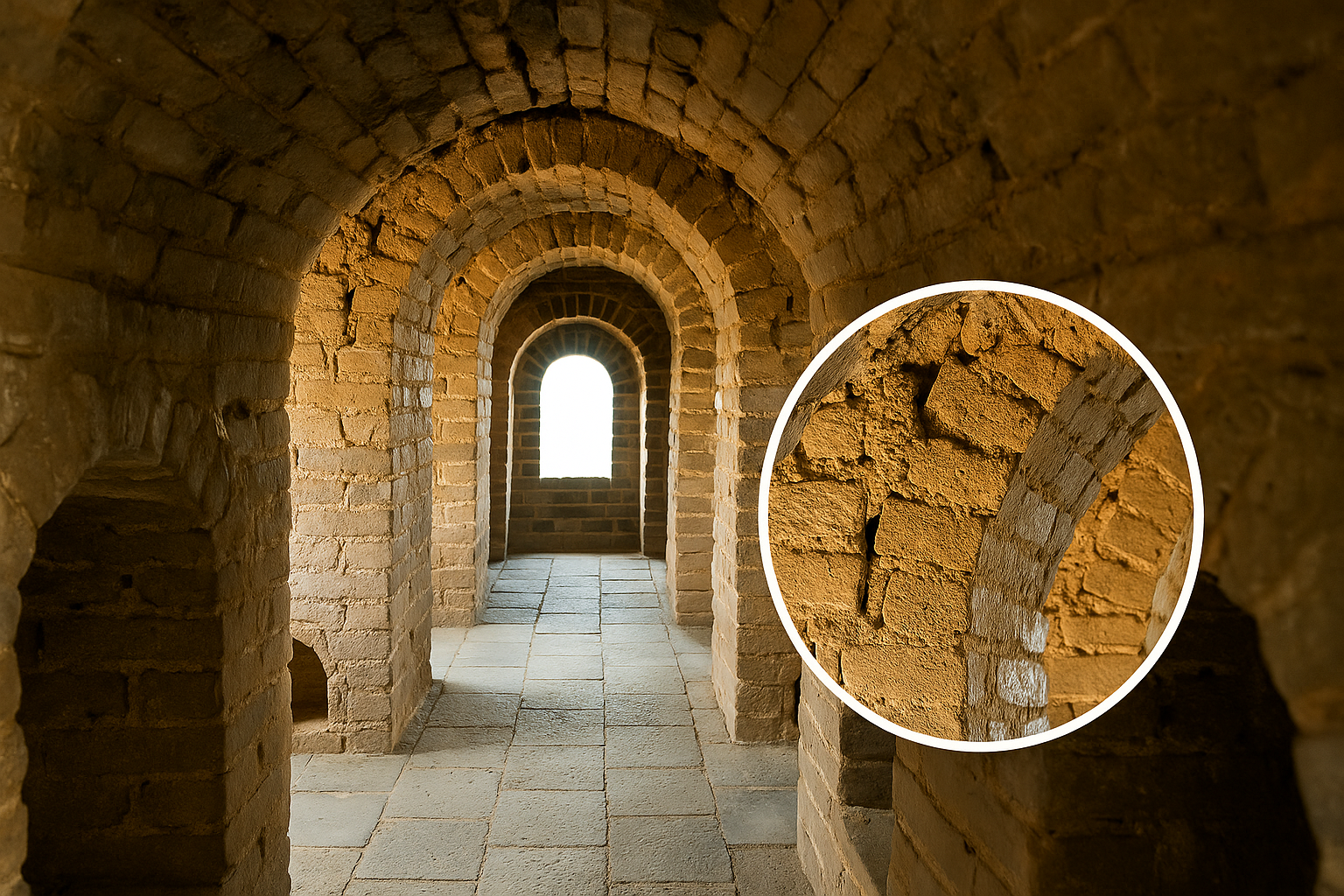
Inside the Great Wall: How It Was Really Built (and Why It Worked)
Forget the drone shots and wide panoramas—the real genius of the Great Wall is inside it. What holds it up. What keeps it standing centuries later. What makes it more than just stacked stone. The interior architecture isn’t glamorous, but it’s where the Wall’s function lives.
Structural Secrets of the Great Wall: An Architectural Analysis
The structural components within the Great Wall, including its core materials, drainage systems, and defensive features.
Core Structure: What’s Beneath the Surface
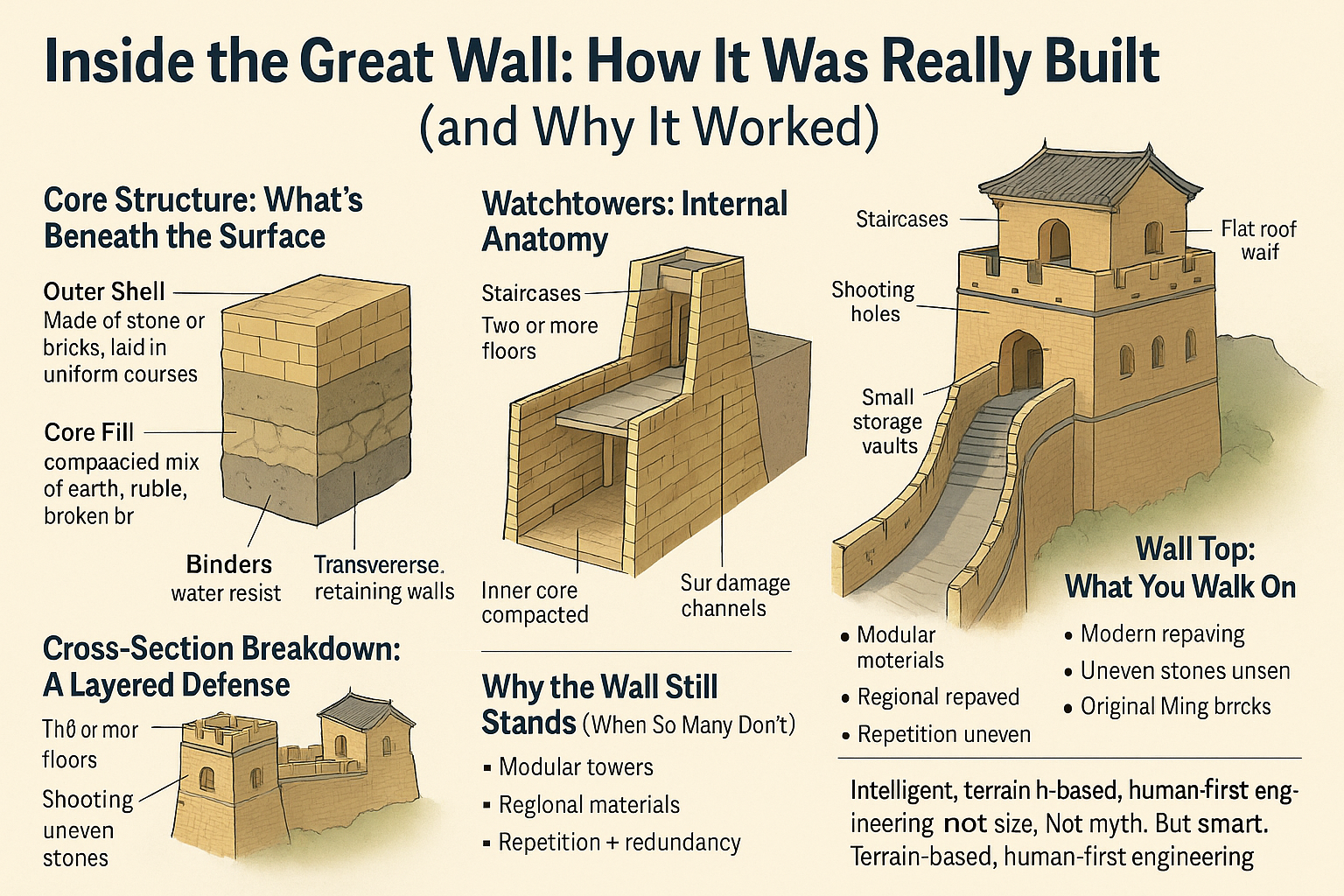
The Wall’s internal makeup varies wildly depending on where you are—but here’s the basic structural logic behind most of the major sections, especially those from the Ming Dynasty:
-
Outer Shell: Made of stone or fired bricks, laid in uniform courses for strength and appearance. These aren’t just façades—they’re load-bearing.
-
Core Fill: A compacted mix of earth, rubble, broken bricks, and lime mortar. This “guts” of the wall absorbs pressure and flexes with the terrain.
-
Binders: In some sections, especially Ming-built, a sticky-rice-lime mortar was used. It chemically bonded with the brick and helped resist water better than some modern cements.
This wasn’t cosmetic masonry. It was engineered density.
Cross-Section Breakdown: A Layered Defense
If you cut a vertical cross-section through a main Ming section of the Wall, here’s what you’d typically find:
-
Outer Facing: Thick bricks (in the east) or dressed stone slabs (in the mountains)
-
Ramparts: Solid parapets with crenellations—alternating high/low sections for archers
-
Carriageway / Walkway: The flat path on top—wide enough for soldiers, horses, carts
-
Inner Core: Compacted filler, reinforced every few meters with transverse retaining walls
-
Inner Wall (sometimes): Secondary facing for strength or where dual-sided defense was needed
-
Drainage Channels: Cut-throughs at angles to drain rain off the top walkway
Watchtowers: Internal Anatomy
The intricate interior architecture of the Great Wall of China, revealing the engineering techniques that have preserved this marvel for centuries.
Every few hundred meters, the Wall breaks into a tower—and those towers were small fortresses.
Inside a watchtower you’d find:
-
Staircases: Usually spiral or ladder-style, built into the walls
-
Two or more floors: One for living/supplies, one for defense/surveillance
-
Shooting holes: Narrow slits for arrows or early gunpowder weapons
-
Flat roof with parapet: Used for signaling or fighting
-
Small storage vaults: In some areas, rooms dug under the tower held grain, firewood, or spare gear
Some towers had stone vault ceilings. Others used heavy timber and were prone to collapse. What survives today depends on weather, materials, and regional upkeep.
Wall Top: What You Walk On
Most people think the walkway is original. It’s not always.
-
Restored sections (e.g. Mutianyu, Badaling): Modern repaving with period-style bricks
-
Unrestored sections (e.g. Jiankou): Crumbling, uneven stones or exposed earth fill
-
Original Ming sections: Durable, flat bricks set in lime-based mortar, often arched slightly for drainage
Some sections are curved intentionally—not just for aesthetics. Curvature helped shed rain and prevent erosion from pooling water.
What You Don’t See (But Should Pay Attention To)

-
Transverse retaining walls: Built perpendicular inside the core—like ribs. They control shifting. Most people don’t even know they exist.
-
Sub-wall footings: In mountain sections, deep stone footings are buried into bedrock, anchoring the wall against landslides.
-
Deterioration zones: Look for bulging walls, hollow sounds, or exposed fill—that’s where the structure is failing internally.
Why the Wall Still Stands (When So Many Don’t)
It wasn’t just “strong”—it was smartly built:
-
Modular towers for controlled spacing
-
Regional materials to avoid over-transport
-
Repetition + redundancy in case of breach
-
Continuous top path for signaling and supply movement
Form followed function, and the Wall was built to last not because it was perfect—but because it was adaptable.
That’s what makes the Great Wall great—not size. Not myth. But intelligent, terrain-based, human-first engineering.
Build Your Own: LEGO Architecture – Great Wall of China
The Great Wall Engineering
In Focus: Key Architectural Features of the Great Wall — A Structural Deep Dive
The Great Wall’s exterior is what tourists admire—but its brilliance lies in structural adaptation. Here's where to direct your attention if you're approaching the Wall like an architect, engineer, or historian—not a sightseer.

1. Core Composition: What the Wall Is Really Made Of (and Why It Matters)
Most of the Great Wall’s strength comes from what you don’t see. While outer bricks or stones get the attention, the interior core is what kept it standing for centuries.
-
Ming Dynasty technique: Fired brick shells filled with a tamped mixture of rubble, soil, lime, and recycled construction debris.
-
Earlier walls: Rammed earth compacted layer by layer between wooden molds—sometimes up to 4 meters wide.
-
Key insight: The Wall flexed with terrain and climate—that’s what made it survive earthquakes and seasonal expansion.
▶ Architect’s Note: You’re not looking at a solid monolith. You’re looking at a layered, engineered sandwich built for weight dispersion and regional availability.
2. Drainage Mechanisms: How the Wall Managed Water Without Modern Plumbing
One of the most overlooked engineering feats of the Wall is its passive water management.
-
Drainage spouts (stone or brick) were integrated every 10–15 meters on the parapet side.
-
Walkways were subtly arched or tilted to channel water away from inner cores.
-
Towers had interior runoff routes, sometimes carved into their base stones, to keep interiors dry.
-
Restored sections today often fail because improper repaving traps water inside.
▶ What to observe: Look for sloping bricks on top surfaces, outlet gaps along the sides, or discoloration near original spouts. The Wall wasn’t waterproof—it was water-wise.
3. Watchtower Interiors: Form, Function, and Spatial Strategy
Watchtowers weren’t just for looking out—they were multi-use fortifications designed for everything from warfare to weather survival.
-
Two or three internal levels: storage on the bottom, combat in the middle, signaling or lookout above.
-
Vaulted stone ceilings or heavy timber beams carried vertical load and helped fireproof the structure.
-
Arrow slits, portholes, and smoke chimneys were aligned by prevailing wind for tactical efficiency.
-
In high-altitude regions, some towers had basalt heating stones built into the walls for overwintering.
▶ Architectural takeaway: Think of these as mini-fortresses—each one an autonomous module with its own material logic based on height, threat level, and weather.
4. Material Variations by Region: Not Just “Stone and Brick”
The Wall is not a uniform structure—it’s a living map of regional supply chains and political strategy.
| Region | Primary Material | Reason |
|---|---|---|
| Beijing / Hebei | Fired bricks + granite | Access to kilns, imperial investment |
| Gansu / Ningxia | Rammed earth + reeds | Remote area, fast build, dry climate |
| Shanxi | Local limestone + mud mortar | Balanced cost and strength |
| Liaoning | Fieldstone + lime | Coastal humidity required tougher shell |
-
Sticky rice mortar, often romanticized, was only used in sections where moisture retention was critical, especially in the Ming era.
-
Rammed earth walls still standing today owe their longevity to careful compacting—not sheer size.
▶ Modern relevance: Restoration projects must honor these regional differences. Rebuilding with uniform materials erases both history and structural logic.
Beneath the Bricks: Understanding the Great Wall's Inner Workings
Architectural Insights: The Inner Structure of China's Great Wall
What the Wall Teaches Us About Form and Function

You can admire the silhouette of the Great Wall all day—but the real genius isn’t in the view. It’s in the structure that’s hidden. The part you don’t see. The part that works.
The interior architecture isn’t glamorous, but it’s where the Wall’s function lives.
So what can we actually learn from it?
Form Was Always Secondary to Function
The Great Wall was designed to survive—and it still does.
-
The walkways are slightly arched—not for looks, but to channel water away from the core.
-
Watchtowers are plain on the outside, but inside, they’re layered, multi-use machines: supply room, bunker, lookout, command post.
-
The core fill—often dismissed as “rubble”—was structurally smart. Cheap, local, heavy, flexible.
▶ Lesson: In architecture, function isn’t just important—it’s survival.
Form Adapted to Terrain
In modern design, we often push the land to match our blueprint. The Great Wall did the opposite.
-
In the mountains? Narrower, steeper, tighter grain masonry.
-
On the plains? Wider walls, heavier fill, modular spacing.
-
In the desert? Less stone—more sun-hardened rammed earth layered like pastry.
▶ Lesson: Don’t fight the terrain. Design with it, not against it.
Durability Was Designed, Not Decorated
What’s wild is that some of the best-built sections of the Wall are the least photogenic.
-
No symmetry.
-
No decoration.
-
No fine detailing.
Just smart material use, tight joints, local labor, and a deep understanding of weather, weight, and wear.
▶ Lesson: Resilience isn’t about looks. It’s about load paths, runoff, and regional logic.
Why It Still Matters
Modern architects obsess over minimalism, sustainability, and durability—but the Great Wall had those baked in 500 years ago:
-
Minimalism through necessity
-
Sustainability via local sourcing
-
Durability through layered construction and material redundancy
The real takeaway?
Form should follow function. But function doesn’t have to kill creativity.
The Great Wall proves that you can make something massive, regional, responsive—and still have it feel monumental.
FAQ
Q1: What materials were used inside the Great Wall's structure?
A: The interior of the Great Wall varies by region. Common materials include rammed earth, stones, bricks, and a mortar made from lime and sticky rice. The choice depended on local availability and the era of construction.
Q2: How were the watchtowers designed internally?
A: Watchtowers typically featured multiple levels with narrow staircases, storage areas, and openings for surveillance and signaling. Their design facilitated communication and defense.
Q3: Are there drainage systems within the Wall?
A: Yes, especially in Ming Dynasty sections. The Wall includes drainage channels and spouts to prevent water accumulation, preserving the structure's integrity.
Q4: How did the interior design contribute to the Wall's longevity?
A: The combination of durable materials, strategic design (like retaining walls), and maintenance practices ensured the Wall's resilience against natural and human-induced wear.
From Core to Crest: The Internal Design of the Great Wall
The Anatomy of the Great Wall: Interior Architectural Features
Recommended Books & Resources
-
Books:
-
The Great Wall: China Against the World, 1000 BC–AD 2000 by Julia Lovell
-
The Great Wall of China by Arthur Waldron
-
The Great Wall: From Beginning to End by Michael Yamashita and William Lindesay
-
Build Your Own: LEGO Architecture – Great Wall of China
For enthusiasts and students, the LEGO Architecture Great Wall of China set offers a hands-on experience to understand the Wall's design. It's an excellent educational tool that combines fun with learning about ancient engineering.
Related
Chinese Architecture & History
-
Great Wall of China Architecture: Real Design, Real Materials
Explores the authentic building techniques and materials used in the construction of the Great Wall. -
Chinese Architecture: Everything You Need to Know About Its Past, Present, and Future
A sweeping overview of Chinese architectural development, from ancient dynasties to today. -
Ancient Chinese Architecture
Highlights the structural styles, symbolism, and traditions of early Chinese buildings. -
Traditional Elements in Chinese Architecture
Examines features like sweeping roofs, symmetry, and Feng Shui principles. -
Chinese Courtyard Architecture
Delves into the layout and cultural significance of Siheyuan-style courtyard homes. -
Classical Gardens in Chinese Architecture
Focuses on the artful integration of nature and architecture in historic Chinese gardens. -
Chinese Architectural Decorative Features
Reviews intricate carvings, vibrant colors, and symbolic ornamentation found in buildings. -
Chinese Buildings
A general guide to notable types of structures in Chinese architectural history. -
Exploring Chinese Architecture: Ancient to Modern
Traces the evolution of design across dynasties and into the modern age. -
Modern Chinese Architecture
Looks at how China blends futuristic design with cultural heritage in today’s urban projects. -
China Imperial Palace - Forbidden City
A deep dive into the design, layout, and symbolism of this architectural marvel in Beijing. -
Chinese Architecture History, Beijing
Covers significant historical sites and their architectural legacies within the capital city.
Architecture Learning Resources
-
Francis D.K. Ching Books: Essential Reading for Architecture Students
A guide to the most influential titles by Ching, foundational for anyone studying architecture. -
Architectural Sketching for Beginners: From Tools to Techniques
Introductory guidance on drawing basics, sketching styles, and recommended supplies.