

Muslim and Arab dynasties left an enduring imprint on medieval India, shaping its architecture, knowledge systems, infrastructure, and economy.
This report provides an overview of major Islamic dynasties and regions, and dives into their contributions – from the fusion of Indo-Islamic architectural styles to advances in science, public works, and trade.
Major Dynasties and Regions of Islamic Rule
Islamic rule in India began with an early Arab foothold and expanded through several Turkic and Mughal dynasties:
-
Arab Conquest of Sindh (712 CE): The first Muslim rule in India was established when the Umayyad general Muhammad bin Qasim conquered Sindh in 712. His administration was noted for social justice, effective governance, and tolerance towards the local Hindu and Buddhist populations bestdiplomats.org. This early Arab province in Sindh was short-lived but set a precedent for later Islamic rulers in India.
-
Delhi Sultanate (13th–16th centuries): After 1192, Turkic Ghurid invasions paved the way for the Delhi Sultanate, a succession of Central Asian Muslim dynasties ruling much of North India. Five dynasties – Mamluk, Khilji, Tughlaq, Sayyid, and Lodi – made Delhi their capital and introduced Persian culture and Islamic governance across their domains. The Sultanate’s authority extended over Delhi, the Gangetic plains, Bengal, and parts of the Deccan, though it often fragmented into regional sultanates.
-
Regional Sultanates: In parallel, independent Muslim-ruled kingdoms emerged in various regions. Notable examples include the Bengal Sultanate, the Gujarat Sultanate, and the Deccan Sultanates (like Bijapur and Golconda) that broke away from the crumbling Bahmani Sultanate. These states blended local traditions with Islamic influence and fostered rich provincial cultures.
-
Mughal Empire (16th–18th centuries): Founded by Babur in 1526, the Mughal Empire eventually unified large parts of the subcontinent. The Mughals, who claimed Mongol-Timurid heritage, established a vast, centralized empire spanning northern and central India. By the late 17th century under Emperor Aurangzeb, most of India was under Mughal rule. The Mughal era is especially renowned for stability, prosperity, and a flourishing of art and architecture on a grand scale.
Overall, Muslim rule brought greater political integration to the subcontinent. For example, the Mughals’ territorial consolidation of northern and western India facilitated commerce and communication across regions. Even in predominantly Hindu societies, Muslim sultans and emperors introduced new administrative practices and cultural influences, leaving a lasting legacy on the Indian landscape.
Architectural Contributions: The Indo-Islamic Synthesis
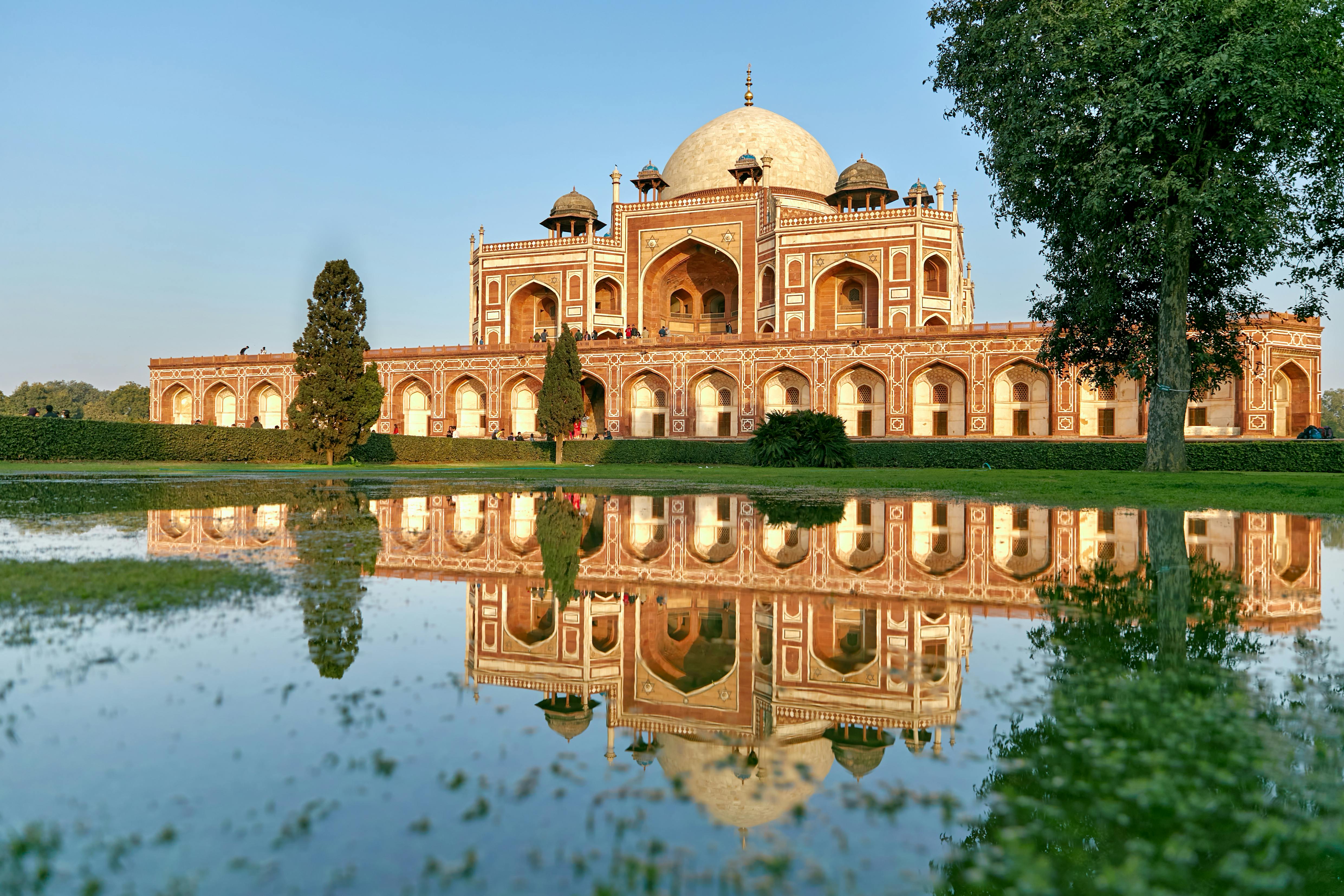
Humayun’s Tomb in Delhi (1560s) – the first monumental garden-tomb of the Mughals – exemplifies Indo-Islamic architecture with its Persian-designed dome, arched facades, symmetry, and geometric ornamentation. Built in red sandstone and marble by architect Mirak Mirza Ghiyas, it inspired later masterpieces like the Taj Mahal.
One of the most visible contributions of medieval Muslim rulers is in architecture. They introduced new structural techniques and aesthetic principles, which, combined with Indian craftsmanship, gave rise to the Indo-Islamic architectural style. Key characteristics of this style include large true arches and domes (seldom seen in earlier Indian construction), geometric and floral ornamentation instead of figural carving, and expansive courtyards and gardens. These features were applied to new building types like mosques, tombs, and madrasas, which had no precedent in pre-Islamic India.
Early Sultanate Architecture (Delhi): The Delhi Sultanate’s architects often repurposed materials from older Indian structures while introducing Islamic forms. A prime example is the Qutb Complex in Delhi. The Quwwat-ul-Islam mosque (c. 1192–1199), built by Qutb ud-Din Aibak, was the first mosque in North India and was constructed using columns taken from demolished Hindu and Jain temples (a common practice in early Sultanate architecture). Its layout followed Persian mosque plans, but the builders still used corbelled arches in the Indian tradition rather than true arches. Adjacent to it, the Qutb Minar – a soaring victory tower begun in 1199 and later completed by Iltutmish – stands 73 m tall with five tapering storeys. The minaret’s red sandstone shaft is fluted and intricately inscribed with Quranic calligraphy and geometric patterns. Its closest inspiration is the Minaret of Jam in Afghanistan, yet Indian motifs and craftsmanship give the Qutb Minar a unique character. By the 14th century, Delhi’s builders had mastered true arcuate construction; for instance, the tomb of Balban (d. 1287) contains one of India’s earliest true arches using keystones. Subsequently, Turkic sultans like Alauddin Khalji and the Tughlaqs built massive fortresses (e.g. Tughlaqabad in Delhi) and tombs with dome structures, refining the Indo-Islamic style.
Fusion of Styles: As Islamic architecture took root, local artisans adapted their skills to new designs. Indian stone masons, for example, were experts in carved sandstone, and under Muslim patronage they applied those techniques to Islamic archways, latticed screens (jalis), and arabesque carvings. This fusion produced monuments that incorporated both indigenous Indian elements and imported Persian-Central Asian elements. Common design features included: bulbous domes, often topped with lotus finials; pointed arches and scalloped arches; minarets or slender towers (sometimes purely ornamental in Indian mosques); wide open courtyards; and ornate mihrabs and pulpits in mosques. Decorative art on these buildings eschewed human or animal figures (in line with Islamic preferences) and instead used intricate geometric patterns, interlacing arabesques, floral motifs, and Quranic calligraphic inscriptions. In the Deccan and other regions, local vernacular styles (like Gujarati or Rajasthani motifs) were also absorbed. By the Mughal period, even Hindu temples in some areas showed influence of Islamic architecture (such as the use of dome-like structures and arch shapes), reflecting the deep architectural exchange.
Mughal Architecture: The Mughal emperors, especially Akbar, Jahangir, and Shah Jahan, carried Indo-Islamic architecture to its zenith. Mughal architecture is marked by grand scale, balance and symmetry, and a blend of Persian, Central Asian, and Indian design motifs. Buildings were often set in formal Charbagh gardens (a four-part paradise garden layout) aligned on geometric grids. Early in Akbar’s reign, red sandstone was the material of choice; later, under Shah Jahan, white marble became prominent eurasiareview.com.
-
Example – Humayun’s Tomb, Delhi: Completed in 1572, this tomb of Emperor Humayun heralded the Mughal style. It was the first garden-tomb in India, designed by the Persian architect Mirak Mirza Ghiyas destinationtourcabs.com. The tomb sits on a massive stone platform at the center of a Charbagh. It features a Persian-style double dome and high arching facades, but also incorporates Indian decorative chhatris (pavilions) on its roof. Humayun’s Tomb set the template for later mausoleums – most famously the Taj Mahal – with its perfect symmetry and blend of red sandstone and white marble.
-
Example – Fatehpur Sikri (City of Victory): Emperor Akbar built this planned city as his capital (1571–1585) near Agra. Fatehpur Sikri’s architecture is a brilliant amalgam of styles. The palaces, public halls, and mosques here were “built massively in red sandstone” in the Timurid (Central Asian) tradition, yet they also display Gujarati and Rajput influence in their details. For instance, the Jodha Bai Palace in Fatehpur Sikri combines Islamic palace layout with ornate brackets and columns reminiscent of Hindu domestic architecture. The city’s magnificent gateway, the Buland Darwaza, was erected in 1601 to commemorate Akbar’s conquest of Gujarat. Standing 54 m high, this triumphal arch features a huge pointed arch framed by marble calligraphy panels and domed kiosks at its roofline. It is one of the tallest gateways in the world and exemplifies the Mughal penchant for monumental scale. Fatehpur Sikri’s orderly plan – with imperial gardens, courtyards, a grand mosque, administrative offices, and living quarters zoned in a coherent layout – reflects sophisticated urban planning for its time. Although this city was later abandoned, its preserved buildings allow historians to vividly reconstruct the Mughal court’s life and the blend of Hindu-Muslim architectural vocabulary in the 16th century.
-
*Example – Deccan Sultanates: In the southern plateau (Deccan), Muslim rulers developed their own regional architectural styles. The Bahmani and Deccan sultans combined Persianate forms with local styles. Notable is the Gol Gumbaz (1656) in Bijapur – the tomb of Sultan Muhammad Adil Shah – famed for having one of the largest masonry domes in the world (second only to Rome’s Pantheon). Deccan architecture often used dark basalt and bold stucco decoration, creating a different aesthetic but still within the Indo-Islamic idiom.
Through these and many other structures (mosques like Delhi’s Jama Masjid and Lahore’s Badshahi Masjid; forts like Agra Fort and Red Fort; tombs like Akbar’s Tomb at Sikandra; public sarais and baths), Islamic rule profoundly transformed India’s cityscapes. The legacy of this era can be seen today in the skylines of Indian cities – dotted with domes and minarets – and in the continued influence of Indo-Islamic design on modern Indian architecture.
Scientific and Technological Exchanges
Medieval India under Muslim rule became a crossroads for scientific knowledge – a place where ideas from the Islamic world and the Indian tradition were exchanged and advanced. Sultanates and Mughal courts welcomed scholars, established madrasas (schools) and libraries, and sponsored translations of texts. As a result, fields such as mathematics, astronomy, medicine, and engineering saw notable developments during this period.
-
Mathematics & Astronomy: Islamic scholars in India built upon both local and foreign knowledge. They were aware of India’s ancient mathematical heritage (such as the concept of zero and the decimal system) and connected it with the algebra and trigonometry of the Islamic world. In fact, the so-called “Arabic numerals” (0–9) were an Indian invention that reached the West via the Islamic world aramcoworld.com. During the 14th century, Sultan Firoz Shah Tughlaq patronized astronomy in Delhi, marking the first major introduction of zij astronomy (astronomical tables) to India deccanchronicle.com. Arabic and Persian zijes (star tables) were copied and studied by Indian astronomers under Firoz Shah’s encouragement deccanchronicle.com. Several astronomy texts were composed, and skilled metalworkers produced astrolabes – the quintessential Islamic astronomical instrument – locally. Firoz Shah even had a large astrolabe installed on a Delhi minaret for observations deccanchronicle.com. These efforts indicate vibrant astronomical activity. Earlier, in the 11th century, the scholar Al-Biruni came from Central Asia with Mahmud of Ghazni and lived in India for years, learning Sanskrit and studying Indian science. He translated and wrote about Hindu astronomy – including Aryabhatta’s theories – and noted, with admiration, India’s advanced knowledge of planetary motions. This two-way exchange enriched both traditions: Indian star charts gained precision from Islamic computational techniques, and Islamic astronomy absorbed Indian concepts (like the sine function and radix methods) that helped refine models of the heavens.
-
Medicine (Tibb-e-Unani and Ayurveda): Medical knowledge flourished under the patronage of Muslim rulers. The Unani system of medicine (Greco-Arabic medicine) was introduced by early Arab and Persian physicians and took root in India by the 13th century. Its real growth, however, occurred during the Mughal era pubmed.ncbi.nlm.nih.gov. The Mughals established hospitals (dar al-shifa) and medical schools in cities, and court physicians (Hakims) compiled extensive medical manuals. Unani medicine in India readily incorporated local Ayurvedic herbs and concepts, creating a syncretic medical practice. During Akbar’s reign, for example, illustrious Hakims like Muqarrab Khan and Hakim Ali Gilani served at court, and some texts on Ayurveda were translated into Persian. The Mughal emperor Aurangzeb was also a patron of Unani – he is said to have commissioned the compilation of an authoritative Unani pharmacopeia. As a result of such support, by the 17th century the Indian subcontinent had become a center of Unani medical learning, surpassing earlier periods in both quantity and quality of medical works pubmed.ncbi.nlm.nih.gov. The integration of Greek, Persian, and Indian medical knowledge helped advance fields like anatomy, pharmacology, and surgery. Hospitals in cities like Delhi treated both royals and the public, and the concept of public health under rulers like Muhammad bin Tughlaq and Shah Jahan included measures like dispensaries and mother-child care (records mention a kind of maternity hospital in Shah Jahan’s time).
-
Technology and Engineering: Muslim rulers introduced or popularized many practical technologies in medieval India. Papermaking is a prime example – paper was known in West Asia by the 8th century but reached India later. It appears to have been introduced on a significant scale during the 13th–14th centuries, under the Delhi Sultans shahidhraja.medium.com. The availability of affordable paper revolutionized record-keeping, literature, and education in India, which previously relied on birch bark or palm-leaf manuscripts. Other technologies from the Islamic world that made their way into India include improved windmills and water-lifting devices (the Persian wheel for irrigation), mechanical clocks, and techniques in optics and chemistry. For instance, Sultan Alauddin Khilji’s era saw the use of water wheels to irrigate gardens around Delhi, and later Mughal workshops (karkhanas) manufactured instruments like celestial globes and precision astrolabes in metal.
Muslim rule also saw the introduction of gunpowder and firearms to Indian warfare. Babur’s use of Ottoman-style cannons at the First Battle of Panipat (1526) is famous for inaugurating Mughal military superiority. By Akbar’s reign, foundries cast bronze cannons in India, blending local metallurgical skill with Persian expertise. Indian metallurgists produced matchlocks and pistols in provincial arsenals; some Mughal firearms were noted to be as good as European ones by the 17th century. In the Deccan, the Bahmani sultans had large cannon foundries (one legendary cannon, “Malik-e-Maidan” in Bijapur, weighs 55 tons). The crafting of Damascened steel swords continued (a tradition of South Indian wootz steel refined with Persian techniques). Meanwhile, city planning and civil engineering advanced – canals, dams, and bridges built in this period often survived into modern times. The reservoir at Hauz Khas (Delhi) and the bridge over the Gomti in Jaunpur are examples of enduring public works.
In summary, the convergence of Islamic and Indian knowledge systems under medieval Muslim rulers had a catalytic effect. Knowledge from Greco-Arabic sources (astronomy of Ptolemy, medicine of Galen, mathematics of al-Khwarizmi and al-Tusi) was brought into India, translated, and studied. Simultaneously, India’s own innovations (like the numerical system, herbal medicine, and astronomical observations) were disseminated through Persian translations to the wider Islamic world aramcoworld.com. This era laid groundwork for further scientific developments, including those by Sawai Jai Singh in the 18th century (who built observatories using a blend of Islamic and Hindu star charts) and the later dissemination of Indian medical and mathematical knowledge globally.
Infrastructure and Public Works
Medieval Muslim rulers significantly improved infrastructure in the subcontinent, investing in roads, fortifications, water supply, and urban amenities. These projects not only served administrative and military needs but also boosted trade and agriculture, benefitting the populace.
-
Roads and Caravanserais: Islamic rulers refurbished and extended the ancient road networks of India. The most famous example is the Grand Trunk Road, an age-old route from the Gangetic plains to the northwest. Sultan Sher Shah Suri (1540s) undertook a massive project to rebuild and straighten this road from Bengal to the Indus. He widened the highway, paved sections, and dotted it with amenities for travelers. Sher Shah had sarais (roadside inns) constructed at regular intervals (approximately one every 2 kos, or ~4 km) along the route, providing food and lodging free of charge to wayfarers. He also planted shade-giving trees on both sides of the road and dug wells for water at frequent intervals. These measures greatly increased safety and comfort for traders and pilgrims. After Sher Shah, the Mughals continued to maintain and enhance the road system. Emperor Jahangir, for instance, ordered that all sarais be built of durable brick or stone and lined the road between Agra and Lahore with fruit trees for shade. He also built bridges over rivers and streams to ensure uninterrupted travel. The Grand Trunk Road (known then as Sadak-e-Azam or “Great Road”) thus became a vital artery of the empire, facilitating postal communication and the movement of goods and armies. Similar road improvements were made elsewhere: the Mughal provinces had a network of smaller roads connecting market towns (qasbas), often marked with kos minars (mile pillars) as distance indicators. Roads and caravanserais improved connectivity, knitting India into a more unified economic space.
-
Forts and Urban Defense: To secure their realms, Muslim rulers constructed numerous forts and fortified cities. The early Delhi Sultans built massive stone forts like Tughlaqabad (c. 1325) with sloped walls and bastions, and Siri Fort (1303) to defend their capital. In the Deccan, fortress-cities such as Golconda and Daulatabad were expanded under Bahmani and Ahmadnagar rulers. The Mughals, too, were prolific builders of forts – notably Agra Fort (1560s–70s) and Lahore Fort, both renovated by Akbar in red sandstone, and Shahjahanabad (Old Delhi) with its imposing Red Fort (1648) in red sandstone and marble. These forts featured robust curtain walls, moat systems, and monumental gates (e.g., Delhi’s Lahore Gate) that protected palatial complexes inside. Many forts included ingenious engineering, such as gradient ramps for war elephants and elaborate drainage and granary systems to withstand sieges. Additionally, city walls encircling urban centers (with guarded gates that locked at night) were common – e.g., the walls of Ahmedabad (built by Gujarat’s sultans) or those of Jaipur (built by a Rajput ally under Mughal influence). Such fortifications ensured security and helped centralize authority.
-
Water Supply and Irrigation: Ensuring water for drinking and farming was a priority. Sultan Firoz Shah Tughlaq (1350s–80s) is remembered as a pioneer of irrigation in India theprint.in, young.downtoearth.org.in. He repaired and dug canals to divert river waters for agriculture. One of his largest projects was a 240-kilometer long canal linking the Yamuna River to the arid districts of Hissar (in present-day Haryana) young.downtoearth.org.in. This Western Yamuna Canal, completed in 1355, greatly expanded the area under cultivation by bringing fresh water to farms and orchards. Firoz Shah built additional canals from the Sutlej and Ghaggar rivers, earning the title “father of the irrigation system in India” in some accounts theprint.in, young.downtoearth.org.in. Besides canals, rulers constructed and maintained baolis (stepwells) and tanks for public water supply. Delhi alone saw dozens of baolis built during Sultanate times – these were deep wells with step corridors, providing year-round access to groundwater. For example, the Rajon Ki Baoli and Gandhak Ki Baoli in Mehrauli were built under Lodi-era nobles, and the colossal Agrasen Ki Baoli may have been refurbished under the Tughlaqs. Firoz Shah Tughlaq also built the Hauz Khas tank and an adjoining madrasa, ensuring water for his city. Under Akbar and Jahangir, the upkeep of ponds, wells, and canals remained important; in the 17th century, Jahangir’s commander Allahabad Khan constructed a network of wells in Gujarat. The emphasis on water management improved agriculture and made cities more livable.
-
Public Buildings and Amenities: Medieval Muslim rulers endowed their cities with many public utilities. They built mosques not just for prayer but as community centers where the faithful could gather – from the grand Friday mosques like the Jama Masjid of Delhi (1656) which could host 25,000 worshippers, to small neighborhood mosques serving local quarters. They built bathhouses (hammams) for hygiene – some forts (like Mandu in Madhya Pradesh) still have remains of Mughal-era hammams with heated water systems. Caravanserais (sarais), as mentioned, served as traveler’s rest houses and also functioned as hubs of commerce and news exchange. Many sarais evolved into market towns if enough traders began settling around them. Sher Shah Suri’s sarais, for instance, often had a mosque and a well attached, and some grew into villages over time. The Mughals later built elaborate sarais; one example is the Akbari Sarai in Lahore (built during Jahangir’s rule) with over 180 rooms for merchants and a large central courtyard.
The Mughal love of nature led to the creation of many gardens and green spaces. They laid out large pleasure gardens in and around cities – such as the Shalimar Bagh in Lahore (1641) and in Srinagar (1619) – featuring charbagh symmetry, fountains, and pavilions. These gardens were open to the noble public and used for leisure and imperial gatherings. The planting of avenues of shade trees along roads (like Jahangir’s initiative on the Agra-Lahore route) was another environmental infrastructure benefiting travelers and reducing road dust.
-
City Planning: Some Muslim rulers undertook ambitious city-building projects. Besides Fatehpur Sikri (already discussed), examples include Jaunpur in Uttar Pradesh, which was developed by the Sharqi Sultans in the 15th century with fine mosques, bridges, and markets; and Hyderabad, founded in 1591 by the Qutb Shahi dynasty, laid out with a grid of Charminar as the center and four grand roads radiating from it. The very act of founding new cities (like Agra’s rebuilding by Sikandar Lodi around 1504, or Shah Jahan’s founding of Shahjahanabad in 1638) allowed for more organized urban design than in organically grown medieval towns. Features such as straight wide roads, bazaars (markets) at the city center, designated quarters for various communities or professions, and provision of public squares can be seen in these planned cities. For instance, Shahjahanabad (Old Delhi) had the Chandni Chowk bazaar street laid out with a canal running down its center for cooling and sanitation, and was divided into neighborhoods (katras) each with its own mosque and well.
The emphasis on infrastructure under Muslim rule had lasting effects. It not only facilitated governance and military control but also stimulated trade and agriculture (irrigation works brought more land under cultivation, and roadside inns encouraged long-distance commerce). Many of these medieval works – roads, bridges, caravanserais – were later used or improved by the British, testifying to their solid construction. Even today, remnants such as the kos minars (mile pillars) along old highways, Mughal bridge ruins, and the stepped wells in North India remind us of the public works legacy of this era.
Economic Impact and Trade
Muslim and Arab rule in India significantly reshaped the economy, linking the subcontinent more closely with the global trading networks of the Islamic world. They introduced fiscal innovations, developed ports and inland trade routes, and fostered a vibrant environment for commerce and crafts.
-
Trade Routes and Ports: The political unification of large regions under the Delhi Sultanate and even more so under the Mughals created a safe canvas for trade to flourish. Overland caravan routes were secured from Central Asia to India – for example, the Silk Road branch through Afghanistan into Mughal India allowed caravans from Persia and beyond to reach Delhi and Agra. The territorial integration achieved by the Mughals “facilitated trade and commerce” on an unprecedented scale. Meanwhile, maritime trade on the Indian Ocean saw major Indian ports thrive under Muslim rule. On the west coast, ports like Cambay (Khambat) and Surat in Gujarat, and Calicut on the Malabar coast, became bustling entrepôts for commerce with the Middle East, Africa, and Southeast Asia vaia.com. For instance, Surat (under the Mughals) was the principal port for the Hajj pilgrimage and for export of Indian textiles and spices; it maintained extensive trade with Safavid Persia, the Arab Peninsula, and beyond vaia.com. Gujarati ships and merchants (many of them Muslims) carried Indian goods to Basra and Mocha, returning with Arabian horses, coffee, and pearls. In the Bay of Bengal, the Bengal Sultanate’s ports like Chittagong and Hooghly traded with the Malay world and China. The cosmopolitan port city of Thatta in Sindh (under Mughal sway) likewise connected to the Persian Gulf. Overall, Indian oceanic trade flourished – contemporary European travelers marveled at the volume of spices, indigo, textiles, and precious stones flowing from India to Arabian and Red Sea markets, and the steady import of gold, silver, and horses into India in return arcjournals.orgjstor.org. These robust trade networks led to cultural exchanges as well: Arab and Persian merchants settled in port cities (some intermarrying with locals and spreading Islam further), and Indian merchants established diasporas in Central Asia and West Asia.
-
Commercial Practices: Medieval Muslim rulers also introduced institutions that helped commerce. The widespread use of the Persian language in administration from the 13th century provided a common lingua franca for traders of different regions (Persian was understood by merchants from Iran to Bengal). They standardized weights and measures – Sher Shah Suri, for example, enforced uniform weights throughout his realm testbook.com. Markets were regulated to ensure fair prices. Sultan Alauddin Khilji famously instituted market price controls in Delhi to prevent inflation during wartime, appointing muhtasibs (market inspectors). Trade guilds existed in many cities, and some sultans patronized specific industries (such as silk weaving or carpet weaving) by inviting skilled artisans from Persia and Central Asia to settle in India. The establishment of royal workshops (karkhanas) under the Mughals spurred production of luxury crafts – everything from fine cotton muslin and silk carpets to weapons and paintings – many of which were then traded abroad.
Furthermore, the building of sarais (inns) and improvement of roads, as discussed in infrastructure, lowered the costs and risks of long-distance trade. Itinerant merchants could travel under the protection of the state, stopping at sarais that also doubled as marketplaces. The Mughals erected custom posts and sarai bazaars where merchants from different regions could exchange goods. Cities like Delhi, Lahore, Agra, and Ahmedabad became thriving commercial hubs with large merchant communities (Hindu, Jain, Muslim, etc.) cooperating under the imperial peace (Pax Mughalica).
-
Taxation and Revenue Reforms: A hallmark of Muslim rule was the development of efficient revenue systems. The agrarian tax (land revenue) was the primary income for the state, and Muslim rulers refined its assessment and collection. Sultan Sher Shah Suri introduced a standardized silver coin, the rupiya, weighing about 178 grains, and fixed standard weights and measures across his empire testbook.com. This innovation – the silver rupee – provided monetary stability and became the basis of India’s currency for centuries (the modern “rupee” derives from Sher Shah’s coin). Sher Shah also implemented a revenue schedule based on crop type and land fertility, and appointed accountants to supervise local collectors, reducing corruption. Later, the Mughal Emperor Akbar (1556–1605) carried out sweeping revenue reforms under his finance minister Raja Todar Mal. Akbar’s administration conducted extensive land surveys and categorized soils and crops; they then set a fixed schedule of cash rates for produce, averaging out good and bad harvest years (the Dahsala system). This policy attempted to make taxation fair and not overburden the peasantry – farmers were ideally to pay about one-third of the average produce value as tax. By collecting revenue in cash (after valuing crops) rather than in kind, Akbar’s system monetized the rural economy and provided the state a steady stream of income. The Mughals also abolished some unjust taxes – for example, Akbar removed the jizya (poll tax on non-Muslims) in 1564 to integrate his Hindu subjects economically and psychologically into his rule. Such reforms increased agricultural output and state revenue simultaneously. Indeed, observers note that under the Mughals, India became extremely prosperous agriculturally, with revenues allowing opulent patronage of arts and war. It’s estimated that India under Mughal rule produced about 25–30% of the world’s industrial output around 1700, being a leading exporter of textiles, spices, and manufactured goods.
-
Industries and Guilds: Many industries benefited from the patronage and open trade policies. Textiles were the backbone of India’s exports – especially cotton cloth (calico, muslin, chintz) from Bengal and the Deccan, and silk from Gujarat. The sultans and Mughals encouraged textile production by settling weavers in royal towns and sometimes providing raw materials. Shipbuilding prospered at Gujarat ports and in Bengal (where Muslim shipwrights built sturdy vessels for trade and war, some for the Mughal navy, others for export – Indian teak ships were prized by Arab traders). Metallurgy and mining were stimulated by demand for cannons, armor, and ornate art objects. The state’s need for war horses led to a vigorous horse trade: horses were mostly imported from Arabia, Persia, and Central Asia since Indian-bred horses were few – Mughal records show that over three-quarters of the imperial cavalry mounts were of foreign breed arcjournals.org. This created a huge market for horse merchants from Afghanistan and Arabia, who were granted trading licenses and sometimes land in exchange for a regular supply of horses.
-
Cross-Cultural Exchange: The economic links also facilitated cultural and intellectual exchanges with the wider Islamic world. Indian merchants and pilgrims traveled westward, while Persian, Arab, and Turkic traders settled in Indian cities. Over time, this contributed to the emergence of new cultural syntheses – for instance, the Urdu language developed in Mughal camps and bazaars as a mix of Hindi grammar with Persian-Arabic vocabulary, perfectly illustrating the blend of cultures. Indian products gained fame abroad (e.g., “Hindustanī” calico and indigo were highly sought in Ottoman and Safavid markets), and influences came the other way: carpet-weaving and glass-making techniques were imported from Persia, while fruits like apricots and melons and Persian cooking styles (pilaf, biryani) entered Indian life. In commerce, Indian hundis (bill of exchange) and banking practices also merged with Islamic credit systems as Multani and Chettiar merchants extended credit networks from Central Asia to South India.
In summary, the Muslim and Arab rulers of medieval India integrated the subcontinent into a broader Eurasian economic system. They improved internal infrastructure for trade, reformed revenue and currency for stability testbook.com, shahidhraja.medium.com, and encouraged a flourishing of industries. The result was a booming economy – one that attracted foreign travelers for its riches. By the 17th century, India under the Mughals was, as many economic historians note, one of the wealthiest regions in the world, accounting for a large share of global GDP and trade. This prosperity was built on the foundations laid by the administrative foresight of rulers like Sher Shah and Akbar and sustained by the peace and unity that the Mughal Empire imposed over a huge territory. The period also left a legacy of cosmopolitan trade enclaves and a syncretic culture that would influence Indian society for generations.
Conclusion: Through centuries of Muslim and Arab governance in medieval India, the subcontinent witnessed transformative changes. New dynasties brought administrative unity and linked India with the Islamic world. A glorious Indo-Islamic culture blossomed – epitomized by majestic architecture like the Qutb Minar, Humayun’s Tomb, and Fatehpur Sikri destinationtourcabs.com. Science and technology saw cross-pollination of ideas, from astronomy and mathematics to medicine deccanchronicle.com, pubmed.ncbi.nlm.nih.gov. Public infrastructure – roads, water canals, forts – enhanced people’s lives and commerce young.downtoearth.org.in. And India’s economy became more interconnected and innovative, thriving on expanded trade routes and refined fiscal systems, testbook.com. The era of Muslim rule was thus a dynamic period that left an indelible imprint on the Indian subcontinent’s landscape and heritage, much of which endures in modern India’s cities, sciences, and economic patterns.
Books on Muslim and Arab Rule in India
1. India in the Persianate Age: 1000–1765 by Richard M. Eaton
Why read it: A deeply researched, readable overview of how Persian culture shaped India—from language to court life.
Focus: Cultural blending, Indo-Islamic identity, and historical clarity.
2. The Wonder That Was India, Vol. II by S.A.A. Rizvi
Why read it: A respected classic that explores the social, economic, and religious landscape during Islamic rule.
Focus: Broader context beyond just emperors and wars—this book discusses daily life and knowledge systems.
3. The Mughal Empire by John F. Richards (Cambridge History of India series)
Why read it: Comprehensive academic history of the Mughals—rich in political, economic, and military detail.
Focus: Trade, administration, and empire building.
4. Delhi: A Novel by Khushwant Singh
Why read it: Historical fiction that weaves fact and story, showing Delhi’s evolution through centuries of Muslim rule.
Focus: Emotional and cultural shifts, architecture, and how people lived through dynasties.
5. Indo-Islamic Architecture by by ZIYAUD-DIN A. DESAI
Why read it: A detailed guide to the art and architecture that defined the period.
Focus: Specific buildings, structural techniques, and aesthetic innovation.
Why These Matter
-
Give real historical depth to India’s medieval period
-
Help connect architecture, science, and governance
-
Provide both scholarly and story-driven insights
-
Great for students, researchers, or curious readers looking to go beyond textbooks
Sources
-
Richard M. Eaton, India in the Persianate Age, 1000–1765. University of California Press, 2019.
-
Catherine B. Asher & Cynthia Talbot, India Before Europe. Cambridge University Press, 2006.
-
Encyclopædia Britannica, “Delhi Sultanate”, “Mughal Empire”, “Indo-Islamic Architecture”en.wikipedia.org, en.wikipedia.org, en.wikipedia.org.
-
Jayant Narlikar, “Raja Jai Singh and his Zij,” Deccan Chronicle (2016) deccanchronicle.com.
-
Al-Biruni, Tarikh al-Hind (History of India), c.1030 en.wikipedia.org (on Indian astronomy).
-
S.A.A. Rizvi, The Wonder That Was India, Volume II, 1987 (on Mughal administration and culture).
-
Shahid H. Raja, “Major Contributions of the Muslims Ruling India,” Mediumshahidhraja.medium.com, shahidhraja.medium.com.
-
Aramco World, “Islamic Science’s India Connection” (2017)aramcoworld.com.
Related
Ancient Indian Engineering | Smart Designs from 4,000 Years Ago