

What High School Classes Should You Take to Become an Architect?
Best Courses for Future Architects in High School
Want to be an architect? The right high school classes can give you a real head start. Here’s what to focus on now so college—and your future career—goes a whole lot smoother.
MUST READ
For aspiring architects, pairing these with actual sketch practice (or design exercises from books like Architecture for Teens) can give you a massive head start before college.
High School Courses for Future Architects: What to Study

Why This Matters
If you’re thinking about becoming an architect, start early. The courses you take in high school can set you up for success in architecture school—and help you figure out if it’s really the right path for you.
What Architecture Is Really About
● It’s not just drawing buildings—it’s problem solving, planning, and collaboration.
● Architects mix math, design, science, and people skills.
● You’ll work with clients, engineers, and builders to bring your ideas to life.
Getting a head start now makes college easier and helps you stand out later.
Design Books That Actually Changed the Game
These aren’t fluff books. These are the ones with thousands of real reviews, real lessons, and serious design influence:
📘 Homebody by Joanna Gaines – Clean layout thinking, use of light + comfort
📘 The Nesting Place by Myquillyn Smith – Flaws are part of the design
📘 The New Design Rules by Emily Henderson – Avoid rookie layout mistakes
📘 Remodelistaby Julie Carlson – Minimalist design for serious thinkers
MUST READ: Pair with Architecture for Teens and start sketching now.
How to Prepare for an Architecture Career in High School
High School Blueprint: Classes Every Aspiring Architect Should Take
Must-Have High School Classes for Future Architects

● Math: Build Your Logic and Precision
You don’t need to love math—but you do need to be good at it.
▪ Geometry – Learn how shapes and space work together.
▪ Algebra – It’s the foundation of design equations and scale.
▪ Trigonometry or Pre-Calculus – Helpful for more advanced drafting and structural concepts.
● Physics: Understand How Structures Stand
You’ll need a basic grasp of forces, materials, and how things hold up.
→ Physics helps you design buildings that don’t just look good—they actually work.
● Art and Design: Train Your Creative Brain
Don’t skip the creative side. Design matters.
▪ Art – Build your eye for composition, shape, and form.
▪ Graphic Design – Useful for digital drawing and layout.
▪ 3D Design or Sculpture – Helps you visualize buildings in space.
● Drafting or CAD (Computer-Aided Design)
If your school offers it—take it. CAD is used in nearly every architecture firm today.
→ Learning CAD early gives you a huge advantage in architecture school.
● English and Communication
Yes, really. Architects need to write, present, and explain their ideas clearly.
▪ Strong writing = better project proposals
▪ Good communication = better teamwork
Extra Courses That Help
▪ Environmental Science – For sustainable design
▪ Psychology – To understand how people use space
▪ History – Especially architectural history or world cultures
These subjects help you design with more context, empathy, and responsibility.
Recommended Reading
- "Yes is More: An Archicomic on Architectural Evolution" by Bjarke Ingels
Preparing for Architecture in High School: What You Actually Need
Want to Be an Architect? Start with These High School Courses
Does High School Math Matter?

Yes—but not to scare you. Here’s what you need and why it helps.
What to Know
-
Basic skills in algebra and geometry are key.
-
You don’t need calculus to start.
Why It Matters
-
Shapes & space: Geometry helps you understand plans and structures.
-
Problem solving: Algebra teaches you to break big problems into simple steps.
-
Real-world: Site layout, materials quantities, budgets—all use basic math.
How to Succeed
-
Take core classes: Algebra I/II, Geometry.
-
Practice daily: Do 10 problems a week, not cramming before tests.
-
Use tools: A simple calculator and free online videos can clear doubts.
What to Avoid
-
Skipping math classes: Lack of basics makes drafts and models harder.
-
Last-minute study: Builds stress, not understanding.
Tips from an Architecture Prof
✓ Start a portfolio now—even if it’s just sketches or photos of models
✓ Take part in competitions, summer programs, or architecture camps
✓ Visit buildings and try to sketch or analyze them for fun
✓ Learn basic model making—foam core, cardboard, wood
→ Bonus tip: Read architecture books or watch real studio walkthroughs online. Learn how architects think.
Recommended Books
- "Architecture: Form, Space, and Order" by Francis D.K. Ching
- "The Architecture of Happiness" by Alain de Botton
Smart Course Picks for Teens Who Want to Study Architecture
Learn which high school subjects help you build a strong foundation for architecture school and your future career.
High School Courses Every Future Architect Should Take
Thinking of becoming an architect? The right high school classes can give you a serious head start. Here’s a plain-English breakdown of the subjects that actually matter—and how they’ll help in real life.
Related: Free Online Architecture Courses for High School Students
1. Core Academic Subjects for Aspiring Architects
The best architecture students aren’t just creative—they’re also grounded in the basics. Here's where to focus now, while you're still in high school.
Best Math and Science Classes for Architecture Students
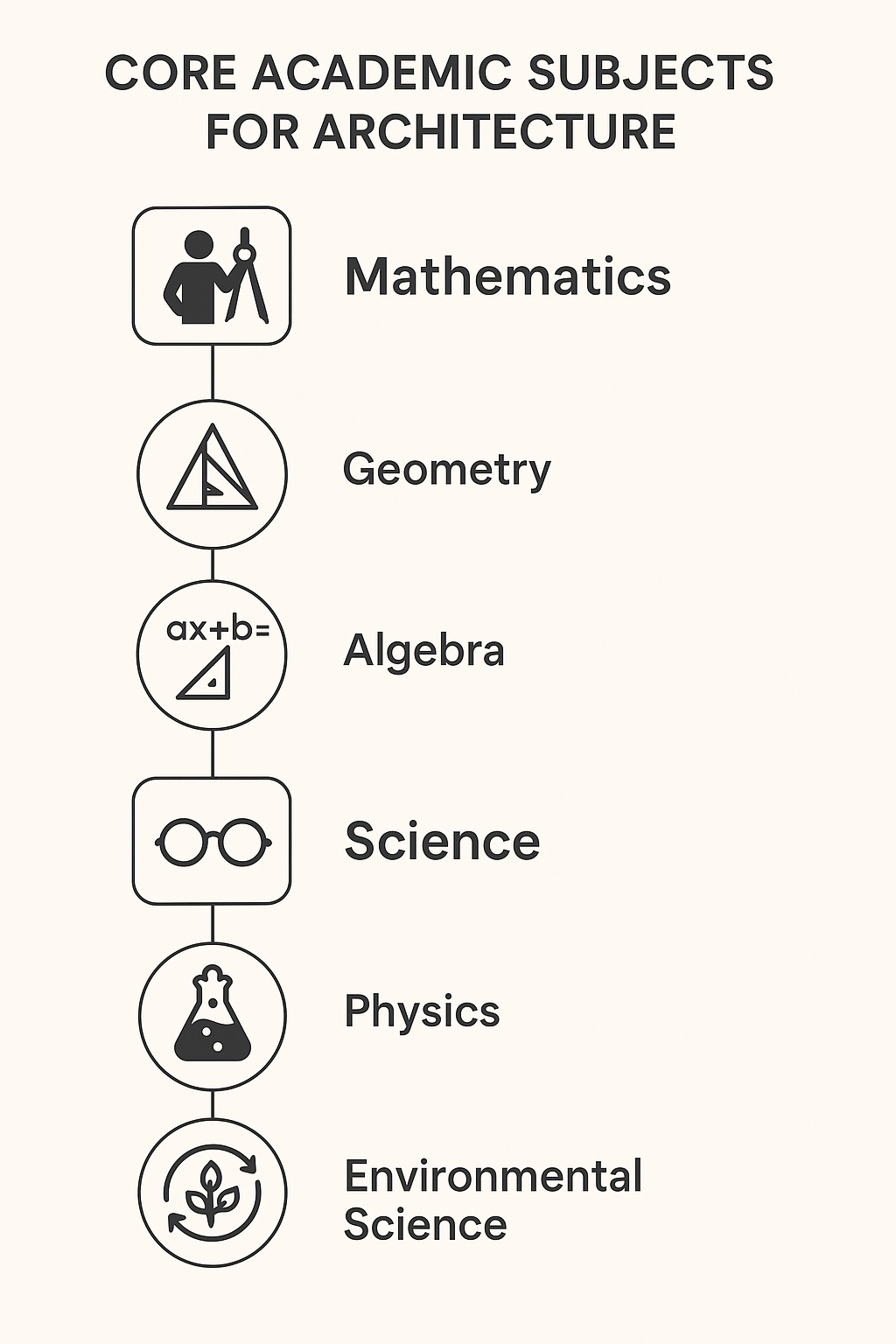
1.1 Why Math Really Matters for Architecture
Why math, science, and art courses matter when preparing for architecture school.
Math isn’t just for engineers. In architecture, it’s how you solve real problems, understand structure, and stay within budget.

Key Subjects to Take:
● Geometry
Start here. Geometry teaches you about shape, proportion, and how to think spatially. That skill becomes essential later when you're sketching floor plans or using CAD tools.
● Algebra
You’ll use algebra to calculate dimensions, budget materials, and understand loads. It’s practical, not just theory.
● Trigonometry
Roof slopes, structural angles, and support designs all depend on trig. It shows up in real-world design all the time.
● Calculus (Optional)
Not every architect needs this, but if you plan to go into structural design or architectural engineering, it helps.
Real-Life Payoff:
Students strong in geometry and trig have an easier time with 3D modeling, layout planning, and even architecture software.
Pro Tip:
Use graph paper. It’s basic, but it helps train your eye for scale and balance early.
Must-Read: "Architecture: Form, Space, and Order" by Francis D.K. Ching — View on Amazon
Still Deciding?
Ask yourself: Can you look at a sketch and imagine it as a 3D space?
1.2 Science: The Logic Behind Every Structure
Design can’t ignore physics. Science helps you understand how buildings actually stand up—and how they fail.
Top Science Subjects for Future Architects:
● Physics
Learn about force, motion, and structural integrity. This is the science that keeps buildings safe and standing.
● Chemistry
Understanding materials (like concrete, glass, or insulation) comes from chemistry. It’s also useful for sustainable building choices.
● Environmental Science
Modern architecture is about green design. This class helps you understand climate, energy efficiency, and eco-friendly materials.
Why It Matters:
If you don’t know what your materials do under pressure, you can’t build anything safely.
Pro Tip:
Watch short videos of real building failures and case studies—it helps you understand the science in a visual way.
Must-Read: "Structures: Or Why Things Don't Fall Down" by J.E. Gordon — View on Amazon
Good Question to Ask Yourself:
What kind of architect do you want to be—more artistic, or more technical?
What Subjects Do You Need to Become an Architect?
Art and Design Classes: Which High School Classes Prepare You for Architecture School?
2. Art & Design Essentials for Aspiring Architects

Balancing creativity with technical skill is key. Focus on building a strong visual toolkit alongside your math and science knowledge. Below are expert tips and tricks for each course category.
2.1 Mastering Visual Arts
Focus on Perspective & Proportion
-
Drawing & Painting:
-
Tip: Spend 10 minutes daily sketching simple forms (cubes, cylinders) to train your eye.
-
Trick: Use one-point perspective drills to lock in depth.
-
-
3D Modeling & Sculpture:
-
Focus on scale—build models at 1:50 or 1:100 to understand real-world dimensions.
-
Tip: Work with foam core or clay to test how light and shadow define form.
-
2.2 Excelling in Digital Design
Focus on Precision & Presentation
-
Computer-Aided Design (CAD):
-
Tip: Learn keyboard shortcuts first—they speed up your workflow.
-
Trick: Always set your units and layers before you start drawing to avoid cleanup later.
-
-
Graphic Presentation:
-
Focus on hierarchy—use size and contrast to guide the viewer’s eye.
-
Tip: Build a template for your title blocks and legends so every drawing looks polished.
-
2.3 Leveraging Architectural Photography
Focus on Light & Composition
-
Perspective Control:
-
Tip: Shoot with a wide-angle lens at eye level to minimize distortion in your building photos.
-
Trick: Use a tripod and two-second timer to keep images sharp.
-
-
Visual Storytelling:
-
Focus on capturing human scale—include people in shots to show how spaces feel.
-
Tip: Walk around your subject—find the angle that best highlights key design features.
-
Expert Reminder: Treat every sketch, model, and photo as a design exercise. The habits you form now—daily sketching, consistent CAD setup, thoughtful framing—will set you apart as an architect who thinks visually and communicates clearly.
Planning to Study Architecture? Start with These Subjects
How to Prepare for an Architecture Career in High School
3. Practical Skills & Workshops
Hands-on experience is essential to turn your designs into real buildings. Focus on these technical classes to bridge the gap between theory and construction.
3.1 Precision Drafting
Why It Matters: Drafting is the blueprint language of architecture.
-
Basic Techniques:
-
Focus on accuracy: Practice drawing to scale every day—start with 1:100 plans, then move to 1:50 details.
-
Tip: Master line weights (thin for dimensions, thick for walls) to make your drawings clear at a glance.
-
-
Advanced Drafting:
-
Focus on compliance: Learn building-code symbols and annotation standards.
-
Tip: In every drawing, double-check symbol libraries and dimension tolerances before you finalize.
-
3.2 Construction Technology & Woodworking
Why It Matters: Understanding materials and methods makes your designs buildable.
-
Hands-On Workshops:
-
Focus on joinery: Build simple wood models using mortise-and-tenon or dowel joints to feel structural connections.
-
Tip: Label each model part and sketch its assembly sequence—this trains you to anticipate on-site challenges.
-
-
Materials & Methods:
-
Focus on properties: Compare wood, steel, and concrete—note strengths, weights, and typical use-cases.
-
Tip: Keep a materials journal with photos and notes on finish, cost, and ease of assembly.
-
Next, you’ll explore how humanities and social sciences deepen your understanding of architectural context and human experience.
Architecture Prep: Key Subjects to Focus on Early
Learn which high school subjects give future architects a strong head start in college and beyond.
4. Humanities & Social Sciences
Understanding people and cultures makes your architecture more relevant and impactful. Focus on these three areas, and apply the expert tips below:

4.1 History
-
Focus on Context: Study how styles evolve—Roman arches, Gothic vaults, Modernist facades.
-
Tip: Create a timeline of key movements and note their social triggers (e.g., Industrial Revolution → steel frames).
-
Do: Visit local heritage sites and sketch architectural details to internalize historical lessons.
4.2 Geography
-
Focus on Site & Climate: Analyze topography, sun paths, prevailing winds.
-
Tip: Use simple climate diagrams to guide building orientation and window placement.
-
Do: Map local materials and their environmental impact—match material choice to climate needs.
4.3 Sociology & Psychology
-
Focus on User Behavior: Observe how people move and gather in spaces.
-
Tip: Conduct quick surveys or shadow users in public areas to identify comfort zones.
-
Do: Prototype layouts with paper models or VR mockups to test and refine user flow.
Expert Reminder: Integrate cultural context, environmental factors, and human needs into every design decision. This balanced approach elevates buildings from mere structures to places that resonate deeply with users.
The best high school classes for students who want to study architecture, explained simply.
5. Boost Your Architecture Portfolio with Extracurriculars

Stand out in applications and interviews by showing real-world skills. Below are the best activities, plus what to focus on, how to get started, and common pitfalls to avoid.
Extracurricular Activities
Design Club: Build Collaboration & Creativity
What to Focus On
-
Team Projects: Co-design small structures or installations.
-
Sketching Drills: Quick 5-minute idea sketches each meeting.
How to Get Started
-
Find or launch a club at school.
-
Pitch a mini-competition: design a pop-up pavilion.
-
Rotate roles so everyone practices leadership and feedback.
What to Avoid
-
Don’t let one person dominate decisions—rotate leadership.
-
Avoid overcomplicating models; keep first prototypes simple.
Internship: Gain Professional Insight
What to Focus On
-
Observation: Watch how architects solve on-site problems.
-
Basic Tasks: Model-making, CAD cleanup, site photographs.
How to Get Started
-
Reach out to local firms with a brief email and portfolio of sketches.
-
Offer to volunteer a few hours on weekends.
-
Ask for a mentor and set clear weekly goals.
What to Avoid
-
Don’t promise more time than you can give—set realistic hours.
-
Avoid passive presence—always ask, “How can I help today?”
Local Volunteering: Impact Your Community
What to Focus On
-
Needs Assessment: Talk to neighborhood groups about their challenges.
-
Proposal Sketches: Draft simple before-and-after site ideas.
How to Get Started
-
Partner with Habitat for Humanity or a community garden project.
-
Offer free concept sketches to local non-profits.
-
Organize a weekend build day for small structures (benches, planters).
What to Avoid
-
Don’t skip local regs—check permits before building.
-
Avoid “designing in isolation”—get user feedback early.
Discover the best high school courses for students aiming to become architects, from math to design.
6. Preparing for Architecture College Success

Get ready for architecture school with focused courses, a standout portfolio, and a strong application. Here’s how:
College Preparation and Beyond
Choose Advanced Courses
What to Focus On
-
Art & Design AP (if available)
-
Advanced Math & Physics
How to
-
Enroll in AP Art & Design, AP Calculus, AP Physics
-
Use class projects for portfolio pieces
Avoid
-
One-note coursework—mix creative and technical classes
Build Your Portfolio
What to Focus On
-
Mix of 2D sketches, 3D models, and digital work
-
Projects that solve real problems
How to
-
Include step-by-step design notes
-
Get feedback from teachers or mentors
Avoid
-
Unlabeled or unedited work
-
Overloading with similar pieces
Select & Apply to Schools
What to Focus On
-
Programs with strong studios and internships
-
Schools that match your design interests
How to
-
Research faculty and facilities
-
Craft essays showing your passion and goals
Avoid
-
Applying blindly—skip schools without site visits or research
What If Architecture Isn’t for You?
It’s normal to change your mind. Your architecture prep still matters—those skills go far.
Why it’s not wasted:
-
Problem solving: You know how to break big problems into steps.
-
Creative thinking: You can sketch, model, and see patterns.
-
Tech skills: CAD, drafting, and math work in lots of fields.
Next steps:
-
Try related paths: Urban planning, interior design, graphic design, construction management, real estate.
-
Focus on your strengths: Pick the jobs that match what you enjoy most.
-
Talk it out: Meet with career counselors and pros in fields you’re curious about.
Related: From Architecture to IT: Why I Switched Careers and Why You Might Too
Mixing Architecture & Tech
Tech is changing design. Learn these tools to stand out.
BIM (Building Info Modeling):
-
Focus on 3D data: Model walls, doors, systems in one file.
-
Do: Take an online intro course. Practice in Revit or ArchiCAD.
VR & AR:
-
Focus on “walking through” designs: Let clients see spaces before they’re built.
-
Do: Try free VR viewers. Use smartphone AR apps to overlay plans on real sites.
What to avoid:
-
Don’t skip software practice—small daily drills beat one big session.
-
Avoid half-finished models—make each file a complete demo.
Facing Global Challenges
Design for a changing world. Think big and start small.
Climate resilience:
-
Focus on safe materials: Choose fire- and flood-resistant options.
-
Do: Learn simple passive cooling and rainwater catchment.
Urban growth:
-
Focus on smart density: Fit homes and parks into tight spaces.
-
Do: Study local zoning rules. Sketch quick space-saving layouts.
Health & well-being:
-
Focus on light and air: Big windows, fresh-flow layouts.
-
Do: Observe how sunlight moves through a room at different times.
Using Your School Counselor
They’re there to help you figure out next steps.
Course planning:
-
Focus on must-haves: Art, CAD, calculus, physics.
-
Do: Meet each semester to update your plan.
College prep:
-
Focus on deadlines: Applications, portfolios, scholarships.
-
Do: Get essay feedback. Practice interviews with them.
Keep Going
Be curious and patient. Architecture takes time—and so does finding your best fit.
-
Stay open: Try new tools, new styles, new roles.
-
Stay connected: Keep talking to teachers, pros, and classmates.
-
Stay passionate: Every sketch and model counts for something.
Recommended Books
To further your understanding and passion for architecture, here are some books that can provide valuable insights and inspiration:
- "Architecture: Form, Space, and Order" by Francis D.K. Ching - A foundational book that introduces the basic elements of architecture.
- "The Architecture of Happiness" by Alain de Botton - Explores the relationship between our surroundings and our emotional well-being.
- "Yes is More: An Archicomic on Architectural Evolution" by Bjarke Ingels - A graphic novel that presents innovative architectural concepts in an engaging format.
Final Word
Want to make your first year in architecture school easier? Start now.
You don’t need to master everything. Just focus on building a solid base—math, design, and clear thinking. These skills will follow you into college, your portfolio, and your future job.
Get curious. Be patient. Keep sketching.
If architecture feels right to you now, choosing the right classes is how you show you’re serious. That effort will pay off later—in college, internships, and beyond.
FAQ
Q: What should I do if I’m struggling with math or science courses?
- A: It’s common to find some subjects challenging, but don’t get discouraged. Seek help from teachers, tutors, or classmates, and remember that understanding these subjects is crucial for architecture. Practice regularly, and try to connect what you’re learning with real-world architectural applications to make it more engaging.
Q: Is it necessary to be good at drawing to become an architect?
- A: While drawing is an important skill in architecture, it’s not the only one. You’ll also need to be strong in problem-solving, critical thinking, and communication. If you’re not confident in your drawing skills, practice regularly and consider taking additional art classes to improve. Remember, many successful architects started with basic drawing skills and improved over time.
Q: How can I gain architectural experience while still in high school?
- A: Look for opportunities to participate in architecture clubs, design competitions, or internships. Volunteering for community projects or shadowing professionals can also provide valuable experience. Additionally, working on personal design projects and building a portfolio will help you gain practical experience.
Q: What should I include in my architecture portfolio?
- A: Your portfolio should showcase a variety of work that demonstrates your creativity, technical skills, and design process. Include drawings, sketches, 3D models, and any digital design work you’ve done. Make sure to explain the concepts behind each project and how you approached the design challenges.
Q: What if I change my mind about studying architecture?
- A: Changing your mind is perfectly okay. The skills you’ve developed while preparing for architecture—such as critical thinking, creativity, and problem-solving—are valuable in many other fields. You can transition into related areas like urban planning, interior design, graphic design, or even business management. The time you’ve spent has not been wasted; it’s provided you with a strong foundation for success in various careers.
Related
Architecture School Preparation
-
Introduction to Architecture for High School Students
Basic intro to architecture concepts, terms, and thinking styles for teens considering the field. -
Free Online Architecture Courses for High School Students
Links and tips on free online courses that help students explore architecture before college. -
Tips for High School Students Considering Urban and Landscape Design
Simple advice on what urban and landscape design mean and how to prepare in high school.
Architecture Degree Pathways
-
Diploma in Architecture: Your Guide from High School to Advanced Diplomas
Explains different diploma levels and how students can move through them step by step. -
Architecture Schooling: From High School Prep through B.Arch to PhD
A full breakdown of the education path in architecture—from first classes to top degrees. -
All About Architect Schooling: Online and Offline Pathways!
Covers traditional and online ways to study architecture depending on time and budget.
Architecture School Rankings & Guides
-
Guide to Architecture Schools
A broad summary of what all students should know before applying to any architecture school. -
Best Architecture Schools: 2025 Ranking and What Makes Them Stand Out
Lists top schools with a simple explanation of what makes each one special. -
Architecture Schools: What to Know Before Choosing a Program
Helps students understand what to look for when choosing the right school. -
The Best Architecture Schools in California: Your Ultimate Guide
Focuses on California schools—location, reputation, and opportunities. -
Exploring Architecture Programs in Illinois: Top Schools and Opportunities
Overview of Illinois architecture schools with details about their strengths. -
Top US Architecture Schools for 2025–2026: Pros, Cons, and Career Prospects
Highlights top schools, with easy comparisons to help pick one that fits. -
Top Architecture Schools in the US: An Insider's Perspective
Practical insight into what life is like at top US schools from a student view. -
Architecture Schools in Canada
Overview of top Canadian architecture schools and how they compare. -
Best Architecture Schools in the World
A look at top-rated global programs with simple explanations of their strengths.
Graduate Architecture Education
-
Thriving in Graduate School for Architecture Students
Tips for surviving and succeeding in master’s or PhD architecture programs. -
Preparing a Strong Graduate School Application for Architecture Students
What to include in your application to stand out to grad school reviewers. -
Preparing an Impressive Architecture Portfolio for Architecture School Admission
How to build a solid portfolio that shows off your skills and thinking. -
Choosing the Right Architecture School
What to keep in mind when comparing different schools and programs. -
Importance of Accreditation in Architectural Schools
Why accreditation matters and how to check if a school is properly recognized.
Architecture Thinking & Culture
-
101 Things I Learned in Architecture School
Key lessons about design, problem-solving, and communication from architecture education. -
Why Old-School Architecture Can't Compete Anymore
A look at how modern methods have outpaced traditional ones and why that matters today.
The foundational steps and essential knowledge needed for a successful career in architecture
- Architecture Education in America: Everything You Need to Know
- Top US Architecture Schools: Pros, Cons, and Career Prospects
- Top Architecture Schools in the US: An Insider's Perspective
- Architecture Programs in Illinois: Top Schools and Opportunities
- Exploring USC’s Architecture Program: Strengths, Opportunities & More
- Best Architecture Colleges Worldwide: Top Picks and Insights
- Studying Architecture Abroad: Benefits, Challenges, and Top Schools
Resources
- National Architectural Accrediting Board (NAAB): The NAAB accredits professional degree programs in architecture in the United States. Their website provides information on accredited programs, ensuring that you choose a college or university that meets the highest standards of architectural education.
- Website: www.naab.org
- U.S. Department of Education: Offers resources on college planning, financial aid, and career paths in architecture. It’s a valuable tool for researching architecture programs and understanding the educational landscape.
- Website: www.ed.gov
- National Council of Architectural Registration Boards (NCARB): NCARB oversees the licensure process for architects in the United States. Their website provides information on becoming a licensed architect, including details on the Architect Registration Examination (ARE) and the Architectural Experience Program (AXP).
- Website: www.ncarb.org
- American Institute of Architects (AIA) Students: AIA Students is a branch of the American Institute of Architects dedicated to supporting architecture students. They offer educational resources, scholarships, and networking opportunities.
- Website: www.aias.org
- American Institute of Architects (AIA): The AIA is a leading professional organization for architects in the United States, offering resources on continuing education, professional development, and advocacy for the architectural profession. They provide valuable tools and support for both practicing architects and students.
- Website: www.aia.org
- Architectural Research Centers Consortium (ARCC): A non-profit organization that promotes research in architecture and related disciplines. ARCC supports scholarly activities and offers a platform for the exchange of ideas between academic institutions and practitioners.
- Website: www.arcc-arch.org
- Architecture for Humanity: A non-profit organization focused on promoting architectural and design solutions to humanitarian crises and environmental challenges. Their work emphasizes the role of architecture in improving living conditions and addressing social issues.
- Website: www.architectureforhumanity.org
- US Green Building Council (USGBC): A non-profit organization committed to promoting sustainability in building design, construction, and operation. The USGBC developed the LEED certification system and offers educational resources on green building practices.
- Website: www.usgbc.org
- The National Trust for Historic Preservation: A non-profit organization dedicated to saving America’s historic places. They offer resources on preserving and revitalizing historic architecture, which is an important aspect of architectural education and practice.
- Website: www.savingplaces.org