
Architecture school entry requirements look simple until you start applying.
Grades matter. So do math, physics, drawing, portfolio work, recommendations, statements, deadlines, and sometimes entrance tests.
But the real question is sharper:
Can you prove you are ready for studio?
That is where weak applications fall apart. Some students have strong grades and no visual work. Some have attractive drawings but weak math. Some submit polished digital images with no process, no hand drawing, no model work, and no evidence that they can revise a design after criticism.
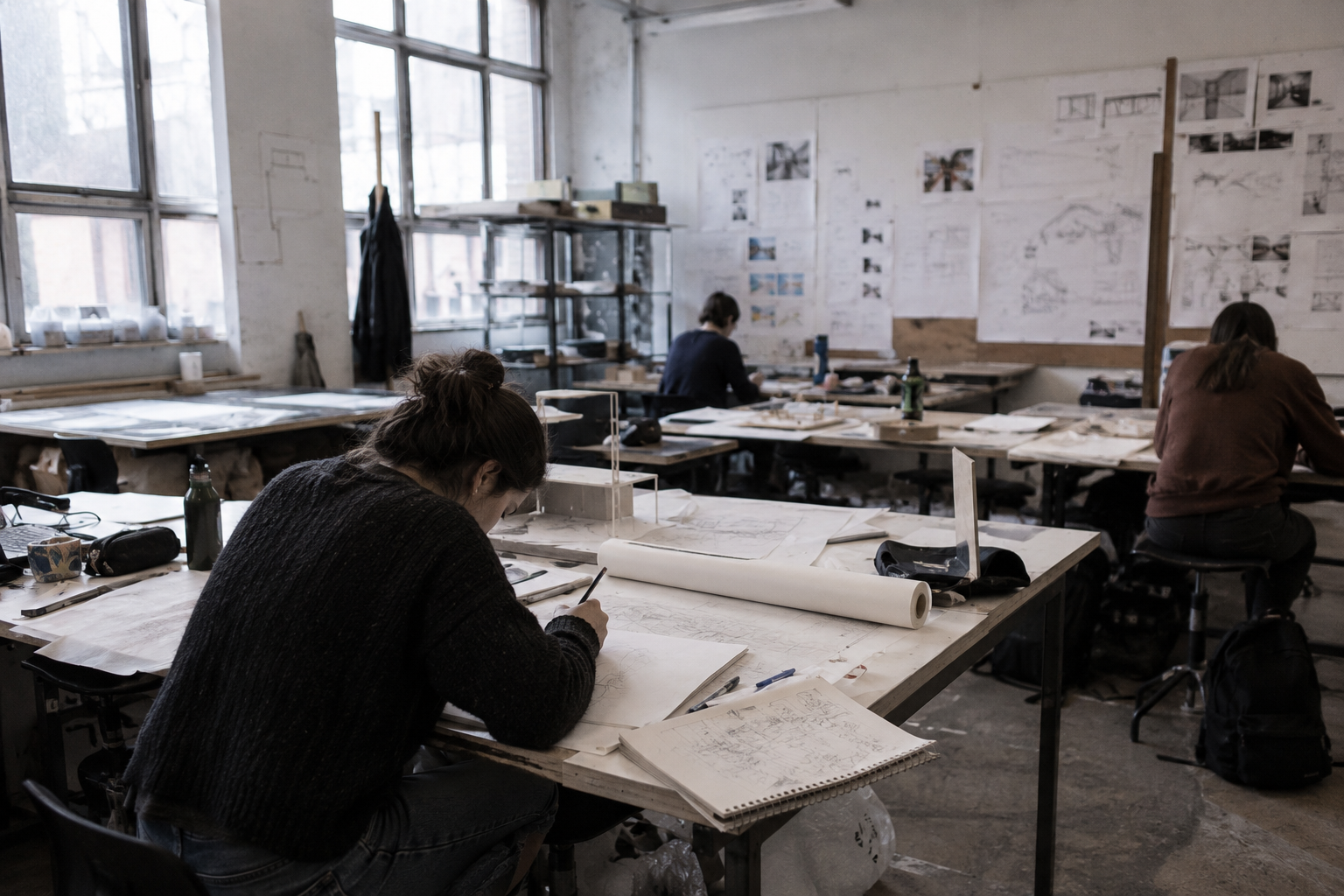
Architecture schools are not only checking whether you like buildings. They are checking whether you can survive the way architecture is taught.
What Schools Really Check
Most architecture programs look at five things: academic preparation, portfolio quality, spatial thinking, communication, and fit for the degree path.
The exact requirements vary by country and school. A B.Arch program, a BA or BS in Architecture, a technical diploma, and an M.Arch will not ask for the same proof. But the pattern is similar: the school wants evidence that you can think visually and stay with a difficult project long enough to improve it.
| Requirement | What it proves | Common weak spot |
|---|---|---|
| Math | You can handle geometry, proportion, structure, dimensions, and basic technical reasoning | Good drawings, weak number confidence |
| Physics | You understand forces, loads, materials, gravity, and why buildings stand up | Treating architecture like art only |
| Art or design | You can observe, draw, compose, and work visually | Only digital renders, no life drawing |
| Portfolio | You can develop ideas, build, revise, and explain work | Too much polish, not enough process |
| Statement | You know why you are applying and can write clearly | Generic “passion for design” language |
| Recommendations | Someone has watched you work through difficulty | Famous recommender who barely knows you |
The strongest applicants are not perfect in every category. They are clear. Their application shows a real pattern of work: drawing, making, thinking, correcting, and finishing.
Start With the Degree Path
Before checking entry requirements, know which kind of architecture program you are entering.
This matters because “architecture degree” can mean very different things. A professional B.Arch is not the same as a four-year BA or BS in Architecture. A drafting diploma is not the same as an accredited professional degree. A master’s degree may be professional, post-professional, or research-focused.
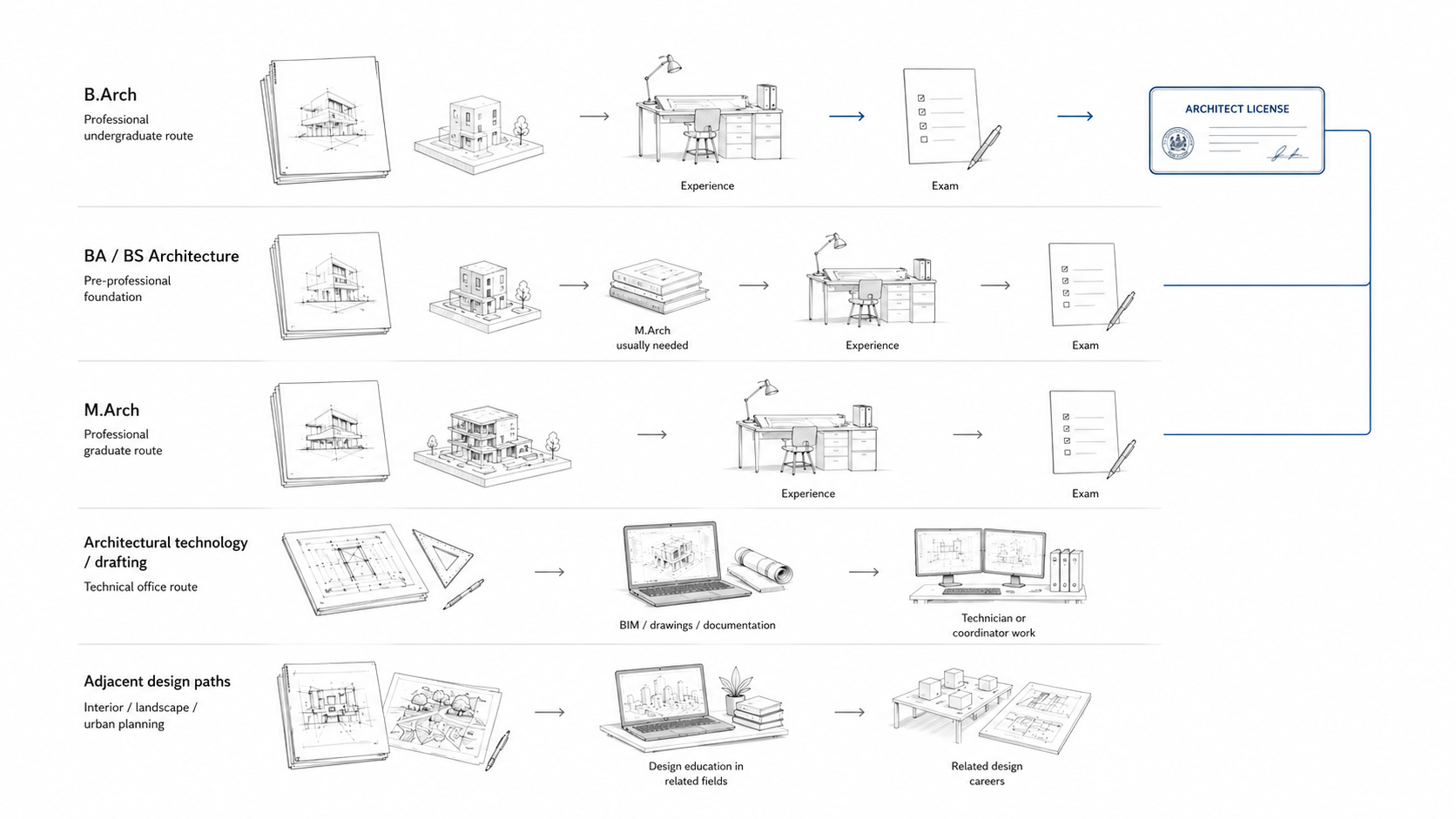
| Path | Typical entry focus | What to check |
|---|---|---|
| B.Arch | High school preparation, portfolio, math, physics, art/design | Accreditation and studio workload |
| BA or BS in Architecture | Academic record, design interest, sometimes portfolio | Whether it is professional or pre-professional |
| M.Arch | Undergraduate transcript, portfolio, statement, recommendations | Whether your background qualifies for 2-year or 3-year placement |
| Architecture diploma or drafting program | Technical readiness, software interest, basic math, sometimes drawing | Whether it leads to drafting work or transfers later |
| Online architecture-related program | Self-direction, digital skills, portfolio-building goals | Whether it is only skill-building or part of a recognized path |
For the broader map, read Types of Architecture Degrees.
B.Arch, BS, BA, and the Licensure Trap
This is where many students get confused.
A B.Arch is usually the direct professional undergraduate route when the program is properly accredited. A BS or BA in Architecture may be a strong degree, but it is often pre-professional. That means you may still need an M.Arch later before the standard licensure path opens.
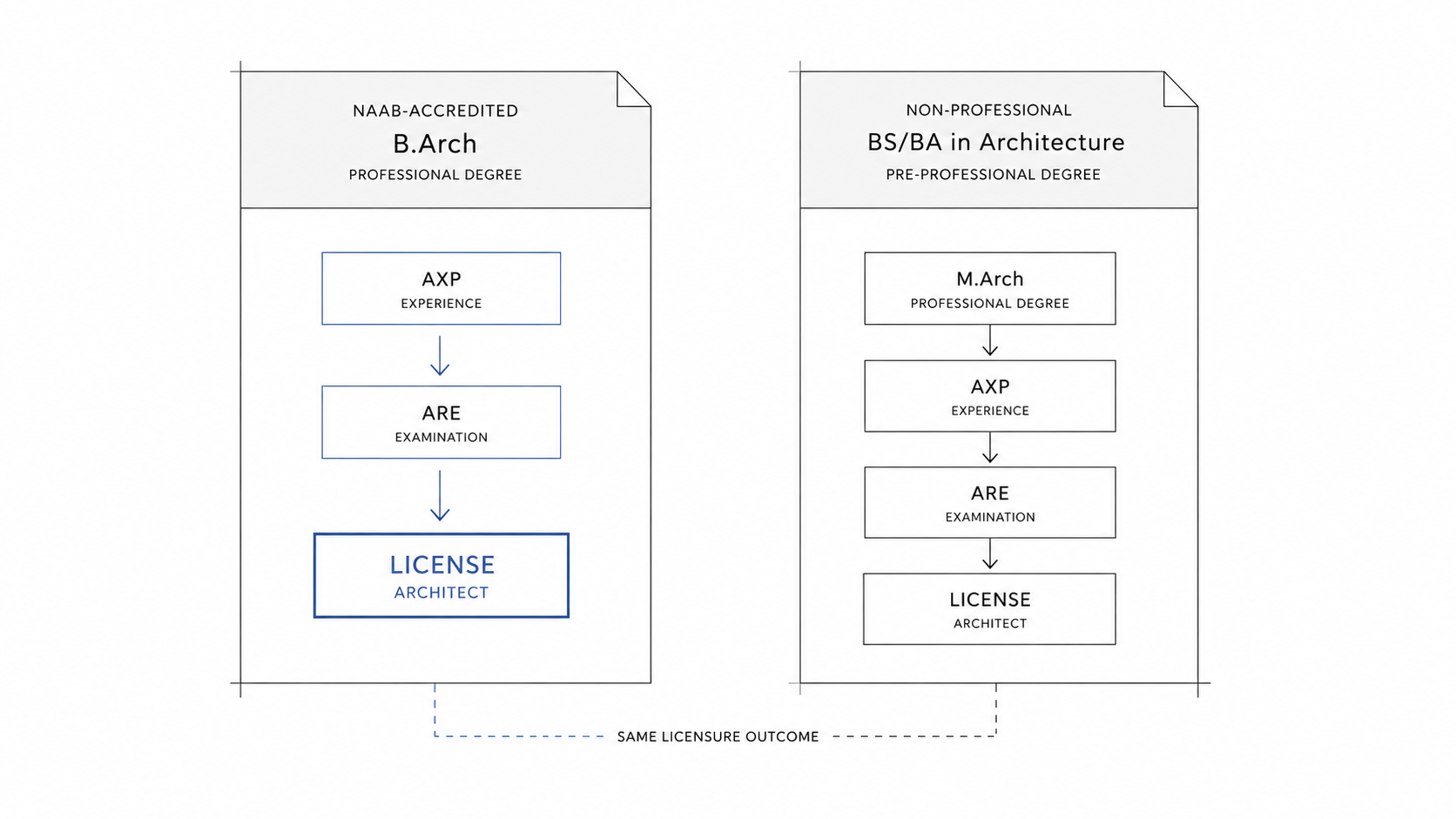
This does not make the BA or BS useless. It can be a good route for students who want flexibility, more academic room, or a later graduate decision. But it must be chosen with the added step in mind.
For the direct professional route, read Bachelor of Architecture. For the pre-professional route, compare Bachelor of Science in Architecture and Bachelor of Arts in Architecture.
Subjects That Matter
Architecture is both visual and technical. Schools know this. They look for applicants who can draw and think, but also handle numbers, structure, and written explanation.
Math
You do not need to be a math genius to apply to architecture school. But you do need enough geometry, algebra, proportion, and basic trigonometry to avoid panic when buildings become real.
Math shows up in stairs, roof pitch, span, scale, slope, grids, structural logic, and dimensions. A student who refuses math usually struggles once design studio meets structures.
Physics
Physics connects drawings to gravity.
Schools may ask for physics because architecture students eventually deal with loads, forces, materials, movement, light, heat, acoustics, and environmental systems. You are not becoming a structural engineer, but you cannot design as if buildings float.
Art and design
Art or design coursework helps because it proves you can observe and make visual decisions. Drawing from life matters more than copying images from the internet.
A clean sketch of a chair, stair, doorway, corner, or street edge can show more readiness than a dramatic digital rendering with no real observation behind it.
English and writing
Architecture students write statements, project descriptions, reports, research notes, and presentation text. A good designer who cannot explain decisions clearly will struggle in reviews and applications.
The Portfolio Is the Real Filter
The portfolio is where architecture applicants separate themselves.
It does not need to look like professional office work. Trying too hard to look professional can even backfire. Reviewers want to see how you think, not whether you can fake a glossy firm portfolio at seventeen.
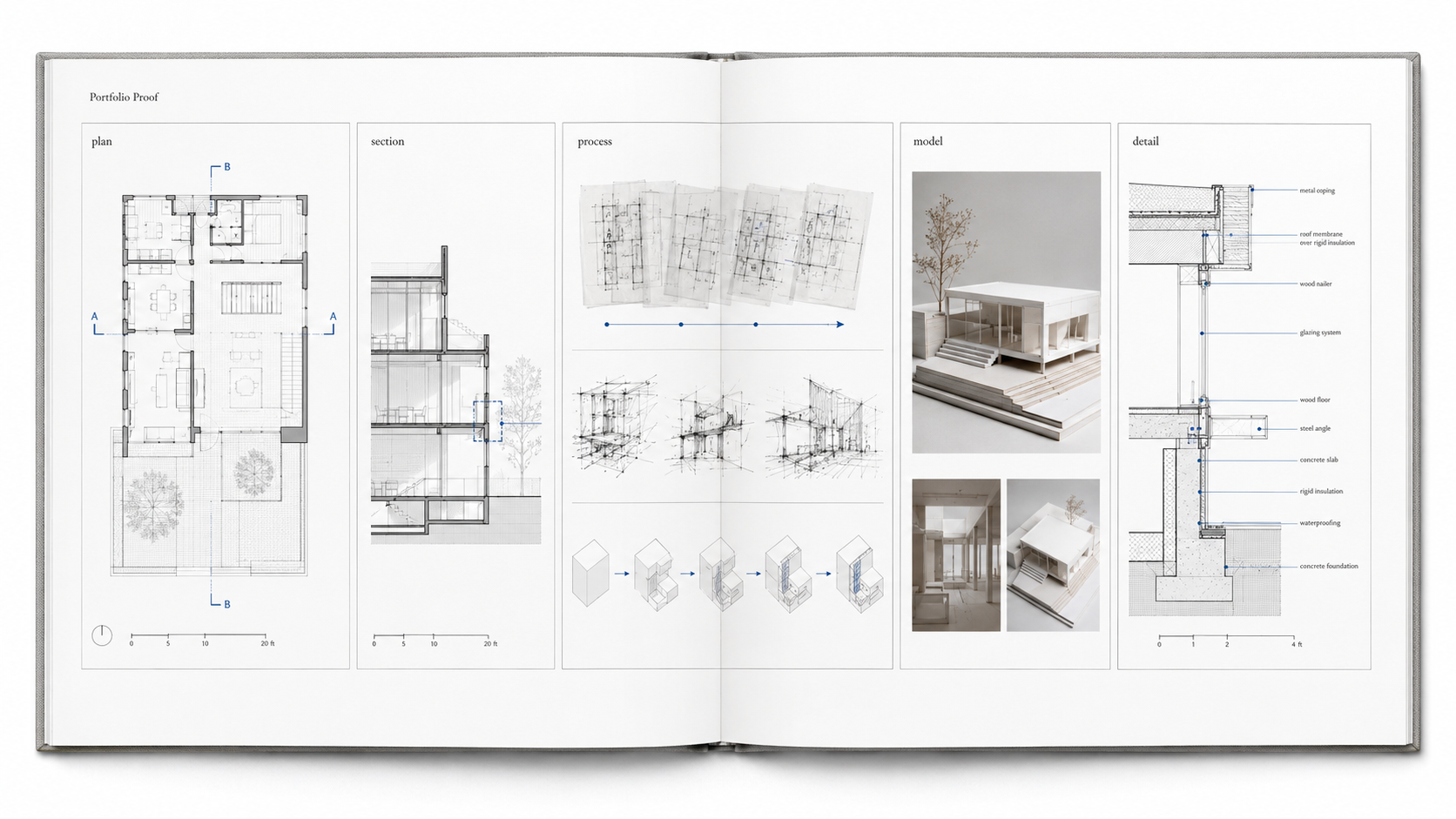
A strong beginner portfolio usually includes:
- observational drawings from life
- one or two measured or analytical building drawings
- a physical model photographed clearly
- a light, shadow, or material study
- one original design idea
- one simple digital model or drawing if useful
- a process page showing sketches, revisions, and mistakes
The process page matters. It tells reviewers that you can develop a project instead of only presenting a final image.
A 10-Piece Portfolio That Actually Works
Do not fill the portfolio with weak extras. Ten strong pieces can beat twenty average ones.
| Portfolio piece | Why it helps |
|---|---|
| Life drawing: object | Shows observation, proportion, and control |
| Life drawing: building corner or stair | Shows space, perspective, and architectural attention |
| Human figure or people in space | Shows scale and awareness of bodies |
| Light and shadow study | Shows form, depth, and atmosphere |
| Measured drawing | Shows patience and accuracy |
| Physical model | Shows making, material handling, and three-dimensional thinking |
| Material experiment | Shows curiosity beyond flat images |
| Small design idea | Shows imagination and problem-solving |
| Simple digital work | Shows tool readiness without pretending to be advanced |
| Process page | Shows how you revise, fail, correct, and finish |
Start with one of the strongest observational pieces. End with process or a project that shows development. Never start or finish with filler.
For deeper portfolio help, read Real Architecture Portfolios.
Application Path
The application is not one task. It is a chain. If one link is weak, the whole file feels weaker.
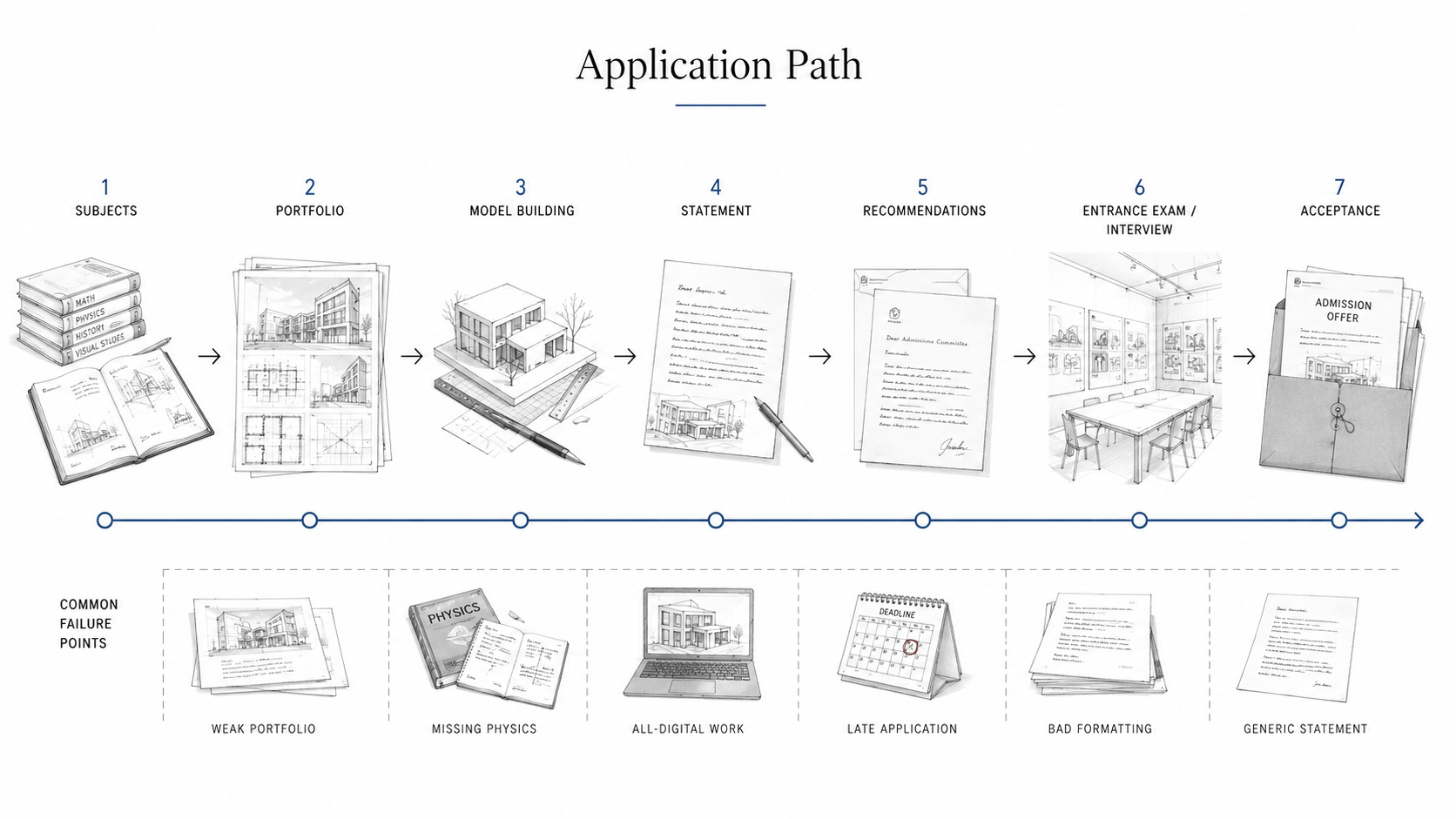
The safest order is not glamorous:
- confirm subject requirements first
- check whether a portfolio is required
- start hand drawing and model work early
- draft the statement after you know what your portfolio says
- ask for recommendations before the deadline rush
- practice any entrance exam or interview format
- check file size, page count, naming, and submission rules
Most application damage happens late. The work may be decent, but the file is too large, the images are dark, the statement sounds generic, the recommendation arrives late, or the portfolio ignores the school’s page limit.
Architecture schools notice care. They also notice sloppiness.
The 3-Month Portfolio Plan
A good beginner portfolio usually takes longer than students expect. Thirty to forty hours is a minimum, not a luxury.
| Time | What to do | What to avoid |
|---|---|---|
| Month 1 | Draw from life, measure one building element, start a sketch habit, build one simple model | Spending the whole month choosing fonts and layouts |
| Month 2 | Add range: light study, material experiment, human scale, second model, small design idea | Only making more versions of the same drawing |
| Month 3 | Edit, photograph, create one process page, write captions, test the PDF, remove weak work | Adding filler because the portfolio feels “too short” |
Photograph models in daylight. Crop cleanly. Do not let a strong model look bad because the photo is dark, tilted, or full of bedroom clutter.
Test the file on another computer before submitting. A broken PDF is not a design problem. It is an avoidable application problem.
What Students Discover After Acceptance
This is the part most entry-requirement pages skip.
Getting accepted does not mean the hard part is over. It means the real test starts.
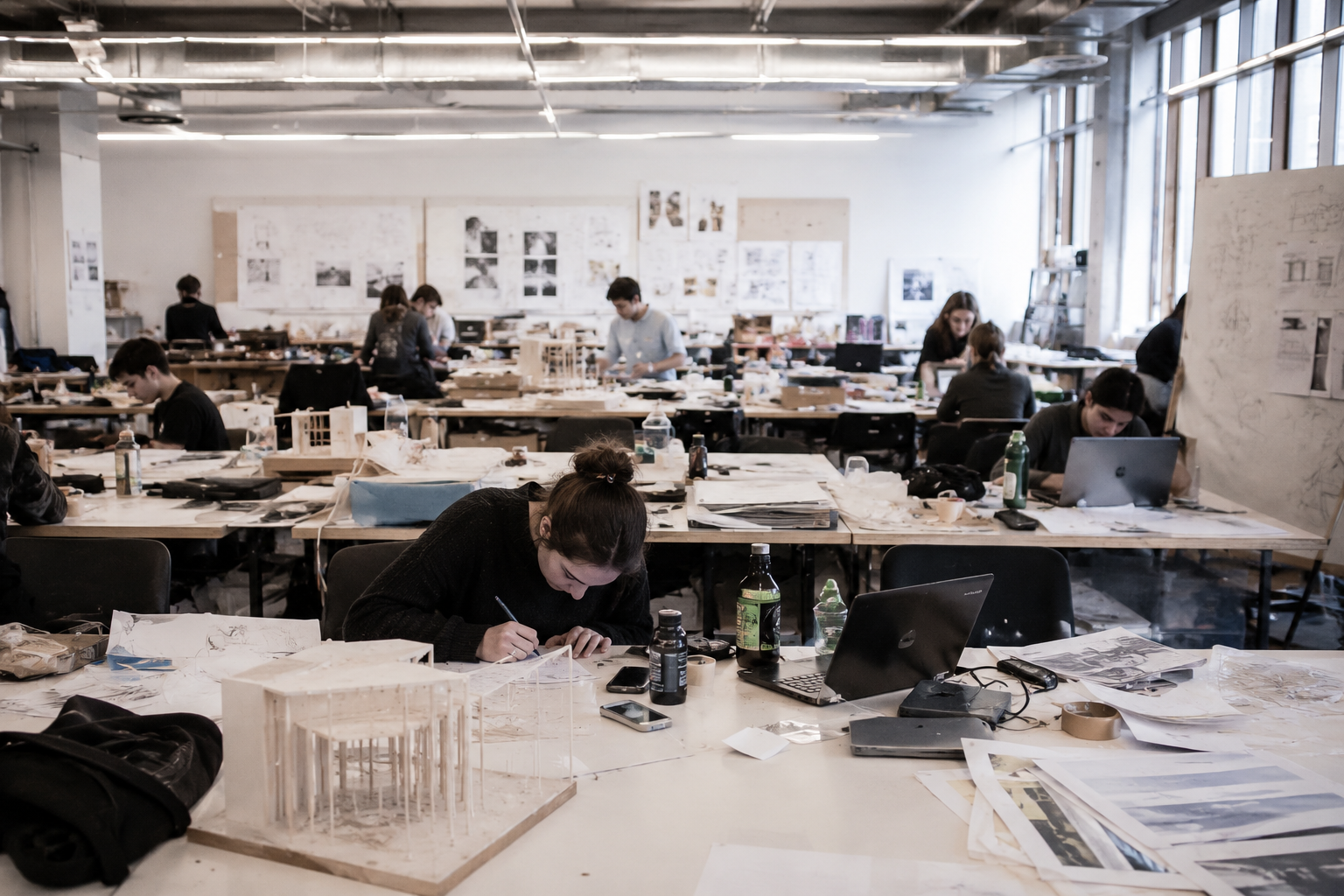
Students quickly discover that architecture school costs more than tuition. Model materials, prints, cutting tools, blades, glue, sketchbooks, software, storage, transport, and laptop upgrades can show up all semester.
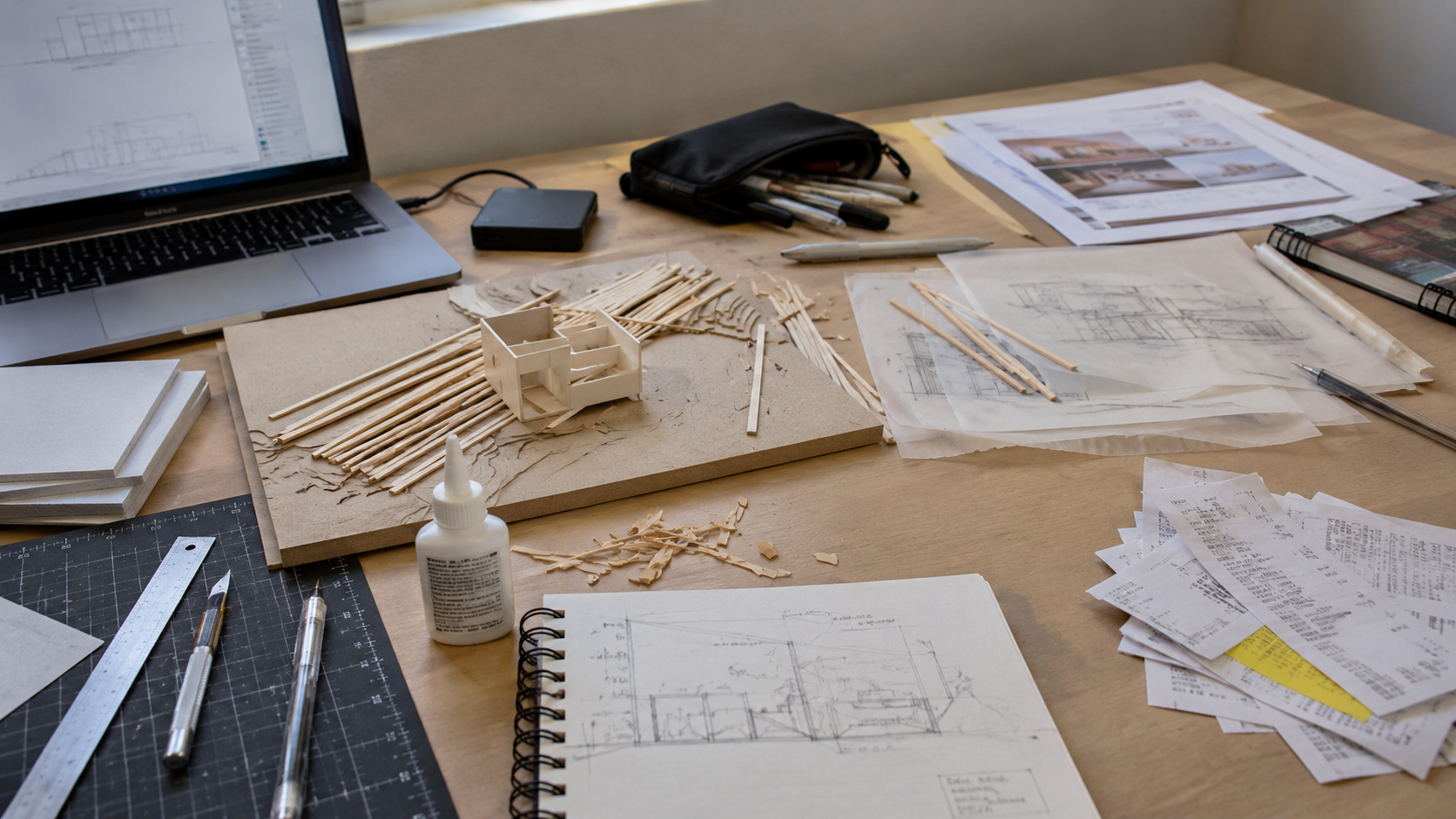
The schedule is another shock. Studio projects do not behave like normal homework. A drawing can take three hours longer than expected. A model can fail the night before review. A critic can ask for a full revision when the student thought the project was finished.
Then structures arrives. Some students who came for facades and sketching realize they still have to deal with loads, spans, gravity, and material behavior.
The protective move is to prepare for the work, not the fantasy. Build something before school. Draw from life before school. Learn basic file organization. Practice taking criticism without collapsing. Save money for supplies. This does more for first-year survival than another inspirational architecture quote.
Entrance Exams and Interviews
Not every school uses entrance exams or interviews. When they do, they are usually testing spatial thinking, calmness, and basic design judgment.
The exam may include timed sketches, visual puzzles, object rotation, pattern recognition, short design prompts, or simple logic questions. It is not about perfect rendering.
Practice under time. Draw stairs, cubes, rooms, doorways, chairs, and street corners with a clock running. The point is to become less fragile when the time pressure starts.
In interviews, do not try to sound like a famous architect. Talk clearly about your own work. Explain what you made, what failed, what changed, and what you would improve.
Recommendation Letters
One specific letter is better than three generic ones.
Choose someone who has seen how you work. An art teacher who watched you revise a drawing, a physics teacher who saw you push through difficult material, a shop teacher who saw you build carefully, or a mentor who knows your project habits can write a stronger letter than someone with a bigger title and no details.
Give the recommender context:
- the schools you are applying to
- the degree path you want
- a short note about why architecture
- a few examples of your work
- the deadline and submission method
Do not ask at the last minute. A rushed letter usually reads like a rushed letter.
The Statement Should Not Sound Like a Brochure
The weakest statements usually start with big claims.
“I have always been passionate about architecture.”
That line says almost nothing.
A stronger statement starts smaller. A building you measured. A house you helped repair. A model that collapsed. A drawing habit. A street you kept sketching. A construction site that made you understand buildings as work, not just images.
Keep the statement short, specific, and grounded. One honest reason beats five decorative sentences.
Avoid name-dropping famous architects unless the connection is personal and specific. Reviewers have seen enough generic references to Zaha Hadid, Frank Lloyd Wright, Le Corbusier, and “timeless design.” They want to understand you, not your search history.
Online and Transfer Applicants
Online courses can help applicants build skills. They can also create false confidence.
A short online course may help you learn drawing basics, CAD, digital modeling, history, or portfolio layout. It does not automatically replace a professional architecture degree or studio sequence.
If you are using online study as preparation, use it to produce evidence: drawings, models, measured work, process pages, and better portfolio pieces.
Transfer applicants have a separate problem. Credits may transfer on paper, but studio placement is different. A school may accept your general courses and still place you earlier in studio if your work does not match its sequence.
Ask directly:
“With my current portfolio and transcript, what studio year would I enter?”
That answer matters more than a vague promise about transfer credit.
For online paths, read Can You Earn an Architecture Degree Online?.
Common Application Mistakes
| Mistake | Why it hurts | Better move |
|---|---|---|
| Only digital renders | Looks polished but thin | Add hand drawing, models, and process |
| No physics or weak math | Raises concern about structures and technical courses | Retake, strengthen, or explain improvement |
| Too many weak portfolio pieces | Filler lowers the whole file | Use fewer stronger pieces |
| Generic statement | Sounds copied from every other applicant | Use one specific story |
| Late recommendation request | Produces vague letters | Ask early and provide context |
| Ignoring file rules | Looks careless before anyone reviews the work | Check format, size, page count, and naming |
FAQ
What subjects do I need for architecture school?
Most applicants should have math, physics, English, and some art or design preparation. Exact requirements vary, but architecture schools usually want proof of both technical and visual ability.
Do I need a portfolio for every architecture program?
Not every technical or introductory program requires one, but serious bachelor’s and master’s architecture programs often do. Always check the program page before assuming.
How many pieces should an architecture portfolio include?
Ten to twelve strong pieces are often better than twenty uneven ones. Include observation, models, process, and one or two original design ideas.
Is math important for architecture?
Yes. You do not need extreme math ability, but you do need comfort with geometry, scale, proportion, slopes, structure, and dimensions.
Can strong drawing make up for weak grades?
Sometimes, but not always. A strong portfolio can help, but serious weaknesses in required subjects can still block admission or make first year harder.
Do I need to know Revit or CAD before applying?
Usually no. Basic familiarity helps, but schools care more about thinking, observation, and process at entry level.
What should I write in my personal statement?
Write about one specific reason architecture matters to you. Avoid generic passion language and famous-architect name-dropping unless it connects directly to your own work.
Can I switch into architecture from another major?
Yes, especially through M.Arch programs, but you may need a strong portfolio and may enter a longer studio sequence if your background is not design-based.
What is the biggest portfolio mistake?
Submitting polished final images with no process. Reviewers want to see how you think, revise, and solve problems.
Read This Next
For the full degree map, read Types of Architecture Degrees.
For the direct professional undergraduate route, read Bachelor of Architecture.
For graduate entry, read Master’s Degree in Architecture.
For choosing a school, read Choosing the Right Architecture School.
For portfolio help, read Real Architecture Portfolios.
Before You Apply
Architecture school entry is not a checklist you finish the night before submission.
It is proof of readiness.
The best applicants show enough academic strength to survive the technical side, enough visual work to enter studio seriously, and enough process to prove they can revise instead of quitting when the first idea fails.
Do not prepare for the brochure version of architecture school.
Prepare for the desk, the critique, the model, the redlines, the file deadline, the physics problem, and the project that takes longer than you thought.