

Alvar Aalto made modern architecture warmer without making it soft. His best work proves that comfort is not decoration. It is built through light, wood, air, acoustics, furniture, and the small places where a body meets a building.
Alvar Aalto is usually described as a Finnish modernist. That is true, but it is not enough. Aalto took modern architecture and made it less cold. He kept the clarity, the white surfaces, the clean plans, and the belief in useful design. Then he added what strict modernism often forgot: touch, sound, warmth, daylight, landscape, illness, rest, and daily life.
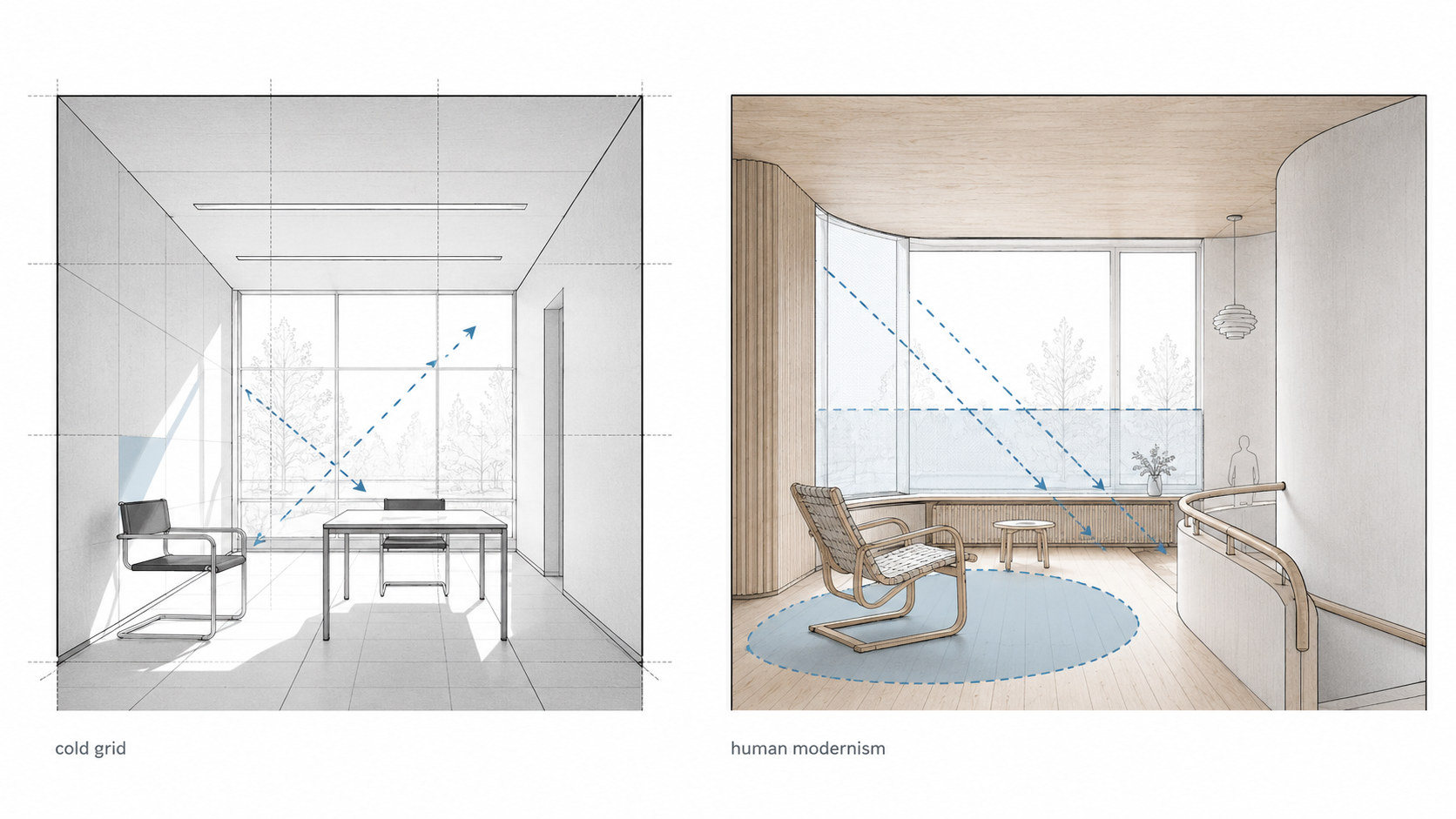
Illustration by ArchitectureCourses.org. Aalto did not reject modernism. He softened it with warmer materials, curved details, controlled daylight, human-scaled edges, and furniture that made the room feel usable instead of rigid.
That is why his work still matters. Aalto did not make buildings that only looked advanced in photographs. His better buildings changed how people sat, walked, healed, read, studied, waited, and lived.
The mistake is to reduce him to curved walls and bent plywood. Those are the visible signs. The deeper lesson is harder: a building can be modern without becoming hostile to the body.
The Modernist Who Refused the Cold Room

Aalto’s architecture often used courtyards, brick, timber, controlled daylight, and softer edges to make modern space feel lived-in rather than mechanical.
Hugo Alvar Henrik Aalto was born in 1898 in Kuortane, Finland. He studied architecture at Helsinki University of Technology and opened his own office in the 1920s. His early work passed through Nordic classicism before moving into modernism, but Aalto never became a strict machine-age designer.
He used modern architecture as a tool, not a cage.
That difference matters. Some modernist buildings feel as if people were added after the drawing was complete. Aalto worked the other way. He cared about where the hand touches the rail, how a chair supports the lungs, how daylight enters a library, how sound behaves in a reading room, how brick makes a civic building feel less bureaucratic, and how timber can soften an otherwise hard plan.
Aino Aalto, his first wife and collaborator, belongs in the story too. The Aalto office and the later Artek project were not only about one man’s signature. Furniture, interiors, exhibitions, glassware, textiles, and daily domestic objects were part of the same design culture. The building did not stop at the wall. It continued into the chair, the lamp, the vase, and the way a person used the room.
For a useful contrast inside the famous architects cluster, Santiago Calatrava turns structure into movement and civic drama. Aalto works at another temperature. His strongest architecture rarely shouts. It changes the pressure in the room.
Paimio Was Not a Style Exercise
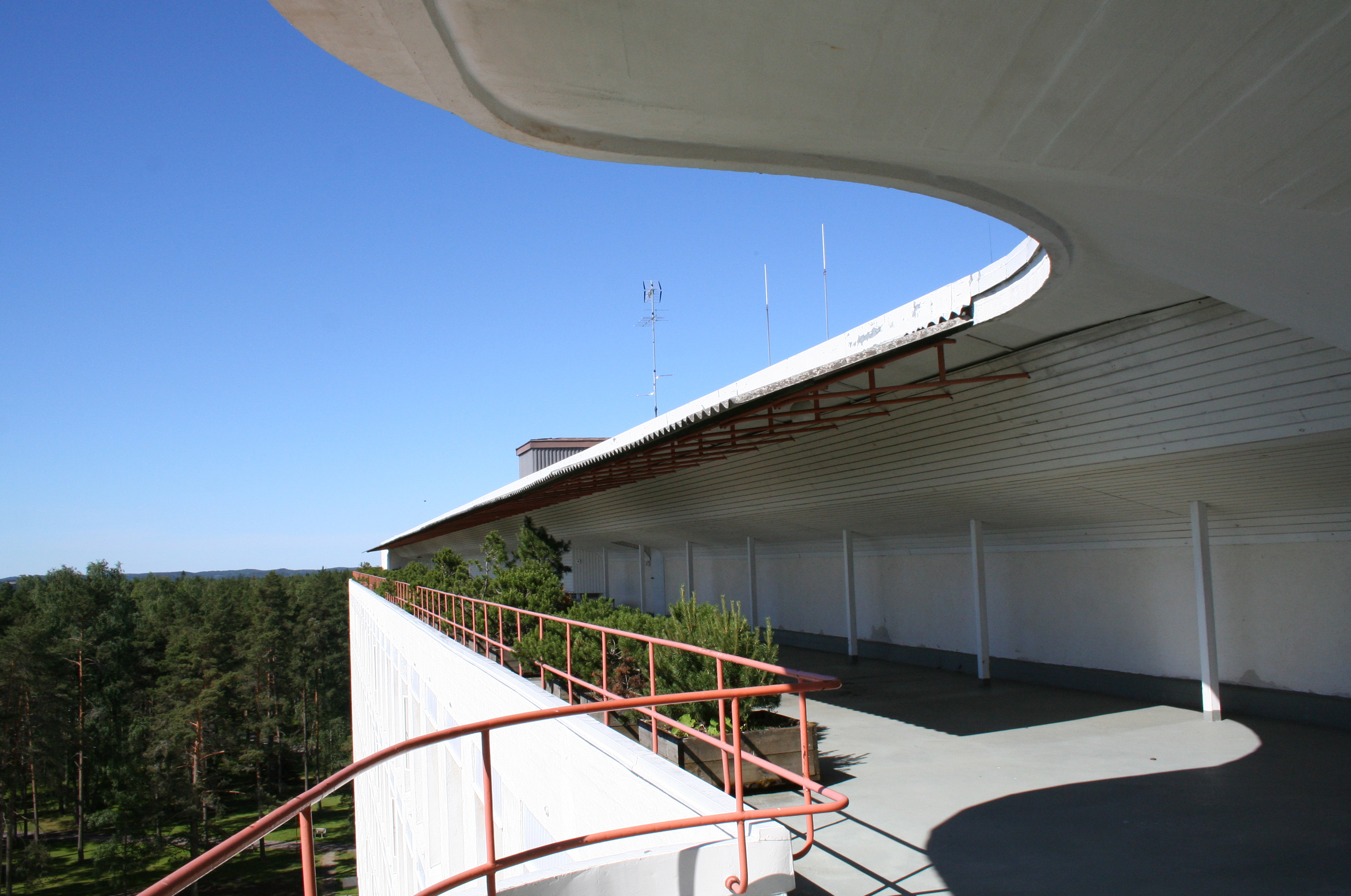
Paimio Sanatorium shows Aalto’s design method clearly: light, air, color, furniture, and detail were part of patient care, not decorative extras.
Paimio Sanatorium is the cleanest way to understand Aalto. Designed for tuberculosis patients in the early 1930s, it was not only a white modern building in the forest. It was a building shaped around recovery.
That sounds sentimental until you look at the details.
Patient rooms were treated as places where sick bodies spent long hours looking at ceilings, hearing water, needing light without glare, and breathing air that mattered. Aalto paid attention to ceiling color, washbasin noise, window position, furniture angle, outdoor terraces, and the rhythm of daily care. The building was modern because it was precise. It was humane because that precision was aimed at the patient, not at the photographer.
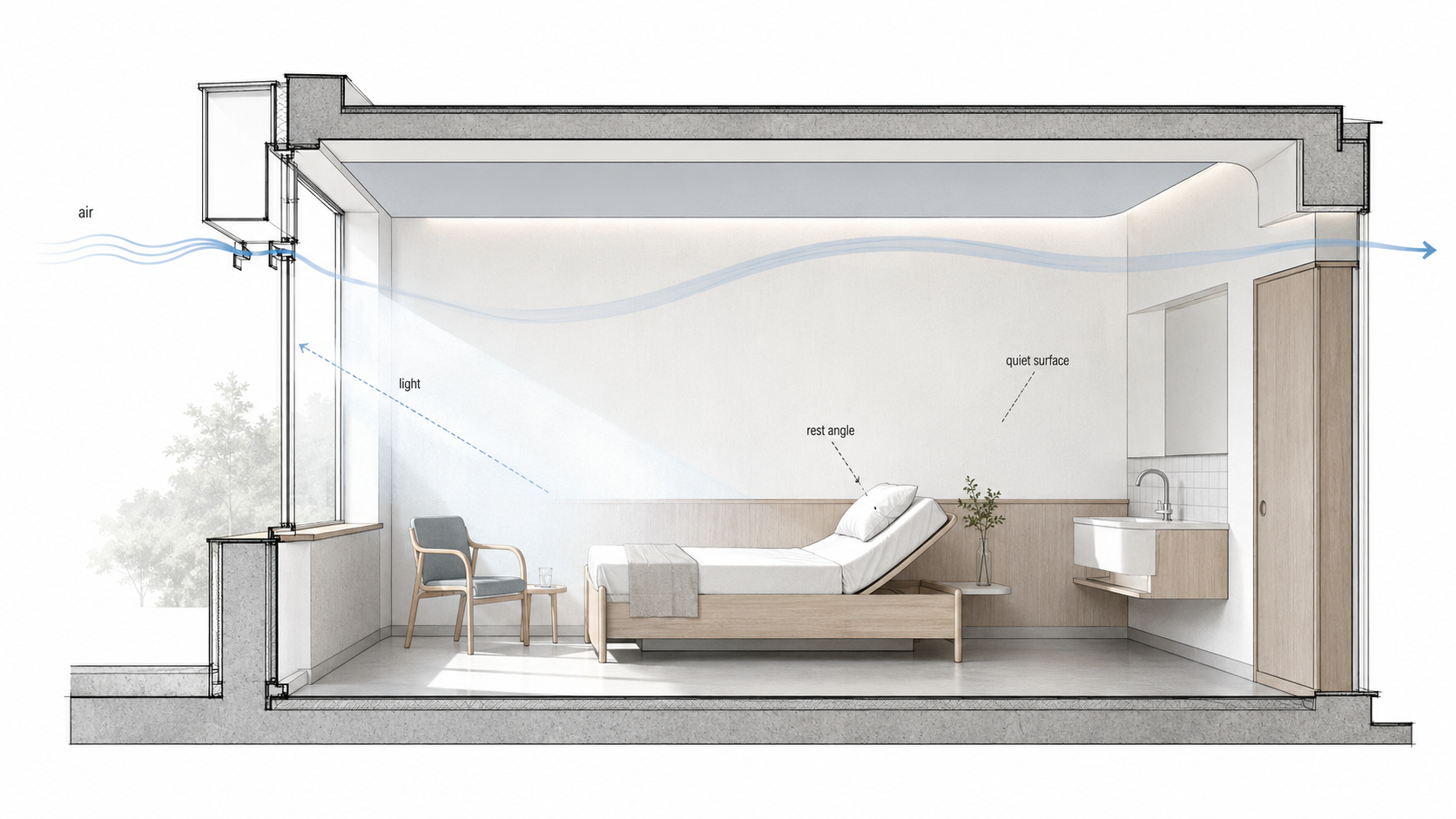
Illustration by ArchitectureCourses.org. In a Paimio-inspired room, healing is built into the section: air, light, bed angle, quiet surfaces, and simple service details all shape recovery.
This is where Aalto separates himself from cold modernism. Function did not mean a diagram with a label. Function meant asking what the body experiences after eight hours in the same room.
Paimio also explains why Aalto’s furniture cannot be treated as a side hobby. The famous Paimio Chair came from the same problem as the building: how should a recovering body sit, breathe, and rest? The chair was not a decoration placed inside architecture. It was architecture at the scale of the ribs, back, arms, and lungs.
Comfort Is a Construction Detail
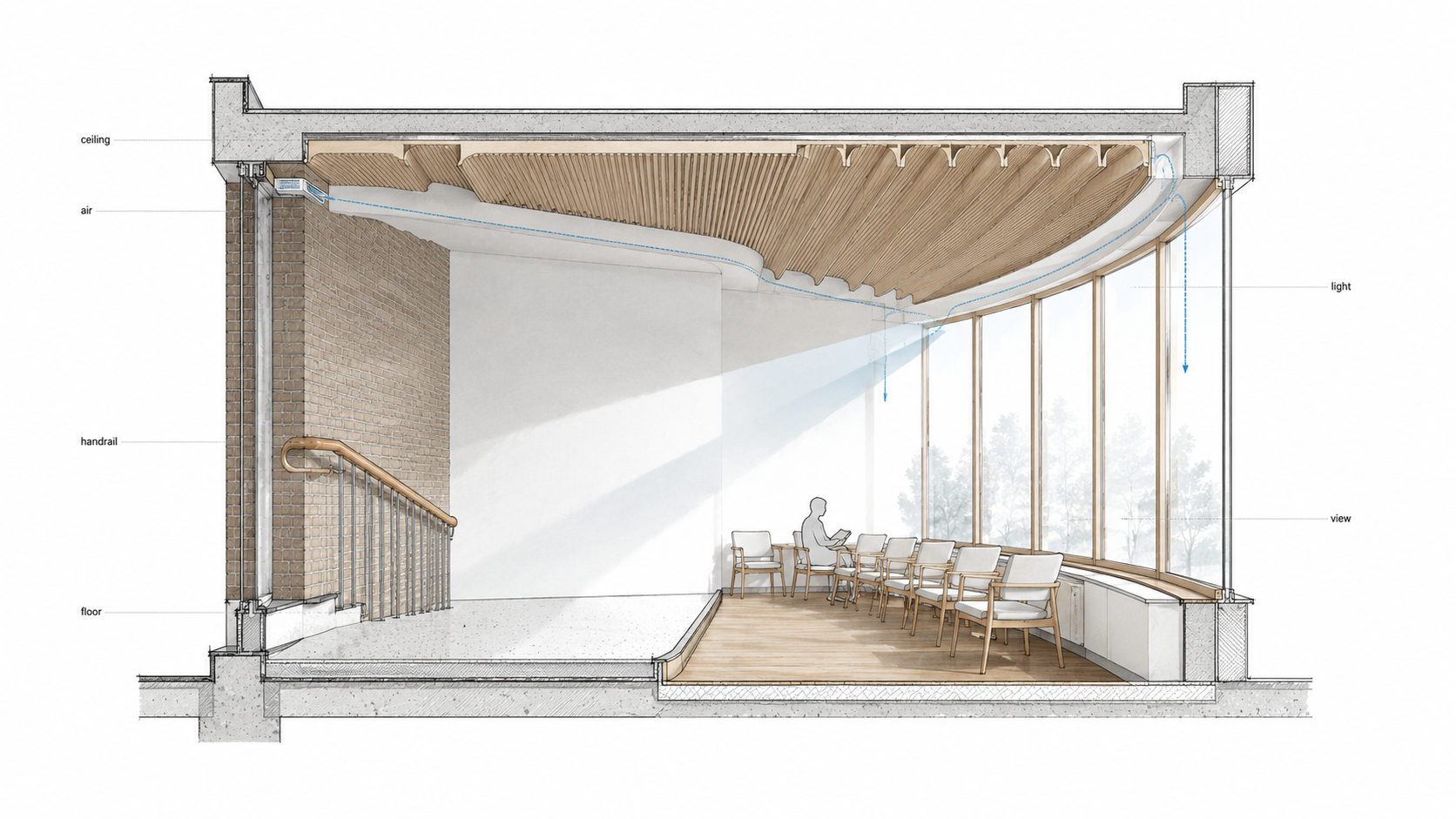
Illustration by ArchitectureCourses.org. This Aalto-inspired section shows that comfort is not a vague feeling. It is built from measurable details such as ceiling profile, daylight control, material texture, handrail shape, seated view, and air movement.
Aalto’s warmth was not mood. It was built. It came from ceiling shape, window height, wood grain, acoustic surfaces, brick texture, handrail diameter, chair angle, door weight, daylight bounce, and how a room behaved in a Finnish climate. If those details are wrong, the building can have all the curves in the world and still feel dead.
That is the useful lesson for students and designers. Do not copy Aalto by adding a wavy wall. Copying the curve is the weakest move. Ask what the curve is doing. Does it shape sound? Does it soften movement? Does it bring light deeper into the room? Does it make a public building feel less institutional? Does it help a hand, a seated body, a reader, a patient, or a person waiting in a corridor?
Aalto’s humanism was practical. It had consequences. Bad acoustics make a library tiring. Harsh glare makes a reading room fail. A cold handrail tells the body the building does not care. A chair with the wrong angle is still wrong, even if it looks beautiful in a museum.
The protective question is simple: where does the body meet the design?
Viipuri Library and the Sound of Modernism
Viipuri Library is another key Aalto project because it shows how modern architecture can serve reading, gathering, and attention. The building is famous for its skylights and undulating acoustic ceiling in the lecture hall, but those features matter because they solve real problems.
Light in a library is not only brightness. Too much glare ruins the room. Too little light makes reading difficult. Aalto used top light, controlled surfaces, and carefully shaped interiors to make modern space feel calm rather than sterile.
The ceiling is the same kind of lesson. It is visually memorable, but it is not just a sculptural flourish. It shapes sound. That is the difference between an Aalto detail and an Aalto-looking copy. One performs. The other poses.
A weak copy would keep the wavy ceiling and forget the acoustic reason. A better study asks why that shape belongs there in the first place.
The Main Aalto Moves
Aalto’s work is easy to recognize once you know the signs. The table below is useful because it separates the visible design move from the performance behind it.
| Aalto Move | What It Does Well | How Bad Copies Fail |
|---|---|---|
| Bent wood and plywood | Adds warmth, flex, lightness, and body comfort without heavy ornament | Becomes a decorative “Scandinavian” surface with no relation to use |
| Curved walls and ceilings | Shape movement, acoustics, softness, and spatial flow | Turns into random curves that complicate construction and add no comfort |
| Controlled daylight | Supports reading, healing, orientation, and calm interiors | Becomes glare because the window is treated as a style feature |
| Brick, timber, and tactile materials | Ground modern buildings in place, climate, and touch | Gets reduced to “warm materials” without detail, proportion, or craft |
| Furniture as part of architecture | Connects the building to the body at the scale of sitting, resting, and working | Treats chairs and lamps as styling after the room has already failed |
Aalto’s work rewards this kind of reading. The visible move is rarely the whole point. The detail usually has a job.
Aalto’s Furniture Was Not a Side Project

The Paimio Chair shows Aalto’s furniture thinking clearly: bent plywood, body angle, material warmth, and medical function working as one design problem.
Aalto’s furniture matters because it makes his architecture harder to fake. You cannot understand his buildings only through plans and elevations. You have to look at the objects that meet the body.
The Paimio Chair, Stool 60, Armchair 41, the Savoy Vase, and Aalto’s lighting designs all belong to the same design world as his buildings. They are simple, but not empty. They are warm, but not nostalgic. They are modern, but not cold.
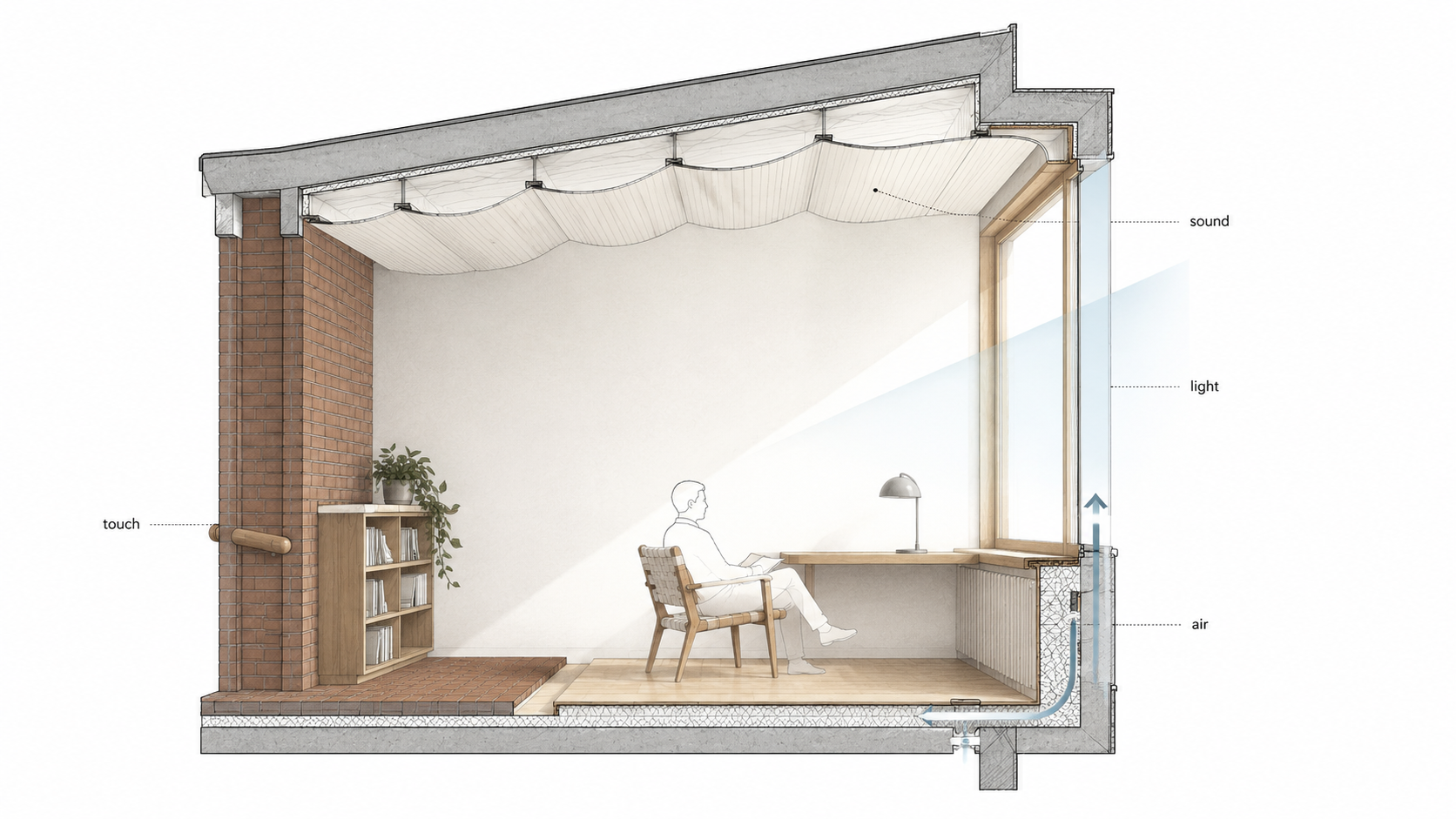
Illustration by ArchitectureCourses.org. Aalto’s human modernism worked through built details: softened acoustics, controlled daylight, warm touch surfaces, ventilation paths, seated views, and material changes that shape how a room feels.
Stool 60 is a good example because it looks almost too simple: a round seat, three bent legs, stackable, useful, and plain. The intelligence is in the L-leg and the way bent wood turns structure into a repeatable system. That is Aalto at his best. The object is ordinary enough to use every day, but the detail is doing more than it first admits.
Artek, founded in 1935 by Alvar and Aino Aalto with Maire Gullichsen and Nils-Gustav Hahl, gave that thinking a business and cultural home. The goal was not only to sell furniture. It was to bring modern art, interiors, and useful design into daily life.
The mistake is to treat Aalto furniture as tasteful décor. The better reading is tougher: furniture was how Aalto tested architecture at the scale of the body.
Aino Aalto Belongs in the Room
Aalto articles often push Aino Aalto to the edge of the story. That weakens the history.
Aino Marsio-Aalto was an architect, designer, and close collaborator in the office. She worked on interiors, furniture, glassware, exhibitions, and domestic design, and she helped shape the design culture that made Artek possible. Her work matters because Aalto’s “human modernism” was not only a heroic architectural idea. It was also an interior, domestic, material, and everyday design practice.
The home, the glass, the chair, the lamp, the room, and the building were not separate worlds. That is one reason Aalto’s work still feels less brittle than much early modernism. It had people inside it from the start.
Aalto’s Own House Explains the Method
Aalto’s house and studio in Helsinki is not his loudest work. That is why it is useful.
The house does not try to become a monument. It mixes living and working, plain surfaces and warm materials, simple massing and careful texture. It shows how Aalto handled modern architecture when the client was daily life itself.
This is where his work becomes especially relevant for students. A grand public building can hide behind scale. A house cannot. A bad corner, a cold room, a poor window, or an awkward work area appears immediately because the user meets it every day.
Aalto’s house shows restraint. It also shows control. The lesson is not to make everything curved or wooden. The lesson is to know when a small detail is enough.
Säynätsalo Town Hall and Civic Warmth
Säynätsalo Town Hall may be Aalto’s best lesson in civic architecture. It uses brick, timber, stairs, courtyard space, and careful proportions to make local government feel serious without becoming cold.
That balance is harder than it looks. Public buildings often fail in one of two directions. They either become bureaucratic and dead, or they overperform as landmarks. Säynätsalo sits in a quieter middle. It gives civic life a room, a court, a stair, a chamber, and a material weight that feels local.
The brick matters. The courtyard matters. The approach matters. This is not “warmth” as a slogan. It is a sequence of decisions that changes how authority feels.
Related reading: modern architecture gives the wider movement. Aalto is one of the best architects to study when that movement starts to feel too clean, too white, or too abstract.
How to Study Aalto Without Copying Him
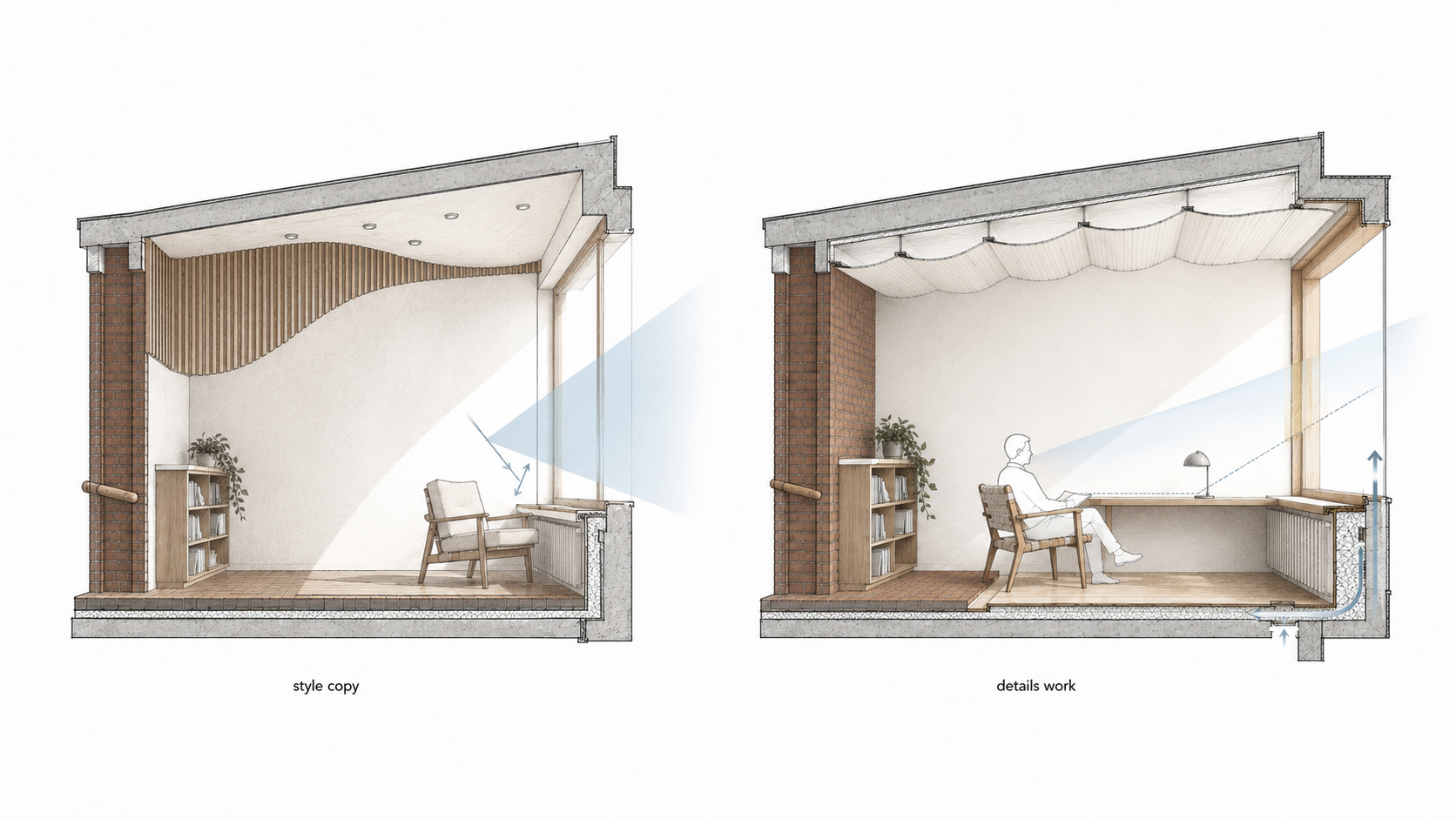
The lazy Aalto copy uses pale wood, a curved ceiling, a white wall, and a chair with soft edges. It looks gentle. It usually has no depth.
Start somewhere else.
Study one room by asking what each detail does. Where does the daylight come from? Where does glare stop? What does the ceiling do to sound? Where does the hand touch wood instead of metal? What view does a seated person get? Where does the building feel local instead of imported? Which detail helps the body, and which one is only there to look like Aalto?
This is the difference between style and method. Aalto’s method was not “add warmth.” It was to make modern design answer to human use at every scale.
The same rule applies to furniture. Do not copy the Paimio Chair by drawing a swoopy plywood shape. Ask why the back angle matters. Ask how the material bends. Ask what the chair was designed to do for a patient. The answer is where the design lives.
Eco-Design Before the Marketing Language
Aalto should not be turned into a modern sustainability mascot. That would be too easy. He worked in a different period, with different assumptions, codes, energy systems, and material economies.
Still, several parts of his work remain useful for sustainable design today: durable furniture, natural materials, daylight, repairable objects, local craft, and buildings that do not need novelty to stay valuable.
The strongest sustainability lesson is not “use wood.” Wood can be wasted too. The better lesson is to design things people keep. A chair that remains useful for decades beats a fashionable object that gets replaced in five years. A room with good daylight, good acoustics, and durable materials does not need constant cosmetic rescue.
Aalto’s work is not perfect environmental doctrine. It is a useful reminder that longevity, repair, comfort, and material intelligence belong inside the sustainability conversation.
For a broader site path, see sustainable architecture.
Books Worth Having
Aalto is best studied through buildings, drawings, furniture, and interiors together. A thin biography will miss the point if it treats the chairs as an afterthought.
Worth reading: Aalto by Robert McCarter is useful for readers who want a deeper project-based study of Aalto’s architecture and design thinking.
Also useful: Alvar Aalto: The Mark of the Hand is a better fit if you care about sketches, process, craft, and how ideas moved from hand drawing into buildings and objects.
I would use books like these for one reason: Aalto’s work loses too much when reduced to online image grids. The drawings, furniture, room sections, and project sequences matter.
Aalto Beside Other Famous Architects
Aalto belongs in the famous architects cluster, but his page should not compete with a generic “top modern architects” list. His lane is specific: human modernism, furniture, Finnish landscape, patient-centered design, and the softening of modern architecture without abandoning discipline.
Frank Lloyd Wright is a useful comparison because both architects cared about organic form, daily life, and the relationship between building and setting. Wright’s work is more tied to land, house, hearth, and horizontal space. Aalto’s is more tied to light, wood, furniture, civic interiors, and the body.
Norman Foster gives a sharper contrast. Foster’s best work explains systems, engineering, and global practice. Aalto explains human scale.
Santiago Calatrava turns structure into civic drama. Aalto usually moves in the opposite direction. He makes modern architecture less theatrical and more habitable.
For broader placement, use Most Famous Modern Architects and Top 10 Famous Architects You Need to Know as the cluster pages that send readers into this deeper Aalto profile.
FAQ
What is Alvar Aalto best known for?
Alvar Aalto is best known for human modernist architecture, bentwood furniture, Paimio Sanatorium, Viipuri Library, Säynätsalo Town Hall, Finlandia Hall, the Paimio Chair, Stool 60, and the Savoy Vase.
Was Alvar Aalto a modernist?
Yes. Aalto was a modernist, but not a cold or rigid one. He used modernist ideas while bringing in wood, brick, curves, daylight, landscape, acoustics, and human comfort.
What makes Alvar Aalto’s architecture different?
Aalto’s architecture feels different because it treats comfort as part of the design problem. Light, sound, furniture, handrails, room shape, material touch, and climate all matter.
What is Aalto’s most famous building?
Paimio Sanatorium is often the clearest introduction to his method. Viipuri Library, Säynätsalo Town Hall, Finlandia Hall, Baker House at MIT, and the Aalto House are also key works.
What furniture did Alvar Aalto design?
His best-known furniture includes the Paimio Chair, Stool 60, Armchair 41, and other bentwood pieces produced through Artek. He also designed lighting, glassware, and interiors.
Why is the Paimio Chair important?
The Paimio Chair was designed for tuberculosis patients, with attention to posture, breathing, and comfort. It shows how Aalto treated furniture as part of architecture, not decoration added at the end.
How should students study Aalto?
Study the details, not just the curves. Look at daylight, acoustics, furniture placement, material touch, window height, handrails, chair angles, and how the room feels to a body using it.