
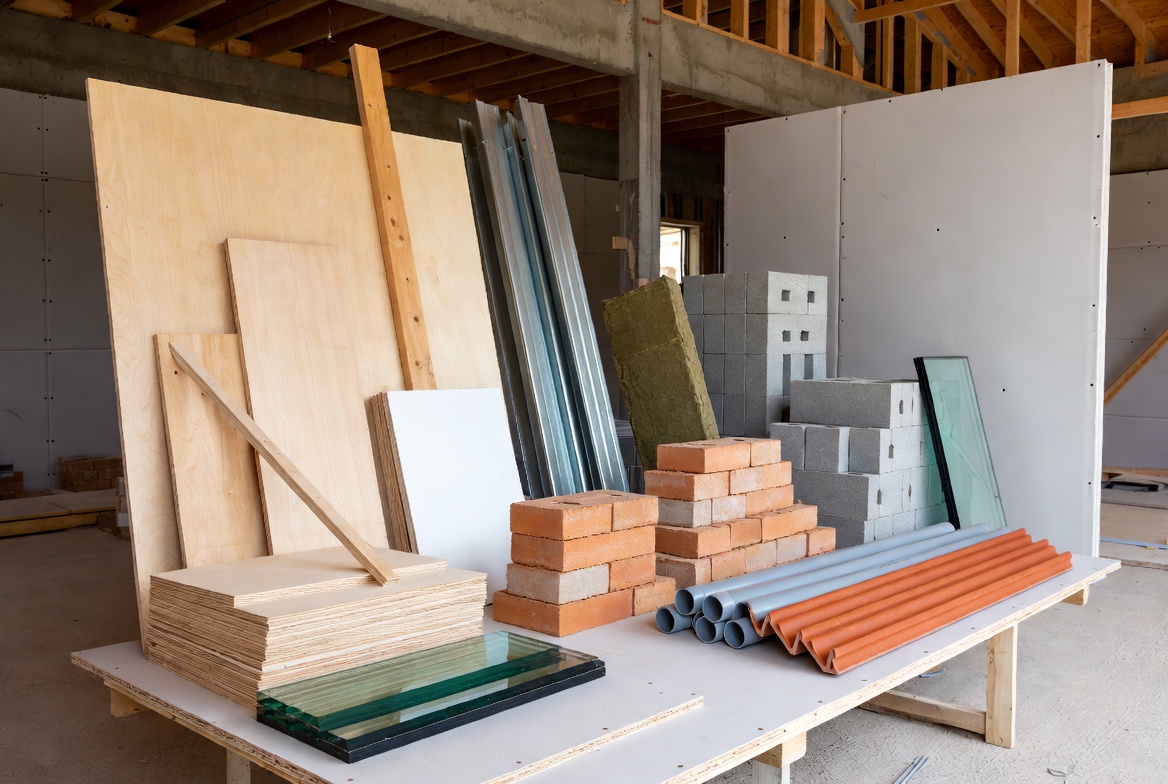
This complete list of building materials is for students, designers, and builders who need more than a glossary. Instead of dumping random names, it groups the main categories of building materials by function, shows where they are used, and explains what usually drives the right choice in real construction.
It also does one thing many pages do not admit clearly enough: it covers not just materials, but also the layers and key construction components that make those materials work. That matters. A wall is not just siding. A roof is not just shingles. A foundation is not just concrete.
Use it as a working reference. Sitework, structure, foundations, wall layers, openings, roofs, insulation, interiors, service rough-ins, lower-carbon materials, and specialty systems all show up here.
So yes, this is a list. But it is meant to be a useful one.
What This Guide Covers
- the main categories of building materials
- common material names, types, and where they are used
- how structural, enclosure, insulation, service, and finish materials differ
- the hidden layers that matter more than the visible finish
- what usually goes wrong when materials are chosen by looks or price alone
- how students, designers, and builders can narrow choices faster
You do not need 400 disconnected material terms. You need to know what each family does, where it tends to fail, and what usually drives the right choice.
The Mistake People Make First
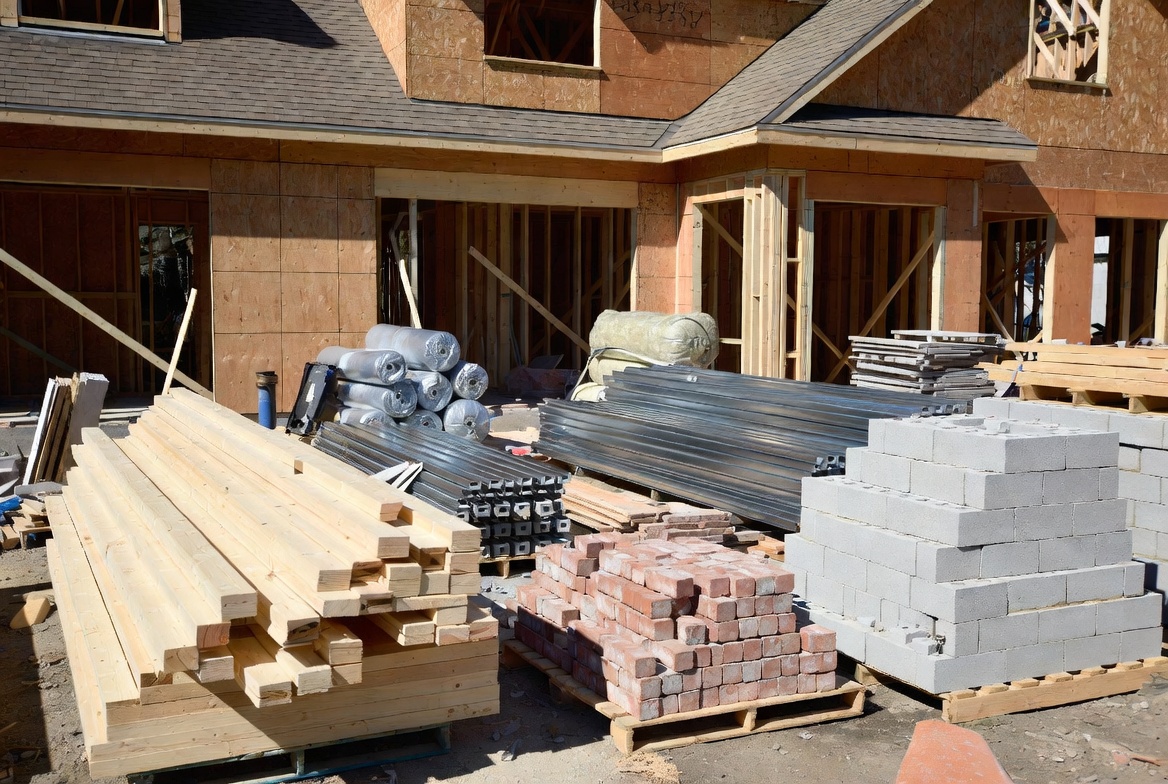
Most material decisions get framed as a beauty contest or a budget contest. On site, the order is rougher than that: structure first, water second, heat and air control next, finish last. Ignore that order and the expensive finish usually gets blamed for a failure that started behind it.
That is why the boring layers matter so much. Flashing, membranes, sealants, fasteners, sheathing, insulation layout, drainage gaps, and repair access decide whether the visible surface ages well or starts trapping trouble.
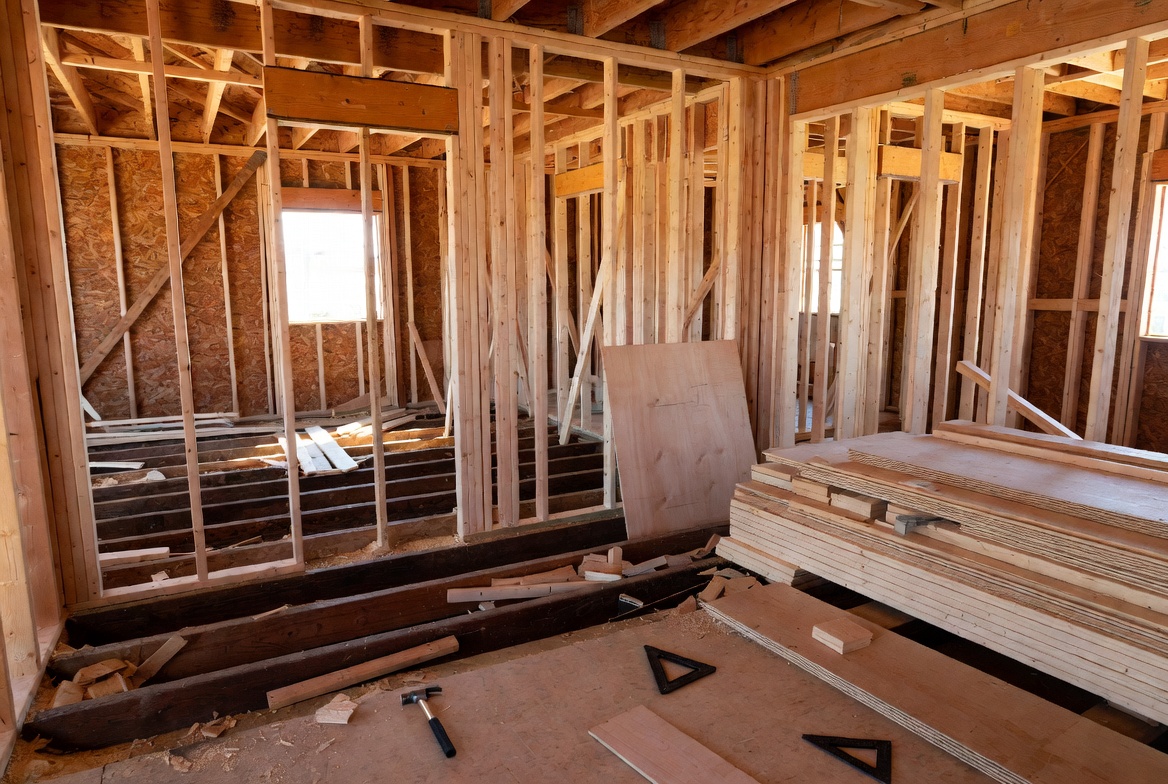
Field regret usually sounds the same. Cheap valves. Bad head flashing. No drainage behind cladding. Fancy finish, weak substrate. The visible material catches the anger later, but the hidden layer usually started the problem.
How to Think About Building Materials
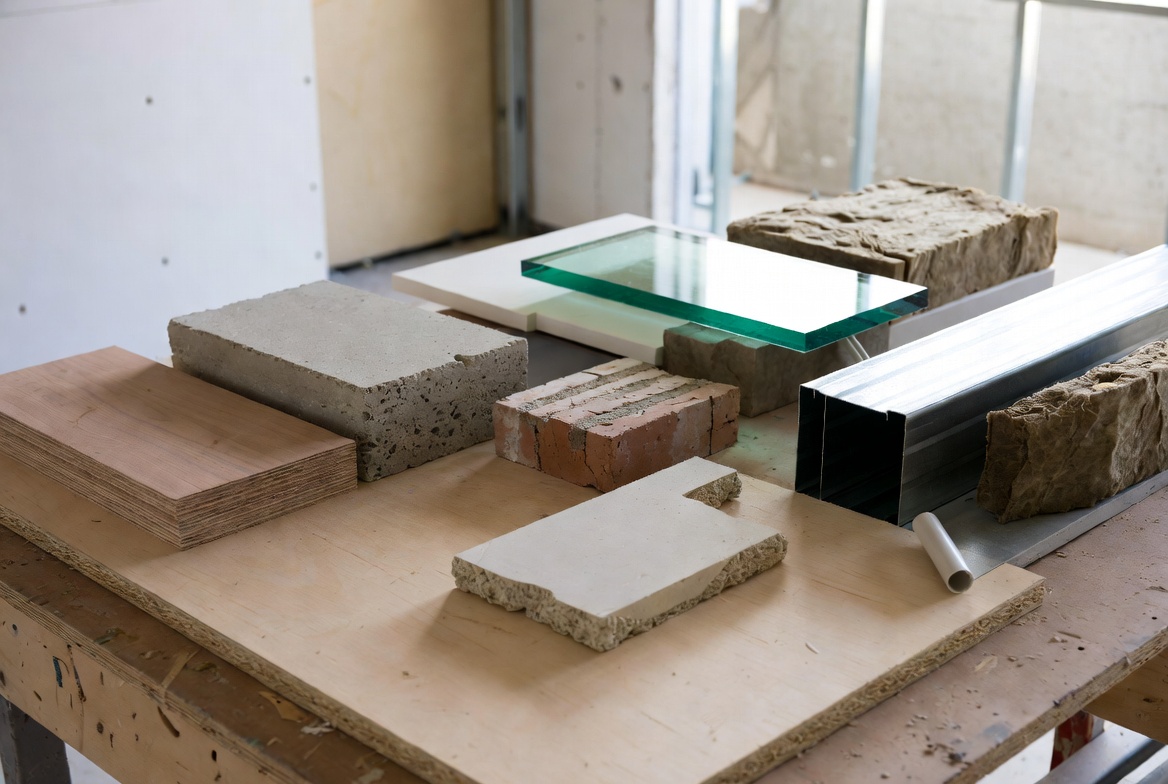
| Part of the building | Main material families | What drives the choice |
|---|---|---|
| Sitework and subgrade | fill, gravel, drainage stone, sand, geotextiles, erosion-control products | soil, drainage, frost, compaction, site conditions |
| Structure and foundation | concrete, steel, timber, masonry | loads, spans, soil, fire, schedule, crew skill |
| Wall assembly and openings | sheathing, membranes, flashing, windows, doors, sealants | water control, air control, sequencing, repairability |
| Exterior skin | brick, stone, stucco, metal, fiber cement, wood, vinyl | rain exposure, movement, maintenance, repairability |
| Roof finish and roof support layers | asphalt, metal, membrane, tile, slate, underlayments, flashings | slope, climate, service life, detailing quality |
| Thermal and control layers | fiberglass, mineral wool, cellulose, foam, panels, membranes | R-value, drying potential, air sealing, fire, moisture |
| Interior build-out and finishes | drywall, plaster, tile, wood, stone, resilient finishes, ceilings | wear, cleaning, acoustics, moisture, replacement cost |
| Service rough-in materials and components | pipe, wire, boxes, conduit, ducts, vents, supports | code, access, durability, coordination, serviceability |
| Low-carbon and natural materials | hempcrete, rammed earth, bamboo, reclaimed products, natural insulation | code path, sourcing, labor familiarity, long-term performance |
| Specialty and emerging materials | GFRC, UHPC, advanced composites, smart glass, high-performance envelope products | testing history, availability, repair path, code acceptance |
| Exterior works and drainage | pavers, flatwork, gutters, downspouts, drains, guardrails, decking | runoff, freeze-thaw, slip resistance, maintenance, replacement |
A good material choice is rarely about one property. It is about how the whole assembly behaves over time.
Sitework and Subgrade Materials
What they do. These materials prepare the ground before the visible building even starts. They stabilize soil, move water, reduce settlement risk, and create the base that everything else depends on.
What people get wrong. They treat site materials like background cost. Then drainage fails, slabs move, paving settles, or frost starts lifting things that should have stayed quiet.
Common Sitework and Subgrade Material Types and Uses
- Engineered fill — controlled backfill and structural ground buildup
- Granular base — base layer under slabs, footings, pavements, and walks
- Crushed stone — drainage layers, base material, and capillary breaks
- Drainage stone — perimeter drains, retaining walls, and subgrade water relief
- Sand — leveling beds, paver bases, and some utility bedding
- Geotextile fabric — soil separation, stabilization, and drainage support
- Geogrids — reinforcing weak subgrades under pads, drives, and paved areas
- Erosion-control blanket — slope protection and temporary site stabilization
- Silt fence — temporary sediment control during construction
Structural and Foundation Materials
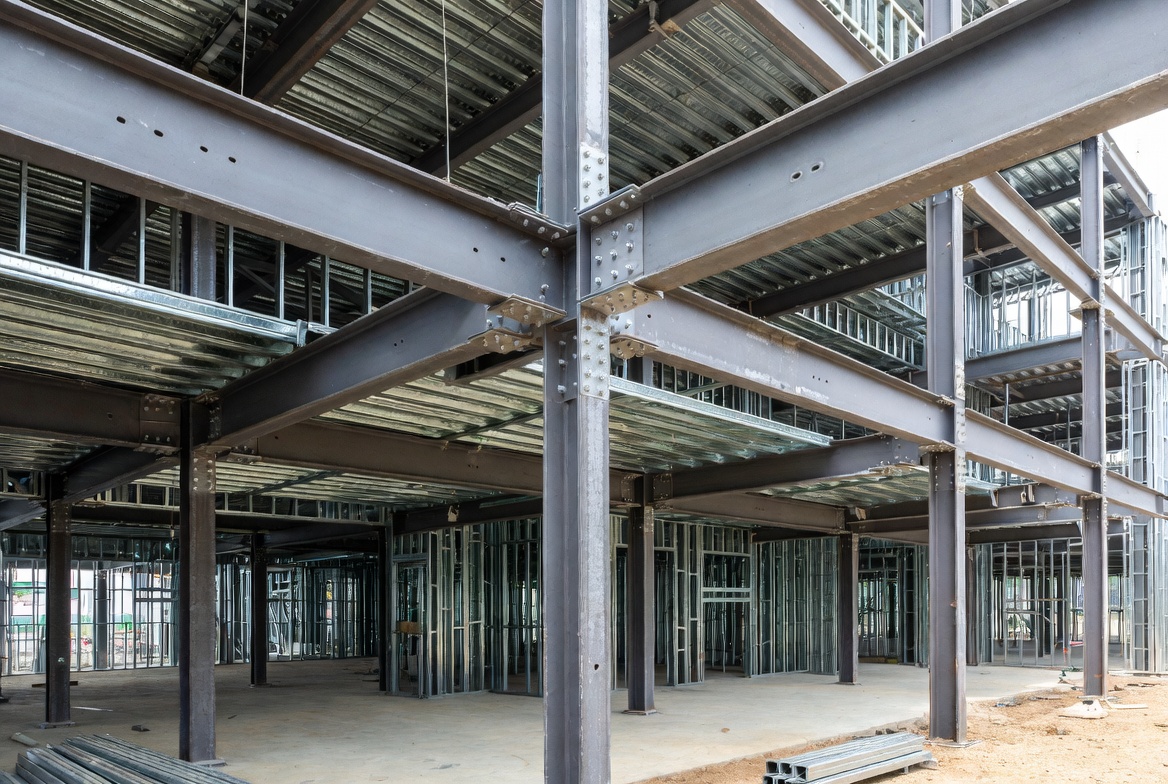
What they do. Structural materials carry load, control span, set wall thickness, shape openings, and often determine the entire construction sequence.
- Concrete is common in foundations, slabs, retaining walls, cores, and heavy structural work. It is strong in compression, durable when detailed well, and useful where mass matters.
- Steel works well when long spans, slender profiles, or fast dry assembly matter. It is powerful, but fire protection, corrosion strategy, and connection detailing do not take care of themselves.
- Timber and engineered wood are lighter, faster, and easier to work with on many low- and mid-rise projects. They reward good moisture discipline and punish sloppy weather exposure.
- Masonry gives mass, fire resistance, and durability, but it is heavy and labor-dependent, and it changes how the rest of the enclosure has to be built.
What people get wrong. They compare these materials like they are simple substitutes. They are not. A timber project changes connection logic, vibration behavior, fire strategy, and drying risk. A concrete project changes curing time, wet-trade coordination, structural weight, and finish tolerance.
Different structure, different consequences. That part gets missed all the time.
Common Structural Material Types and Uses
- Plain concrete — slabs, footings, sidewalks, and mass foundations
- Reinforced concrete — beams, columns, walls, suspended slabs, and heavy foundations
- Precast concrete — wall panels, floor planks, stairs, facade panels, and modular structural components
- Concrete block — foundation walls, service spaces, and some structural wall systems
- Structural steel — frames, long spans, industrial buildings, and commercial structures
- Cold-formed steel — light framing, studs, noncombustible partitions, and some exterior wall systems
- Light wood framing — most low-rise residential walls, floors, and roofs
- Engineered wood — longer spans, floor systems, beams, and roof members
- Cross-laminated timber — floor plates, walls, and mid-rise mass-timber systems
- Brick masonry — some structural walls, infill, and durable exterior assemblies
- Stone masonry — specialty structural work, retaining walls, and heavy-load traditional construction
Common Foundation Materials, Layers, and Key Components
- Formwork panels — shaping poured footings, walls, piers, and slabs
- Rebar and mesh — tensile reinforcement in foundations and slabs
- Anchor bolts and hold-downs — connecting structure to concrete foundations
- Vapor retarder — moisture control below interior slabs
- Capillary break stone — limiting moisture migration below slabs and footings
- Drainage board — relieving water pressure at below-grade walls
- Footing drain pipe — carrying groundwater away from foundations
- Protection board — protecting below-grade waterproofing from damage during backfill
- Foundation waterproofing membranes — exterior moisture protection for basements and retaining walls
- Sump pit and pump assembly components — collecting and discharging subgrade water
Go deeper with our structural materials guide and this foundation breakdown.
Wall Assembly, Sheathing, and Openings Materials
What they do. These are the layers between structure and finish. They brace walls, manage air and water, support cladding, and make windows and doors work without turning into leak points.
What people get wrong. They think “wall material” means siding or brick. Not even close. Most enclosure failures begin at sheathing joints, sill details, bad tapes, weak flashing, wrong sealants, or sloppy opening installation.
Common Wall Assembly Material Types and Uses
- OSB sheathing — structural wall and roof sheathing in framed construction
- Plywood sheathing — structural sheathing where higher moisture tolerance or stiffness is wanted
- Gypsum sheathing — noncombustible exterior sheathing in many commercial wall systems
- Housewrap — water-resistive barrier behind cladding
- Liquid-applied WRB — continuous water and air control on complex wall surfaces
- Flashing tape — sealing joints and opening transitions
- Liquid flashing — sealing rough openings, penetrations, and hard-to-tape transitions
- Rainscreen battens — drainage and ventilation gap behind cladding
- Backer rod and sealant — movement joints and perimeter sealing
- Firestopping products — maintaining rated assemblies at penetrations and joints
Common Openings Material Types and Uses
- Vinyl windows — cost-driven residential window systems
- Wood windows — higher-end or traditional window systems
- Aluminum windows — durable commercial and contemporary window frames
- Fiberglass windows — dimensionally stable window systems with good thermal performance
- Exterior fiberglass doors — durable insulated entry doors
- Steel doors — security, service, and commercial exterior openings
- Wood doors — traditional entry systems and architectural interiors
- Sill pans — drainage at window and door openings
- Drip cap and head flashing — shedding water over openings
- Shims and low-expansion foam — setting and insulating window and door frames
- Weatherstripping — air and water control at operable openings
- Thresholds and door sweeps — bottom-edge weather protection
Exterior Cladding and Roofing Materials
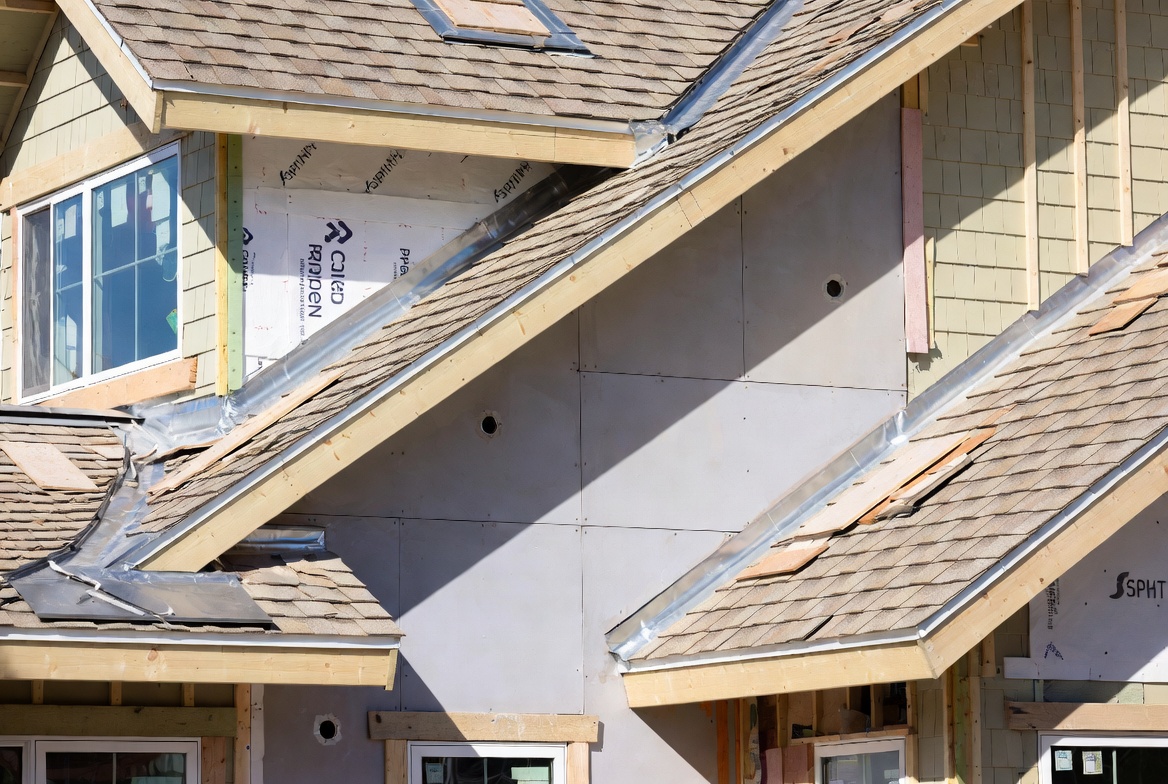
What they do. These materials take the weather hit. They manage rain, sunlight, temperature swings, movement, and aging in public view. They also shape the building’s character more than almost any other visible layer.
Common cladding families include brick veneer, stone, stucco, fiber cement, metal panels, timber cladding, and vinyl. Common roof families include asphalt shingles, metal roofing, membrane roofs, tile, and slate.
What matters most here. Not just appearance. Water management. Expansion and contraction. UV exposure. Service life. Ease of patching. Whether the assembly behind the finish can dry when water gets in, because at some point it will.
What people get wrong. They spend too much time comparing the face material and not enough time checking the boring parts around it. Bad head flashing, weak kick-out details, no drainage plane, no vented gap where one is needed, short-lived sealants, wrong fasteners, or cladding run too close to grade will do more damage than the finish brochure ever mentions.
Common Exterior Cladding Material Types and Uses
- Brick veneer — durable exterior skin over framed or backup walls
- Natural stone — premium cladding, base courses, and high-wear exterior areas
- Manufactured stone veneer — lighter decorative wall finishes where full-depth stone is not practical
- Stucco — continuous wall finish for dry and mixed climates when drainage details are correct
- Fiber cement siding — low-maintenance residential cladding with good fire performance
- Metal panels — rainscreen facades, commercial exteriors, and modern wall systems
- Aluminum composite panels — lightweight facade systems and clean-lined commercial skins
- Wood cladding — warm exterior finish with higher maintenance demands
- Engineered wood siding — wood-look cladding with more controlled manufacturing
- Vinyl siding — low-cost residential cladding where budget is driving the decision
- Terracotta panels — ventilated facade systems and specialty exterior skins
- Curtain wall framing and glazing systems — commercial exterior enclosures where daylight and appearance drive design
Common Roofing Material Types and Uses
- Three-tab asphalt shingles — budget sloped residential roofs
- Architectural asphalt shingles — standard pitched residential roofs with better thickness and appearance
- Wood shingles — traditional roof finish in climate-appropriate assemblies
- Wood shakes — thicker rustic roof finish with higher maintenance needs
- Standing seam metal — long-life roofing for steep or low-slope applications
- Corrugated metal roofing — agricultural, utility, and some residential roof systems
- EPDM membranes — low-slope and flat roof assemblies
- TPO membranes — commercial low-slope roofs with reflective welded seams
- PVC membranes — low-slope roofs where chemical resistance or welded detailing matters
- Modified bitumen — durable low-slope roofing with layered sheet systems
- Built-up roofing — traditional multi-ply low-slope roof assemblies
- Clay tile — long-life sloped roofs in appropriate climates and structures
- Concrete tile — heavy but durable roofing where the structure can carry the load
- Natural slate — premium long-service-life roofing
- Synthetic slate or synthetic shake — lighter alternatives where appearance matters more than original material
Common Roofing Support Materials and Accessories
- Roof sheathing panels — structural deck under roofing
- Roof underlayment — secondary water-shedding layer below shingles or panels
- Ice-and-water membrane — vulnerable eaves, valleys, penetrations, and cold-climate roof zones
- Drip edge — protecting roof edges and directing runoff
- Starter strips — first-course support at asphalt shingle edges
- Valley metal — drainage at roof valleys
- Step flashing — sidewall and roof-to-wall transitions
- Counterflashing — covering and protecting stepped flashing systems
- Pipe boots and vent flashings — sealing penetrations through roofs
- Ridge vent materials — exhausting attic heat and moisture
- Soffit vent materials — low intake ventilation at eaves
- Closure strips and seal tapes — sealing corrugated or profiled metal roofing edges
- Snow guard accessories — controlling roof snow slide on metal and slate roofs
- Roof fasteners — manufacturer-specific attachment of shingles, membranes, and metal panels
If you are comparing roof skins or wall skins, start with this roofing guide and these wall-sheathing details.
Insulation and Control-Layer Materials
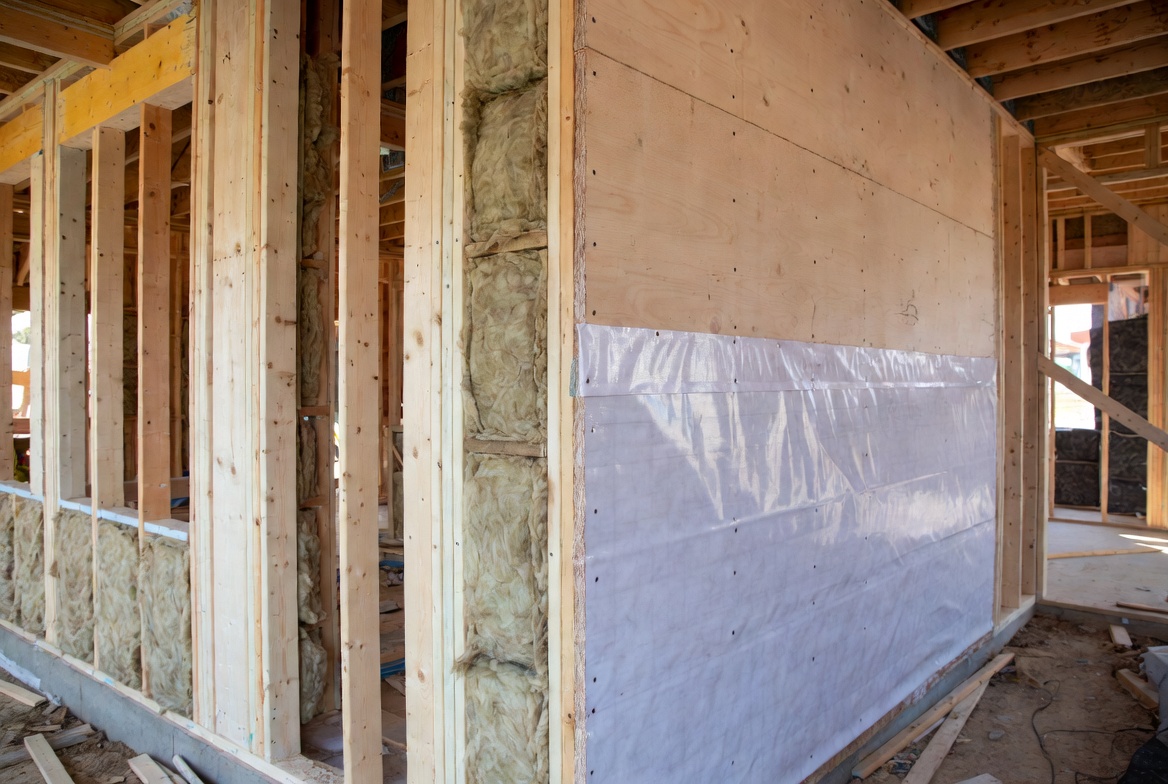
What they do. These are the materials that quietly decide comfort, condensation risk, energy demand, sound control, and often durability. They are not glamorous, but they are where a lot of real performance lives.
- Fiberglass and cellulose are common cavity-fill options. They can work well, but they depend heavily on good air sealing and correct installation.
- Mineral wool earns attention for fire resistance, sound control, and moisture tolerance.
- Rigid foam boards can help with continuous insulation and thermal bridging, but they need assembly-specific detailing.
- Spray foam can seal aggressively and insulate well, but it changes drying behavior and future access for repairs.
- Membranes and air barriers are not optional background noise. They are part of the system.
What people get wrong. They ask which insulation is “best” without asking for which wall, which roof, which climate, and which drying path. The better question is whether the whole assembly can manage heat, air, and moisture without trapping a future problem.
Common Insulation and Control-Layer Material Types and Uses
- Fiberglass batts — wall, floor, and roof cavities in budget-conscious assemblies
- Blown cellulose — attics and dense-packed framed cavities
- Mineral wool batts — walls and floors needing better fire or sound performance
- Rigid EPS, XPS, or polyiso boards — continuous insulation on walls, roofs, and foundations
- Closed-cell spray foam — air sealing and high-R-value applications with tighter moisture constraints
- Open-cell spray foam — interior air sealing where drying behavior is acceptable
- Housewraps and WRBs — water-resistive layers behind exterior cladding
- Air barriers and membranes — control of air leakage across walls and roofs
- Vapor retarders — moisture diffusion control in climate-specific assemblies
For deeper comparisons, see the full insulation guide and this practical look at sustainable insulation.
Interior Build-Out and Finish Materials
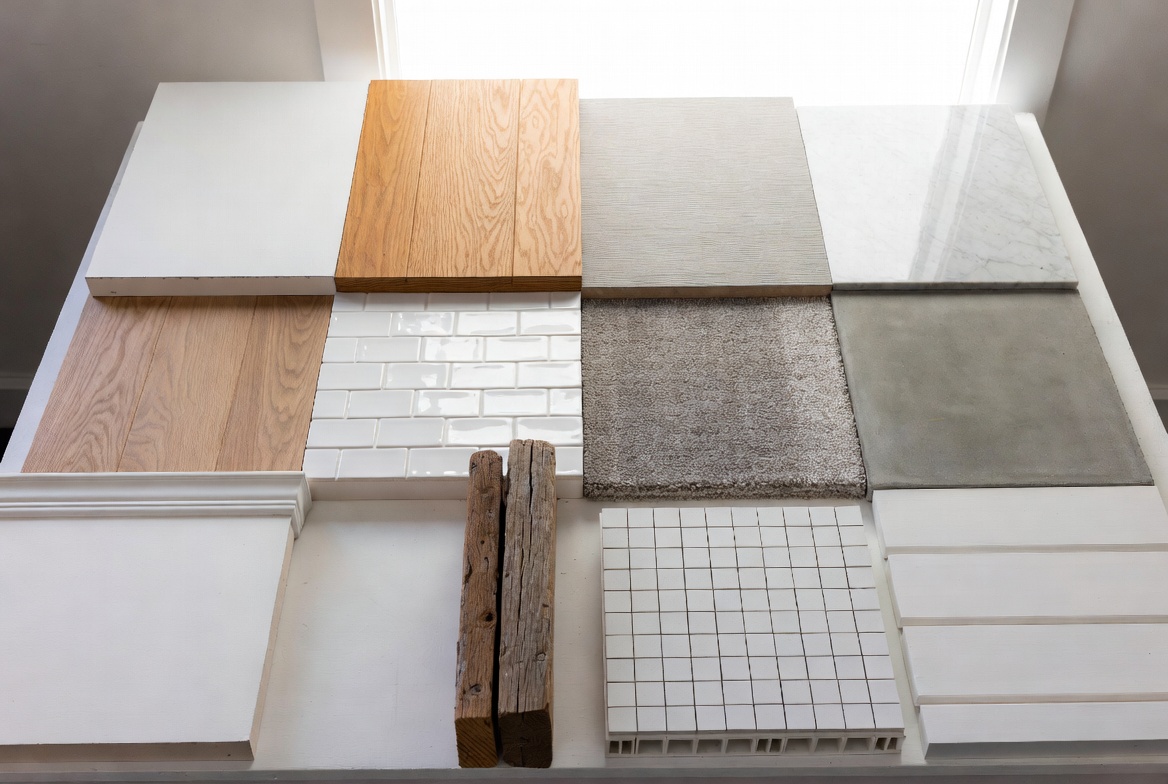
What they do. Interior materials handle layout, backing, service coordination, wear, cleaning, moisture, acoustics, repair frequency, and how a room feels in use. This is where clients often focus first, but it should come after the assembly logic is settled.
What people get wrong. They over-spec the visible surface and under-spec the substrate, backing, moisture control, or movement allowance beneath it. That is how finishes crack, curl, stain, or debond while everyone blames the “material” itself.
Common Interior Build-Out Material Types and Uses
- Interior wood studs — non-load-bearing partitions and room layout
- Light-gauge metal studs — noncombustible partitions and commercial interiors
- Blocking and backing — support behind cabinets, rails, screens, accessories, and trim
- Pocket-door frames — sliding-door cavity systems inside partitions
- Access panels — maintenance openings for service shutoffs, valves, and equipment
- Corner bead — protecting outside drywall corners
- Joint tape and compound — finishing drywall joints and fastener heads
- Control joints — movement accommodation in larger drywall and plaster surfaces
Common Interior Finish Material Types and Uses
- Drywall — standard walls and ceilings in most residential and commercial interiors
- Moisture-resistant board — bathrooms, laundry areas, and damp interior zones
- Cement board — tile backer in showers, tub surrounds, and wet areas
- Plaster — harder wall finish, restoration work, and higher-end traditional interiors
- Veneer plaster — smoother harder finish over gypsum base systems
- Ceramic tile — bathrooms, backsplashes, utility walls, and moderate-wear floors
- Porcelain tile — higher-wear floors, wet areas, and tougher interior surfaces
- Mosaic tile — shower floors, feature walls, and detailed finish zones
- Terrazzo — durable commercial floors, schools, corridors, and lobbies
- Hardwood flooring — living areas, bedrooms, and spaces where refinishing matters
- Engineered wood flooring — more dimensionally stable wood finish in mixed conditions
- Laminate flooring — budget-conscious dry interior floors
- Luxury vinyl plank or tile — rental units, utility spaces, basements, and moisture-prone rooms
- Sheet vinyl — healthcare, utility, and easy-clean interior floors
- Rubber flooring — gyms, schools, play areas, and high-impact interiors
- Linoleum — resilient lower-impact flooring in some institutional interiors
- Carpet tile — offices and replaceable soft-floor commercial interiors
- Broadloom carpet — bedrooms, hospitality interiors, and quieter soft-floor rooms
- Natural stone — premium flooring, walls, vanities, and detail surfaces
- Quartz surfacing — vanities, counters, and durable engineered finish surfaces
- Solid-surface counters — repairable sinks, vanity tops, and healthcare surfaces
- Plastic laminate — cabinets, counters, and budget-conscious millwork faces
- Wood veneer panels — warm wall finishes and millwork faces
- Paint and primer systems — final wall, ceiling, trim, and door finishes
- Baseboard, casing, and trim — transition, protection, and finish detailing
- Acoustic ceiling tiles — offices, classrooms, and serviceable ceiling grids
- Acoustic wall panels — rooms where echo control and speech clarity matter
- Suspended ceiling grid systems — accessible service ceilings in commercial interiors
For stone and finish-specific reading, see our granite breakdown and this guide to interior materials and textiles.
Service Rough-In Materials and Components
What they do. These materials and components make the building livable. Water in. Waste out. Air moving. Power distributed. Fixtures only work because the rough-in behind them was chosen and coordinated properly.
What people get wrong. They talk about fixtures and forget the support system. Cheap valves, bad vent routing, undersized conduit paths, inaccessible junctions, weak duct transitions, and poor service access cause real pain later.
Common Plumbing Material and Component Types
- PEX pipe — domestic water distribution in many residential projects
- Copper pipe — domestic water lines and some longer-service installations
- PVC pipe — drain, waste, vent, and some site piping
- ABS pipe — drain, waste, and vent systems in some jurisdictions
- Cast-iron pipe — quieter and heavier drain systems in some residential and commercial work
- Valves and shutoffs — fixture isolation, service control, and maintenance access
- Manifolds — organized water distribution in some PEX systems
- Pipe insulation — freeze protection, sound reduction, and energy control
Common Electrical Material and Component Types
- NM cable — standard residential branch wiring
- Armored cable — protected wiring in some residential and commercial interiors
- Conduit — wire protection and replaceable pathways
- Electrical boxes — device, splice, and fixture termination points
- Panels and breakers — service distribution and circuit protection
- Nail plates — protecting wiring and piping near framing faces
- Device rings and cover plates — finishing and protecting electrical terminations
Common HVAC Material and Component Types
- Sheet-metal duct — supply and return air distribution
- Flexible duct — short branch runs where allowed and properly installed
- Duct insulation — thermal control and condensation reduction
- Bath fan ducting — moisture exhaust from bathrooms
- Dryer vent ducting — lint-safe exhaust routing
- Refrigerant lines — heat pump and split-system connections
- Condensate drain components — removing moisture from cooling equipment
- Equipment vibration pads and supports — reducing movement and noise transmission
Low-Carbon and Natural Materials

What they do. These materials try to reduce environmental impact, improve indoor conditions, lower embodied carbon, support renewability, or make better use of reclaimed and recycled resources.
This group includes reclaimed timber, recycled-content products, bamboo, hemp-based materials, rammed earth, low-carbon concrete alternatives, natural insulation, and other low-impact assemblies.
What matters most. Performance first, story second. A material is not automatically smart because it sounds green. The real questions are harder: Is it code-viable here? Does the local labor force know it? Is supply reliable? Can it be repaired? What does it replace? What new detailing does it require? What happens after ten or twenty years, not just opening day?
What people get wrong. They treat “sustainable” like a style. It is not. It is a set of trade-offs around durability, carbon, toxicity, maintenance, transport, reuse, and service life. Sometimes the greenest move is not a new miracle product. It is using fewer materials, using durable materials well, or choosing assemblies that can be repaired instead of torn apart.
Common Low-Carbon and Natural Material Types and Uses
- Reclaimed timber — flooring, finish carpentry, beams, and reuse-driven projects
- Recycled steel — structural frames and components with lower virgin-material demand
- Bamboo — flooring, panels, finish materials, and some structural uses in appropriate systems
- Hempcrete — non-load-bearing wall and insulation applications
- Rammed earth — high-mass walls in climate- and code-appropriate projects
- Wood fiber insulation — breathable insulation layers in lower-carbon envelope systems
- Cork — flooring, insulation, and acoustic layers
- Cellulose insulation — recycled-paper insulation for attics and wall cavities
- Natural lime plasters — breathable wall finishes in restoration and lower-toxicity interiors
For that cluster, start with our sustainable materials hub and this natural materials guide.
Specialty and Emerging Materials
What they do. These materials usually solve narrower problems: lighter panels, unusual spans, higher-performance envelopes, sensor-driven behavior, custom facades, or experimental low-carbon systems.
That may include advanced composites, GFRC, translucent concrete, parametric facade systems, and adaptive or smart materials. Some are genuinely useful. Some are still more conference slide than jobsite standard.
What matters most. Availability, testing history, repair path, replacement cost, code acceptance, and whether your contractor team has actually installed anything like it before.
What people get wrong. They confuse novelty with performance. A new material is only helpful if it solves a real problem better than a simpler assembly already can.
Common Specialty and Emerging Material Types and Uses
- GFRC — lightweight facade panels, trims, and shaped exterior elements
- GFRP — corrosion-resistant reinforcing and specialty structural components
- UHPC — thin structural or facade elements needing high strength and tighter tolerances
- AAC panels and blocks — lightweight wall systems and some low-load assemblies
- Translucent concrete — feature walls and specialty daylight applications
- Advanced fiber-reinforced composites — lightweight panels, reinforcement systems, and specialty spans
- ETFE systems — lightweight roof and facade enclosures in specialized projects
- Aerogel insulation products — thin high-performance thermal assemblies
- Phase-change materials — thermal moderation in higher-performance envelope systems
- Smart glass — dynamic solar control in facade and glazing systems
- Electrochromic glazing — tint-changing glass for daylight and heat management
- Carbon-fiber reinforcement — retrofit and specialty strengthening work
- Photovoltaic facade or roof-integrated products — assemblies combining enclosure and energy generation
If you want the forward-looking side of this topic, see our piece on metamaterials.
Exterior Works, Drainage, and Final Site Materials
What they do. These are the materials that finish the building’s relationship to the ground and weather. They deal with runoff, walking surfaces, edge protection, decks, stairs, and the exterior pieces that get abused every season.
What people get wrong. They spend heavily on the facade and then get cheap or vague at the ground line. That usually ends with splashback, icing, movement, trip hazards, rot, or early maintenance trouble.
Common Exterior Works Material Types and Uses
- Concrete flatwork — walks, pads, exterior stairs, and service surfaces
- Precast pavers — patios, paths, plazas, and replaceable hardscape surfaces
- Natural stone pavers — premium site surfaces and landscape transitions
- Asphalt paving — drives, parking, and larger vehicle surfaces
- Deck framing lumber — exterior deck structure
- Composite decking — lower-maintenance deck surfacing
- Pressure-treated wood decking — budget-conscious deck surfaces
- Metal guard and handrail components — stair and edge safety
- Gutters and downspouts — collecting and moving roof runoff
- Splash blocks and downspout extensions — keeping discharge away from foundations
- Channel drains and catch basins — surface water collection and redirection
- Exterior sealants and joint fillers — movement control in exposed hardscape and site joints
The Decision Rules That Save the Most Pain
Start with climate. Wet, hot, cold, mixed, coastal, freeze-thaw, wildfire, hail, and high-UV regions do not forgive the same mistakes. A material that behaves well in one region can become a maintenance trap somewhere else.
Decide what must stay dry. This sounds obvious, but it is where many assemblies live or die. Water management is usually more urgent than style arguments. If the assembly cannot shed water, drain, dry, and survive incidental wetting, the finish choice is already on borrowed time.
Check assembly compatibility. Good materials can fail when paired badly. Vapor profile, thermal bridging, movement rates, fastener corrosion, substrate flatness, and sealant compatibility matter more than brochure language.
Think about labor, not just material. Some materials are forgiving. Some demand a sharp crew and tight sequencing. A “better” material installed badly becomes the expensive mistake.
Use life-cycle cost, not sticker price. Initial cost matters, but so do service life, cleaning, repair access, replacement intervals, energy use, and how disruptive future failures will be.
Choose repairable assemblies when you can. Buildings age. Access matters. Mechanical fasteners, replaceable components, and standard dimensions usually age better than sealed-up systems that force demolition for a small repair.
The Detail People Miss
Most failures do not start with the material people photograph. They start at the joint, the edge, the penetration, the transition, or the maintenance decision nobody wanted to pay for.
So when you compare materials, always ask these six questions:
- What is the water-control strategy?
- How does this assembly dry?
- What moves, and where does that movement go?
- What is the expected maintenance cycle?
- Can a damaged part be repaired without tearing apart half the wall?
- Who on the actual crew knows how to install it well?
Not glamorous. Still important.
Most of the money gets saved right there.
Looking for a building materials list PDF? Download it and see common materials, what they’re used for, and how to choose based on cost, durability, and climate.
FAQ
What Are the Main Categories of Building Materials?
The simplest useful split is sitework materials, structural and foundation materials, wall assembly and openings materials, exterior cladding and roofing materials, insulation and control layers, interior build-out and finishes, service rough-in materials and components, low-carbon and natural materials, specialty and emerging materials, and exterior works. In practice, a complete page like this also has to cover some key layers and construction components, because materials do not perform alone.
What Matters More: Cost, Strength, or Energy Performance?
None of them alone. The right answer depends on where the material sits in the assembly. Foundations and frames usually start with structural demand. Enclosures start with water, air, and heat control. Finishes start with wear, cleaning, and replacement cycle.
What Is the Most Common Material Mistake?
Choosing by visible finish before solving moisture control, transitions, and repair access. That is how attractive assemblies turn into expensive callbacks.
Are Sustainable Materials Always the Better Choice?
No. They still need to meet code, match climate, fit the labor market, and perform over time. Sustainable claims only matter if the assembly actually works.
Do Expensive Finishes Make a Building Better?
Not by themselves. A cheaper finish on a well-built assembly usually ages better than a luxury finish over weak detailing.
Should I Choose by Climate or by Style First?
Climate first. Always. Style can be adjusted. Rot, trapped moisture, failed sealants, and wrong assemblies are harder to negotiate with.
Go Deeper From Here
- Core structural materials
- Roofing materials by type
- Thermal insulation materials
- Foundation material basics
- Sustainable material options
- History of building materials
Final Notes
A serious material decision is never just about what something is made of. It is about what the assembly has to survive, what the crew can actually build well, and what the owner will still be dealing with years later.
That is usually where the right choice gets clearer.
The best material choice is usually the one that still makes sense after weather, labor, maintenance, and time have all had their say.
Official Sources
- WBDG: Building Enclosure Design Principles and Strategies
- WBDG: Moisture Management Strategies
- U.S. Department of Energy: Insulation
- U.S. Department of Energy: Life-Cycle Costs for Acquisition
- U.S. EPA: Sustainable Materials Management Basics
- U.S. EPA: Reducing, Reusing, and Recycling Construction and Demolition Materials