

Clients remember how a project felt long after they forget the fabric name or the paint code.
If the process felt steady, they trust you. If it felt chaotic, they question everything, even the parts that went right.
That feeling does not come from taste alone. It comes from project management.
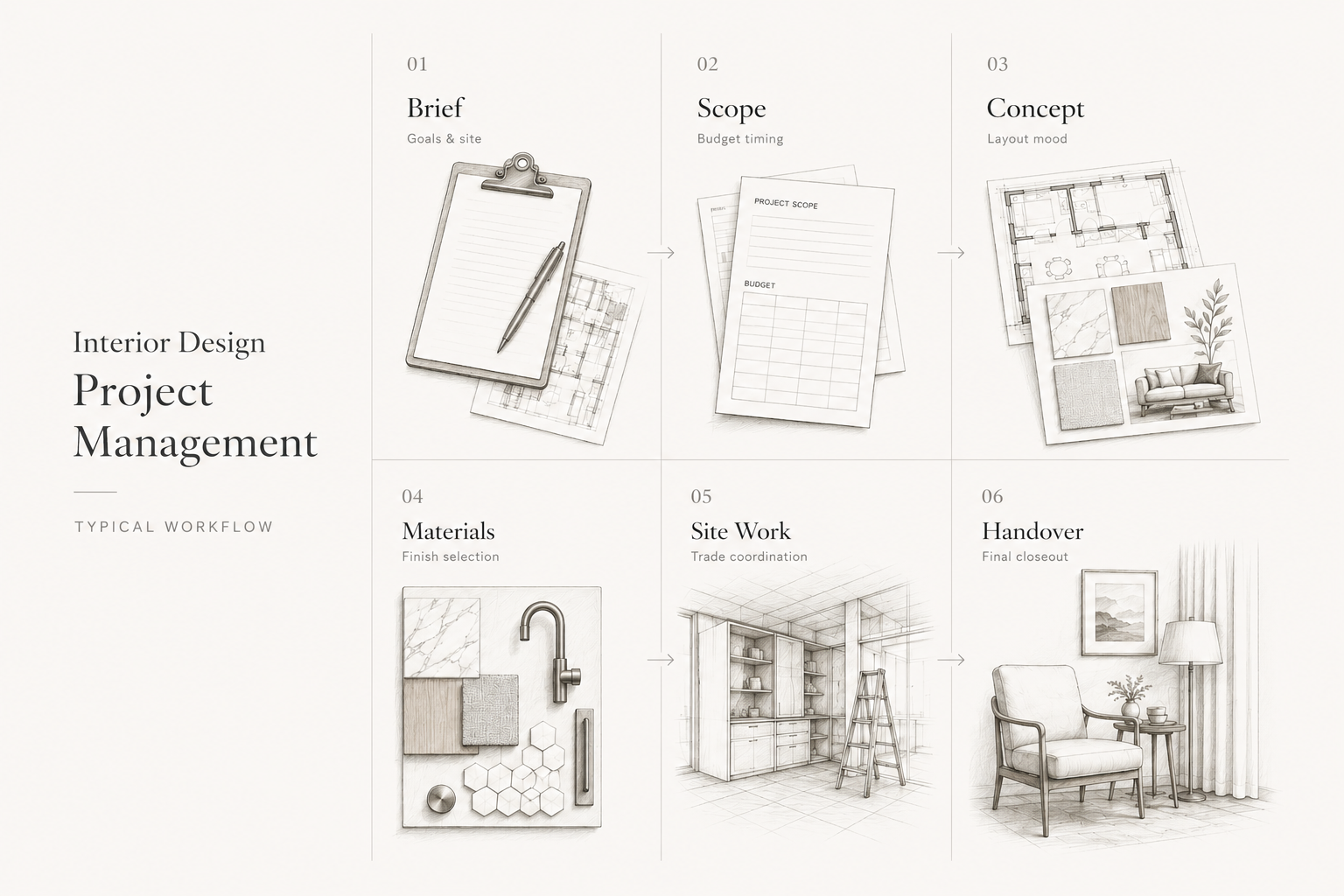
Interior design project management keeps the creative work from cracking under real budgets, real lead times, real installers, real clients, and real site mistakes.
The invisible work that keeps projects from drifting
Most interior projects do not fail loudly. They drift.
A decision gets postponed. A budget assumption stays unspoken. A drawing is “close enough.” Nobody panics, but tension builds. By the time the client says, “I thought that was included,” the damage is already done.
Good project management is not about acting controlling. It is about removing uncertainty before it turns into resentment.
Strong designers do more than present ideas. They make the project legible. Who decides what. What gets priced now. What gets deferred. What changes if the budget tightens. What happens if a delivery slips. Clients calm down when the process makes sense.
Why the first meeting matters more than the mood board

The first client meeting sets the emotional ceiling for the entire project.
Clients are listening for safety, not inspiration. They want to know if this process will protect their money, time, and sanity. They may say they want ideas. What they are really checking is whether the job feels manageable in your hands.
This is where you explain how decisions move. How many revisions exist. What happens when something changes late. When selections need approval. When pricing gets refreshed. What the next phase includes.
If you skip this, clients invent their own rules. Those rules are usually kinder to their hopes than to your time.
For the design fundamentals behind this work, see interior design basics.
Scope is a fence, not a paragraph
Scope is the least respected document in interior design.
Designers write it once. Clients skim it. Everyone forgets it until something goes wrong.
A real scope does one thing well: it defines what is not included. Not only what sounds nice in the opening proposal. Not only what you hope the client understands. The exclusions matter as much as the deliverables.
Procurement? Styling? Site visits? Contractor coordination? Returns? Install day supervision? Punch-list follow-up? If those edges stay soft, the project gets emotional fast.
When tension shows up, a clear scope ends arguments quietly. A vague scope turns every discussion into a personality test.
Budgets fail when they stay emotional instead of structural
Clients rarely lie about budget. They misunderstand it.
“Mid-range” means nothing. “Reasonable” means nothing. Designers live in ranges. Clients live in totals. Those are not the same language.
Break budgets into visible buckets early: furniture, lighting, construction, soft goods, delivery, installation, and contingency. Then when money shifts later, the client can see the tradeoff instead of feeling ambushed by it.
Good management turns cost into structure. Weak management leaves it as mood.
Timelines are felt before they are understood
Every interior project has two timelines.
The real one and the one the client imagines.
Clients imagine steady progress. Designers know there are pauses, lead times, approvals, backorders, site surprises, trades waiting on trades, and windows where nothing visible happens at all.
Say the quiet parts out loud. Waiting is less stressful when it is expected. Silence only feels suspicious when nobody explained the gap.
A clean timeline is not one where everything moves fast. It is one where the client can tell the difference between delay, sequence, and normal waiting.
Install week exposes every soft decision
Install week is where soft decisions become visible.
A lot of projects feel fine until installation starts. Then the loose decisions become expensive. The table arrives but the circulation is tighter than everyone pictured. The curtains are beautiful but the rod height was never signed off clearly. The light fixture scale looked fine in a rendering and wrong on site. The rug size that “should work” suddenly looks small once the sofa actually lands.
Install week does not create problems from nowhere. It reveals the ones that were left blurry too long.
Experienced designers slow down earlier than younger designers expect. They know the cheapest place to solve a bad decision is before ordering, before delivery, before site coordination, and definitely before a room full of installers is standing there waiting for an answer.
The protective move is simple. Confirm dimensions again. Reconfirm priorities. Recheck drawings against actual site conditions. Lock the sequence. The project feels calmer at install when the indecision has already been spent on paper instead of on site.

Revisions are where trust is gained or lost
Unlimited revisions do not create better work. They create fatigue.
Clients change their minds for many reasons. Sometimes the option was not clear. Sometimes the consequence was never stated plainly. Sometimes they are still testing whether every decision is permanent. None of that gets better when the process has no edge.
Clear revision limits make clients decide more carefully. Vague limits make every choice feel temporary.
This is not about being strict for the sake of it. It is about protecting momentum. The project needs moments where it moves from exploring to deciding.
Contractors sense weak management before clients do
Contractors feel unclear drawings immediately.
When instructions conflict or answers arrive late, contractors stop asking questions. That is when mistakes get built. Not because the trades are careless. Because site work keeps moving whether the design team is ready or not.
Strong designers protect the build phase with clarity and authority. They answer cleanly. They issue updates clearly. They know which detail is flexible and which one is not. That confidence flows back to the client.
It also changes the tone on site. Good contractors are calmer around a designer who resolves decisions early and documents changes clearly. Weak management makes everyone start protecting themselves instead of protecting the project.
The emotional labor nobody puts in the contract
Interior designers absorb stress so clients do not have to.
They translate bad news. They buffer delays. They reframe problems into options. They decide when something needs a calm explanation and when it needs a firm boundary.
Clients rarely thank you for what did not go wrong. They only feel calm. That calm is earned. It comes from dozens of invisible corrections and clarifications that never become a crisis because somebody managed them early.
This is one reason project management gets undervalued. When it works, it does not look dramatic. It just makes the whole project feel less fragile.
Why experienced designers slow down on purpose
Early in a career, designers rush decisions because movement feels like progress.
Later, they get better at slowing down the moments that matter and speeding up the rest. They know which questions are dangerous, which approvals need writing, and which “small” details come back later with a bigger bill attached.
Experience teaches which problems are real and which are only noise. That judgment is part of project management too.
What clients feel when management is done well
They feel informed without being overwhelmed.
They feel decisions are intentional.
They feel safe spending money.
They may never say “great project management,” but they will say “this felt easier than expected.” That sentence is usually the real review.
Why this matters more now
Budgets are tighter. Lead times are longer. Clients are more informed and less patient.
Interior design today is less about taste alone and more about coordination. Designers who last are not always the loudest. They are often the calmest.
For layout problems that affect scope, budget, and installation, read space planning and layout in interior design. Project management gets easier when the room logic is already strong.
What clients remember
Clients remember how a project felt.
Project management shapes that feeling quietly, daily, and on purpose.
Recommended reading and tools
These resources help designers avoid preventable mistakes in scale, layout, measuring, and ordering.
Must read: The Interior Design Handbook
Clear rules on scale, proportion, layout, and decision order. It is one of the few design books that helps before mistakes get built into the room.
Recommended tool: laser measure
Prevents ordering mistakes and saves returns. Small tool, big impact when dimensions need to be checked twice instead of guessed once.
FAQ
Is project management really part of interior design?
Yes. Design without management becomes decoration the moment reality shows up. Scope, budget, approvals, lead times, site coordination, and installation all affect whether the design can actually work.
Why do clients push back on rules early?
Rules feel limiting until chaos appears. Then they feel protective. A clear process helps clients understand what is included, when decisions are due, and what happens when something changes.
Does structure kill creativity?
No. It protects it from exhaustion, budget drift, and rework. Good project structure gives creative decisions a place to land.
What is the most common mistake designers make?
Letting ambiguity linger because it feels polite. Unclear scope, soft budgets, vague timelines, and unlimited revisions usually become harder conversations later.
What usually goes wrong latest in the process?
Install week. That is when fuzzy decisions about size, placement, hardware, lighting, and sequencing suddenly become visible, expensive, and hard to hide.
Read This Next
Start with interior design basics for the broader beginner-side foundation.
Read space planning and layout in interior design if the next problem is layout, not management.
Use architecture vs interior design if you are still defining the designer’s role against architecture.