
Commercial Litigation Finance for Businesses: Turning Legal Claims into Cash Flow
Simple, Real-World Guide for Businesses, Lawyers, and Curious Students
I still remember the first time a small-business owner asked me, “So… is this litigation funding thing just legal loan-sharking, or is it actually legit?” That’s the reaction a lot of people have the first time they hear about commercial litigation finance. It sounds complicated and a little shady. In reality, it’s just one more tool in the money toolbox – powerful if used properly, dangerous if you don’t understand the fine print.
In this guide, I’ll walk through what commercial litigation finance actually is, how it works behind the scenes, who it helps, who it can hurt, and the red flags to watch for before you sign anything. Think of this as the version you’d get from a friend who’s already been through a few lawsuits and learned the hard way what to ask.
What Is Commercial Litigation Finance, in Plain English?
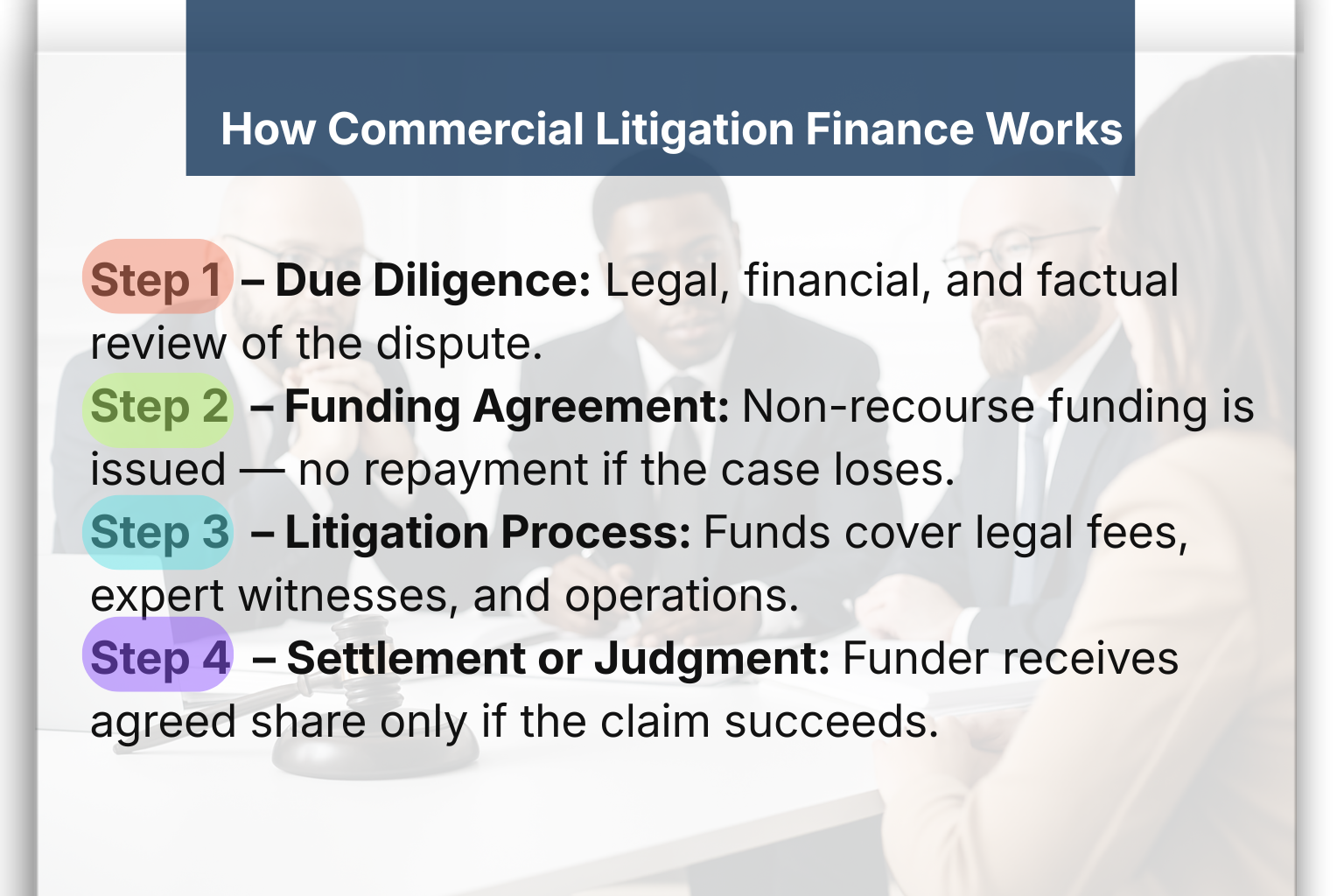
Commercial litigation finance (also called litigation funding) is when an outside company puts up money to pay for a lawsuit in exchange for a share of whatever money is recovered. It’s usually used in business-to-business disputes – things like contract fights, shareholder disputes, IP cases, and big construction or real-estate claims.
At its core, it’s very simple:
- You (or your company) have a legal claim that could be worth serious money.
- You can’t or don’t want to pay the huge legal bills yourself.
- A funder pays some or all of the legal costs.
- If you win or settle, the funder gets back their investment plus a pre-agreed return.
- If you lose, in most arrangements the funder gets nothing – they take the loss.
For businesses that are cash-tight or already under pressure, this can be the difference between walking away from a strong claim or actually seeing it through. For lawyers, it can mean steady fees instead of carrying the whole case on contingency.
On the construction side, litigation financing sometimes shows up on big projects where there are parallel disputes about payment, delay, or defects. In those cases it sits alongside tools like liens, bonds, and special project financing. If you’ve never dealt with liens at all, you might want to first get a feel for how construction liens work in real life on a job site – it’s a different tool, but it lives in the same “money plus legal rights” universe.
What Does “Litigation” Even Mean? Simple Definition

“Litigation” is just the formal word for taking a dispute through the court system (or sometimes arbitration). It covers all the messy parts:
- Hiring lawyers
- Filing claims and responses
- Exchanging documents (discovery)
- Depositions, expert reports, motions
- Either a settlement or a hearing/trial
So when we say commercial litigation finance, we’re talking about a funder putting money into that whole process – usually for business claims with a potential payout big enough to justify the risk.
How Does Commercial Litigation Finance Actually Work?
Most funding deals follow the same basic steps, whether you’re in the U.S., Canada, the UK, Australia, or New Zealand:
1. You Bring the Case to a Funder
You or your lawyer approach a litigation finance company with your case. They’ll usually want:
- A summary of the facts and legal issues
- Key documents (contracts, emails, expert reports, prior correspondence)
- Your damages estimate – how much you realistically think the case is worth
- Which jurisdiction you’re in (because the rules are different in each country)
2. They Do “Due Diligence”
This is where the funder kicks the tires. They’ll:
- Review the legal merits (is this claim strong, or a long shot?)
- Check collectability (if you win, can the other side actually pay?)
- Look at time frame (is this likely a two-year fight or a seven-year saga?)
- Model different outcomes (quick settlement vs. trial vs. appeals)
They may also talk directly with your lawyers, or even bring in an independent counsel to give them a second opinion. It’s not personal – it’s just risk management.
3. You Negotiate Terms
If they like the case, you get a term sheet. Typical pieces:
- Investment amount: how much they’ll fund (fees, disbursements, sometimes a slice of your company’s overhead).
- Return structure: usually a mix of a multiple of the investment (e.g., 2–4x) and/or a percentage of the recovery.
- Priority: who gets paid first out of any settlement or judgment.
- Control: how much say the funder has in settlement decisions or changing lawyers.
- Security: in some jurisdictions, they may structure the deal as a charge over the claim proceeds.
This is where having a lawyer who’s seen these agreements before is worth their fee. The contracts can be dense – a bit like complex construction or PCSA agreements. If you’re new to legal money structures in general, it can help to first read something like a breakdown of common pitfalls buried in PCSA-style contracts and cost clauses so you’re in the habit of hunting for “gotcha” language.
4. The Case Runs – and the Funder Pays
Once the agreement is signed, the funder typically pays invoices as they come in (or advances a lump sum). You’re not getting “free money” – you’re trading a slice of the future outcome for the ability to fight today.
5. You Win, Lose, or Settle
- If you win or settle, the funder gets paid their agreed share out of the proceeds, then you and your partners get the rest.
- If you lose, in a standard non-recourse arrangement you don’t repay the funder – they eat the loss.
Because of this, funders are very selective. Out of hundreds of inquiries, they might fund a handful of cases each year.
Is Commercial Litigation Finance Just a Fancy Loan?
Not really. In most places, commercial litigation funding is structured as a non-recourse investment, not a loan.
That means:
- You don’t make monthly payments.
- If you lose, you typically owe the funder nothing.
- Their “security” is your claim and its potential proceeds, not your house, car, or personal assets.
Because it’s non-recourse and high-risk, the pricing is aggressive. That’s why the funder’s share can look eye-watering compared to a normal bank loan or mortgage.
If you’re more used to conventional, asset-backed borrowing, it can help to mentally separate litigation funding from things like construction mortgages used to actually build projects. Those are secured against hard property; litigation finance is secured against an uncertain future court outcome.
How Much Does Litigation Funding Cost? (What Percentage Do They Take?)
There’s no one number, but you’ll see patterns:
- Percentage of recovery: Often 15–50% of the proceeds, depending on risk, case size, and how early they come in.
- Multiples: Some deals say the funder gets back 2–4x what they invested, whichever is higher, subject to a cap.
- Step-ups over time: The longer the case runs, the higher the multiple or percentage – a built-in “interest clock.”
For example (totally simplified):
- The funder invests $1M over three years.
- If you settle in year two, they might get the greater of 2.5x their money ($2.5M) or 25% of the recovery.
- If you settle late in year four, maybe it’s 3.5x or 35% – again, depending on the agreement.
That’s expensive compared to a bank line, but remember: banks usually won’t lend simply against future lawsuit proceeds, especially if you have no hard collateral.
Is Litigation Finance Profitable – and for Whom?
1. For Funders
Well-run litigation funds hope to make strong, private-equity-style returns across a whole portfolio. They know they’ll lose money on some cases, break even on others, and make outsized gains on a few big wins.
Their internal models live in the same world as other high-risk investment funds: they’re aiming to beat public markets over time, not just earn a safe interest rate.
2. For Clients
For the business bringing the claim, “profit” looks different. They’re asking: Is this better than the alternative?
- Without funding, they might not be able to bring the case at all.
- They might be forced into an early, lowball settlement because they can’t carry the legal costs.
- Or they might starve other parts of the business to feed the lawsuit.
In those situations, giving up 20–40% of a recovery can still feel like a win. They trade some upside for survival and certainty.
3. For Law Firms
Lawyers benefit when funding lets them:
- Run large cases without carrying massive unpaid contingency risk.
- Get proper budgets for experts, discovery, and trial prep instead of cutting corners.
- Take on meritorious but cash-poor clients.
In some jurisdictions, firms also use portfolio funding – where a funder backs a basket of cases, smoothing risk across wins and losses.
Who Pays the Legal Fees – and What About “Loser Pays” Costs?
In most commercial funding deals:
- The funder pays your lawyers’ fees and major out-of-pocket expenses (experts, court fees, discovery platforms, etc.).
- The agreement will spell out what’s covered and what’s not.
In countries like the UK, Australia, and parts of Canada, where the general rule is “loser pays” some or all of the winner’s legal costs, another issue comes up:
- Adverse cost insurance: Many funded cases pair the funding with insurance to cover the risk of having to pay the other side’s legal costs if you lose.
Sometimes the funder arranges and pays for this insurance; sometimes you do. Either way, it needs to be crystal-clear in the documents who’s on the hook.
What Are the Pros of Commercial Litigation Finance?
- Access to justice for businesses: Companies that can’t self-fund big cases can still enforce their rights.
- Risk transfer: You move part of the financial risk of losing from your balance sheet onto the funder’s.
- Budget certainty: Legal spend becomes more predictable; you can keep running the business instead of feeding the lawsuit.
- Settlement strength: Knowing you’re properly funded can stop the other side from simply “waiting you out.”
- Portfolio strategy: For repeat litigants, funding lets you manage legal claims like investment assets, not pure expenses.
And the Cons? Where Can This Go Wrong?
- You give up a big slice of the upside. If the case over-performs, the funder shares that win.
- Possible conflict over settlement. You might want to settle early, while the funder might push to hold out (or vice versa).
- Complex contracts. Poorly drafted agreements can create nasty surprises about who controls what and who gets paid first.
- Ethics and rules vary by jurisdiction. Some places heavily regulate or restrict certain funding structures.
- Reputational risk. In a few industries, opponents still try to spin the use of funding as a negative (“They’re just backed by a funder!”).
Most of these risks can be managed with clear documentation and an honest conversation between client, lawyer, and funder at the start. If you’re used to construction or development work, think of it like carefully reading the contract before you let anyone pour concrete or file a lien – it’s all about what happens when things don’t go as planned.
Does Commercial Litigation Finance Look Different in the US, Canada, UK, Australia, and New Zealand?
The basic idea is similar everywhere, but the rules around fees, ethics, and “loser pays” costs change the details.
United States
- Contingency fees are common; funding often layers on top of or alongside contingency arrangements.
- No general “loser pays” rule, so adverse cost insurance is less central than in the UK or Australia.
- Regulation is more patchwork – a mix of state rules, bar opinions, and case law.
Canada
- Rules vary by province, but courts have increasingly accepted commercial funding in large, complex cases.
- Because “costs follow the event” more often, adverse cost coverage and careful structuring matter.
United Kingdom
- Very active market for commercial funding, especially in London.
- Strong “loser pays” tradition, so funding and adverse cost insurance are often tightly paired.
- Courts have developed case law on what makes a funding agreement acceptable or abusive.
Australia & New Zealand
- Some of the earliest and most developed litigation funding markets, especially for class actions.
- Regulation has tightened in recent years, but funding remains a major feature of large commercial disputes.
If you’re a student or early-career professional looking at all this and wondering how it fits into the wider construction and development world, it can help to zoom out and see how clients manage risk across contracts, cash flow, and disputes. Guides that show you how owners act as their own general contractor – like real-world stories from people who ran their own builds – can give you a feel for how money, risk, and legal rights interact long before anyone files a lawsuit.
Red Flags and Practical Tips Before You Sign Anything
- One-sided veto rights. Be careful if the funder can effectively force you to accept or reject a settlement.
- Uncapped returns with long time frames. Step-ups are normal, but watch out for deals that climb forever.
- No independent legal advice. You should have your own lawyer review the funding agreement – not just the funder’s template.
- Confusing priority waterfall. You should be able to clearly answer: “If we settle for $X, who gets what, in what order?”
- Silence on adverse costs. In “loser pays” systems, the contract must say who is carrying that risk.
A simple mental test: If you can’t explain the deal to a smart friend over coffee without looking at the paperwork, you don’t understand it well enough yet.
Frequently Asked Questions About Commercial Litigation Finance
Is litigation funding only for huge corporations?
No. While many funded cases involve big numbers, small and mid-sized businesses are often the ones who need funding the most. They feel legal costs immediately in their cash flow, so shifting that risk can be a life-saver.
Can individuals use commercial litigation finance?
Sometimes, especially in high-value commercial cases where an individual is effectively acting like a small business (for example, a shareholder dispute or a major IP claim). But most consumer-level injury and accident cases are funded differently, often just through contingency fees.
Will the other side know I’m funded?
It depends on your jurisdiction and the court’s rules. In some places, you may have to disclose that you’re funded (and possibly some terms). In others, you don’t unless it becomes relevant to a specific motion. Strategically, some clients like the other side to know they’re properly backed; others prefer to keep it quiet.
Does using a funder make the court think my case is weaker?
Not usually. In fact, in sophisticated commercial courts, the fact that a third-party funder has done due diligence and still invested can sometimes be seen as a signal that the claim has real merit.
Can I change lawyers after I’ve signed a funding deal?
Often yes, but the process will be governed by your funding agreement. The funder wants to know that competent counsel is in place, and that a change won’t blow up the budget. Always check the clauses about changing firms or fee structures before you sign.
Can I combine litigation funding with traditional financing?
Sometimes. A business may have bank lines or project finance for normal operations, and use litigation funding purely for the lawsuit. Because the lawsuit proceeds are usually carved out as their own “asset,” it’s important that your lenders and funders don’t trip over each other’s security interests.
Bringing It All Together: Should You Use Commercial Litigation Finance?
Litigation funding is not magic money and it’s not automatically evil. It’s a tool. Like any powerful tool on a construction site, it can help you build something you couldn’t otherwise manage – or it can cause serious damage if you don’t respect it.
Ask yourself:
- Do we have a strong, well-supported claim?
- Is the defendant able to pay if we win?
- Would paying for this case out of pocket seriously hurt the business?
- Do we understand exactly what slice of the upside we’re giving away?
If the honest answer is yes to the first two and yes to the third, then it’s at least worth having a calm conversation with your lawyers about funding options. If nothing else, you’ll learn more about the real value of your claim, your appetite for risk, and how money quietly shapes what “justice” looks like in commercial disputes.
And if you work anywhere near construction, development, or architecture, remember that litigation funding is just one piece of the bigger puzzle of how projects are financed, managed, and fought over. Understanding contracts, cost control, and tools like liens and mortgages will often do more to keep you out of court than any funder ever will.