
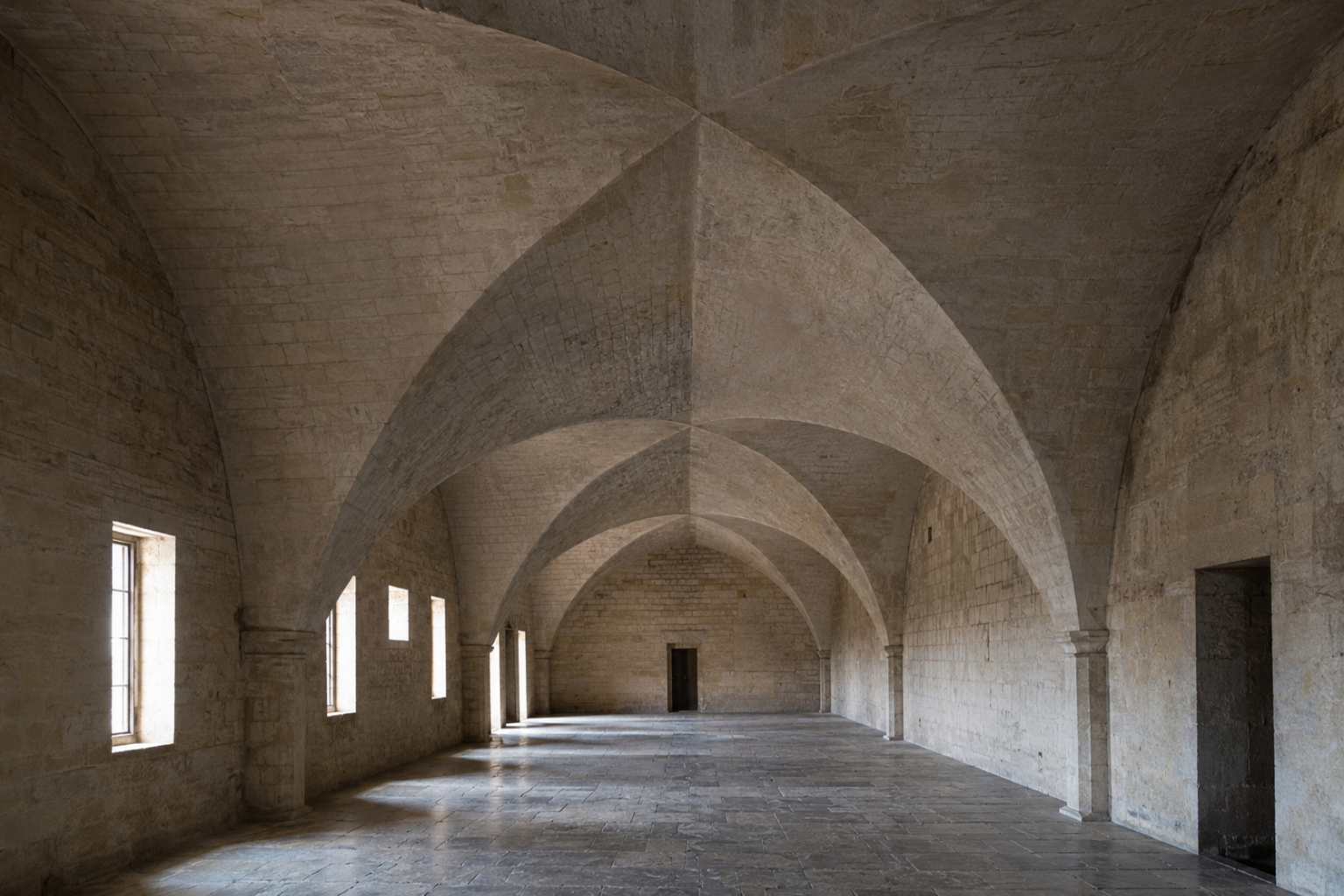
A groin vault is formed when two barrel vaults cross. The crossing creates four diagonal groins and turns the ceiling into a bay supported near its corners.
That geometry is what separates it from a plain barrel vault. It also explains why openings can fit between the supports and why the same bay can repeat across a hall, market, passage, or public room.
What Is a Groin Vault?
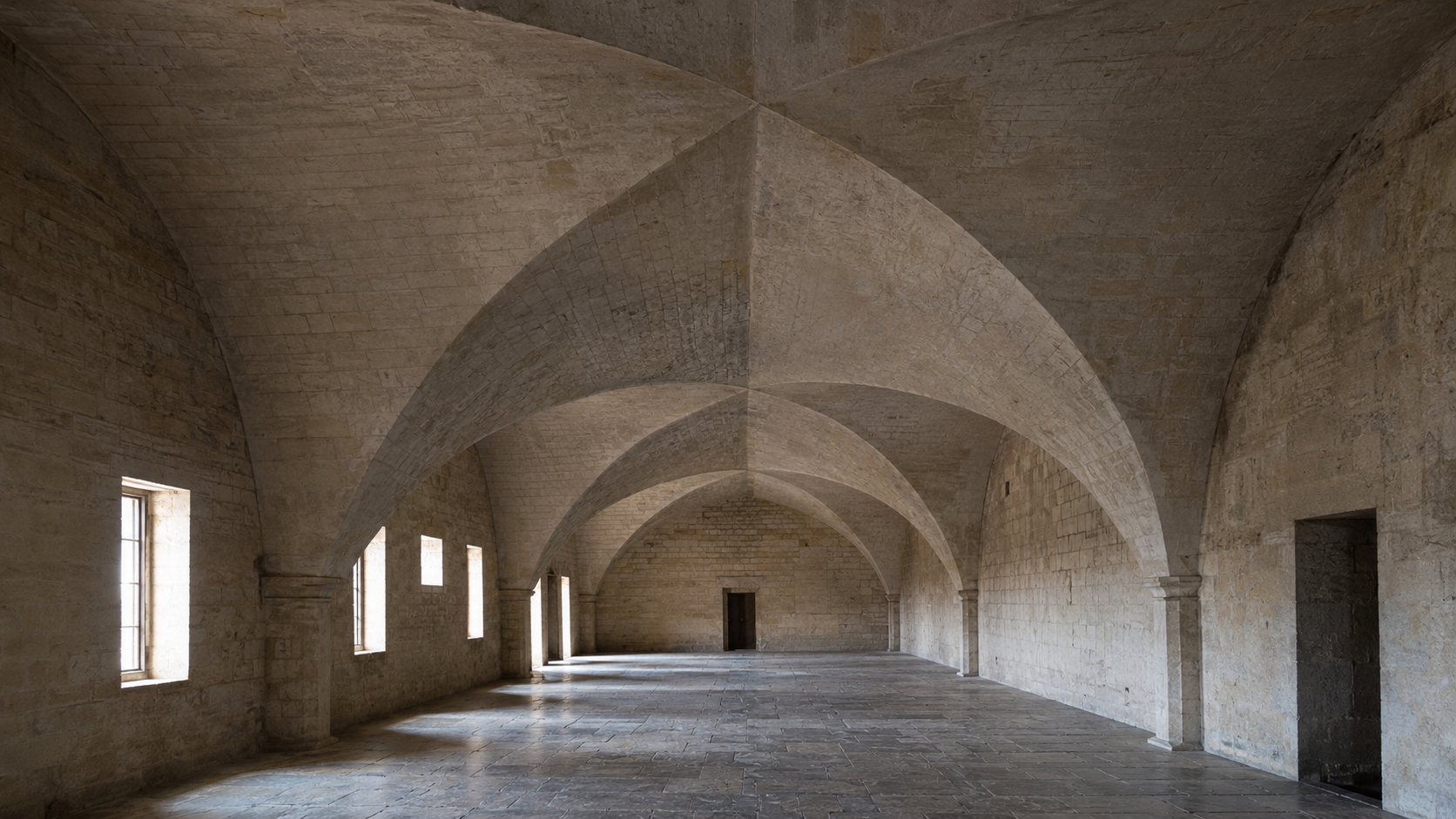
A groin vault is the curved ceiling created where two barrel vaults intersect, usually at right angles. The four curved surfaces between the intersections are called webs. The diagonal meeting lines are the groins.
A plain groin is not a separate rib. It is the edge formed by the two curved surfaces meeting. The same form may also be called a groined vault or cross vault.
Main Parts
- Bay: the square or rectangular area covered by one vault.
- Crown: the highest area near the center.
- Groins: the four diagonal meeting lines.
- Webs: the curved surfaces between the groins.
- Springing: the level where the curves begin.
- Supports: the piers, columns, or heavy wall sections below the corners.
How to Recognize One
Ignore the paint and decoration. Read the geometry.
- Find one ceiling bay and its four corners.
- Look for diagonal lines rising from those corners.
- Follow the lines toward the center of the bay.
- Check whether four curved webs meet along those lines.
- Look for two vault directions crossing each other.
In plan, the groins form an X. From below, each line curves upward from one corner toward the crown.
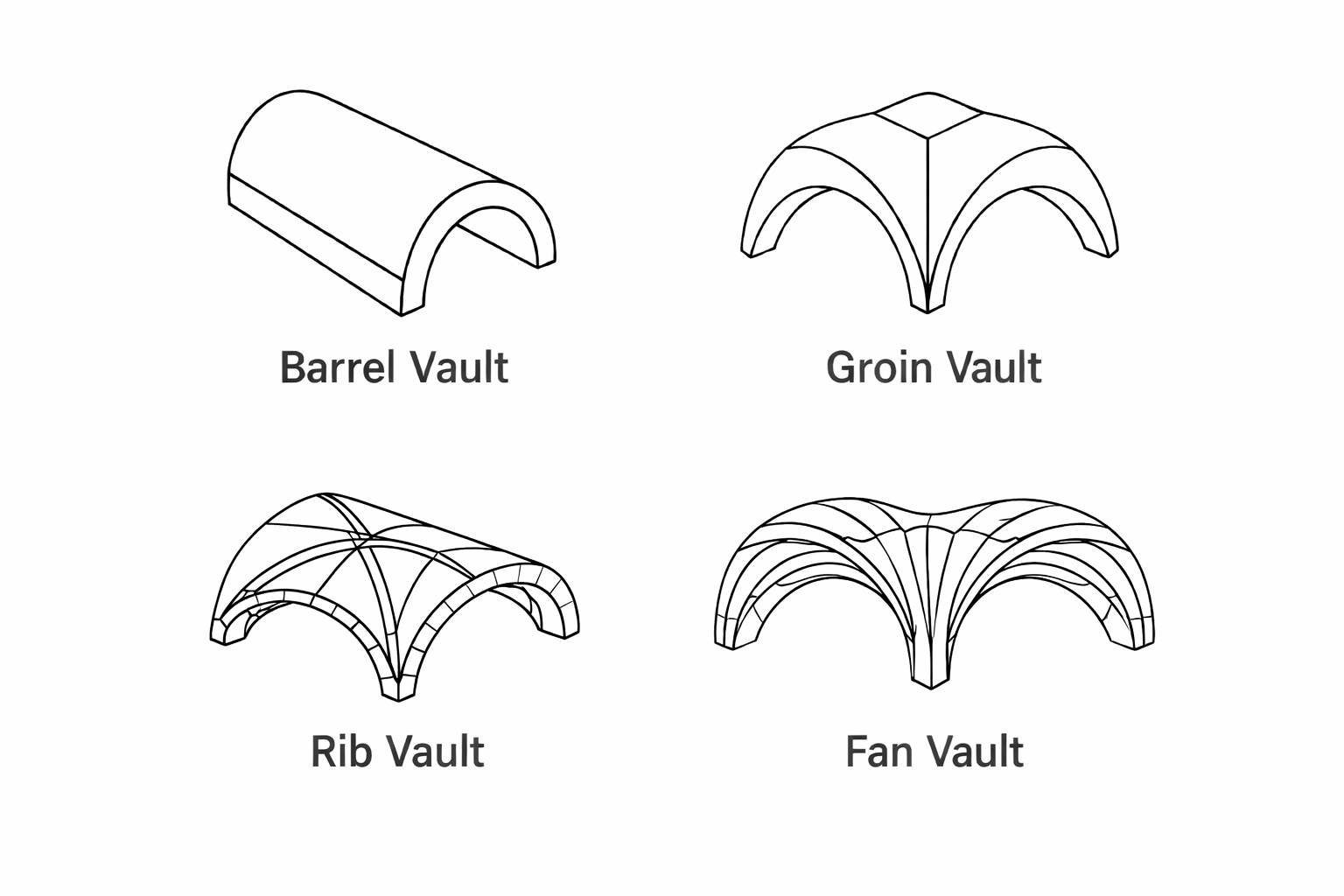
A long, unbroken tunnel shape is a barrel vault. A ceiling with projecting ribs and lighter panels between them is usually a rib vault. The difference is easier to see in groin vault versus barrel vault.
Why Square Bays Work Best
The cleanest groin vault comes from two barrel vaults with the same width, height, and springing level. When they cross over a square bay, the crown stays near the center and each groin runs cleanly toward one corner.
Rectangular bays are harder. One curve may need to be flatter, steeper, pointed, or set at a different springing height. The result can look stretched or uneven even when the vault is sound.
Repeating square bays also gave builders a reliable planning grid. Columns, openings, corridors, and adjoining rooms could follow the same spacing.
How the Load Moves
Masonry vaults work mainly in compression. Brick, stone, or concrete carries load through the curved shell toward the supports.
It is common to say that a groin vault sends all its weight to four corners. That is useful as a first explanation, but it is too simple. The groins collect important reactions, yet the webs, haunches, mortar, nearby walls, and adjoining bays still work together.
The vault also pushes outward. Thick walls, heavy piers, tie rods, buttressing, or neighboring bays must resist that thrust. End bays often need more help because they do not have another bay balancing one side.
The practical advantage over a long barrel vault is that support can gather near the corners instead of running continuously along two solid side walls. The wall areas between those supports can hold arches, windows, or passages.
Groin Vault or Rib Vault?
These forms are related, but they are not the same.
A groin vault gets its diagonal edges from two curved surfaces meeting. A rib vault adds projecting ribs that form a visible framework, with lighter web panels between them.
| Vault | What You See | Support Pattern | Common Mistake |
|---|---|---|---|
| Barrel vault | One continuous tunnel-like curve | Strong support along both sides | A cross opening is mistaken for a groin |
| Groin vault | Two crossing curves with diagonal groins | Reactions gather near four corners | The groin edge is called a rib |
| Rib vault | Projecting ribs with web panels between them | Ribs and supports organize the bay | Every rib vault is called a groin vault |
| Fan vault | Many ribs spreading outward from each support | Loads gather at repeated supports | The fan pattern is treated as crossed barrels |

How Masons Built Them
The bay had to be set out accurately before the masonry rose. A small error at the springing could become a large mismatch near the crown.
- Set the bay. Mark the supports, springing level, and crossing axes.
- Build centering. Timber formwork held the curves during construction.
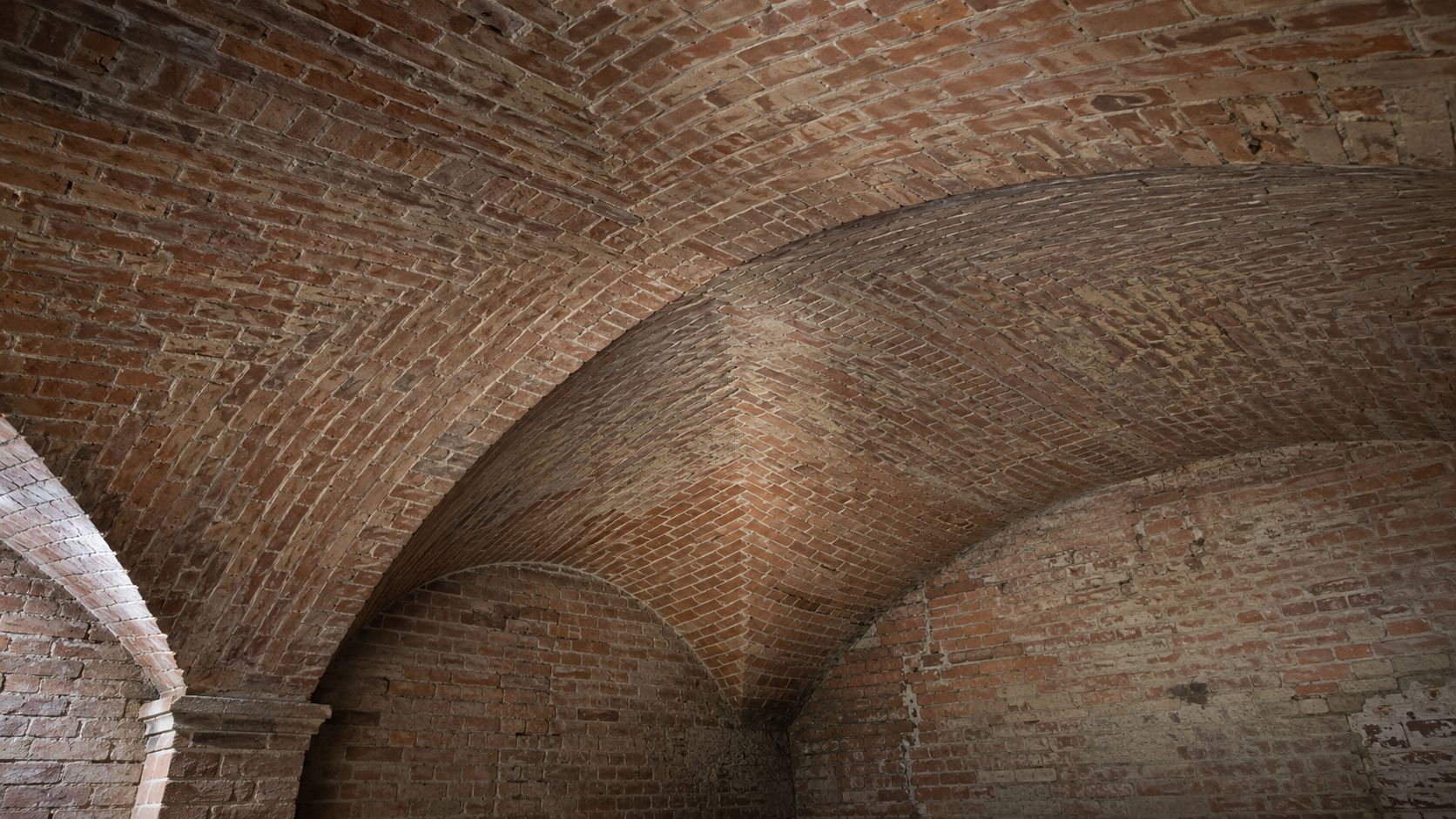
- Lay the webs. Brick, stone, or Roman concrete rose over the forms.
- Shape the groins. Units had to fit changing angles where the two surfaces met.
- Close the crown. The upper courses completed the compression shell.
- Remove the centering. The vault settled onto its permanent supports.
The groin was the difficult part. Units that fit a simple barrel did not automatically fit the intersection. Good work depended on careful cutting, tight joints, and steady curves.
Why Builders Used Groin Vaults
A barrel vault favors one direction. A groin-vaulted bay can open on four sides.
That made the form useful in baths, markets, entrance halls, covered walks, civic rooms, palaces, and later transport buildings. One bay could connect to the next without a solid wall blocking the cross direction.
Repeated bays also made large plans easier to organize. Builders could extend a hall by adding another structural unit instead of redesigning the entire ceiling.
Roman builders used vaults, arches, and concrete to create large interiors. That development is covered in ancient Roman architecture. Later builders changed the profiles, materials, and proportions. The change from heavy curved shells to clearer rib systems is one useful distinction in Romanesque and Gothic architecture.
Groin Vaults in Modern Buildings
A modern ceiling can look like a masonry groin vault without carrying the building above it.
Some modern groin vaults are reinforced-concrete, brick, or thin-tile shells. Others are lightweight frames covered with plasterboard, wood, or glass-fiber-reinforced gypsum.
That difference matters during renovation. A framed decorative vault can often be opened like other lightweight construction. A historic masonry vault may depend on its fill, ties, walls, and neighboring bays. Removing material above it can change the structure even when the underside looks untouched.
What Cracks Can Mean
Old masonry often has small cracks and repaired joints. The pattern matters more than the mere presence of a crack.
- a fresh crack following one groin
- separation near the crown
- cracks at the springing
- a bulge or dropped area in one web
- movement in a corner support
- open joints, loose units, or falling mortar
- salt deposits, damp patches, or repeated staining
- a loose, cut, or badly corroded tie rod
Spreading supports are serious. When two supports move apart, one crossing vault can begin to hinge and crack. Water may make the problem worse by weakening mortar or causing freeze-thaw damage.
Do not fill a moving crack and call the vault repaired. First determine whether the crack is in plaster, a nonstructural lining, or the masonry shell. Historic masonry vaults should be assessed by an engineer or conservation specialist who understands arches and thrust.
Common Mistakes
Calling Every Crossed Ceiling a Groin Vault
Two decorative arches crossing below a flat ceiling do not make a groin vault. Four curved webs must meet along the diagonals.
Calling the Groin a Rib
A groin is the meeting edge of two surfaces. A rib is a separate projecting member.
Ignoring Sideways Thrust
Four corner supports do not remove outward force. The supports still need enough mass, bracing, or tying to resist spreading.
Forcing the Form Into a Poor Bay
A long rectangle can create awkward webs and uneven curves. Smaller repeated bays or a different vault profile may work better.
Assuming a Modern Vault Is Structural
Many current groin-vault ceilings are decorative. Check drawings or inspect above the finish before treating the ceiling as part of the main structure.
FAQ
Why is it called a groin vault?
The name comes from the diagonal edges formed where the two curved vault surfaces meet.
Is a groin vault the same as a cross vault?
Usually, yes. Both terms commonly describe two barrel vaults crossing at right angles.
Does a groin vault need a square room?
No. A square bay simply gives the cleanest geometry when both barrel vaults use the same curve and springing height.
Does all the weight travel along the groins?
No. The groins are important load paths, but the webs and the rest of the masonry shell also carry load.
Can a groin vault have ribs?
Yes. Builders sometimes added ribs along the groins. When the ribs become a clear structural framework, the form is better described as a rib vault.
Can a house have a groin-vault ceiling?
Yes. In houses, it is usually a lightweight framed or plaster feature rather than a heavy masonry vault.
Are cracks in a groin vault dangerous?
Some cracks are only in plaster or old mortar. Fresh, widening, displaced, or damp cracks can point to movement or water damage and need professional review.