

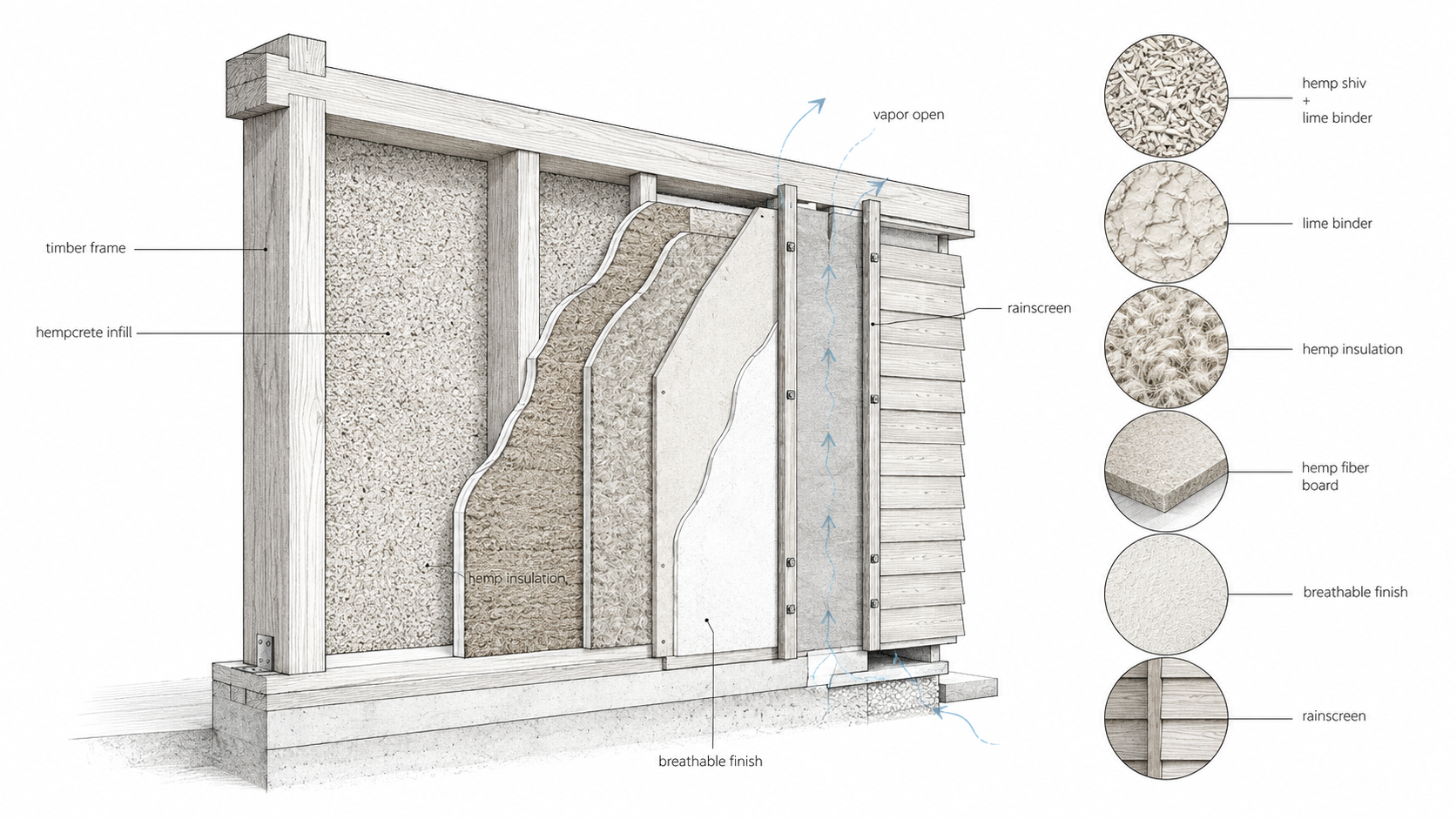
Illustration by ArchitectureCourses.org. Hemp batt insulation is a plant-fiber product used inside framed wall cavities. It is not structural. The batt depends on the stud wall for support and on the surrounding wall assembly for moisture control, drying, and finish layers.
What It Is, Where It Works, and What to Watch
Hemp insulation is real building insulation, but it is not one single product. In the U.S. market, the clearest hemp batt path is HempWool, which Hempitecture describes as a panelized, batt-like insulation for walls, floors, ceilings, attics, and partition walls at about R-3.7 per inch. Hempitecture also sells PlantPanel X, a rigid above-grade continuous insulation board rated at about R-3.25 per inch.
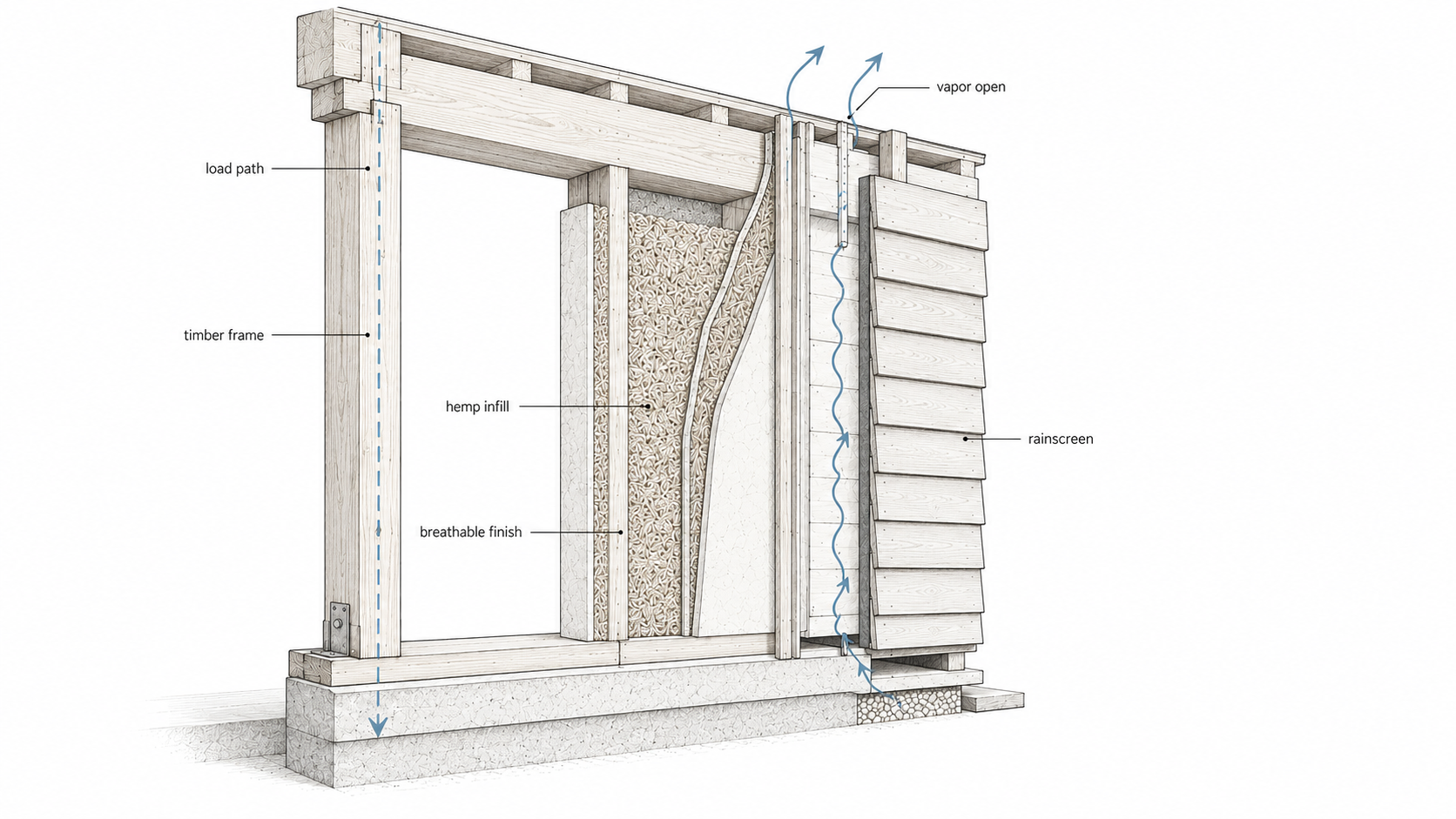
Hemp-lime is a different category. The U.S. Hemp Building Association describes hemp-lime, often called hempcrete, as a non-load-bearing wall filler rather than a structural frame material. USHBA also says the 2024 IRC Appendix BL allows prescriptive hemp-lime use in some one- and two-family buildings up to two stories in low seismic areas, while higher-risk or taller projects still need engineering.
That split is where a lot of bad decisions start. Buyers hear “hemp insulation” and compare everything as if it were one shelf product. It is not. One option fits framed cavities. Another changes wall build-up, finishes, sequencing, and code review.
This page sorts the field out. It explains what hemp insulation usually means, where it makes sense, where it gets harder, and what buyers usually find out too late. If you want the supplier side after this, go next to Hemp Insulation Companies: Best Providers, Costs, and Benefits Across the USA. If you want the wider comparison set, read Natural Insulation Materials: Types, Benefits, and Practical Tips and Sustainable Insulation That Saves Energy and Cuts Costs.
What hemp insulation usually means
| Product path | Best fit | What to know |
|---|---|---|
| Hemp batt insulation | Framed walls, floors, ceilings, attics, partitions | Closest match to a normal batt buying process |
| Rigid hemp board | Above-grade exterior continuous insulation | Useful when you need a continuous layer, not just cavity fill |
| Hemp-lime wall system | New builds or deeper retrofits designed around the system | Not a simple batt swap and not a structural frame by itself |
If you want the simplest version of hemp insulation, start with batts. That is the version most homeowners and builders are really asking about. If you are looking at hemp-lime, you are no longer choosing only an insulation product. You are choosing a wall system.
How hemp insulation performs
On paper, hemp fiber insulation lands in the same broad thermal conversation as other common batts. HempWool lists about R-3.7 per inch. THERMO HANF lists thermal conductivity at 0.040 W/(m·K), which is in the expected range for a real insulation product.
But paper numbers are only part of the answer. DOE says insulation performance depends on type, thickness, density, temperature, aging, moisture accumulation, and installation quality. That is why a product can look good on a data sheet and still disappoint in a bad assembly.
Hemp gets more interesting when the job cares about more than R-value. USHBA’s design material for architects treats hemp-based systems as part of a broader performance package that includes vapor-open, moisture-managing assemblies, fire performance, acoustic attenuation, and thermal comfort. That is where hemp starts to separate from a basic fiberglass-only conversation.
Where hemp works best
Framed walls and ceilings
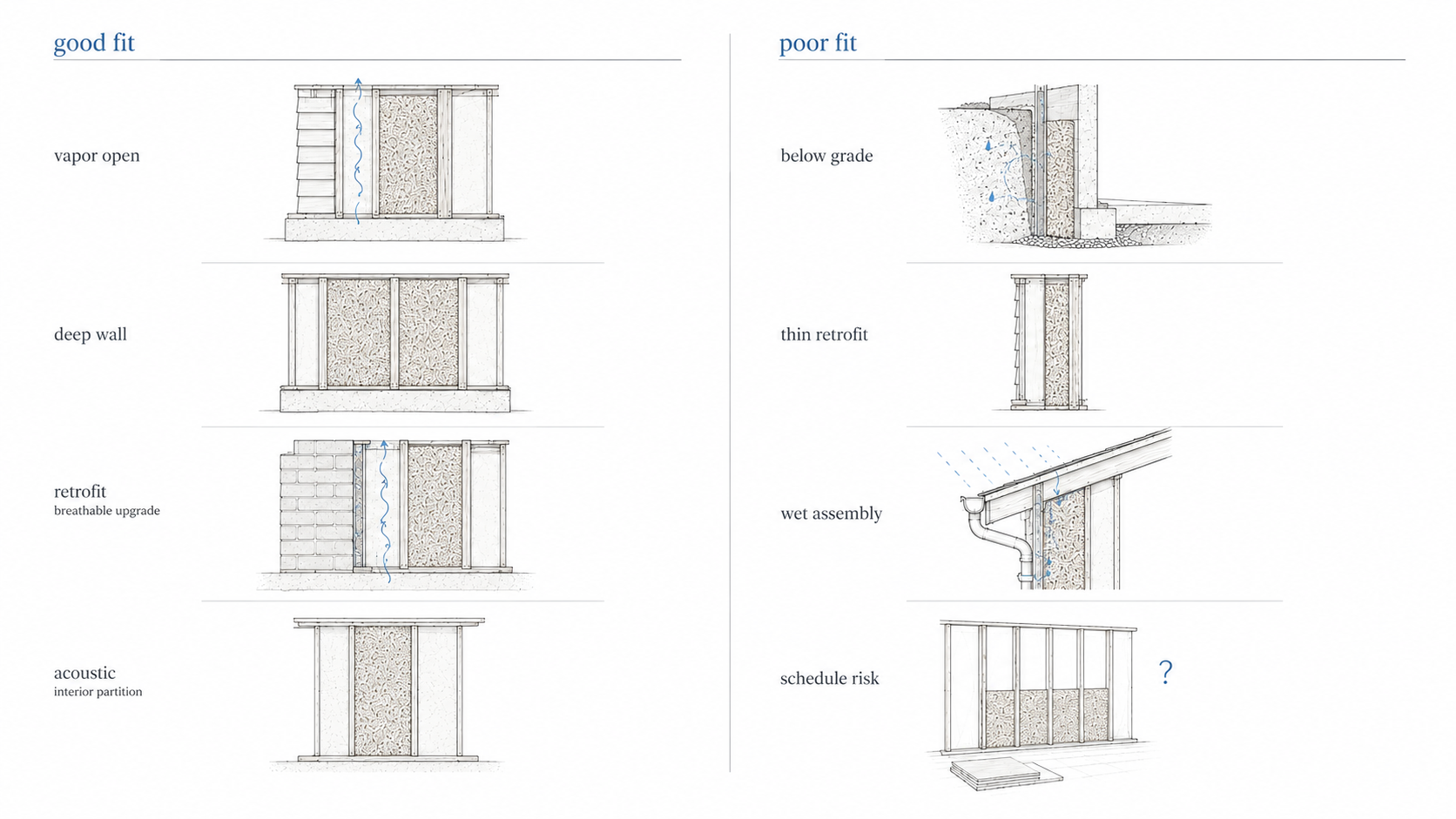
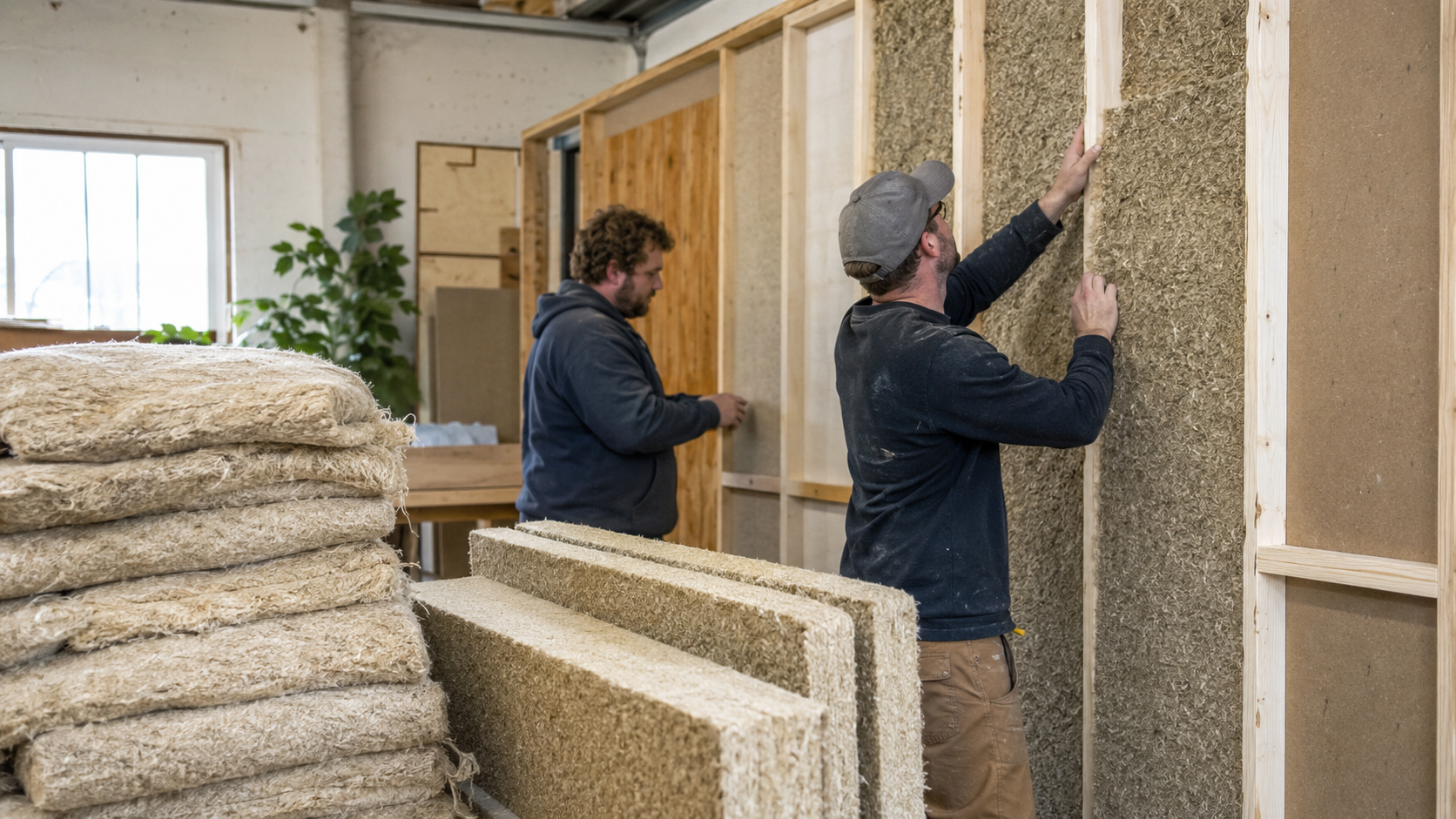
Batt-style hemp insulation makes the most sense in normal framed cavities where the buyer wants a lower-synthetic, non-foam option without switching the whole project to hemp-lime. This is the cleanest entry point because the product format is familiar even if the material is not. HempWool is marketed for walls, floors, ceilings, attics, and partition walls, which is exactly why it is the easiest hemp product for most people to understand.
Above-grade exterior continuous insulation
Rigid hemp board gets more relevant when the real problem is thermal bridging or when you want a continuous layer outside the framing. PlantPanel X is sold for exterior above-grade use, which puts it in a different conversation than cavity batts. It is not there to do the same job in the same place.
Hemp-lime wall systems
Hemp-lime fits best when the project is designed around hemp-lime from the start or when the team already knows that system well. USHBA treats it as a wall infill material with its own detailing, framing compatibility, finish choices, and specification path. That is a real use case. It is just not the same thing as buying insulation batts for a stud wall.
Sound-sensitive interiors
Hemp also gets more attractive in interior partitions and quieter rooms because acoustic comfort is part of the value proposition, not just heat flow. That matters more in offices, studios, shared walls, and bedrooms than in a bare minimum budget wall.
Where hemp gets harder
Thin retrofits
Hemp is harder to justify when every inch matters. If the wall or roof is already shallow and the project needs the highest possible performance per inch, hemp often loses ground to thinner high-performance options. That does not make it bad. It just means the assembly is asking for something else.
Fast commodity jobs
Hemp is also harder on jobs that want the cheapest, fastest, most familiar install. A crew that lives in standard fiberglass and mineral wool details may price unfamiliar materials defensively. The material may still work. The job may still get more expensive.
Projects that confuse batt insulation with hemp-lime
This mistake burns time and money. A buyer who really wants a normal cavity batt should not drift into hemp-lime just because both products have hemp in the name. The product category has to match the job.
What slows hemp jobs down in the real world
A lot of hemp projects do not stall because the material is bad. They stall because the supply chain is still thinner than fiberglass or mineral wool. Buyers run into longer lead times, higher freight, fewer local crews who know the product, and more hesitation from contractors who do not want to learn a new system on your job.
That does not make hemp a bad choice. It means the project needs a clearer plan earlier. If the schedule is tight, the wall depth is already set, or the budget has no room for experimentation, those supply and labor issues can matter more than the product label.
What people usually find out too late
The late surprise is rarely the brochure claim. The late surprise is the knock-on effect of the choice.
With hemp batts, the late surprise is often simpler than people expect: the product is only as good as the cuts, the fit, the air sealing, and the rest of the wall. ENERGY STAR says air leaks should be sealed before insulation is added, and DOE treats moisture control as part of insulation performance, not a separate issue. If those basics are weak, the material takes the blame for a problem that started earlier.
With hemp-lime, the late surprise is bigger. USHBA’s current design guidance points to framing compatibility, finish selection, specification, and installation considerations as core parts of the system. In plain terms, that means jamb depth, trim thickness, sequencing, drying time, and crew familiarity are not side issues. They are part of the decision.
That is the part many softer hemp articles skip. The product story is easy. The wall details are where the bill shows up.
How hemp compares with fiberglass
| Question | Hemp batt | Fiberglass batt |
|---|---|---|
| Thermal performance on paper | In the same broad range as common batt products | Well-established mainstream option |
| Supply chain | More niche and more project-specific | Easy to source almost anywhere |
| Assembly fit | Works best when the project also values vapor openness, acoustics, or lower synthetic content | Works well when cost, familiarity, and installer access lead the decision |
| Big risk | Choosing it for the story without resolving detail changes | Assuming the cheap common option will fix leaks or moisture problems by itself |
The blunt version is this: hemp does not win because it is magical. It wins when the job cares about the combination of thermal performance, moisture behavior, acoustic comfort, and lower synthetic content. Fiberglass stays strong when the job is simple, price-driven, and built around standard details.
If that is your real comparison, read Hemp Insulation vs. Fiberglass after this.
How to decide whether hemp belongs in your project
- Start with the assembly. Wall, roof, floor, retrofit, new build, or interior partition changes the answer fast.
- Decide what you are really buying. Better sound control, vapor openness, lower synthetic content, lower embodied impact, or a full hemp-lime wall system are not the same brief.
- Pick the product family first. Batt, board, or hemp-lime should be clear before you compare brands.
- Resolve air sealing and moisture control early. DOE and ENERGY STAR both make the same larger point: insulation does not get its best performance in a leaky, wet, or badly sequenced assembly.
- Check code and local review if the job is hemp-lime. The model code path is better now, but local familiarity is still not automatic.
- Compare against real alternatives. Hemp is not competing with fantasy. It is competing with fiberglass, mineral wool, cellulose, cork, wood fiber, foam, and standard framed assemblies people already know how to build.
When another material is the better answer
Hemp is not the right answer when the project needs the thinnest possible insulation, the lowest possible first cost, the fastest commodity install, or a team that only wants conventional details.
In those cases, fiberglass, cellulose, mineral wool, wood fiber, cork, or a more standard wall strategy may be the cleaner move. That does not make hemp worse. It just means material honesty matters more than material branding.
What to read next
- Hemp Insulation Companies: Best Providers, Costs, and Benefits Across the USA — go here if you are already shopping brands and suppliers.
- Hemp Insulation vs. Fiberglass — the better next read if that is the real head-to-head decision.
- Hempcrete: The Green Revolution in Construction — better if the project is drifting toward hemp-lime walls rather than batts.
- Natural Insulation Materials: Types, Benefits, and Practical Tips — the wider lower-impact comparison set.
FAQ
Is hemp insulation the same as hempcrete?
No. Batt-style hemp insulation is a cavity insulation product. Hemp-lime is a wall infill system. USHBA describes hemp-lime as non-load-bearing wall filler, which is a very different job from a batt.
Does hemp insulation perform like fiberglass?
Batt-style hemp insulation can land in a similar broad thermal range on paper. HempWool lists about R-3.7 per inch. But DOE also notes that real performance depends on thickness, density, moisture, and installation quality, so the label alone never settles the comparison.
Is hemp-lime structural?
Not by itself. USHBA describes hemp-lime as non-load-bearing wall filler, so it needs a structural frame around it.
Does hemp insulation still need air sealing?
Yes. ENERGY STAR says air leaks should be sealed before insulation is added, and that principle still applies here. A better insulation product does not excuse a leaky assembly.
Where does hemp usually make the most sense?
It usually makes the most sense in framed cavities where the buyer wants a real batt product with lower synthetic content, in above-grade continuous insulation where a rigid board fits the design, or in hemp-lime projects that are designed around the system from the start.
What is the biggest mistake people make?
Treating every hemp product like the same product. Batt insulation, rigid board, and hemp-lime do not buy, install, or detail the same way.