
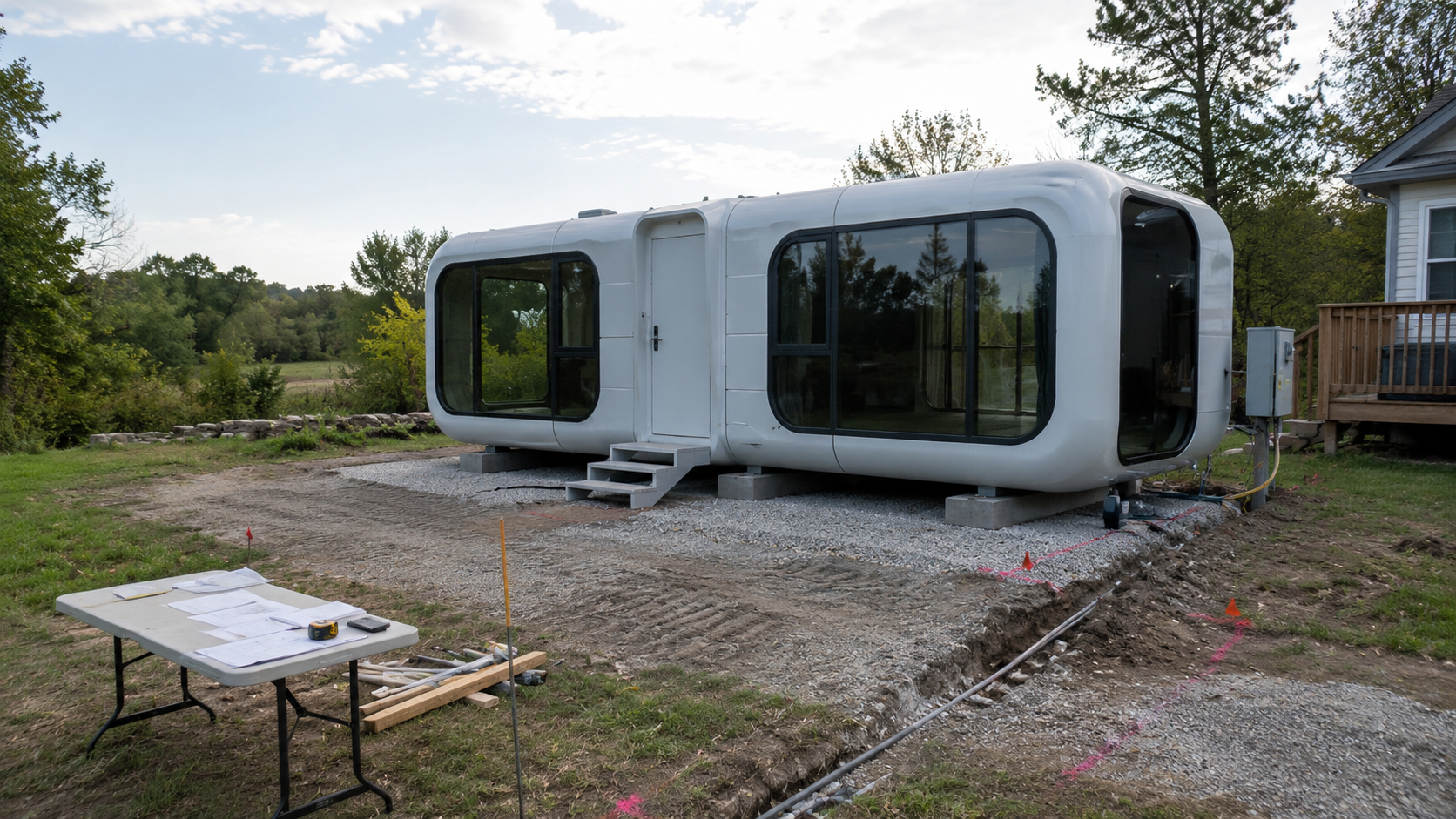
An Etong house looks simple until you try to place one on land.
The unit may be factory-built. It may arrive mostly finished. It may look cleaner than a normal tiny home and cheaper than a conventional house. That is the easy part.
The hard part is everything around it: zoning, foundation, delivery access, utilities, inspections, certification, warranty, financing, insurance, and whether your municipality treats it as a dwelling, accessory unit, cabin, commercial rental, mobile structure, or something else.
That is where buyers usually find out whether the project is real. If the bigger question is whether your land can support any small home or prefab structure, start with I Own Land and Want to Build a House before treating the capsule as the whole project.
What Etong Houses Are
Etong houses are factory-built modular or space-capsule-style prefab units. The company sells several product lines, including compact residential capsules, hospitality units, modular cottages, and larger modular residential systems.
The appeal is obvious. A buyer sees a finished-looking unit with a modern exterior, built-in bathroom, sleeping area, compact kitchen zone, glazing, lighting, and a futuristic capsule shape. It feels like a house you can order instead of a project you have to manage.
That feeling is dangerous if you take it too far.
A factory-built capsule is not automatically a legal home on your property. The shell may be the product. The finished project is still a site project.
The Price Is Not the Project Cost
The advertised price is the number that gets attention.
It is not the number that decides whether the project works.
A capsule unit may be listed at a price that looks low compared with a site-built house. But a livable installation can also need shipping, customs, crane or equipment access, foundation or piers, anchoring, electrical service, water, sewer or septic, heating or cooling coordination, permits, inspections, grading, driveway access, and local professional review.
That is why a low factory price can still turn into a messy project. The same mistake happens with tiny homes: the small unit price looks manageable, then the land, utility, code, and site costs arrive later. For broader cost context, compare it with Tiny Home Cost.
| Cost area | Why it matters | What to ask before paying |
|---|---|---|
| Factory unit | This is the capsule itself, not the whole legal project. | What exactly is included, installed, tested, and warranted? |
| Shipping and delivery | Large prefab units need route planning, unloading space, and site access. | Who pays if the truck cannot reach the final pad? |
| Foundation or support | The unit still needs a stable, approved base. | Is the required foundation engineered and accepted locally? |
| Utilities | Power, water, sewer, septic, internet, and HVAC connections are site-specific. | Who designs, installs, and inspects these connections? |
| Permits and inspection | The municipality may still need drawings, approvals, and inspections. | What code or certification does the unit meet for my location? |
| Finishing and occupancy | A delivered unit may still need work before legal use. | What must happen before someone can sleep there legally? |
The Land Decides More Than the Capsule
A space capsule home is not useful if the land cannot legally support it.
Before choosing a model, check the property. Zoning may control whether a separate dwelling, accessory dwelling unit, short-term rental, cabin, temporary structure, or mobile unit is allowed. Minimum floor area rules may apply. Setbacks may apply. Fire access may apply. Height and lot coverage may apply. Rural land may need well and septic approval.
The capsule can be well built and still fail the property test.
That is the first call to make: not to the seller, but to the local planning or building department. Ask how the unit would be classified on your exact lot. If you are still early in the land stage, read Building on Your Own Land before choosing any prefab model.
The Classification Problem
Etong-style capsule homes sit in an awkward space.
They can look like modular homes, tiny homes, cabins, hotel pods, glamping units, accessory dwellings, or temporary structures depending on the model and use. That classification changes everything.
A unit used as a backyard office may face different rules than a unit used as a full-time dwelling. A vacation rental may face different rules from a family guest unit. A unit placed in a tourist camp may need a different approval path than one placed behind a suburban house.
Do not ask, “Are Etong homes legal?”
Ask this instead:
What would this exact unit be classified as on this exact property for this exact use?
That answer decides the next step. If the unit might be treated like a tiny house, the rules may be closer to Regulations for Tiny Houses on Wheels or a local accessory-dwelling rule than a normal modular house rule.
The Factory Finish Can Hide the Site Work
Prefab marketing often shows the finished object.
It does not show the trench.
It does not show the foundation inspection, utility stub-outs, access road, crane pad, septic permit, electrical service upgrade, grounding, anchoring, drainage, or final occupancy approval.
That is the section buyers need before they order.
A capsule can arrive with a bathroom. That does not mean your site has legal sewer or septic capacity. It can arrive with lights. That does not mean your electrical service is ready. It can arrive with a sleek exterior. That does not mean the foundation, anchoring, snow load, wind load, fire separation, or energy performance has been accepted by your local authority.
The factory may finish the object. The site has to finish the house. That is why site preparation and utilities and infrastructure belong in the budget before the deposit, not after delivery.
Who Etong Houses May Fit
Etong houses may make sense when the use is clear and the approvals are realistic.
They can be a better fit for resort accommodation, glamping sites, rural guest units, backyard studios, controlled tourist projects, or private land where the owner has already checked zoning and services.
They may also work for buyers who want a compact, design-forward unit and are prepared to manage the site work properly.
The best buyer is not the person who wants a cheap house tomorrow.
The best buyer is the person who can treat the unit as one part of a permitted project.
Who Should Slow Down
Slow down if you are trying to solve full-time housing with only the advertised unit price.
Slow down if you do not already own land.
Slow down if your area is strict about tiny homes, accessory dwellings, manufactured homes, short-term rentals, or minimum dwelling sizes.
Slow down if you need conventional mortgage financing.
Slow down if you are buying for Airbnb income before checking local rental rules.
Slow down if the seller cannot give you clear documents for your building department.
What to Ask the Seller Before You Pay
A serious seller should be able to answer boring questions.
Boring questions protect you.
| Question | Why it matters |
|---|---|
| What building code, standard, or certification does this unit meet? | Your inspector may need proof, not marketing language. |
| Can you provide stamped drawings or engineering documents if my municipality asks? | Imported prefab units often hit a wall at permit review without usable documents. |
| What loads is the unit designed for? | Wind, snow, seismic, and roof loads matter by region. |
| What foundation does the manufacturer require? | Wrong support can void warranties, fail inspection, or damage the unit. |
| What parts are installed in the factory and what must be finished locally? | This separates product cost from project cost. |
| Who handles repairs and replacement parts after delivery? | Imported specialty units can become difficult to service. |
| What is excluded from the price? | Shipping, taxes, customs, crane, utility work, permits, and local trades can change the real number. |
Permits Come Before the Deposit
Do not put down a serious deposit because the unit looks good online.
Start with the local authority.
Ask whether the unit can be used as a dwelling, accessory dwelling, rental unit, cabin, office, or temporary structure. Ask what drawings are required. Ask whether factory certification is accepted. Ask whether a local engineer or architect must review the installation. Ask about foundation, anchoring, energy code, plumbing, electrical, septic, water, fire access, and occupancy.
You do not need every answer on day one.
You do need to know whether the project is possible before money leaves your account. A good starting point for the permit side is Residential Building Codes. If the local office asks for drawings, compare that with Drawings for Planning Permission.
The Rental Trap
Many buyers look at capsule homes as short-term rental units.
That can work in some places. It can also fail fast.
A property may allow a private accessory structure but not a short-term rental. A rural property may allow a cabin but require septic approval before overnight use. A resort site may need commercial approvals. A city may restrict backyard rental units, parking, fire access, or separate addresses.
The trap is buying the pod first and checking the rental rules later.
Run the numbers only after the use is legal. Otherwise the rental income is just a fantasy spreadsheet.
The Warranty Question
The warranty is only useful if you know who stands behind which part.
There may be a manufacturer warranty on the unit. There may be separate warranties from local installers, electricians, plumbers, foundation contractors, or site-work crews. There may also be local new-home warranty rules depending on jurisdiction, foundation type, builder status, and whether the project is treated as a permanent dwelling.
Do not assume the capsule warranty covers the whole project.
A leak at a service penetration, a foundation movement problem, a utility connection failure, or a failed inspection may not be the manufacturer’s problem. The contract should make responsibility clear before delivery.
Durability Depends on the Site
Aluminum-clad prefab units can sound durable.
Durability still depends on exposure.
Coastal air, freeze-thaw cycles, heavy snow, high winds, intense sun, poor drainage, insects, and bad anchoring can all change the life of the unit. A capsule shown in a scenic marketing photo may not be designed for your climate without changes.
Ask for technical data, not adjectives.
What is the roof rated for? How does water drain? How are panels sealed? How are openings flashed? What happens at the base? How is condensation handled? Can replacement parts be sourced later?
Etong vs. Conventional Modular Homes
Etong-style capsule homes are not the same as a conventional modular house.
A conventional modular house is usually designed as a code-compliant house placed on a permanent foundation and finished through a normal building process. A capsule home may be more compact, more product-like, more transportable, and more specialized.
That can be a benefit if the goal is a compact guest unit or hospitality pod.
It can be a problem if the buyer expects a normal house replacement. If you are comparing it against broader prefab housing options, read Pre-Built Homes Under 100K with the same caution: the advertised home price is not always the installed, permitted, service-connected project cost.
| Option | Best use | Main risk |
|---|---|---|
| Etong-style capsule home | Compact living, guest use, hospitality, scenic accommodation, backyard studio where allowed. | Classification, permits, local code documents, utilities, and resale uncertainty. |
| Conventional modular home | Permanent primary housing on a foundation. | Higher total cost, site work, builder coordination, and financing complexity. |
| Tiny home on wheels | Flexible or seasonal use where rules allow. | May be treated as an RV, not a legal dwelling. |
| Site-built small house | Permanent housing with local trades and standard permitting. | Longer build time, higher labor exposure, and weather delays. |
The Real Test
An Etong house is worth considering if five things line up.
First, your land allows the use.
Second, your building department can accept the documents.
Third, the installed cost still makes sense after foundation, utilities, shipping, permits, and local trades.
Fourth, the unit suits your climate and maintenance expectations.
Fifth, you know who is responsible if something fails.
If any one of those is unclear, the project is not ready.
What to Do Before Ordering
Use this order.
- Choose the intended use: dwelling, guest unit, office, rental, cabin, or commercial accommodation.
- Call the local planning or building department with that use and your property address.
- Ask what classification, permit, foundation, and inspection path applies.
- Ask the seller for technical documents before paying a deposit.
- Get local pricing for foundation, delivery, crane access, utilities, and site prep.
- Check insurance, financing, and warranty responsibility.
- Only then compare the unit price with other housing options.
Are Etong Houses Worth It?
They can be worth it for the right use.
They are not a shortcut around land rules, building permits, utility work, or inspections. They are not automatically cheaper once installed. They are not automatically legal as homes. They are not automatically good investments as rentals.
The best case is a buyer with suitable land, clear approvals, realistic site pricing, and a use that fits the unit’s size and classification.
The worst case is a buyer who treats the online price as the real price and discovers the missing costs after the unit is already ordered.
Buy the project, not the picture.
FAQ
What is an Etong house?
An Etong house is a factory-built modular or space-capsule-style prefab unit. Depending on the model, it may be aimed at compact living, vacation stays, hospitality projects, backyard units, or modular residential use.
How much do Etong houses cost?
Published prices on Etong-related retail pages may show capsule units in the tens of thousands of dollars, but that is not the full installed cost. Shipping, customs, foundation, crane access, utilities, permits, inspections, and local finishing can change the real number.
Can you live in an Etong house full time?
Possibly, but only if the unit is legal for full-time residential use on that property and meets the required local code, zoning, utility, foundation, and inspection rules.
Are Etong houses legal in the United States or Canada?
There is no single answer. Local zoning and building departments decide how a unit is classified and what approvals are required. The same unit may be treated differently depending on property, use, foundation, and local rules.
Do Etong houses need a foundation?
Most permanent or semi-permanent installations need some kind of approved support, foundation, anchoring, or base. The exact requirement depends on the model, site, climate, local code, and intended use.
Are Etong houses good for Airbnb or rentals?
They can be useful for short-term rentals only where zoning, rental rules, utilities, fire access, insurance, and occupancy approvals allow that use. Do not buy one for rental income before checking the rules.
What is the biggest risk with Etong houses?
The biggest risk is assuming the factory unit price is the same as a legal, installed, inspected, service-connected place to live. The missing work around the unit is where many projects become expensive.
Read Next
If you are comparing Etong houses with other small-house options, read Tiny House Design.
If you already own the land, read Building on Your Own Land before choosing the unit.
If the site work is still unclear, read Site Preparation and Utilities and Infrastructure.
If your main concern is whether the project can pass approval, start with Residential Building Codes.