

Roof planking is common on older houses, and it does not automatically mean the roof deck is bad.
The problem is what the boards look like after tear-off. Dry, tight, flat roof decking boards may be able to stay. Wide gaps, cupped boards, split planks, loose fasteners, rot, or poor nail holding can force plywood or OSB overlay before the new roof goes on.
This page is about old roof planking during reroofing: when it can stay, when it needs repair, when it needs sheet sheathing over it, and what to ask before underlayment hides the deck.
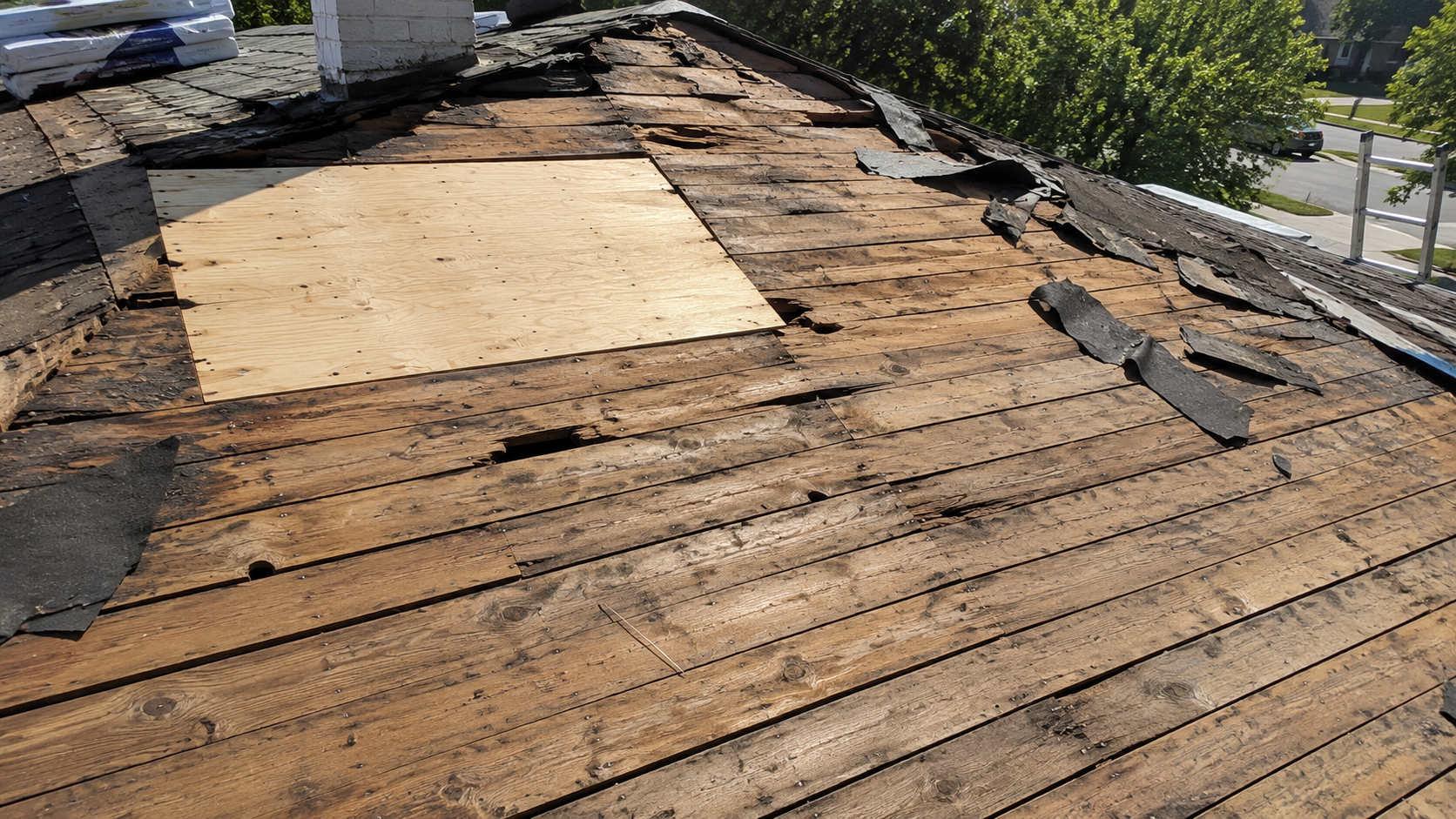
For the broader roof deck assembly, see roof sheathing. If the deck is already soft, rotted, stained, or being cut out in sheets, use replacing roof sheathing instead. For the wider sheathing system across the house, start with house sheathing.
What roof planking means on an older roof
Roof planking is a roof deck made from individual boards instead of plywood or OSB sheets. You may hear it called plank roof decking, plank decking roof, roof decking boards, wood plank roof decking, or old roof boards.
Older houses used board decking because sheet goods were not always the standard roof deck material. Some boards were laid tight, some with small gaps, and some roofs carry old skip sheathing left over from a wood-shingle or shake roof. Those are not the same condition.
The new roofing system decides how forgiving the old deck can be. Asphalt shingles, metal roofing, underlayment, ice barrier, and fasteners all need a deck that is flat, solid, and acceptable to the roofing manufacturer and local inspector.
A board roof deck that worked for old roofing may still be wrong for new shingles.
When old roof planking can stay
Old roof planking can often stay when the boards are dry, tight, flat, well fastened, and close enough together to support the new roof system.
The roofer cannot judge that from the driveway, though. The decision comes after tear-off, when the planks are visible.
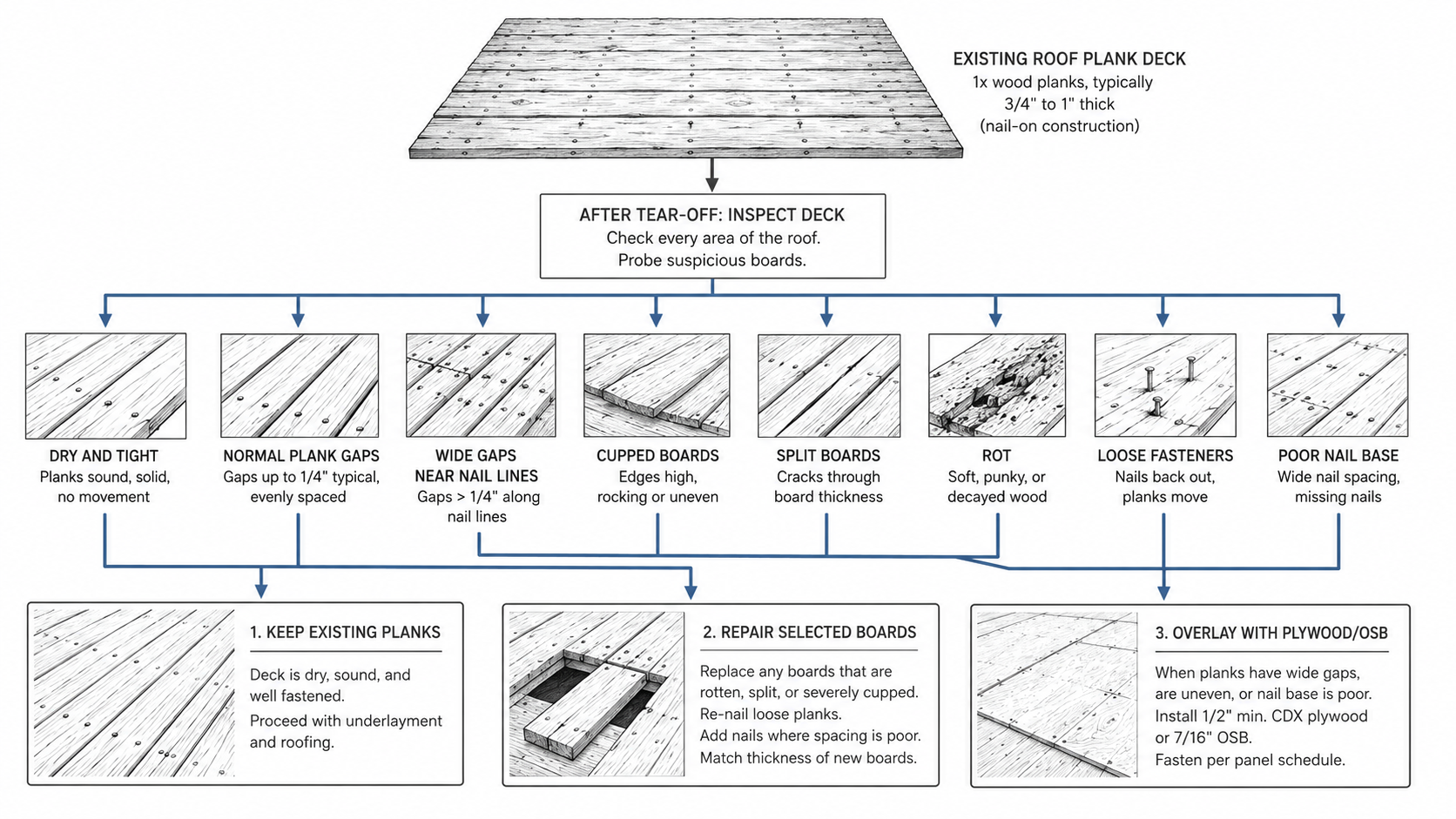
Planking is more likely to stay when:
- The boards are dry and not punky, soft, or stained from chronic leaks.
- The gaps are small enough for the roof covering and underlayment being installed.
- The boards are flat, not cupped high enough to telegraph through shingles.
- Fasteners still bite into sound wood.
- Loose, split, or missing boards can be repaired without rebuilding the whole plane.
Even then, the roofer still has to follow the shingle or roofing manufacturer’s deck requirements. A roof can look good enough to a homeowner and still be a poor base for the product being installed.
When roof planks need plywood or OSB over them
Plywood or OSB overlay is needed when the old roof planks cannot provide a solid, flat, continuous nailing base for the new roofing.
The big triggers are wide gaps, cupping, split boards, loose boards, old skip sheathing, and board edges that do not support fasteners well. On some roofs, the fastest clean fix is to install rated plywood or OSB over the old boards before underlayment goes down.
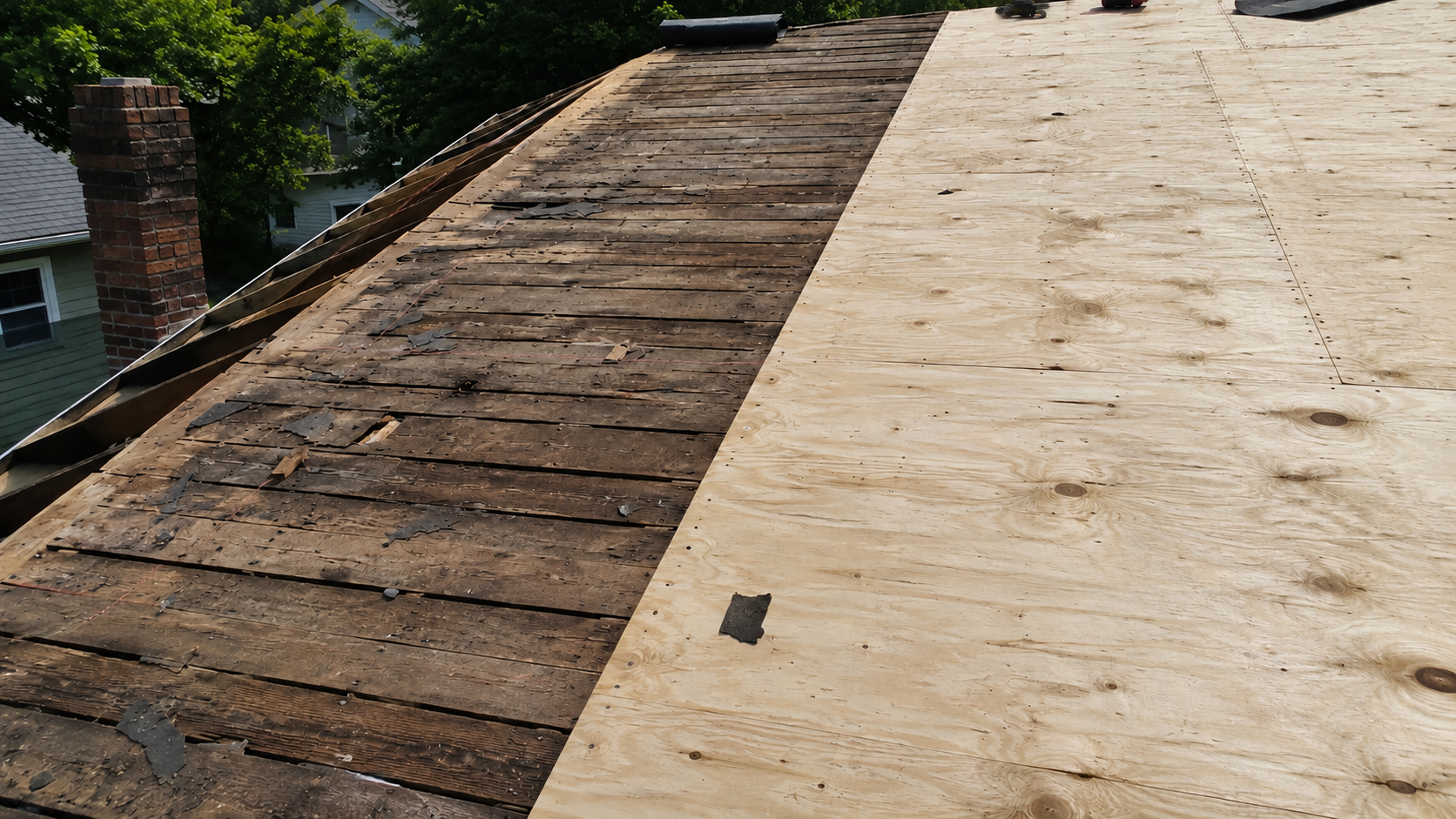
Overlay is not a cover-up for rot. Bad boards still need to be removed or repaired first. If the old planks are wet, soft, moldy, or detached from the rafters, adding plywood over them can trap a bad deck under a new one.
The better sequence is:
- Tear off the old roofing and underlayment.
- Inspect the old roof planking board by board.
- Repair loose, split, rotten, or missing boards.
- Install plywood or OSB overlay if the deck needs a continuous sheet base.
- Install underlayment, flashing, and roofing over a flat, sound deck.
If you need to estimate the sheet count for overlay, use the Roof Sheathing Calculator. If the project has damaged decking or full overlay work, use the Roof Sheathing Replacement Cost Calculator before signing the bid.
Gaps, cupping, splits, and loose boards
The board gaps matter because the new roof does not only sit on the tops of the planks. Fasteners, underlayment, shingles, and roof loads all need support below them.
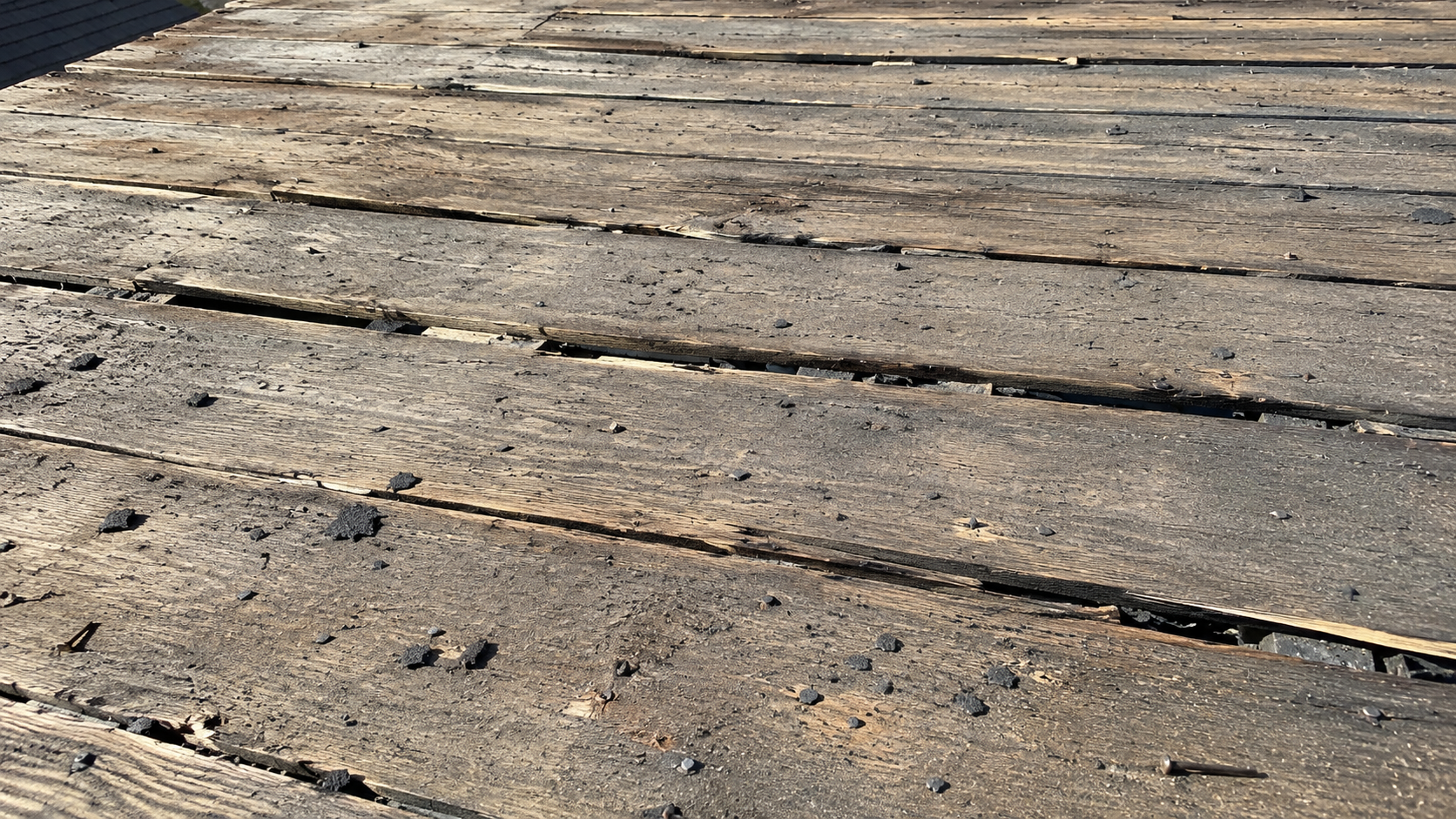
Small gaps between old boards may be acceptable for some roof systems. Wide gaps are different. They can leave underlayment unsupported, allow fasteners to miss solid wood, and create lines that telegraph through shingles.
Cupped boards create another problem. If enough boards are crowned or curled, the new roof may look wavy even with good shingles. The roof covering gets blamed, but the deck caused the shape.
Loose boards are more than a cosmetic problem. A board that lifts underfoot or shifts when you fasten it cannot be trusted as a nailing base, so re-nail or replace it before the new roof covers it.
| Plank condition | What it means | Likely fix |
|---|---|---|
| Dry, flat, tight boards | The existing deck may be usable. | Inspect, re-nail where needed, and confirm roofing requirements. |
| Wide gaps | Fasteners and underlayment may not be supported. | Overlay with plywood or OSB may be needed. |
| Cupped boards | The finished roof can look wavy. | Repair bad boards or overlay if the plane cannot be corrected. |
| Split or loose boards | The deck may not hold fasteners. | Replace or re-fasten before underlayment. |
| Rot or soft planks | The deck is structurally compromised. | Remove and replace damaged boards or deck areas. |
How wide a gap is too wide
This is the question that decides most plank-deck jobs, and it has a real answer, not just “it depends.” The shingle manufacturers set it, and the code makes their instructions mandatory. A roofing nail driven over a gap catches no wood; it just punches through the shingle into open air, and water runs down that nail into the house. That is why the numbers exist.
GAF's board-deck instructions call for boards no wider than about 6 inches, at least a nominal inch thick, and spaced no more than roughly 1/8 inch apart. Owens Corning allows a little more, up to about 1/4 inch, and asks for anything wider to be repaired or replaced. So the rough field rule is simple: gaps under about 1/8 inch are usually fine, 1/8 to 1/4 inch is a gray zone that depends on the exact shingle, and wider than about 1/4 inch almost always has to be corrected. The boards also have to be seasoned, smooth, and sound, not cupped or shrunken, and GAF's deck bulletin even wants them to have been in place for at least five years.
The reason to care is not just water. Installing shingles over a deck that misses the manufacturer's requirements voids the shingle warranty, because the product was not installed per its instructions, and the International Residential Code (R905.1) requires the roofer to follow those instructions. So a wide-gapped deck left uncorrected can cost you both the leak and the warranty you thought you paid for.
The fix follows the damage. A few bad or wide boards get pulled and replaced with new ones. Widespread gaps get the whole plane overlaid with sheet decking, usually at least 3/8 inch and more often 7/16 or thicker, nailed down through the boards into the rafters so the new deck ties to the frame rather than floating on loose planks.
One more thing worth naming, because it explains a lot of old roofs: if the boards are spaced a couple of inches apart on purpose, that is skip sheathing, and it was built that way for a wood-shake or wood-shingle roof so the wood could breathe and dry. It was never meant to carry asphalt shingles, which need a solid deck. Skip sheathing is not a defect on that old roof; it is simply the wrong base for the new one, and it always gets overlaid or re-sheathed. As always, the specific shingle's instructions and the local inspector have the final say over any rule of thumb here.
Roof planking vs plywood roof sheathing
Roof planking and plywood roof sheathing can both form a roof deck, but they behave differently.
Planks are individual boards. Plywood and OSB are sheet panels. Sheets create a more continuous nailing surface, while planks depend on board width, spacing, condition, and fastening.
This is why roofers often recommend plywood over roof planks on old houses. It is not always an attempt to pad the bid; sometimes the old deck simply does not match the new roofing system.
| Deck type | Strength | Main risk |
|---|---|---|
| Old roof planking | Can last a long time when dry, tight, and well fastened. | Gaps, cupping, loose boards, and poor fastener support. |
| Plywood roof sheathing | Continuous deck surface with good repair flexibility. | Can delaminate or rot if leaks continue. |
| OSB roof sheathing | Common, consistent, and cost-effective. | Edges can swell when wet or installed tight. |
The best choice depends on the roof covering, the board gaps, the condition of the old deck, and the local inspector or manufacturer requirements. A simple asphalt-shingle reroof over tight boards is not the same as a roof with old skip sheathing, metal roofing, or heavy water damage.
For a broader comparison of OSB, plywood, gaps, clips, thickness, and roof deck layout, use the main roof sheathing page before choosing materials.
What roofers check during tear-off
The right time to judge roof planking is after tear-off and before underlayment.
After underlayment goes on, the deck problems get harder to see, and after shingles go on, they get expensive to fix.
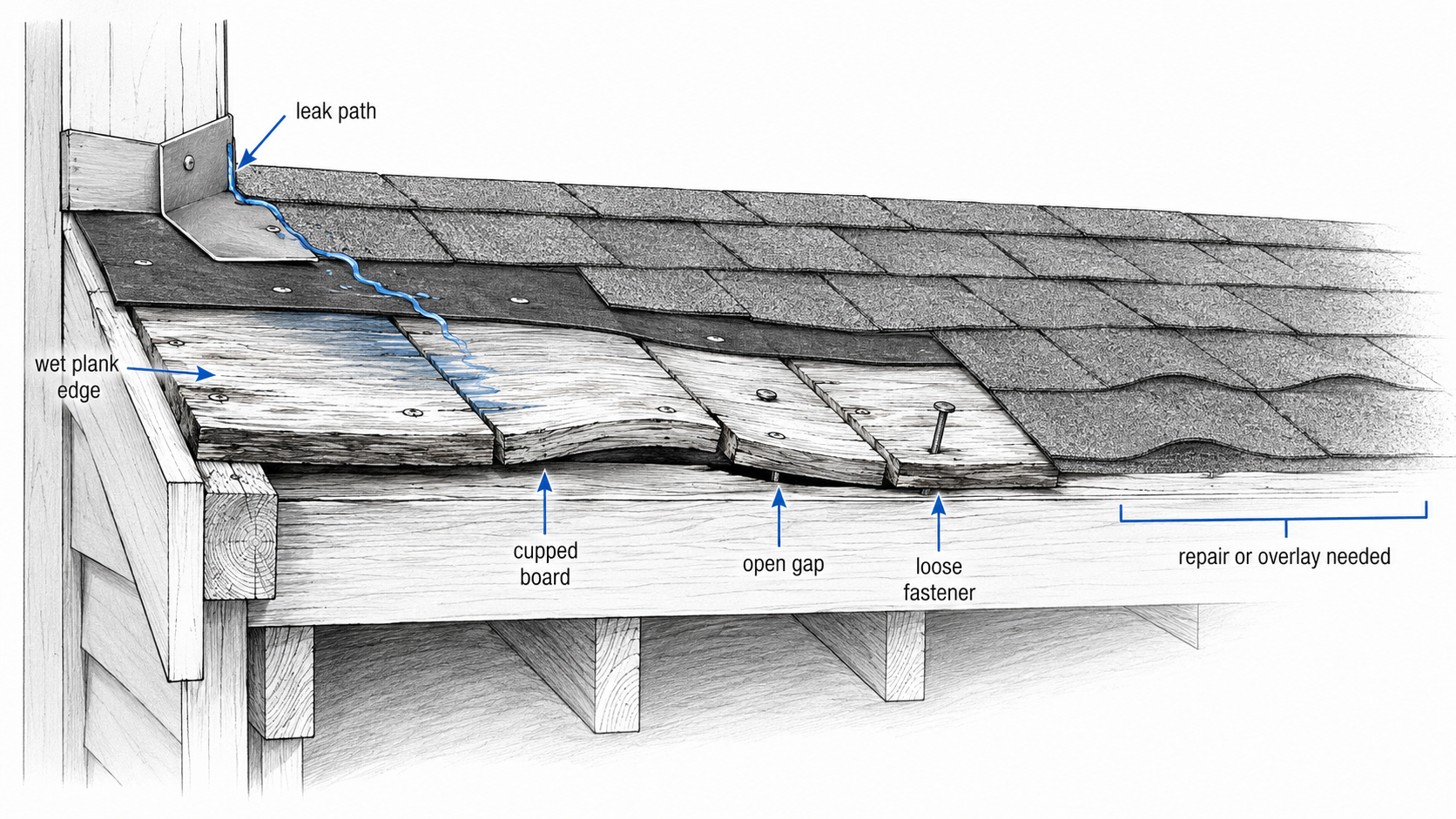
Roofers should check:
- Board spacing across each roof plane, not just one easy spot.
- Cupped, split, cracked, or loose boards.
- Old leak areas at valleys, chimneys, skylights, vents, and eaves.
- Fastener holding, especially where nails land near board edges.
- Rafter spacing and whether the existing boards support the planned roof covering.
Valleys, eaves, roof-wall intersections, chimneys, and old vent penetrations deserve extra attention. Those are common places where water has been reaching the deck for years without being obvious from the outside.
If the roof has soft or rotten plywood or OSB mixed into the old planks, the project may belong partly in replacing roof sheathing. Mixed decks are common on older houses because past repairs were often done one small area at a time.
Cost to repair or cover old roof planking
Roof planking prices are only one part of the cost. The real cost comes from tear-off, inspection, board repair, plywood or OSB overlay, fasteners, disposal, underlayment, flashing, roof pitch, access, and local labor.
As a 2026 planning range, roof decking replacement and overlay work is often estimated around $2 to $5 per square foot for deck work in common cost guides, with many whole-home roof decking replacement projects landing in the low thousands to upper thousands depending on size and complexity. Small localized board repairs may be priced as an add-on during the reroof.
Use these as planning ranges only. A low-slope porch roof, a steep two-story old house, and a large roof with valleys and chimneys are not the same job.
| Condition found at tear-off | Likely scope | Cost risk |
|---|---|---|
| Tight, dry planks | Re-nail loose boards and reroof over approved deck. | Lower, if manufacturer and inspector accept the deck. |
| A few loose or split boards | Replace selected boards before underlayment. | Moderate add-on during reroof. |
| Wide gaps or old skip sheathing | Install plywood or OSB overlay. | Higher because the whole roof plane may need sheet material. |
| Rot at valleys, eaves, or penetrations | Repair boards, fix flashing, then overlay or reroof. | Higher because the water path has to be corrected. |
| Wavy or cupped roof plane | Correct bad boards or overlay to create a flatter deck. | Depends on how much of the slope is affected. |
The best bid separates the roof covering from the deck work. Ask for a line item for plank repair, plywood or OSB overlay, and any per-sheet or per-square-foot adders before the crew opens the roof.
If the cost depends on how many sheets get added after tear-off, run both a low and high scenario in the Roof Sheathing Replacement Cost Calculator. That gives you a better sense of the change-order risk before the crew starts.
The warranty problem nobody explains clearly
Old roof planking can look “good enough” and still create a warranty problem.
Shingle manufacturers usually require a solid, smooth, sound roof deck that meets their installation instructions. If the deck boards are spaced too far apart, loose, cupped, rotten, or unable to hold fasteners properly, the new roof may not meet the product requirements.
This matters after a failure. A homeowner may think they bought a new roof, and the manufacturer or installer may point back to the old deck. By then the question is whether the shingles went down over a substrate the manufacturer accepts, and a roof that looks new from the street can still fail that test.
Protect yourself before installation. Get the deck decision in writing. If the roofer says the old planks can stay, ask what gap limit, fastening condition, and manufacturer requirement they are using. If they recommend overlay, ask why and where.
What to ask before the new roof goes on
Do not wait until the roof is half covered to ask about planking. Ask before tear-off and again after the deck is exposed.
- Are the old roof planks tight enough for the new roofing system?
- What gap size triggers plywood or OSB overlay?
- Will loose, split, or rotten boards be repaired before overlay?
- What plywood or OSB thickness will be used if overlay is needed?
- Will the overlay be fastened into rafters or only into old boards?
- How will valleys, eaves, chimneys, skylights, and roof-wall intersections be handled?
- Will photos be taken before underlayment covers the deck?
- Is deck repair priced per board, per sheet, per square foot, or by change order?
The right answer should be specific. “We’ll see when we get there” is not enough unless the contract also explains how the price changes when the crew sees the deck.
When roof planking becomes a bigger repair
Sometimes roof planking is not just a deck issue. It can expose deeper roof framing or moisture problems.
Watch for sagging rafters, cracked rafters, chronic attic moisture, bath fans venting into the attic, missing ventilation, bad chimney flashing, and old valley leaks. If the planks are soft in several places, the roof has been wet for a long time.
At that point the job has changed from “new shingles over old planks” into a roof-repair project. The roofer may need to repair boards, add overlay, replace flashing, improve ventilation, and correct water paths before the roof is closed.
The protective move is simple: do not let underlayment cover unexplained damage. If the damage is widespread, move from this plank-deck question to the larger roof sheathing replacement scope before approving the roof covering.
FAQ
What is roof planking?
Roof planking is a roof deck made from individual wood boards instead of plywood or OSB sheets. It is common on older houses and may also be called plank roof decking or roof decking boards.
Can you put shingles over old roof planks?
Sometimes. The boards must be dry, sound, flat, tight enough, and acceptable for the shingle manufacturer and local inspection requirements. Wide gaps, loose boards, rot, or cupping can require repair or overlay.
Do old roof planks need plywood over them?
They need plywood or OSB overlay when the boards are too gapped, uneven, loose, split, or poor at holding fasteners. Overlay is also common when old skip sheathing is not suitable for the new roof covering.
Is plank roof decking better than plywood?
Not automatically. Old planks can be strong when dry and tight, but plywood or OSB gives a more continuous nailing surface. The condition of the deck matters more than the name of the material.
What gap between roof boards is too much?
It depends on the shingle, but the common limits are tight: GAF's instructions allow only about 1/8 inch between boards, and Owens Corning allows up to about 1/4 inch. Gaps wider than roughly 1/4 inch almost always have to be corrected by replacing boards or overlaying the deck with plywood or OSB, since a nail over a gap has no wood to hold and can leak.
Can plywood be installed over roof planks?
Yes, when the old planks are sound enough to remain and the overlay is fastened correctly, usually through the boards into the rafters. Rotten, loose, or soft boards should be repaired first instead of being buried under new sheets.
How much does it cost to cover old roof planking with plywood?
Costs vary by roof size, pitch, access, region, sheet thickness, and how much repair is needed. As a planning range, roof decking replacement or overlay work often falls around a few dollars per square foot before the roofing itself.
Should old plank decking be removed?
Only when it is too damaged, loose, rotten, or unsuitable to remain. Many old plank decks can stay if they are sound and properly covered or repaired. Full removal is usually reserved for serious damage or major roof reconstruction.
What should I ask my roofer about roof planking?
Ask whether the boards can stay, what gap limit they are using, whether overlay is included, what thickness will be installed, how bad boards are priced, and whether photos will be taken before underlayment covers the deck.
Read This Next
Old roof planking is only one roof-deck problem. These pages help with the next decision before underlayment and shingles hide the work.
- Roof Sheathing: OSB, Plywood, Thickness, Gaps, and Roof Deck Problems — use this when you need the basic roof deck assembly explained.
- Replacing Roof Sheathing: Cost, Rot, and Repair Scope — use this when the deck is soft, rotted, stained, or being cut out during tear-off.
- House Sheathing: Materials, Wall Panels, Roof Decks, and Common Mistakes — use this when you need the bigger picture across roof, wall, and floor sheathing.
- Roof Sheathing Replacement Cost Calculator — use this before signing a reroof bid that includes plywood, OSB, or deck repair add-ons.
References
Sources used for this article
- GAF: Timberline shingle installation instructions and wood deck spacing requirements
- Owens Corning: roof deck requirements for asphalt shingles, including board spacing over spaced sheathing
- International Residential Code R905.1 and R905.2.1: roof covering application and deck requirements
- APA: Proper Installation of APA Rated Sheathing for Roof Applications
- Asphalt Roofing Manufacturers Association: roof decking spacing and buckled shingles
- IKO: tear-off, roof deck preparation, and shingle installation sequence
- Angi: 2026 roof decking replacement cost context
- HomeGuide: roof decking replacement cost ranges