

A garage addition to a ranch house can solve one problem and create five new ones. The car finally has cover, the tools and bikes have a home, and the groceries come in out of the rain — and then the front of the house starts reading wrong, because the garage gets the biggest opening, the widest driveway, and the strongest roof shape while the entry gets pushed aside, the water moves differently, and the roof tie-in quietly becomes the expensive part. That is where ranch garage additions usually go bad. A ranch is low, long, and simple, and a good addition respects that shape; a bad one turns the house into a garage with a ranch attached to it. The job was never just a garage door and a slab — it is roofline, foundation, driveway, drainage, entry flow, fire separation, storage, permits, and curb appeal, all tied together.
Which Kind of Garage Addition Are You Really Building?
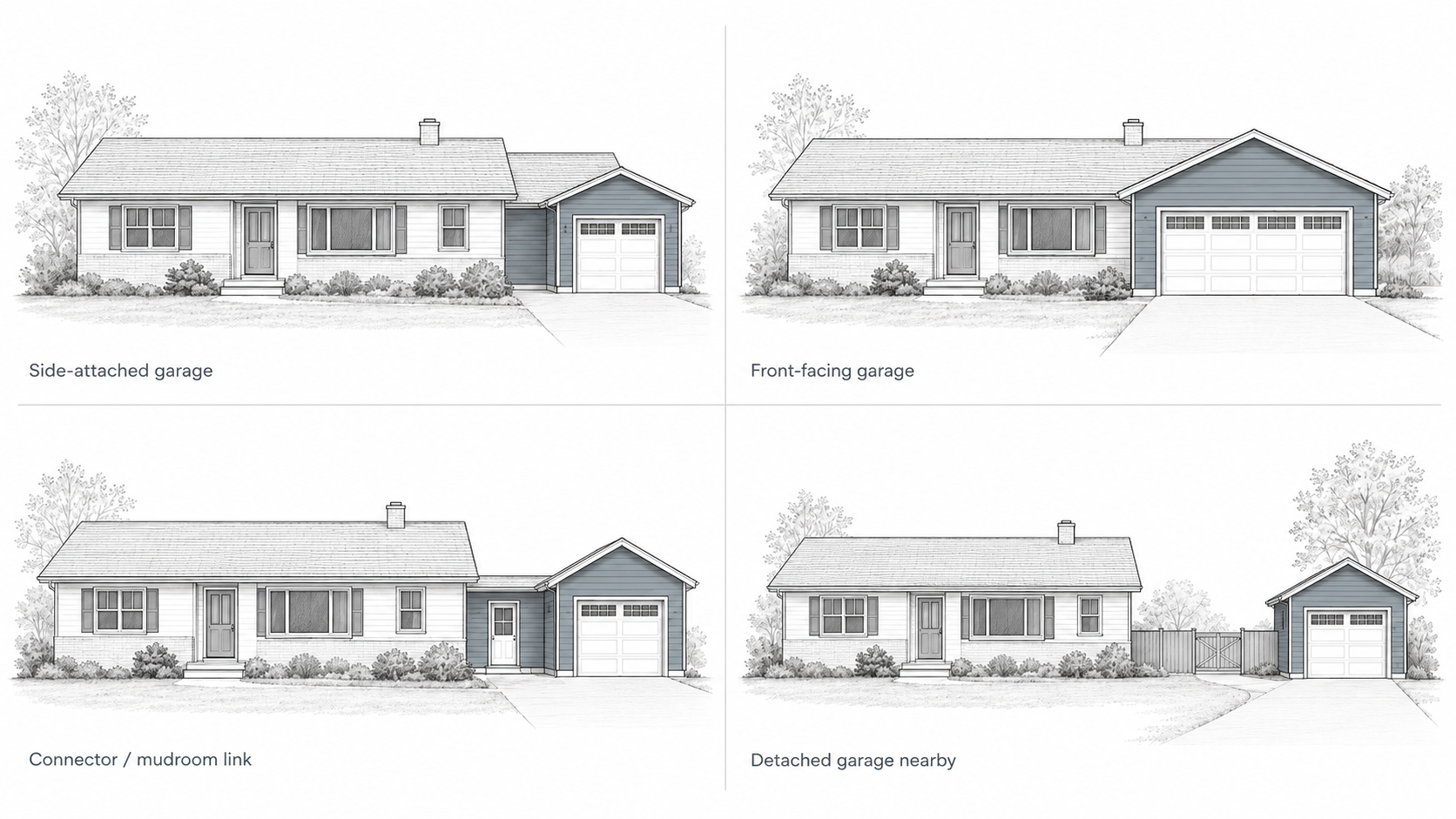
Do not start with the garage door style; start with the type of garage, because a side-attached, front-facing, connector, and detached garage all solve parking differently and change the house differently. A side-attached garage can keep the front calmer, but it needs enough lot width. A front-facing garage may fit the driveway better, but it can take over the house from the street. A connector or breezeway can keep the garage secondary, at the cost of more roof joints and weather exposure. A detached garage protects the ranch form best, but it changes daily life in rain and snow. Size shifts the math too: a one-car garage is usually too tight once you count door swing, storage, trash bins, tools, and a path around the car, and a two-car can push the new mass past twenty feet wide before walls, shelving, and clearance are even counted.
| Garage Type | Best Fit | Common Failure |
|---|---|---|
| Side-attached garage | Wide lots where the ranch can stretch without crowding setbacks | The house becomes too long, flat, and blank on one side |
| Front-facing garage | Lots where the driveway already controls the front approach | The garage door becomes the main face of the house |
| Connector garage | Projects that need a mudroom or softer link between old and new | The connector roof becomes a leak-prone joint |
| Detached garage | Larger lots, workshops, storage-heavy uses, or better façade control | Less convenient daily access in bad weather |
The right answer depends on the lot, the driveway, the roofline, the setbacks, the climate, and how the family actually enters the house every day.
The Garage Can Fix Storage and Break the House
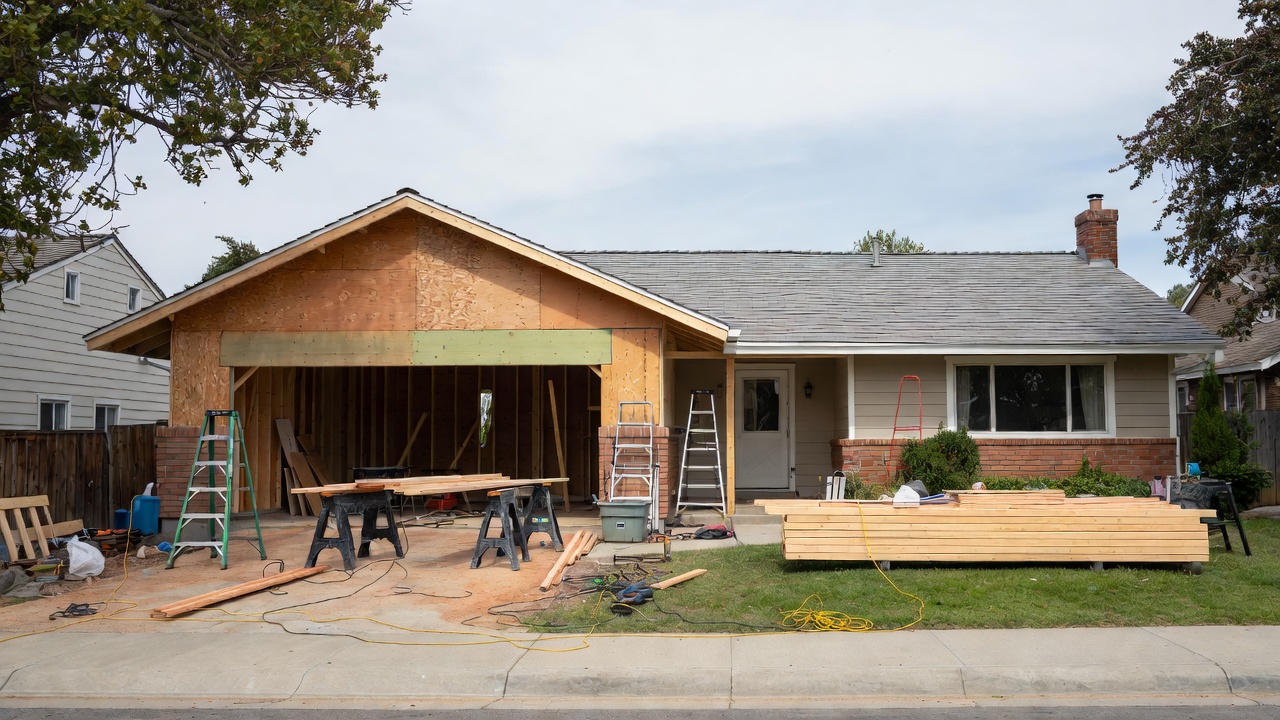
A garage addition is tempting because the benefit is easy to picture: parking gets better, storage gets better, and the house may gain a workshop wall, freezer space, trash-bin storage, sports-gear storage, or a mudroom path. Those are real improvements. The trouble starts when the garage is treated as separate from the house, because on a ranch every new volume shows. The old roof is low, the windows sit in a strong horizontal line, and the entry is usually modest, so if the garage gets a taller gable, a wide door, a fresh driveway, and a bright front light while the entry stays small, the hierarchy flips and the car becomes more important than the front door — and that can happen even when the construction is excellent. Before the garage is drawn, sketch the front elevation and mark the front door, garage door, walkway, driveway, windows, roofline, and main gutter line. If the garage is the first thing your eye lands on, the design still needs work.
When the Garage Takes Over the House
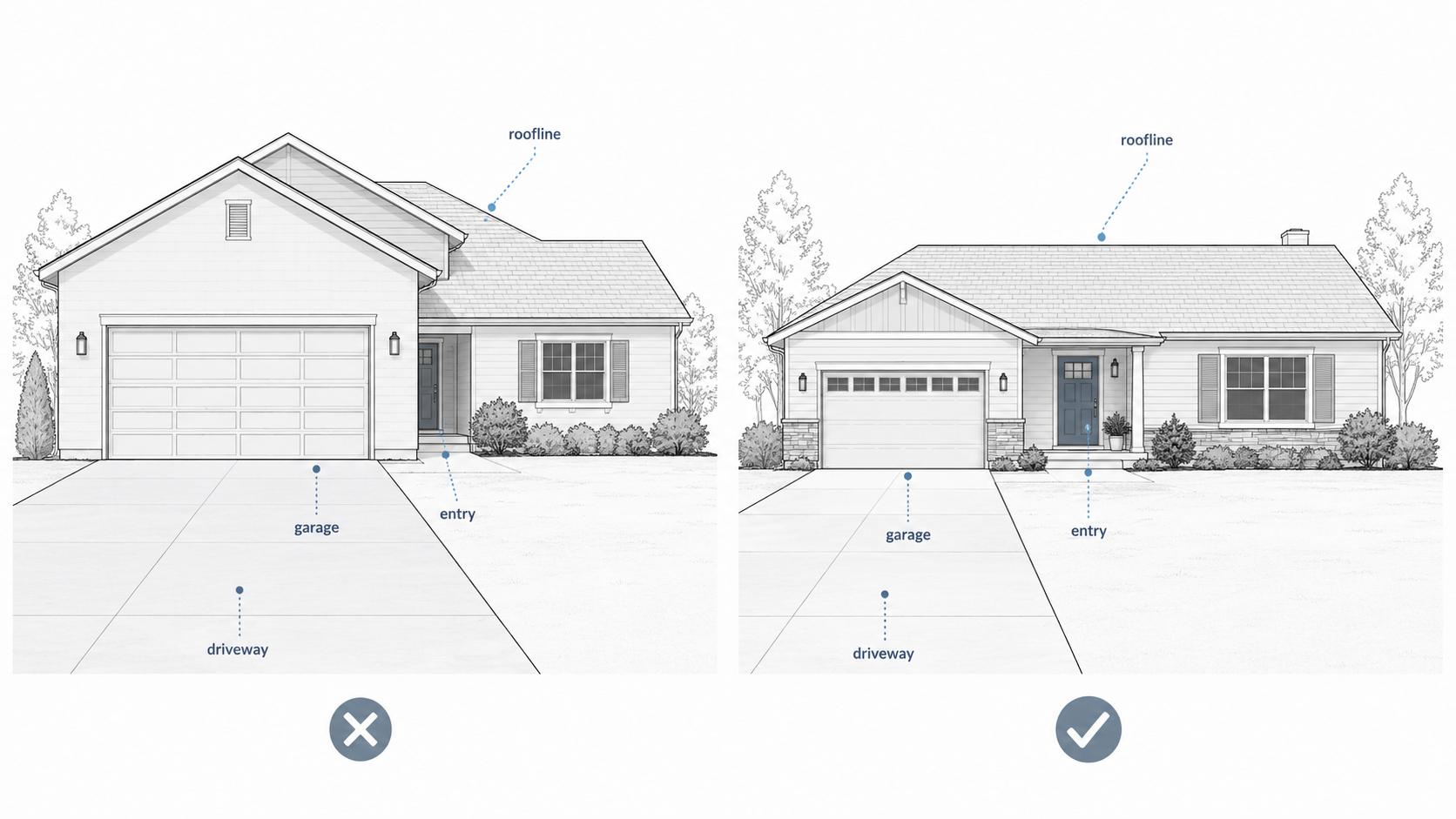
The biggest visual mistake is garage dominance: the new garage gets a broad face, a strong roof, and a wide driveway while the front door stays small, shaded, or off-center, until from the street the house no longer reads as a low ranch but as a garage-first house. Shutters and a nicer garage door will not fix that, because the problem is massing. The garage should sit low enough, quiet enough, and far enough back when the lot allows it, and the entry still needs a clear route, a visible door, good lighting, and a human-scale landing or canopy. A darker garage door helps the mass recede, a clearer entry path pulls attention back to the door, low planting softens the driveway edge without hiding the house, and a small roof adjustment can tie the garage in without overpowering the original roofline — anything to keep the biggest rectangle on the façade from becoming the whole story.
The Roof Tie-In Is Where the Job Starts Getting Expensive
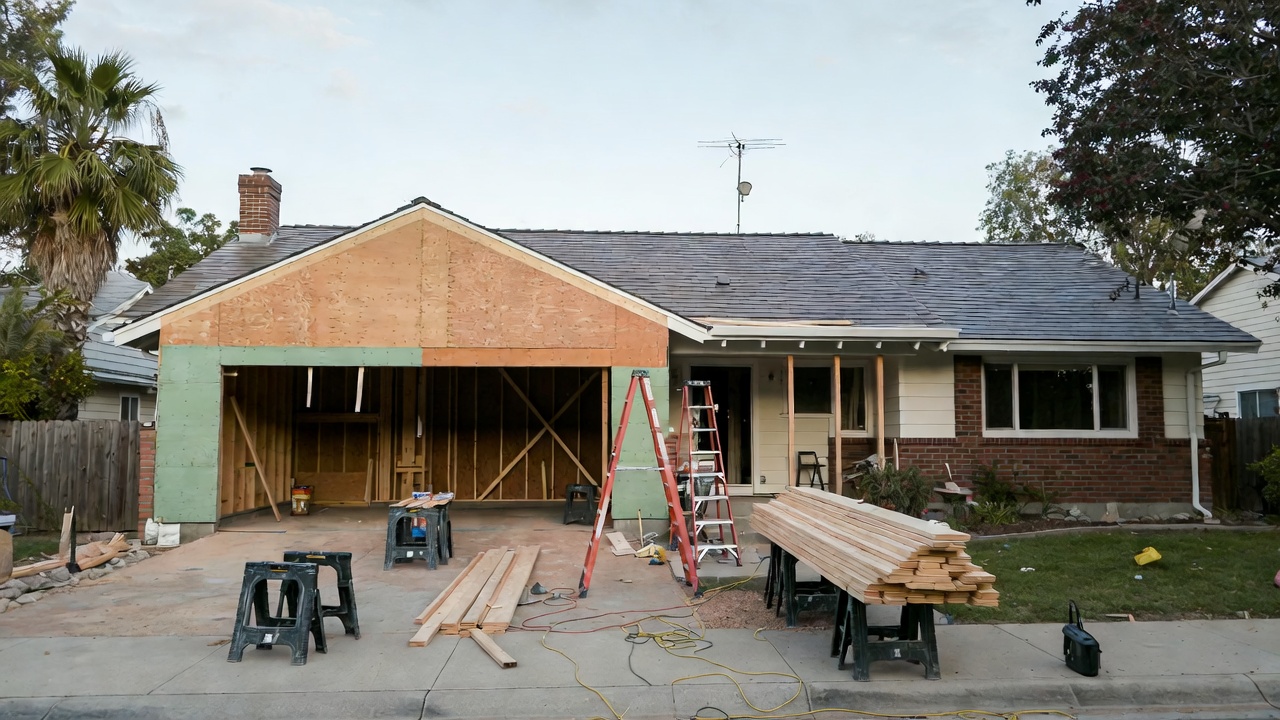
The new garage walls may be simple, but the roof connection is not. A ranch roof is often low and wide, and the new roof has to meet that old plane without creating a dead valley, trapped water, an awkward gutter line, or a strange front shape — and that tie-in decides a great deal. A new gable can look strong but may dump water into a valley; a shed roof stays quieter but the slope and flashing have to be right; extending the existing plane looks clean but can drag more of the old roof into the job than anyone planned. I have seen a proud new gable empty straight into a blind valley against the old ranch roof, and by the next spring the corner behind the garage was soft to the touch. So the estimate should explain, in plain terms, how the new roof meets the old one: what roofing gets removed, where the flashing goes, how the gutter line changes, and where the water leaves. You will not know everything the old roof and wall are hiding until they are opened, which is the real reason the tie-in belongs on its own line rather than folded in as a patch. And if the old roof is already near the end of its life, the addition may force a larger roof decision, because patching new work into a tired roof saves money now and looks rough later.
For broader ranch addition logic, see modern addition to a ranch house. For the connection itself, roof-wall connections is useful background.
Water Problems Start Where the Roof Changes Direction
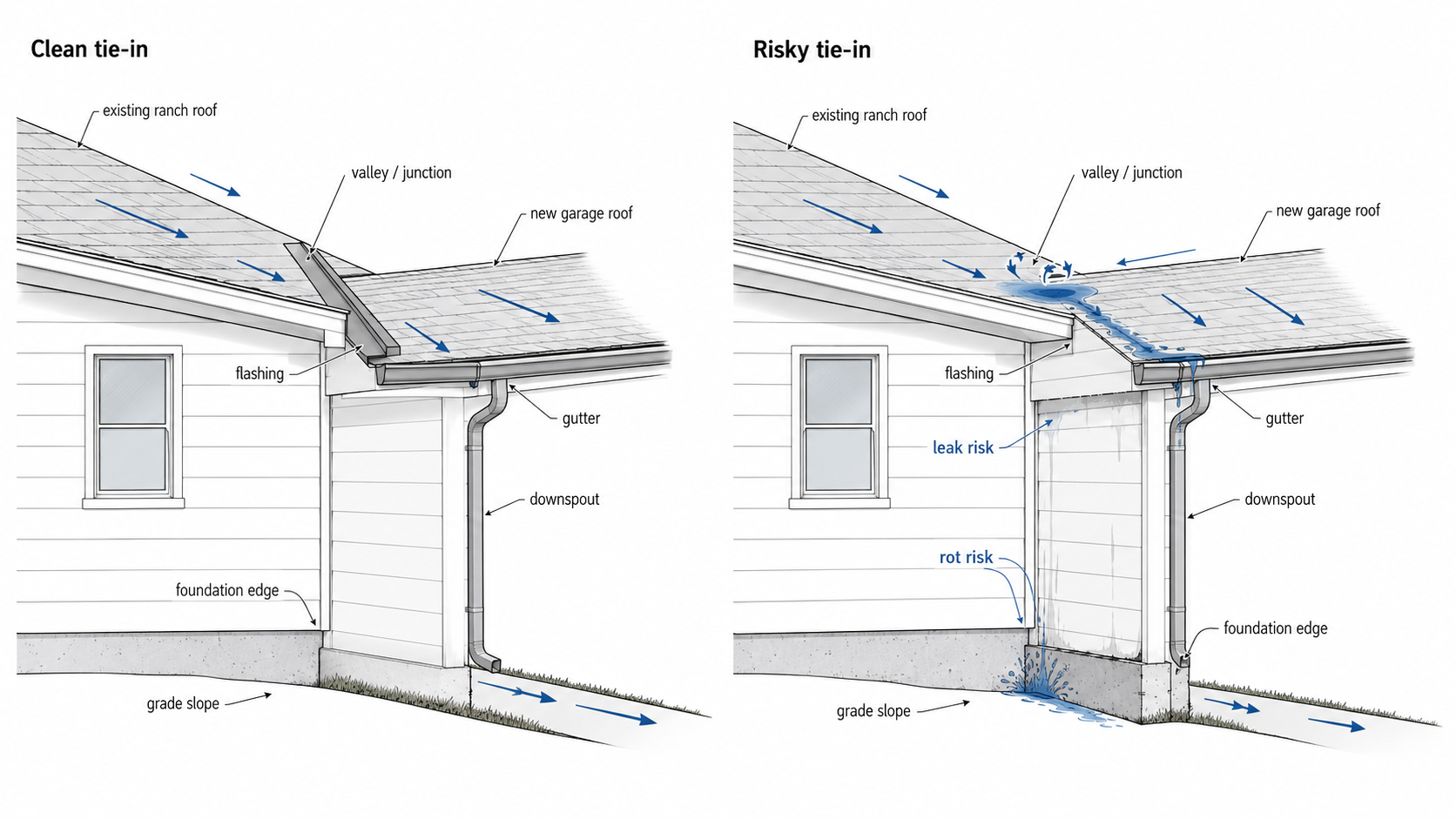
A garage addition redraws the water map around the house. There is more roof area and more water reaching the gutters, more wall and roof edges needing flashing, a driveway that may now slope toward a new door, a slab sitting higher or lower than the old grade, and a downspout that once worked now dumping water beside the garage corner — which is how a parking project becomes a moisture problem. Water has to move away from the old foundation and the new slab: the driveway should not pitch toward the house, downspouts should not discharge into the joint between old and new construction, and planting beds should not hold mulch against siding, sheathing, trim, or brick ledges. None of this shows up on day one. It shows up later as stained siding, swollen trim, wet sheathing, a musty smell, rot at the base of the wall, or drywall damage near the garage connection. If the garage side of the ranch already drains badly, fix that first, because once the slab, driveway, and walls are in, water repairs get much harder to reach. The page on exterior foundation waterproofing is worth reading before a garage covers up a wet side yard.
The Slab Decides More Than the Garage Floor
A garage slab looks like the simple part because it is flat, but it still controls height, drainage, driveway pitch, threshold conditions, the steps into the house, and how water behaves at the door — and in freeze-thaw climates the foundation detail also depends on frost depth, local code, soil, and the inspector. Set it too low and water runs in; set it too high and the driveway approach turns steep or awkward, and I have stood at a finished garage where the slab came in a couple of inches high and every low car scraped its nose on the way up. If the house connection is not planned, the door from the garage into the ranch can land at an awkward step or a missing landing. Before the concrete is poured, four things should already be settled: the finished floor height, the driveway slope toward or away from the door, the step or landing at the house entry, and the drainage path around the new slab edge. The slab is not a separate concrete job — it sets the rest of the addition. For general slab thinking, see slab-on-grade foundation.
The Door Into the House Changes the Project
An attached garage gets more complicated the moment it connects directly into the ranch. The new door may cut through an exterior wall that was never meant to become an interior passage — a wall that can hold wiring, insulation, sheathing, siding, brick, framing, or old repairs — and if the opening is wider than a simple door, structural work enters the picture. The daily-use question matters just as much: a good connection gives shoes, coats, groceries, tools, and wet weather a place to land, while a bad one dumps all of it straight into a kitchen, hallway, or living room, so the garage is attached but the house still has no mudroom logic. Attached garages also need code-compliant separation from living space — under the 2021 IRC, that generally means gypsum-board separation on the garage side, a solid or rated door, and no opening directly into a room used for sleeping (Sections R302.5 and R302.6) — with the exact assembly depending on the local code cycle, the inspector, and whether there is living space beside or above the garage. Do not cut a casual door and assume it is fine, and if a wall opening is involved, read load-bearing vs non-load-bearing walls before treating the connection as a minor change.
Why the Quote Grows After the Garage Is Priced
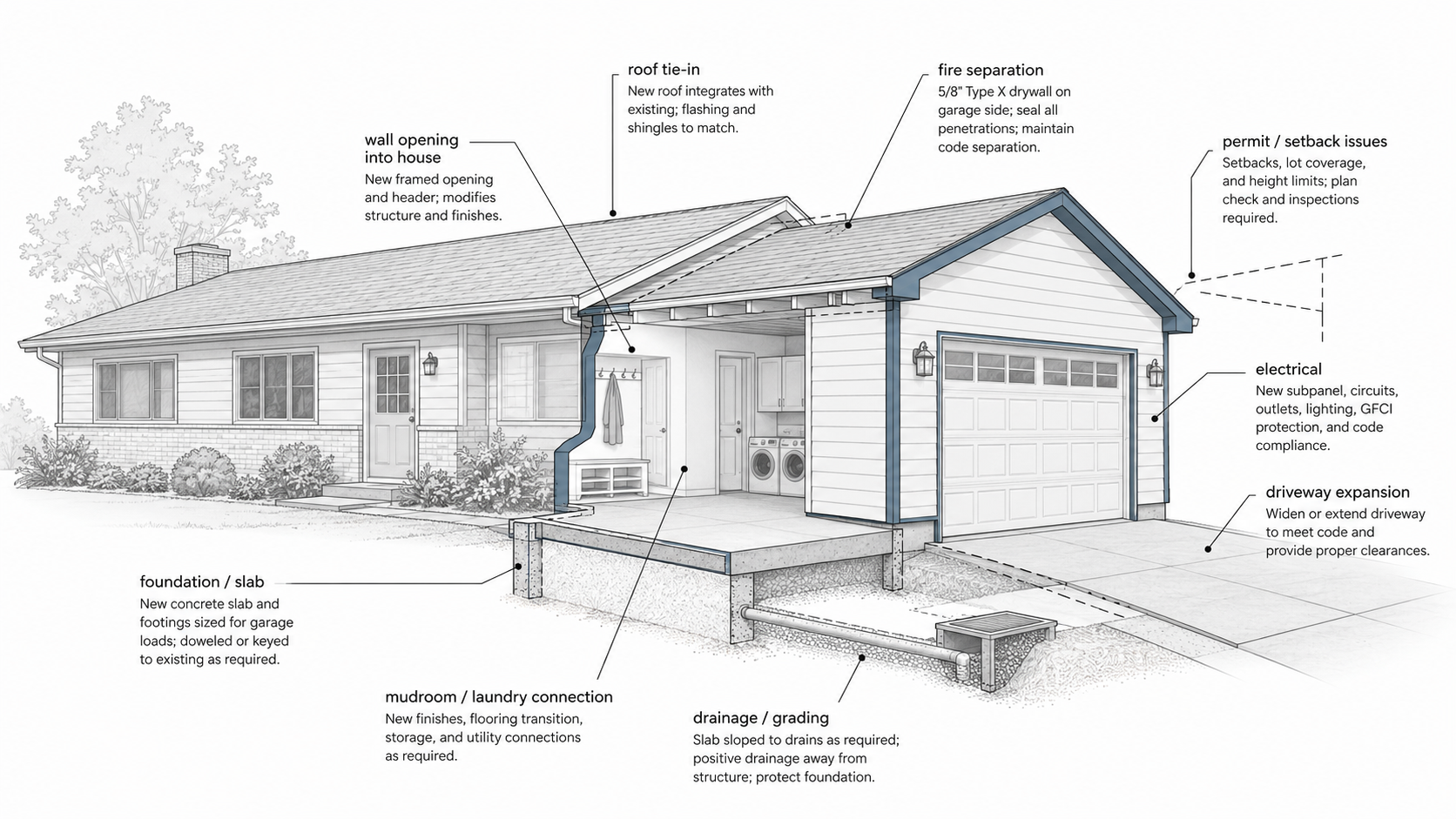
The first price usually sounds like it covers the garage, and then the rest of the job appears: the roof tie-in needs more work, the old siding cannot be matched, the driveway needs replacement instead of a patch, the panel needs review, the garage-to-house door needs fire-rated detailing, the slab height changes the step, and the downspout has nowhere good to drain. That does not always mean the estimate was padded — sometimes the first number was only the garage box, not the whole project.
| Scope Item | Why It Adds Cost |
|---|---|
| Roof tie-in | Old roofing, flashing, valleys, fascia, gutters, and downspouts may all be affected |
| Slab or foundation | Soil, frost depth, vehicle loads, finished height, and drainage change the detail |
| Driveway | Width, slope, cracking, apron location, and drainage can turn a small extension into a larger replacement |
| House connection | Door opening, framing, fire separation, trim, flooring, and interior patching may be needed |
| Utilities | Lighting, outlets, opener power, exterior fixtures, EV readiness, and panel capacity affect scope |
A better estimate separates the garage shell from the connection work, which makes the project easier to understand before the change orders start.
The Garage Changes the Front Even When It Is Built on the Side
This is the part most garage advice skips: the garage may sit on the side, but the front of the house still changes. The driveway widens, the walking route shifts, the garage lights become part of the front elevation, the trash bins and snow shovels find the new corner, and guests start drifting toward the garage instead of the front door. A ranch needs a clear front sequence — driveway, walk, entry light, door, landing, planting, garage — and if the garage gets all the pavement while the front door gets leftover stepping stones, the addition will feel wrong even when it is built well. I have walked up to a well-made addition where the new driveway took all the pavement and the front door was left with three stones in the grass, and the house never read right again. Plan the human path and the car path together: a driveway can serve the garage without swallowing the front yard, a walkway can stay obvious without fighting the garage door, and entry lighting can pull the eye back to the house. The garage should improve daily life without turning the main entrance into a side effect.
Attached Garage or Detached Garage?
An attached garage is convenient, but it is not automatically the better choice. Attached makes sense when the roof tie-in is clean, the driveway already points that way, and the door into the house can become a useful daily entry; it weakens when the garage would dominate the front, crowd the lot line, or force a poor roof connection. A detached garage protects the ranch shape and keeps workshop noise, storage clutter, fumes, and tools farther from the living space, and it often simplifies how the house reads from the street. The tradeoff is use: detached parking feels different in bad weather, and groceries, kids, tools, and winter gear all move differently, so if the garage is the family's main entrance, detached can be less convenient than it looks on a plan. The right call depends on the lot, the climate, the storage needs, the daily entry habits, and the local rules.
Do Not Add a Garage Before Checking Setbacks
A ranch can look like it has room for a garage right up until the property lines are drawn. Side-yard setbacks, front setbacks, lot-coverage limits, easements, utility locations, driveway rules, tree rules, and drainage requirements can shrink the buildable area fast, and corner lots are especially tricky because more than one side may be treated as a front yard. Before paying for a full design, confirm the property lines and setbacks, check whether the driveway location can move, locate the utilities, meters, drains, trees, and easements, and ask whether lot-coverage or stormwater rules cap the garage size. Open lawn is not the same as buildable space — a garage can fit physically and still fail zoning, drainage, or driveway review.
The Driveway Is Part of the Addition
Garage plans routinely understate the driveway, even though an addition may require widening, extending, cutting, replacing, regrading, or draining it, and a two-car garage hung off a narrow old driveway can look right on the elevation and feel awkward every single day. Slope matters as much as width: water should not run toward the garage door, the house wall, or the joint between old and new construction, and if the driveway already cracks, settles, or drains badly, the addition tends to expose a site problem that was easier to ignore before. Construction access matters too, because the same ground needed for the future driveway is usually where the dumpsters, lumber, concrete trucks, deliveries, and contractor parking have to go, and on a tight ranch lot that can drive both timing and cost. Do not price the garage without pricing the pavement.
Where Garage Additions Make the Most Sense
A garage addition pays off best when it solves more than parking. The strongest projects improve parking, storage, and daily entry at once, and the garage often supports a mudroom, a laundry zone, a freezer wall, a tool area, sports storage, trash storage, or a workshop corner — a far better return than simply adding a big door to the front. The test is whether the garage makes the house easier to live in: a cleaner entry rather than a more confusing one, better storage rather than a new unfinished box to pile clutter into, a safer driveway rather than a steeper or wetter one. If the project only adds a garage door and leaves the roof, drainage, entry, and driveway unresolved, it is not ready to build.
When the Garage Addition Is the Wrong First Move
Sometimes the garage should wait. If the roof is failing, the side yard is wet, the driveway slopes toward the house, the electrical service is already stretched, or the foundation has movement on the garage side, those problems need attention first — because the garage can bury the work you should have done earlier. Once the slab is poured and the walls are framed, drainage repair, foundation access, utility rerouting, and roof corrections all get harder, and a garage addition can trap bad conditions behind new construction. That is the expensive mistake: not that the garage was wrong, but that it was built before the site was ready for it.
Before You Approve the Garage Plan
Ask for the plan in pieces, and listen for the vague answers. Where does the new roof meet the old roof? Where does the water go? What is the finished slab height? How does the driveway drain? Where is the door into the house, and what wall is being opened? How is fire separation handled? Where do shoes, coats, trash bins, tools, and stored items land? What happens to the front entry once the garage is built? If those answers are fuzzy, the plan is not ready. A ranch garage addition works when the garage stays useful, the house still reads as a house, and the roof, slab, driveway, drainage, and entry sequence all agree — the goal is not a bigger building, but a ranch that parks better, stores better, drains better, and still looks like someone planned the whole front of the house.
Read Next
- Modern Addition to a Ranch House — how much new mass the original ranch can handle
- Slab-on-Grade Foundation — before treating the garage floor like a simple pad
- Roof-Wall Connections — roof tie-ins, flashing, and where additions leak
- Load-Bearing vs Non-Load-Bearing Walls — before cutting a garage-to-house opening
- Exterior Foundation Waterproofing — if the garage side already has water or grading problems