
Most “is this the best school?” questions are actually three questions: will you get in, will you survive studio, and will it set you up for licensure without weird detours.
UBC can be a great fit. It can also be a miserable fit if you’re picking it for the postcard view instead of the program structure.
- What UBC actually offers (and what it does not)
- The licensure path (Canada-first, with a quick US note)
- Admissions reality: portfolio, background, and what gets people rejected
- Studio life: workload, timing, and the stuff that burns people out
- Cost and logistics: tuition signals, housing pressure, and planning
The Big Misunderstanding
UBC is not “an architecture undergrad + done.” The professional degree is the Master of Architecture (MArch). The Bachelor side is a design foundation, not a license-ready architecture degree.
What Programs Exist
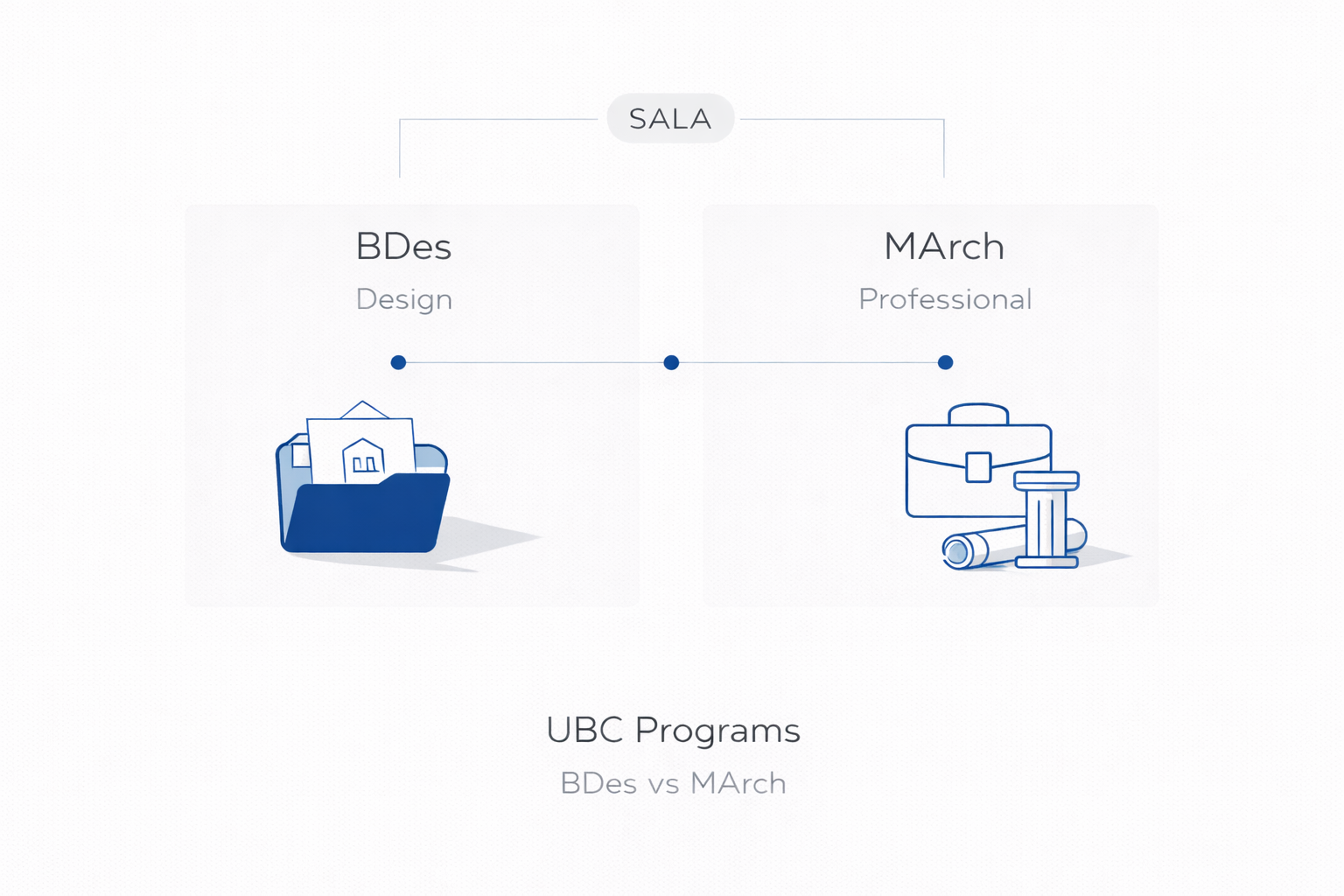
UBC’s School of Architecture and Landscape Architecture (SALA) runs a Bachelor of Design (BDes) and the professional Master of Architecture (MArch), plus other grad programs. The BDes is positioned as the front-end design education; the MArch is the professional path.
Bachelor Of Design
The BDes is where people build portfolio strength, design thinking, and basic technical habits. It’s not the same thing as graduating with a professional architecture credential. Treat it like “design school with architecture proximity,” not “I’m basically an architect in four years.”
Master Of Architecture
The MArch is the program tied to professional accreditation. In the CACB visiting team report, the MArch is described as a professional graduate degree leading toward certification, and the program is explicitly called “highly demanding.”
Licensure Path Reality
In Canada, the cleanest path is an accredited professional architecture degree + the required internship/experience + the exams required by the province/territory. UBC’s MArch sits in that “professional degree” lane.
If you’re aiming for the US, the comparable idea is a NAAB-accredited professional degree. The problem isn’t “UBC is bad,” it’s paperwork and licensing rules: it can be straightforward or it can be a slog depending on the state board and what they accept. Don’t guess. Verify early.
Non-US Note: The Canadian Architectural Certification Board (CACB) is the body that accredits professional programs in Canada, and their visiting team report confirms they reviewed UBC’s MArch in March 2025 and frames it as a professional program leading toward certification.
Admissions: What Trips People
Most applicants fixate on “how pretty is my portfolio.” That helps, but the common fail is simpler: unclear authorship, weak process, and no evidence you can iterate under critique without melting down.
Portfolio Signals That Work
- Process: early sketches, dead-ends, iterations, what you changed and why.
- Range: not 18 posters of the same vibe. Show you can shift scale and method.
- Clarity: readable layouts, consistent labeling, drawings that explain decisions.
- Ownership: if it’s a group project, say what you did. If you can’t, it reads as borrowed work.
Background Questions
A lot of people ask if they “need an architecture undergrad” to do an MArch. In Canada, accredited professional programs often follow either a pre-professional bachelor’s path or a longer professional curriculum for students coming from other disciplines. The CACB report itself lays out these common education structures at the national level (not just UBC).
Workload: The Real Deal
This is where people get burned. Not because they can’t design. Because they treat studio like a hobby with deadlines instead of a production system.
Time Structure
UBC’s MArch timing is not “two quick years.” The CACB report notes the program is represented as 3.5 years on UBC’s side because it includes Summer terms, even though the time spent on campus is described as 32 months. Plan your life like it’s a long haul, not a sprint.
Studio Load
The same CACB report calls the three-year program “highly demanding.” Believe that. Studio is not one course. It is the center of gravity that drags everything else with it.
What Usually Breaks First
- Sleep debt that becomes your “normal.” You get sloppy, then you get slower, then you get more behind.
- File chaos: no naming system, no versioning, last-minute exports that fail.
- Over-rendering to hide weak decisions. Crits don’t buy it.
- Bad feedback filtering: trying to follow every comment instead of choosing a direction and defending it.
Facilities And Hands-On
People love saying “digital fabrication” and “BIM” like it’s magic. The value is basic: you get access to making tools and you learn what breaks when ideas meet gravity and tolerances.
If you want that to actually matter, you have to use it early in the term, not as a panic move in the last two weeks.
Cost And Vancouver Pressure
Two separate problems get mixed up: tuition and living costs. Living costs in Vancouver are usually the bigger stressor, especially if you’re not already local or you’re supporting yourself without family help.
Tuition Signals
UBC’s grad program listing publishes estimated tuition/fees for the MArch and shows different totals depending on domestic vs international status. Use those as baseline numbers, then confirm with UBC fee pages for your exact intake year.
Housing Reality
Studio hours + commute + rent pressure is a real combo. The “best program” becomes the worst program if you’re losing 2–3 hours a day to transit and you can’t afford to miss work shifts.
The One Detail People Miss
Don’t wait for studio to “teach you time management.” Build a weekly production rhythm in week one.
Pick two fixed work blocks (example: two evenings + one long weekend block). Use them for boring work: base drawings, file cleanup, pin-up formatting, model tests. Then use the remaining time for design decisions and iteration.
This one habit prevents the classic failure timing: week 6–8, you realize you’re behind, you start pulling late nights, and your output quality drops right when critiques get harder.
Common Traps
Choosing For Vibes
“Beautiful campus” does not carry you through studio. Program structure, critique culture, and your finances do.
Assuming Licensure Is Automatic
Even with the right degree, you still have experience requirements and exams. If you want to practice outside Canada, you need to plan for equivalency checks early.
Thinking Software Is The Skill
Software is just a delivery system. The skill is making decisions under constraints and communicating them clearly.
Quick Checklist
- Confirm which program you’re actually applying to (BDes vs MArch).
- Map the licensure path you want (Canada vs US) before you enroll.
- Build a portfolio that shows process and authorship, not just final images.
- Plan your weekly production rhythm in week one. Don’t “wing it.”
- Budget for Vancouver living costs like they’re part of tuition.
- Reduce commute time if you can. Studio + transit is a slow death.
- Keep your files clean (naming, versioning, exports). It saves real hours.
FAQ
Is UBC “The Best” For Architecture?
Depends on your goal. If you want a Canadian professional path and you can handle a demanding studio program, it can be a strong option. If you need a lighter workload, cheaper housing, or a US-first licensure path, “best” might be somewhere else.
Does UBC Have A Bachelor Of Architecture?
UBC’s architecture path is not framed as a simple B.Arch → license route. The professional degree is the Master of Architecture (MArch). The Bachelor side is a design degree, not a professional architecture credential.
How Long Is The MArch?
The CACB visiting team report discusses the program as three years and also notes it’s represented as 3.5 years on UBC’s side due to Summer terms, with time on campus described as 32 months. Plan for multiple years, including summers.
What’s The Biggest Reason People Struggle?
Not talent. Systems. Poor time structure, poor file discipline, and leaving production too late in the term.
Do I Need An Architecture Undergrad First?
Not always, but your path length and prerequisites can change depending on your prior degree and how the professional curriculum is structured. Don’t assume. Check the official admissions requirements for your intake year.
Is Sustainability A Real Focus Or Just Marketing?
It’s a real theme in how SALA talks about its work and curriculum. The question is whether you personally want to do the technical and design labor that sustainability requires (envelope, systems, lifecycle thinking), not just mention it in a concept statement.
Can I Use A UBC MArch To Work In The US?
Sometimes yes, but it depends on the state and how they treat accredited Canadian degrees. Verify with the state licensing board early so you don’t graduate into a surprise equivalency problem.
What Should My Portfolio Actually Show?
Process, iteration, and decision-making. Clear drawings. Evidence you can respond to critique and make the work better, not just prettier.
What’s The Smartest Way To Prep Before Starting?
Learn basic drafting/diagram clarity, build a file/versioning habit, and practice producing a coherent pin-up in a fixed time window. Studio rewards repeatable output, not panic miracles.
Final Notes
If you want UBC, choose it for the program structure and the professional path, not the scenery. Then plan your finances and your weekly production rhythm like it’s part of the curriculum. Because it is.