
Stonehenge Architecture & Construction: What We Really Know
Stonehenge isn’t mystical. It’s engineering. Real, raw, and precise. Most people see a bunch of old rocks in a field. But look closer, and you’ll see solar geometry, phased construction, and a design that outlasted 5,000 winters.
Let’s get into the truth behind the stones.
WHAT STONEHENGE REALLY IS

IMAGE: Architectural sketch of Stonehenge depicting its circular layout, upright stones, and lintels.
Stonehenge is a Neolithic monument in Wiltshire, England. Built in stages between 3000 and 1500 BCE, it was part of a vast ceremonial complex. The site includes burial mounds, linear avenues, timber circles, and neighboring megalithic monuments like Avebury.
The structure we call Stonehenge contains two primary types of stone:
- Sarsens: Up to 25 tons, hauled from Marlborough Downs, ~20 miles away
- Bluestones: ~4 tons each, from Preseli Hills in Wales, over 150 miles away
That’s like dragging a car across a country with no roads.
Still Curious? Here's What to Read or Watch Next:
MUST READ: Stonehenge: A New Understanding by Mike Parker Pearson
FIELD PICK: Secrets of the Dead: Bones of the Buddha (PBS Documentary)
HOW THEY BUILT IT
Forget aliens. This was logistics:
- Stones moved on timber sledges over log rollers
- Ropes, levers, ramps, manpower
- Raised vertically into dug pits, lintels added with scaffolding and dirt ramps
Tools used?
- Antler picks
- Wooden mallets
- Stone hammers
- Rope made from twisted plants or hide
They didn’t need magic. Just physics.
WHY IT WASN’T RANDOM
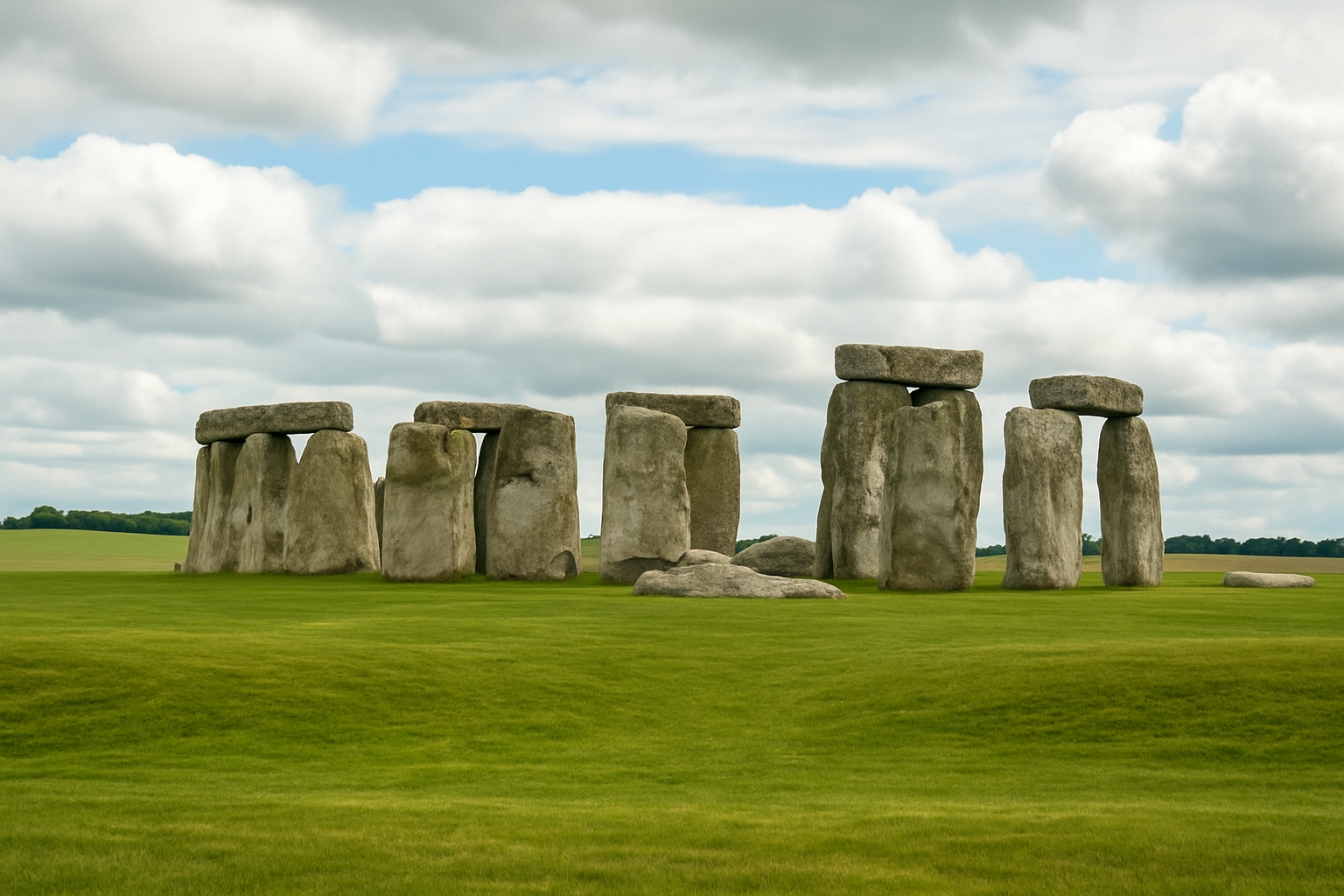
IMAGE: Showing the complete stone circle set within open grassland—capturing the monument’s full architectural presence and prehistoric scale.
Stonehenge aligns precisely with the solstices:
- Midsummer sunrise: Sun rises directly over the Heel Stone when viewed from the center
- Midwinter sunset: Perfect alignment the other way
- The axis line splits the monument symmetrically
Plus:
- Aubrey Holes: 56 chalk pits in a ring—used to track lunar cycles?
- Station Stones: May mark a rectangle aligned to solar and lunar points
This was solar and lunar architecture. Measured by hand. Calculated with the sky.
BUILDING STAGES (OVERVIEW)
● Stonehenge I (c. 3000 BCE): Ditch, bank, timber posts, and cremation burials
● Stonehenge II (c. 2500 BCE): Bluestones arrive from Wales
● Stonehenge III (2000–1500 BCE): Sarsen trilithons erected, bluestones rearranged
This was no one-day monument. It evolved over 1,500 years.
WHO BUILT STONEHENGE?
Not slaves. Not aliens. It was multi-generational human labor:
- Early Neolithic farmers
- Later Beaker people
- Well-fed, healthy laborers
Bones found show workers came from hundreds of miles away. This wasn’t forced labor. It was cultural.
WHY THEY BUILT IT
Theories range from calendar to temple to gathering place:
- Solar observatory: Tracks sun movements
- Ceremonial site: Burial remains support this
- Tribal meeting point: Linked to other Neolithic sites
Most likely? It did all three. And it did it well.
STONEHENGE TODAY
The modern visitor center, by Denton Corker Marshall, uses minimalist design to let the site breathe. It blends into the plain instead of overpowering it.
It’s how you frame history without stepping on it.
WHAT PEOPLE GET WRONG
● No slaves: All evidence points to respected, healthy builders
● No aliens: Tools were simple, effective, and real
● Not a mystery: It was complex, but logical
APPLYING THIS TODAY
Stonehenge still teaches design lessons:
● Orientation matters: Sun, shadow, and seasonality
● Build in phases: Plan for long-term use
● Work with materials: Use local stone, durable structure
● Respect the land: Design with the site, not against it
COMMON MISTAKES (MODERN BUILDERS MAKE)
✕ Ignoring site orientation → Leads to overheating, glare, drainage issues
✕ Over-relying on new tech → Sometimes simple works better
✕ Forgetting symbolism → Buildings need purpose, not just function
COMPARISON GRID
| Feature | Stonehenge | Modern Public Spaces |
|---|---|---|
| Alignment | Solar, symmetrical | Often arbitrary |
| Materials | Local stone, max durability | Steel, glass, concrete |
| Construction Method | Ramps, rope, human labor | Cranes, CAD, prefab |
| Function | Ritual + astronomy + gathering | Circulation, social use |
HOW TO APPLY THIS
□ Consider solar orientation before design begins
□ Choose local, lasting materials when possible
□ Think in phases—build what you can sustain
□ Don’t let symbolism vanish in the blueprint
□ Design for people, not just form
FAQ
WHAT PEOPLE ASK MOST
Q: How old is Stonehenge?
A: About 5,000 years. First dug around 3100 BCE.
Q: Was Stonehenge built all at once?
A: No. It evolved in phases over 1,500 years.
Q: What tools did they use?
A: Antler picks, stone hammers, ropes, and wooden sledges.
Q: Could we rebuild it today?
A: Easily, with machines. They did it with grit and simple tools.
Q: What was it for?
A: Solar tracking, ceremonies, and gathering. Not just one use.
Q: Were people buried there?
A: Yes—cremation burials and bone fragments have been found.
Q: Why bluestone from so far away?
A: Likely spiritual significance. It mattered enough to move them.
Q: Who built it?
A: Neolithic farmers and Beaker people, over generations.
Q: What are trilithons?
A: Two vertical stones with a horizontal lintel on top.
Q: Why is it still standing?
A: Smart engineering. Deep pits, weight balance, durable stone.
Q: What makes it unique?
A: Precision, completeness, and longevity. Few sites come close.
Q: Is it aligned to stars?
A: Mainly to the sun’s solstices, not specific stars.
Q: Can visitors walk among the stones?
A: Not normally. There are limited access tours.
Q: What are the Aubrey Holes?
A: Chalk pits that may have tracked lunar cycles or held posts.
Q: Did Romans use it?
A: They likely saw it, but it was already ancient by their time.
Q: How do we know how old it is?
A: Radiocarbon dating of bones and organic materials in the ditch.
Q: Is it the only stone circle?
A: No. But it’s the most advanced and intact.
Q: What happened to missing stones?
A: Some were removed for building or broke and fell.
Q: Is there a hidden chamber?
A: No confirmed chamber—not like Egyptian pyramids.
Q: Did druids build it?
A: No. They came 2,000+ years later.
Q: Who protects it now?
A: English Heritage manages the site.
Q: Is it a UNESCO site?
A: Yes. Since 1986.
Q: Any myths?
A: Many—including giants and Merlin. None hold up.
Q: Is it still used today?
A: Yes. Solstice festivals and modern ceremonies.
Q: Why does it matter?
A: It shows what humans can build with purpose, tools, and time.
KEEP LEARNING
MUST READ: Stonehenge: A New Understanding by Mike Parker Pearson
FIELD PICK: Secrets of the Dead: Bones of the Buddha (PBS)
TOOL PICK: LEGO Icons: Great Pyramid of Giza (21058) Perfect model to learn scale, chamber design, and layered builds.