
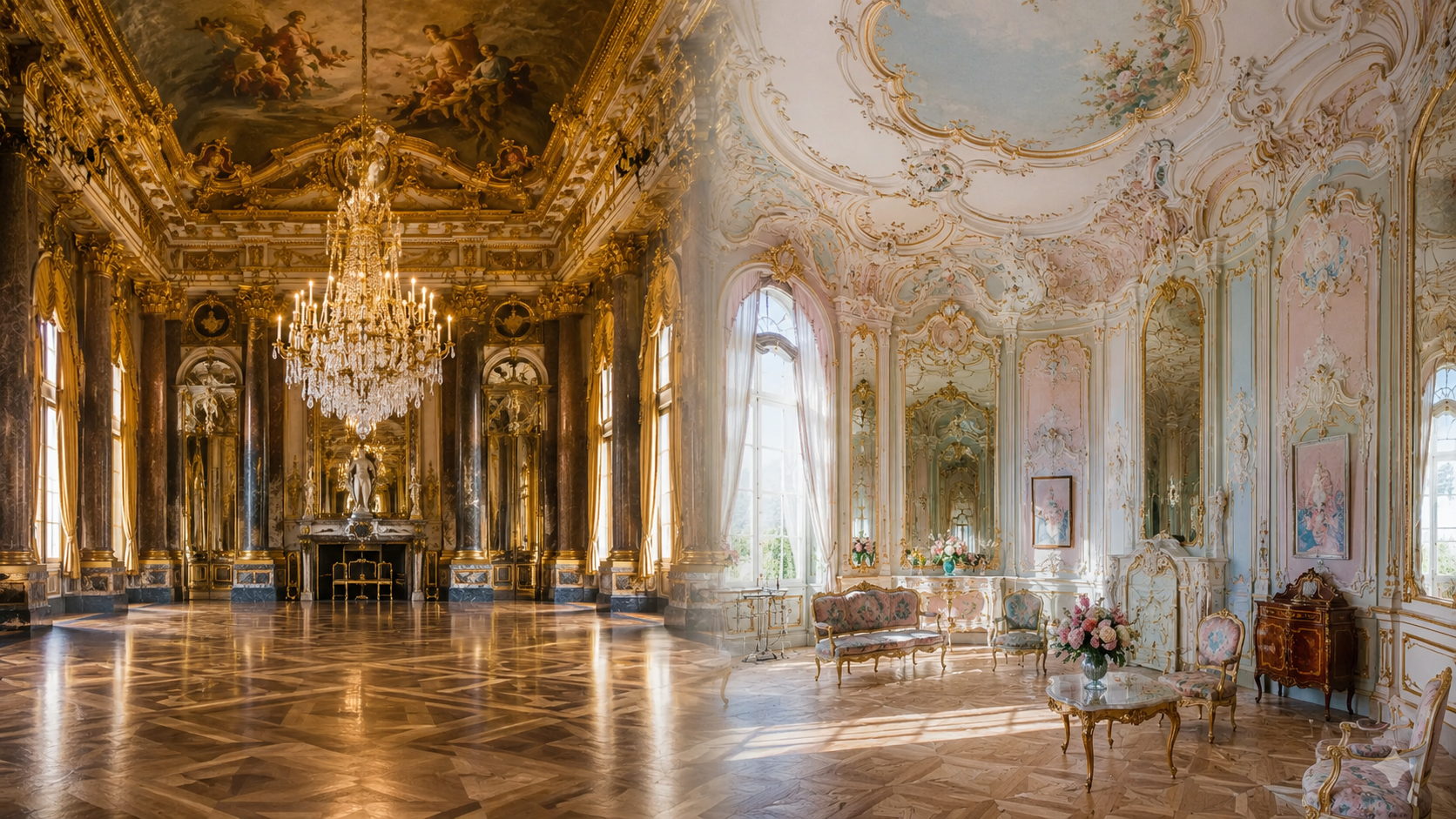
Baroque and Rococo architecture changed how buildings made people feel.
Baroque turned architecture into drama. It used scale, movement, light, shadow, sculpture, painting, stairs, domes, gardens, and facades to make space feel powerful. Rococo came later and pushed that energy into smaller, lighter, more intimate interiors filled with curves, mirrors, pale color, carved detail, and social ease.
These styles are often taught as decorative history. That misses the point. Baroque and Rococo are useful because they show how architecture can control attention, guide movement, shape emotion, and turn a room into a complete experience.
This article looks at the two styles together as a connected architectural story. For a direct side-by-side breakdown, use the dedicated comparison page: Baroque vs Rococo.
What Baroque and Rococo Share
Baroque and Rococo are not identical, but they come from related design instincts. Both care about movement. Both use ornament. Both treat light as part of the design. Both blur the line between architecture, art, furniture, and decoration.
The shared idea is simple: a building should not be a flat container. It should guide the eye, move the body, and create a mood.

| Shared idea | How it appears | Why it matters |
|---|---|---|
| Movement | Curved plans, flowing stairs, shaped panels, dynamic facades | The space feels active instead of still |
| Light | Windows, mirrors, gilding, pale surfaces, deep shadow | Light becomes part of the room’s emotional effect |
| Craft | Carved wood, plaster, fresco, stucco, metalwork, furniture | Architecture and detail work together instead of separately |
| Sequence | Entry, stair, hall, salon, garden, room-to-room movement | The visitor experiences the building over time |
Baroque Architecture: Space Becomes Theater
Baroque architecture grew from a world that wanted stronger emotional force than the calm balance of Renaissance design. It did not abandon order, but it made order more dramatic.
A Baroque building often makes arrival feel important. The facade may swell forward. The stair may rise like a performance. The ceiling may open into painted depth. Light may cut across stone, plaster, and gilding so the room feels deeper than it is.
This is why Baroque architecture is not just a style of ornament. The ornament usually belongs to a larger system of movement, power, and visual control.
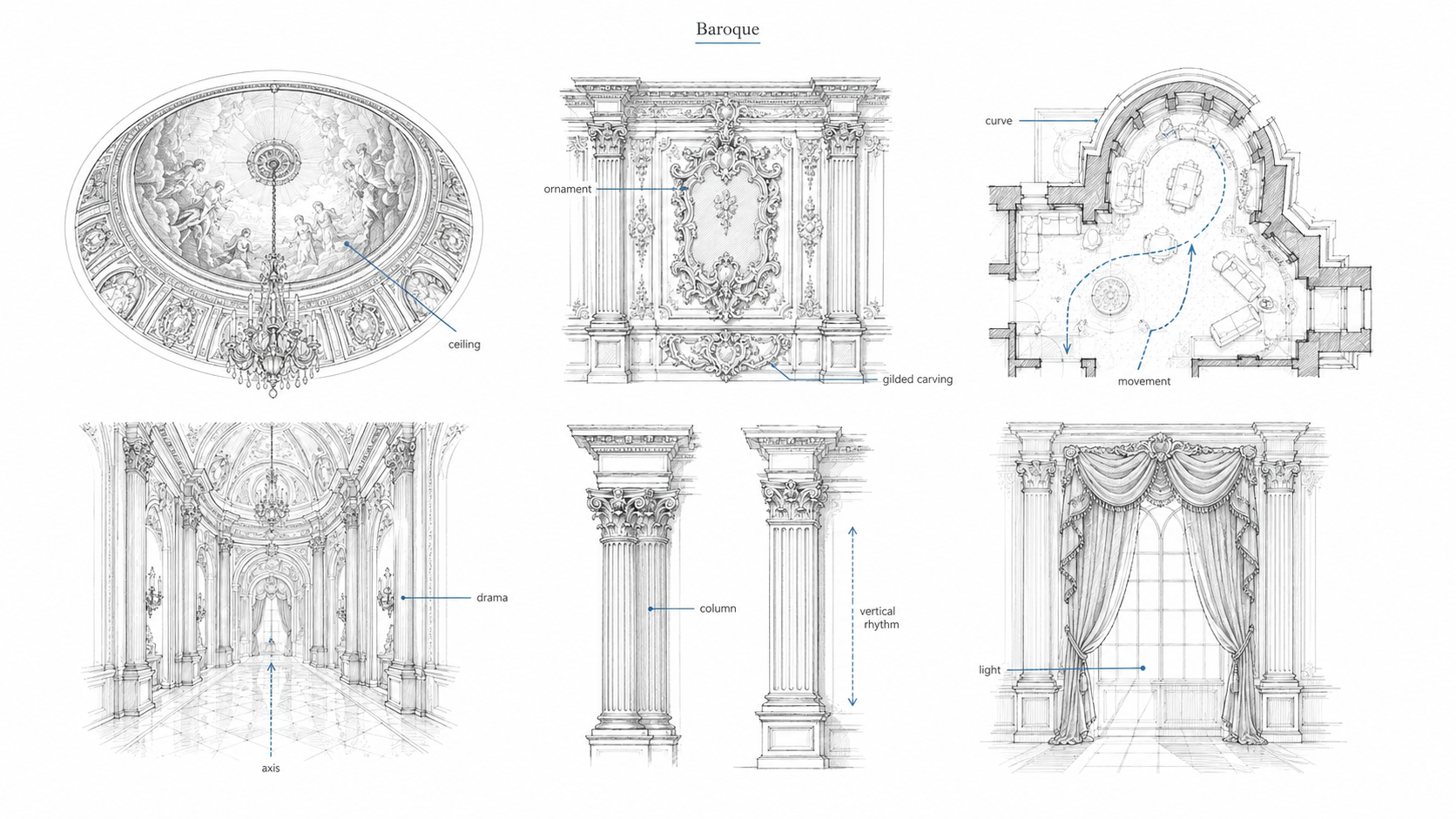
Baroque features students should notice
- Procession: the approach, entrance, stair, and main room often feel carefully staged.
- Light and shadow: contrast creates depth, drama, and focus.
- Curved geometry: ovals, concave and convex surfaces, and swelling facades make space feel active.
- Integrated arts: painting, sculpture, architecture, and decoration often merge into one composition.
- Public effect: many Baroque spaces were designed to impress groups, visitors, patrons, or citizens.
Baroque works to study
- Versailles, France: court architecture, planned movement, gardens, reflection, and long visual axes.
- Schönbrunn Palace, Austria: controlled grandeur, symmetry, and palace sequence.
- Trevi Fountain, Rome: sculpture, architecture, water, and urban drama working as one scene.
- Würzburg Residence, Germany: a strong example of stair movement, ceiling painting, and interior spectacle.
Rococo Architecture: The Room Becomes Social
Rococo came after Baroque, but it did not simply make Baroque smaller. It changed the center of attention.
Baroque often starts with the large gesture: the stair, dome, hall, facade, garden, or city view. Rococo often starts closer to the body: the chair, mirror, wall panel, ceiling edge, porcelain object, carved shell, and pale surface.
Rococo is strongest in interiors and decorative arts because it treats the room as a social setting. The goal is not always awe. Often the goal is conversation, comfort, display, reflection, and pleasure.
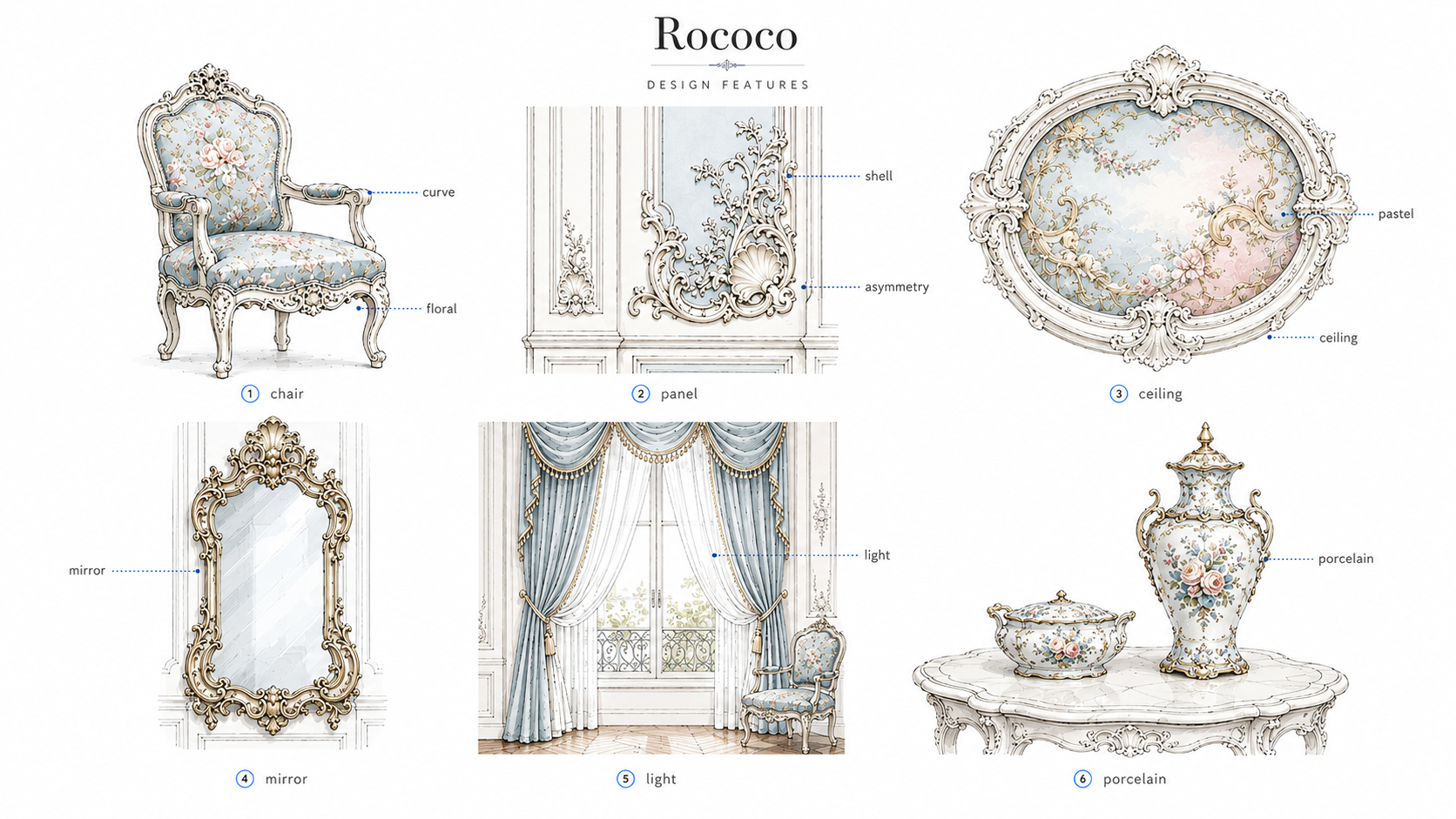
Rococo features students should notice
- Interior-first design: furniture, mirrors, panels, fabric, and objects shape the room as much as walls do.
- Soft curves: S-curves, C-curves, shell forms, and flowing panel edges appear often.
- Asymmetry: ornament may feel balanced without being perfectly mirrored.
- Light surfaces: cream, pale blue, soft green, dusty rose, warm white, and light gilding help soften the room.
- Close detail: Rococo rewards slow looking at edges, frames, carvings, furniture, and small surface shifts.
Rococo works to study
- Hôtel de Soubise, Paris: curved panels, mirrors, gilded frames, and delicate interior movement.
- Amalienburg, Munich: small-scale richness, reflection, pale ornament, and carefully controlled interior atmosphere.
- Catherine Palace, Russia: extreme interior richness, reflective surfaces, gilding, and courtly display.
- Würzburg Residence, Germany: useful because parts of the building sit between late Baroque drama and Rococo refinement.
The Timeline: From Drama to Refinement
Baroque and Rococo make more sense when seen as a sequence instead of two separate boxes.
| Period | Architectural shift | Design result |
|---|---|---|
| Late 1500s | Early Baroque emerges after Renaissance balance | More movement, drama, and emotional force |
| 1600s | High Baroque expands across Europe | Grand palaces, gardens, fountains, stair halls, civic spaces, theaters, and formal interiors |
| Early 1700s | Late Baroque interiors become lighter in some regions | More attention to salons, apartments, mirrors, curves, and surface detail |
| Mid-1700s | Rococo reaches its strongest interior expression | Decorative rooms, pale color, curved furniture, gilded panels, shell ornament |
| Late 1700s | Neoclassicism pushes back against ornate movement | More restraint, straight lines, classical order, and cleaner geometry |
This timeline is not perfectly neat. Some regions held onto Baroque longer. Some interiors mixed late Baroque planning with Rococo surfaces. Some buildings from the same century moved toward Neoclassical architecture instead.
The Boundary Problem: Not Everything Courtly Is Rococo

A common mistake is calling every elegant 18th-century French building Rococo.
Petit Trianon is a useful warning. It is connected to the world that followed Rococo, but its exterior is controlled, geometric, and restrained. It does not behave like a shell-covered Rococo salon. Its value in this article is as a boundary case: a reminder that date, location, and luxury do not automatically define the style.
When reading Baroque and Rococo architecture, look at behavior first. Does the building stage movement and drama? Does the interior dissolve into curved panels, mirrors, and delicate surface detail? Or is it becoming calmer, straighter, and more classical?
The Section Most Articles Miss: How These Styles Were Experienced in Sequence
Baroque and Rococo were not only visual styles. They were experienced while moving.
A visitor did not see a palace or grand interior as a single image. They approached it, entered it, turned, climbed, paused, looked up, crossed thresholds, sat down, and noticed details at different distances.
Baroque used that movement to build drama. The approach mattered. The entrance mattered. The stair mattered. The ceiling mattered. The view across a hall or garden mattered. A building could make the visitor feel pulled through a controlled sequence.
Rococo used sequence differently. It often worked room by room, surface by surface. The visitor moved closer to mirrors, furniture, panels, fabric, porcelain, and carved edges. The experience became less about a grand arrival and more about social movement within the room.
This is why Baroque and Rococo still matter for architects and interior designers. They teach that design is not only what a space looks like from one perfect camera angle. It is what the body experiences over time.
How Baroque and Rococo Shaped Interior Design
The most useful lesson from these styles is the way they connect architecture and interiors.
In weak design, architecture stops at the walls and decoration gets added later. In strong Baroque and Rococo work, the walls, ceiling, light, furniture, mirrors, paintings, and decorative objects belong to one system.
Baroque tends to make that system dramatic and hierarchical. Rococo tends to make it lighter, more social, and more intimate.
- Ceilings were not leftovers. They could open the room upward, frame a scene, or soften the space.
- Mirrors were not only decorative. They extended light, multiplied views, and made rooms feel more animated.
- Furniture was not separate from architecture. It helped define how people sat, talked, gathered, and moved.
- Ornament was not random. In good examples, it followed lines, frames, joints, openings, and room hierarchy.
Modern Lessons Without Copying the Costume
You do not need to copy a palace to learn from Baroque and Rococo architecture. The stronger move is to borrow the logic.
Use the Baroque lesson when a space needs a strong arrival
A lobby, stair, restaurant entry, gallery, theater, hotel hall, or formal living room may need a stronger arrival. That does not mean covering the room in gold. It may mean one strong axis, one dramatic light fixture, one shaped wall, one deep color, or one controlled view.
Use the Rococo lesson when a room needs intimacy
A sitting room, bedroom, powder room, boutique, cafe, or small hospitality space may need softness and close detail. That does not mean filling the room with scrolls. It may mean a curved chair, pale wall color, better mirror placement, shaped paneling, or warm layered lighting.
Use both lessons carefully
Baroque teaches the big move. Rococo teaches the close detail. A strong modern interior may use one from each, but one idea should lead. If everything tries to be dramatic and delicate at the same time, the room becomes confused.
The Practical Problem: Ornament Has to Be Built and Maintained
Baroque and Rococo look effortless in photographs, but real ornament creates real problems.
Carved trim collects dust. Gilded surfaces show bad repairs. Plaster cracks at joints. Mirrors double clutter. Painted ceilings need the right light. Curved furniture can be harder to repair or reupholster. Decorative panels can fight outlets, vents, switches, speakers, and return grilles.
This matters in modern homes, hotels, restaurants, and renovations. A historical reference only works if the room can support it physically.
| Design move | What can go wrong | Better approach |
|---|---|---|
| Heavy Baroque-style trim | A low ceiling can feel crushed | Use one strong wall, ceiling edge, or focal point instead of trimming everything |
| Large chandelier | Wrong scale makes the room feel fake-grand | Size the fixture to the ceiling height, table, and room volume |
| Rococo-style mirrors | Mirrors can multiply clutter and bad views | Place mirrors where they reflect light, depth, or a controlled view |
| Decorative wall panels | Outlets, vents, and switches can break the pattern | Plan panels around real wall services before installing trim |
| Pastel Rococo palette | Cold LED lighting can make soft colors feel flat | Test paint under warm evening light, not only daylight |
Small Spaces Can Learn From Both Styles
Baroque and Rococo do not only belong in large historic buildings. A small room can use their lessons, but it has less room for mistakes.
Use Baroque thinking for one clear focal point. That might be a mirror, a fireplace wall, a dark painted niche, a ceiling medallion, or one strong light fixture.
Use Rococo thinking for softness and close detail. That might be a curved chair, pale color, shaped mirror, floral fabric, or small decorative panel.
The key is restraint. A small room should not pretend to be Versailles. It should borrow one useful idea and let the rest of the space breathe.
How Baroque and Rococo Connect to Other Styles
Baroque and Rococo also become clearer when placed beside neighboring movements.
Baroque and Gothic architecture both create strong spatial emotion, but they do it differently. Gothic often works through vertical structure, height, pointed forms, and exposed structural rhythm. Baroque often works through movement, light, curves, and theatrical staging.
Neoclassical architecture reacts against the restlessness of Baroque and Rococo. It returns to clearer geometry, classical proportion, straighter lines, and restraint.
Art Deco also uses ornament, but its ornament is sharper, more geometric, and more modern in feeling. It does not rely on Rococo shell curves or Baroque theatrical depth.
Visual Gallery: Baroque and Rococo in Focus
Use these images as a visual study bank. Do not only look for gold or ornament. Look for scale, light, surface, movement, furniture, and the distance from which the design works.


What Students Should Sketch
If you are studying Baroque and Rococo architecture, do not start by copying every ornament. Start with the room logic.
- For Baroque, sketch the approach, axis, focal point, light source, stair, dome, or main room sequence.
- For Rococo, sketch the wall panels, mirror placement, furniture curves, ceiling edge, and decorative flow.
- For both, mark where architecture ends and applied ornament begins.
- Then ask whether the details support the room or only decorate it.
That is the difference between memorizing styles and understanding architecture.
FAQ
What are Baroque and Rococo architecture?
Baroque and Rococo are related European design movements known for movement, ornament, light, and crafted interiors. Baroque is usually grander and more dramatic. Rococo is usually lighter, more intimate, and more focused on interior detail.
Did Rococo come after Baroque?
Yes. Rococo developed after Baroque, especially in the early 1700s. It kept some Baroque movement and ornament but shifted the mood toward smaller rooms, pale color, curved panels, mirrors, and social interiors.
Is Rococo architecture or only interior decoration?
Rococo is strongest in interiors and decorative arts, but it still affects architecture because rooms are architectural spaces. Wall panels, ceilings, mirrors, openings, furniture, and circulation all shape how the room works.
Why are Baroque and Rococo important for students?
They show how design can control emotion, movement, light, and attention. Studying them helps students understand architecture as an experience, not just a shape or style label.
Can modern interiors use Baroque or Rococo ideas?
Yes, but the safest move is to borrow the logic instead of copying the whole look. Use Baroque for drama, hierarchy, and arrival. Use Rococo for softness, intimacy, mirrors, curves, and close detail.