

Small apartments do not need more clever furniture. They need fewer bad decisions.
Most small-apartment problems start before anything is bought: the walking path is unclear, the entry has no landing zone, the bed wastes floor area, storage is scattered, and the kitchen counter becomes overflow. Then the apartment fills with bins, carts, shelves, and folding pieces that solve one problem while creating another.
A folding table is not useful if it blocks the only route to the bathroom. A storage bed is not useful if the drawers cannot open. A wall shelf is not useful if every daily object becomes visual noise.
Start with how the apartment actually works. Then buy furniture.
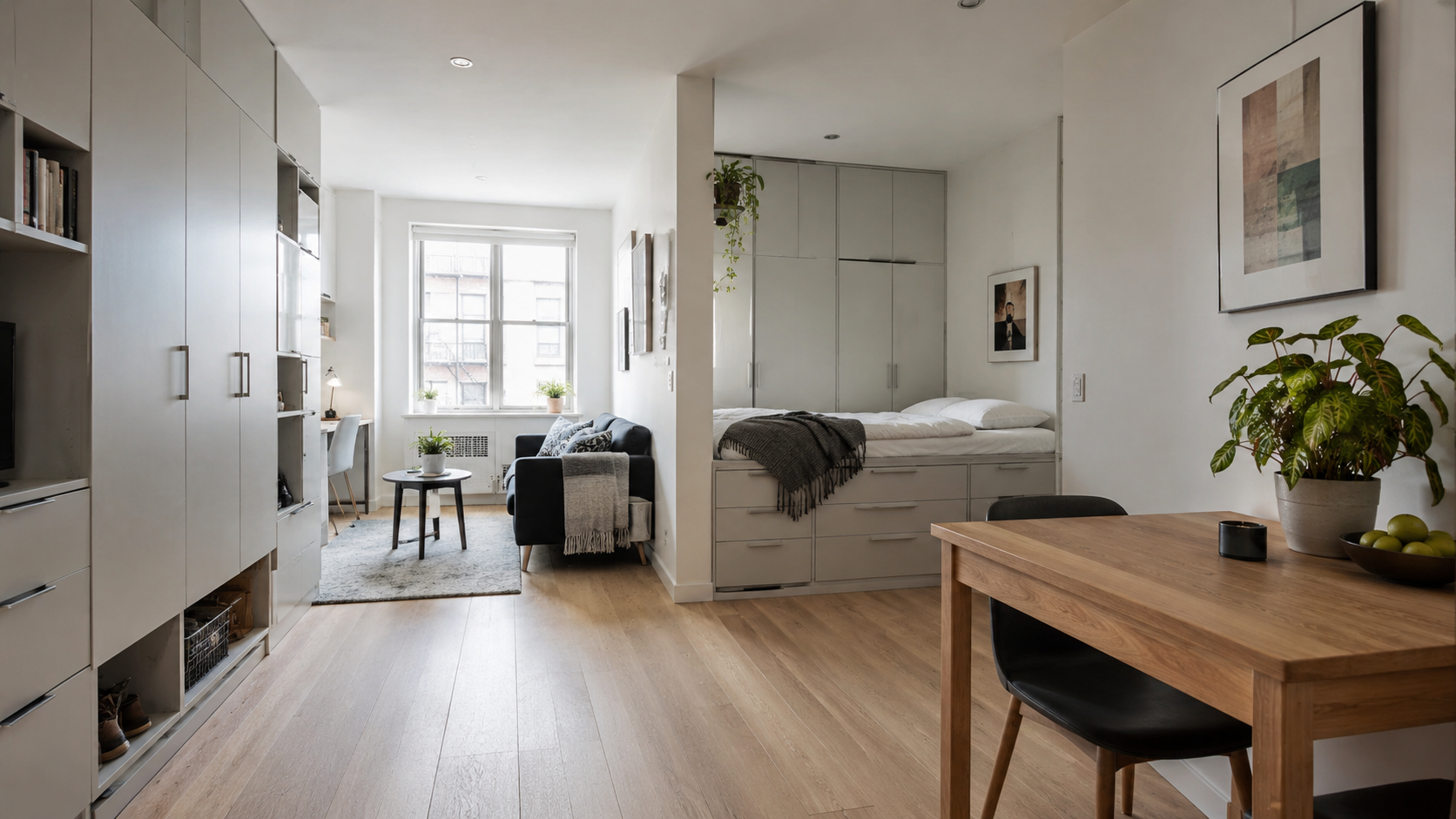
The Real Problem Is Not Size. It Is Conflict.
A small apartment has several jobs fighting for the same square footage: sleeping, eating, working, storage, cooking, getting dressed, and moving through the room.
When those jobs overlap badly, the apartment feels smaller than it is. The bed becomes the office. The dining table becomes the mail station. The sofa becomes laundry storage. The entry becomes a pile of shoes and bags. The floor becomes overflow storage.
That is not a decorating problem. It is a space-planning problem.
Before buying anything, find the conflict:
- Does the entry collect shoes, bags, keys, coats, and mail?
- Is the bed taking over the whole room?
- Is there no proper work or eating surface?
- Is kitchen storage spilling onto the counter?
- Is the main walking path blocked?
- Are you buying bins because the furniture itself does not store enough?
- Can the apartment reset in ten minutes, or does every task leave a pile behind?
Fix those problems first. That is how a small apartment starts to feel planned instead of crowded.
Where Small Apartments Waste Space First
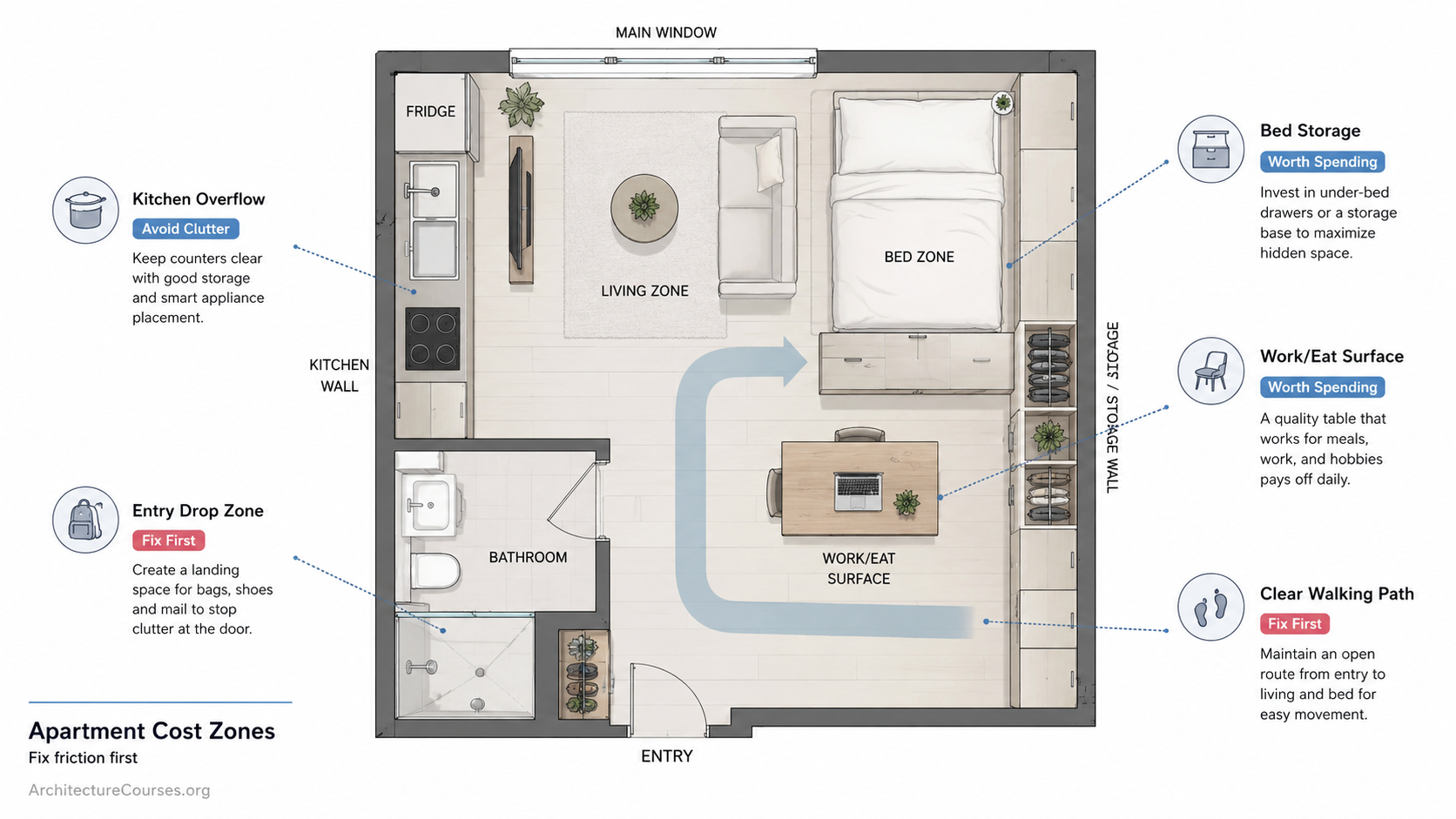
The most expensive mistake is not always buying the wrong sofa or bed. It is spending money on the wrong problem.
A small apartment usually wastes space in five places first: the entry, the bed zone, the kitchen counter, the work or dining surface, and the walking path. If those areas are broken, decorative storage will not fix the apartment. It will only make the clutter look organized for a few days.
| Problem area | What usually goes wrong | Fix before buying |
|---|---|---|
| Entry | Shoes, bags, mail, keys, and coats spread into the room | Shoe storage, hooks, tray, mail spot |
| Bed zone | The biggest item gives back no storage | Under-bed storage, lift-up storage, or better dresser plan |
| Kitchen counter | Appliances and pantry items replace prep space | Remove duplicates, add cabinet function, clear one landing area |
| Work surface | The bed, sofa, or dining table becomes permanent office clutter | Small desk, reset drawer, cable storage |
| Walking path | Furniture technically fits but daily movement feels tight | Reduce depth, move carts, open the main route |
Fix the Walking Path First
The cheapest space upgrade is a clear walking path.
In a small apartment, the route from the front door to the bathroom, kitchen, bed, closet, and main window should stay open. When that route is blocked, the whole apartment feels cramped even when the furniture technically fits.
Do not start with decor. Start with circulation.
Move tables, baskets, chairs, laundry racks, and storage carts out of the main route. A narrow apartment can still work if the path is clean. A larger apartment can feel terrible if every movement requires stepping around furniture.
This is where many people waste money. They buy more storage when the actual issue is furniture depth. A sofa that is four inches too deep, a coffee table in the wrong place, or a wide TV stand can damage the entire layout.
Use Simple Clearance Rules Before You Buy
Small apartments punish bad measurements. A piece can fit on the floor plan and still fail in use.
| Area | Planning target | Why it matters |
|---|---|---|
| Main walking path | About 30 to 36 inches where possible | Keeps daily movement from feeling like an obstacle course |
| Tight secondary path | About 24 inches as a minimum pinch point | Can work briefly, but should not be the main route |
| Storage drawers | Full drawer depth plus standing space | A storage bed is useless if drawers cannot open |
| Desk or table chair | Enough room to pull the chair back | Prevents the work zone from blocking circulation |
| Kitchen prep area | One clear landing surface | Stops the counter from becoming permanent storage |
These are planning targets, not building-code promises. The point is simple: measure the space needed to use the item, not only the space needed to park it.
Build a Real Entry Zone
The entry is the first pressure point in a small apartment.
If the entry has no system, clutter spreads into the living area. Shoes, coats, keys, bags, mail, packages, pet items, and winter gear need a landing place.
A practical entry setup needs:
- a shoe solution;
- a few hooks;
- one tray for keys;
- one place for mail;
- a small basket or shelf for daily carry items.
Do not buy a big console table unless the apartment has room for it. In many small apartments, a narrow shoe cabinet, wall hooks, and one small tray work better.
This is one of the best low-cost upgrades because it stops clutter before it reaches the main room.
Make the Bed Earn Its Space
The bed is the biggest space decision in a studio or small one-bedroom apartment.
A bad bed choice wastes more space than almost any other furniture decision. Before buying a bed frame, ask three questions:
- Can the storage drawers open fully?
- Can you make the bed without climbing over furniture?
- Does the bed create dead space around it?
A storage bed can be worth the money when it replaces a dresser. It is a bad buy if the room is too tight for the drawers to open. In that case, lift-up storage or simple under-bed bins may work better.
A Murphy bed can help in a very small studio, but it is not automatically the best answer. It costs more, needs proper installation, and may not be allowed in a rental. It also only helps if you fold it away often enough to recover usable floor space.
For many apartments, the most practical answer is a simple platform bed with usable storage underneath and a calm wall treatment behind it.
Use Closed Storage Before Open Shelves
Open shelves look cheap and easy, but they often make small apartments look busier.
Use open shelves for controlled items: books, baskets, plants, or dishes that look consistent. Use closed storage for the ugly daily stuff: cables, paperwork, cleaning supplies, medicine, tools, backup toiletries, snacks, pet items, and random small objects.
This is a money issue. Many people keep buying baskets because they chose too much open storage. Baskets help, but they do not replace proper closed cabinets.
A small apartment usually needs at least one serious closed-storage piece. That could be a wardrobe, cabinet wall, storage bench, closed media cabinet, or bed storage.
Create One Strong Storage Wall
Storage scattered everywhere makes a small apartment feel crowded.
A better plan is to create one strong storage wall. This could be along the entry, beside the bed, around the TV, near the kitchen, or along the longest blank wall.
The storage wall should do the heavy lifting:
- clothing;
- cleaning tools;
- paperwork;
- extra bedding;
- seasonal items;
- work supplies;
- household overflow.
Tall storage usually gives better value than low storage because it uses vertical space without eating more floor area. But it should not block windows, vents, radiators, heaters, or the main walking path.
This is where built-ins can make sense for owners. For renters, freestanding wardrobes and modular cabinets are safer.
What Is Worth Spending Money On
Not every small-apartment product is worth buying. Spend money where the item removes daily friction.
| Worth spending on | Why it helps | What to check before buying |
|---|---|---|
| Storage bed | Can replace a dresser or seasonal storage bins | Make sure drawers or lift-up storage can actually open |
| Narrow closed cabinet | Hides visual clutter and protects daily items | Check depth so it does not block circulation |
| Compact sofa or loveseat | Controls the living zone without swallowing the room | Measure depth, not just width |
| Proper work surface | Stops the bed or sofa from becoming the office | Plan where laptop, charger, papers, and chair go |
| Entry shoe cabinet | Stops clutter at the door | Choose slim depth and enough capacity for daily shoes |
| Closet system | Improves storage without adding furniture to the room | Measure hanging height, shelf depth, and bin sizes |
The test is simple: will this item reduce daily friction, or will it just add another object to manage?
What Usually Wastes Money
Some small-space products look helpful because they photograph well. That does not mean they work every day.
Be careful with:
- decorative ladder shelves that hold little useful storage;
- too many small carts that end up blocking movement;
- cheap folding furniture that feels unstable;
- oversized sectionals bought because they looked comfortable in a showroom;
- large coffee tables in the main walking path;
- open shelving used for clutter;
- multi-use furniture that takes too many steps to change.
If a piece only works when the apartment is perfectly clean, it is not a strong small-space solution.
Renter-Safe Solutions
Renters need practical fixes that do not damage the unit.
Good renter-safe options include:
- freestanding shelving;
- storage beds;
- shoe cabinets;
- tension rods inside closets;
- over-door hooks used carefully;
- rolling carts only where they do not block movement;
- removable hooks on surfaces that can handle them.
Be careful with wall-mounted desks, heavy shelves, ceiling storage, and anything that requires anchors. If the lease does not allow drilling, do not build the whole plan around wall-mounted storage.
A renter’s best investment is portable storage that can move to the next apartment.
Owner Solutions
Owners can think more permanently.
Good owner upgrades include:
- built-in wardrobes;
- banquette storage;
- custom closet systems;
- recessed medicine cabinets;
- built-in desk niches;
- kitchen pull-outs;
- properly planned wall storage.
But built-ins should be designed around actual use, not just appearance. A beautiful built-in that does not fit shoes, cleaning tools, luggage, or paperwork will not solve the apartment’s real problems.
Before building anything, list the objects it must hold.
Kitchen Space Problems
Small kitchens fail when counters become storage.
The first step is to remove duplicate tools and rare-use appliances. Then improve cabinet function.
Useful kitchen fixes include:
- vertical tray dividers;
- pull-out bins;
- stackable pantry containers;
- hooks inside cabinet doors;
- magnetic knife storage;
- one clear landing area for food prep.
Do not buy more counter organizers if the counter is already too crowded. The goal is to move things off the counter, not arrange clutter more neatly.
Work-From-Home Problem
A small apartment needs a work surface that can shut down at the end of the day.
This does not always mean a full desk. It may be a narrow writing table, fold-down desk, dining table with a storage drawer nearby, or a compact desk beside a window.
The important part is not the desk itself. It is the reset system.
Cables, laptop, notebook, pens, papers, and chargers need one place to go when work is finished. Without that, the apartment stays in work mode all night.
The Best Order to Fix a Small Apartment
Do not start by buying random organizers. Fix the apartment in this order:
- Clear the walking path.
- Fix the entry.
- Solve bed storage.
- Add closed storage.
- Create one work or eating surface.
- Reduce kitchen counter clutter.
- Improve closet layout.
- Add decor last.
This order saves money because it solves the structural problems first. Decor comes after the apartment functions.
Common Money Wastes
Buying Storage Before Decluttering
Storage for items you do not need is paid clutter. Before buying cabinets, bins, or shelves, remove duplicates, broken items, expired products, and things you never use.
Buying Furniture That Is Too Deep
Depth matters more than people think. A sofa, table, cabinet, or bed that sticks too far into the room can ruin circulation.
Buying Too Many Small Pieces
A room full of small shelves, carts, bins, stools, and side tables can look more chaotic than one strong cabinet.
Copying Online Photos
Many small-space photos are staged for one camera angle. They do not show where the vacuum, laundry, trash, shoes, paperwork, or winter coats go.
Professional space planning starts with the ugly daily items.
Small Apartment Checklist
Use this before buying anything:
- Is the main walking path clear?
- Does the entry have a landing system?
- Does the bed provide storage or waste space?
- Is there enough closed storage?
- Are windows and heaters clear?
- Is there one proper work or eating surface?
- Are counters used for work, not storage?
- Can the apartment reset in ten minutes?
- Will this purchase solve a daily problem?
- Can this item move with you if you rent?
If the answer is no, fix the plan before buying more things.
FAQ
How do I make a small apartment more functional?
Start with circulation, entry storage, bed storage, and closed storage. Those four areas usually solve more problems than decor, shelves, or small accessories.
What should I buy first for a small apartment?
Buy the item that solves the biggest daily mess. For many apartments, that means entry storage, a storage bed, or one closed cabinet.
Are Murphy beds worth it?
They can be worth it in a very small studio, but only if installation is allowed, the wall works, and you will fold the bed away often enough to recover floor space. A storage bed is often simpler and cheaper.
How do I save money furnishing a small apartment?
Measure first, buy fewer pieces, choose furniture with storage, avoid decorative-only items, and fix the entry and bed zone before buying accessories.
How do I make a studio apartment feel less like one room?
Create zones with furniture placement, rugs, lighting, and storage. Avoid heavy dividers that block light or movement.
What is the biggest mistake in small apartment design?
The biggest mistake is buying products before diagnosing the problem. A small apartment needs a layout plan first, then storage, then furniture, then decor.