
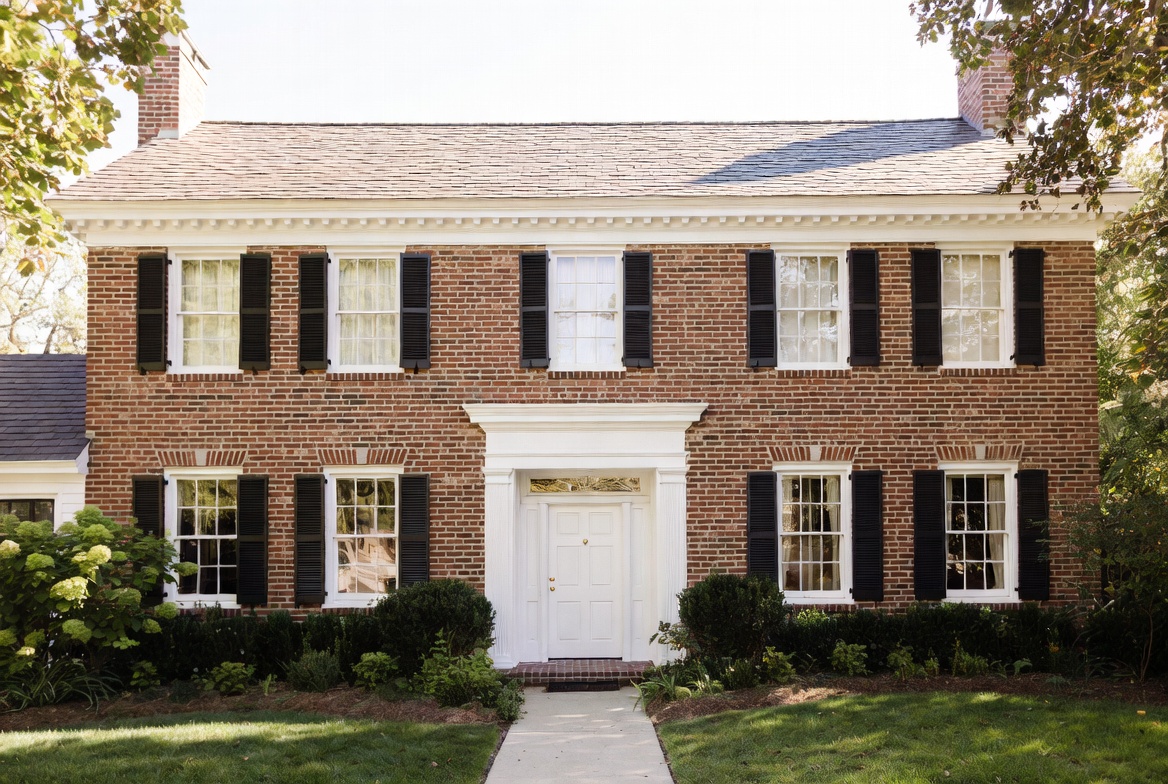
“One-story colonial” gets used loosely. Sometimes it means a true traditional house reduced to one level. More often it means a later Colonial Revival house, or a ranch-shaped house with colonial trim, shutters, and a more formal front.
That distinction matters. If you are trying to identify one, renovate one, or build something inspired by one, the wrong label usually leads to the wrong decisions. People start chasing decorative details and miss the part that makes the house read correctly in the first place: proportion, symmetry, and restraint.
A good one-story colonial is not trying to be flashy. It works because the front stays calm, the roof stays believable, and the parts all feel like they belong to the same house.
What Usually Makes It Read Colonial

Image by ArchitectureCourses.org. A colonial revival house showing the features that usually make the style read colonial: a centered entry, balanced windows, simple massing, and restrained trim.
A one-story colonial house is usually a low, traditionally styled house with a centered front, balanced windows, and a simple overall mass. In most cases, it is a later interpretation of colonial design rather than a direct colonial-period house.
- Centered entry: the front door usually sits in the middle, with the rest of the façade organized around it.
- Balanced windows: double-hung windows, often evenly spaced, do a lot of the visual work.
- Simple footprint: rectangular or near-rectangular plans are common.
- Gable or side-gable roof: the roof shape is usually straightforward, not busy.
- Restrained trim: shutters, modest cornices, paneled doors, and simple porch supports are typical.
- Conservative materials: brick, clapboard, painted siding, and traditional trim colors tend to fit best.
The style works when the house looks composed from the street. No awkward bump-outs. No oversized entry treatment trying too hard. No mixed materials fighting each other.
Also Useful: for the bigger picture on where this fits, see Types of Houses and Home Styles.
What It Usually Is, and What It Usually Is Not
| House Type | What It Tends to Look Like | What Gives It Away | Better Label |
|---|---|---|---|
| Historic colonial house | Older, compact, usually taller, simpler period construction | Age, tighter proportions, true historic fabric | Colonial house |
| One-story traditional house with colonial cues | Symmetrical front, formal entry, lower overall profile | Colonial look on a later one-level plan | One-story Colonial Revival |
| Ranch with colonial detailing | Long, low house with shutters and a more formal front | Postwar ranch proportions underneath the styling | Colonial ranch |
This is where the confusion usually starts. Real-estate listings blur these categories all the time. Homeowners do too. The label is often close enough for conversation, but not always precise enough for renovation work.
If the house is low, wide, suburban, and clearly postwar, it may sit closer to a colonial ranch than a strict colonial form. Before You Move On: that overlap shows up a lot in 1950s House Styles.
The Parts Worth Protecting
If the house already has a good colonial read, the parts worth keeping are usually the quiet ones.
- The front composition: once the centered entry gets shifted, buried, or oversized, the whole façade starts to wobble.
- The window rhythm: mismatched replacement windows flatten the house fast, especially on the front elevation.
- The roof shape: oversized front gables, random dormers, and chunky additions do more damage than people expect.
- The trim discipline: this style depends on proportion. Too many decorative add-ons usually make it look cheaper, not richer.
- The material simplicity: brick, painted wood, or clean siding usually age better than a patchwork of veneer, fake board-and-batten, and accent finishes.
That is the part people get wrong. They focus on shutters because shutters are easy to swap. The bigger issue is almost always the large geometry of the front.
Why One Story Changes the Feel
A one-story version softens the formality of colonial design. That is part of the appeal.
Full-height colonials can feel upright and strict. A one-story plan keeps the order, but makes daily living easier. Fewer stairs. Easier aging in place. Easier side or rear expansion. Often easier furniture flow too.
It also changes the proportions. The lower and wider the house gets, the more it starts drifting toward ranch-house logic. That is not automatically a problem. It just means the house stops reading as a scaled-down historic colonial and starts reading as a more hybrid suburban form.
What Keeps the Style Intact
| Better Move | Common Mistake | Why It Matters |
|---|---|---|
| Keep the entry centered and well-scaled | Add a bulky portico or oversized surround | Colonial houses rely on balance more than drama |
| Match window size and alignment carefully | Mix window types across the front | The front elevation loses its order quickly |
| Use one or two restrained exterior materials | Layer stone veneer, decorative panels, and extra trim together | The house starts looking themed instead of settled |
| Hide additions at the side or rear | Push a new volume onto the front | The original composition is usually the most valuable part |
Worth Knowing: if you are reworking the front elevation more broadly, House Front Design is the more useful follow-up than chasing decorative details first.
Where These Houses Usually Start Feeling Dated
The exterior often holds up better than the plan.
Many one-story colonial houses still have a composed street presence, but inside they can start showing their age in familiar places: tighter kitchens, lighter storage, and rear additions that improved size without fully fixing flow. The front still makes sense. The back is where things usually get uneven.
- What still works: simple circulation, clear room hierarchy, good wall space, and practical one-level living.
- What often feels old fast: small kitchens, narrow service areas, undersized closets, and additions that never fully settle into the original plan.
That is why these houses can be satisfying to update. The bones are often calm and legible. The friction is usually not everywhere at once. It is concentrated.
How to Modernize Without Losing the House
These houses usually take modernization well, but only if the front-facing order stays intact.
- Safer moves: improve insulation, air sealing, and windows without changing the façade rhythm.
- Usually smart: open the rear of the house more than the front.
- Often worth it: enlarge kitchens and improve storage where the plan is tightest.
- Usually risky: trying to make the house look grander than it was meant to be.
If you want the house to stay convincing, spend your attention on rooflines, window spacing, entry scale, and how additions meet the old structure. Decorative upgrades come after that.
A lot of low, traditional postwar houses run into the same remodeling tension. Related Reading: 1950s Ranch Home Remodel Guide: What to Keep, What to Fix.
The One Detail People Usually Miss
It is not the shutters. It is proportion.
A one-story colonial can survive missing shutters, simpler trim, or a repainted door. It usually does not survive a bad roof change, windows that no longer line up, or a front addition that throws the whole house off balance. Those are the moves that quietly break the style.
If you are deciding where to spend money, spend it first on the parts that control how the house reads from the street. That is usually a better investment than decorative colonial costume pieces.
FAQ
Is a one-story colonial house a real style?
Yes, but the label is broad. Some are one-story Colonial Revival houses. Some are ranch houses with colonial detailing. A few are closer to earlier regional colonial traditions.
What makes a one-story colonial different from a ranch?
A one-story colonial usually leans harder on symmetry, a centered entry, and a more formal front composition. A ranch is usually more horizontal and informal in how the front is organized.
Can you add onto a one-story colonial house without ruining it?
Yes. Side and rear additions usually work better than front additions. The main goal is to preserve the original front balance and keep the roof geometry believable.
Are shutters necessary for the style?
No. They help when they are scaled and placed well, but they are not the main thing holding the style together. Proportion matters more.
Is this a good house type for modern living?
Often, yes. One-level living is practical, and the plans are usually easier to adapt than taller formal houses, especially when the original structure is simple.
Bottom Line
A good one-story colonial house is less about historical purity and more about control. The best ones keep the symmetry, restraint, and calm street presence people associate with colonial design, then adapt that language to easier one-level living. Get the proportions right, protect the front, and the style holds up. Get distracted by decorative extras, and it starts falling apart fast.