
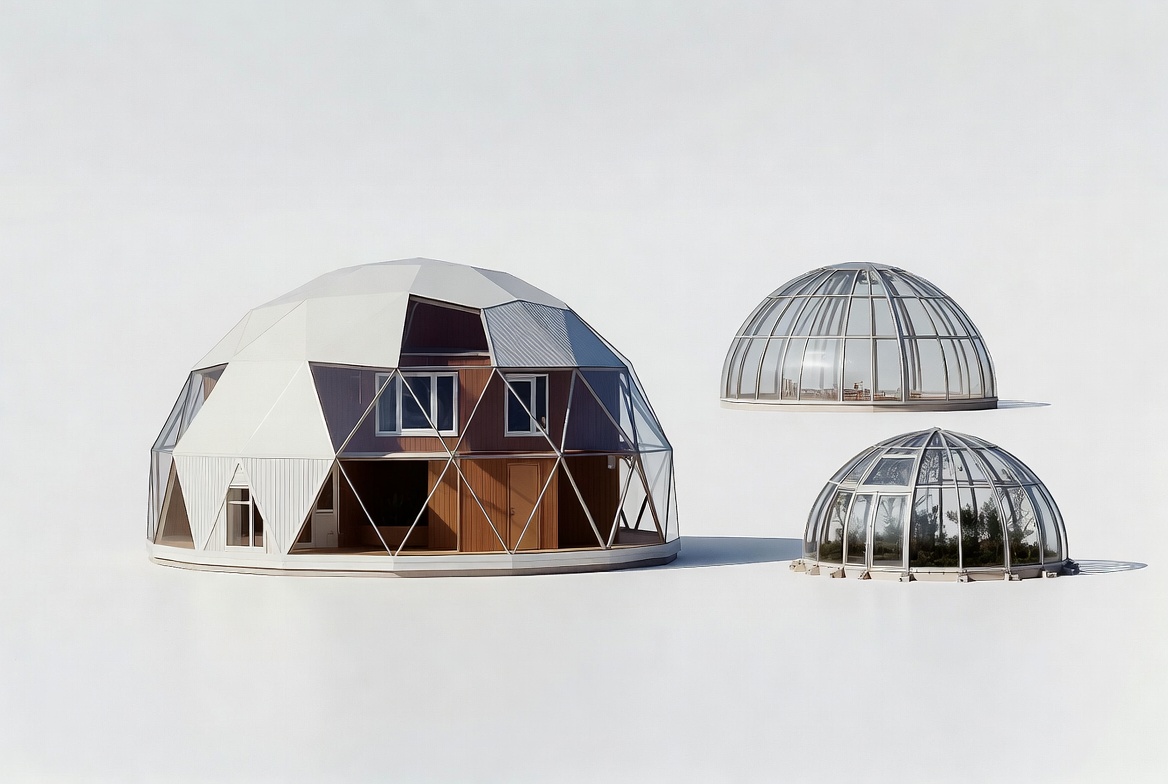
Dome houses work for fewer people than the photos suggest.
They can be strong, compact, quiet, and memorable. They can handle wind well and make a small footprint feel bigger. But the same shape that gives them that appeal also makes them less forgiving to live in and less standard to build. Layout gets harder. Roofing gets trickier. Repairs get more specialized. Builder fit matters more than people think.
The mistake is assuming the dome shape solves problems by itself. It does not. It will not rescue weak detailing, bad glazing, clumsy planning, or the wrong contractor.
A dome house can be a smart choice. But it is a specific one, not a general one.
Start With The Right Question
The right question is not “Are dome houses good?” It is “Good for what, and good for whom?”
A family trying to build a durable long-term home on an exposed rural site is asking one question. Someone chasing a dramatic vacation rental is asking another. A buyer who mostly wants views and glass is not really evaluating the same thing as a buyer looking at a concrete or geodesic shell for resilience. Group all of those together and the advice goes soft fast.
That is why a dome-house page has to do some sorting early. There is no point pretending these are all one category with a different silhouette.
| Type | What It Usually Prioritizes | Where It Can Work Well | Where It Starts Fighting You |
|---|---|---|---|
| Geodesic dome house | Structure, shell efficiency, visual identity | Custom homes, exposed sites, owner-led projects, niche markets | Roofing complexity, awkward perimeter planning, custom interior fit-out |
| Monolithic or continuous-shell dome | Durability, resilience, continuity of enclosure | Severe weather regions, long-term ownership, performance-driven builds | Openings, interior subdivision, conventional room expectations |
| Glass-heavy dome house | Views, daylight, spectacle | Selective climates, carefully shaded sites, high-budget custom work | Solar gain, glare, privacy, condensation, replacement cost |
| Small eco or off-grid dome | Compact footprint, low-volume living, experimentation | Cabins, retreats, seasonal use, niche full-time living | Storage, resale flexibility, furniture layout, everyday practicality |
If the structural side is the real question, go deeper into Geodesic Domes. If the attraction is mostly the idea of living under a glazed shell, the better branch is Glass Dome House. And if what you are really picturing is a growing structure, not a primary residence, that belongs under Greenhouse Domes.
This hub is the broader residential call: what works, what costs more than expected, and who should not keep going just because the renderings look good.
The Appeal Is Real
It helps to admit this part without getting carried away. Dome houses are appealing for real reasons.
The first is obvious. They do not disappear into the background. Even a modest dome has more presence than a conventional house of the same size. The building reads as a decision, not a default.
The second is spatial. A dome can make a compact plan feel larger because the enclosure does more than standard walls and a flat ceiling. That effect is strongest in the central volume. Small dome houses can feel unexpectedly open. Larger ones can feel ceremonial without becoming stiff.
The third is resilience. A lot of buyers are not chasing novelty at all. They are reacting to ordinary houses that feel flimsy, too exposed, too leaky, or too dependent on a long list of familiar but failure-prone assemblies. Dome geometry, when paired with the right shell and detailing, promises something tougher and calmer.
The fourth is the shell itself. Some owners are drawn to a form that is compact and legible. Fewer arbitrary jogs. Fewer cosmetic gestures. Less of the standard builder habit of making a house “interesting” by adding more corners, more roof lines, and more places for water and labor to get expensive.
None of that is fake. The mistake is treating those strengths as automatic. A dome house earns them only when the whole project stays disciplined enough to support them.
The Plan Gets Hard Before The Shell Does
This is where a lot of first-time dome enthusiasm runs into the wall. Not a literal wall. The lack of one.
People look at the outside first. The harder part is inside. A dome changes how you use the perimeter. It changes where full-height storage lives. It changes where bathrooms want to go, where cabinets can run cleanly, and where ordinary furniture starts looking like it came from another house. If the shell is small, those trade-offs show up fast. If the shell is large, the waste can get expensive fast.
The outer ring of a dome often looks more generous on paper than it feels in use. Low or sloping edges can be fine for circulation, seating niches, storage zones, built-ins, plant shelves, or sleeping areas that accept reduced wall height. They are less forgiving where you need efficient kitchens, simple closets, vertical storage, or standard room planning.
The owners who talk well about living in dome houses usually did one of two things. Either they kept the plan simple enough that the shape still helped more than it hurt, or they accepted early that the house needed built-ins and custom planning almost everywhere that mattered. The owners who struggle tend to expect the shell to behave like a normal house with a more interesting roof. That is where the frustration starts.
This Part Matters: dome interiors improve when the plan protects the center for the spaces that benefit from height and volume, then pushes storage, bathrooms, utility, stairs, and lower-priority functions into the less forgiving zones. Do it the other way around and the house starts fighting you room by room.
Roofing And Water Are Where The Romance Usually Breaks
A lot of dome owners remember the same sentence after a few years: the house is mostly roof.
That is the blunt version, but it is useful. On a conventional house, the roof is one part of the enclosure. On many dome houses, especially faceted geodesic ones, a large percentage of the visible shell is sloped weather surface. That changes everything about material choice, flashing logic, maintenance access, seam treatment, and long-term repair risk.
Regular roofers are good at regular roofs. That should not need explaining, but this is where projects still go off course. A dome has different geometry, different waste, different transitions, and different ways of failing. If the shell is heavily segmented or the surface material does not like the geometry, the nice abstract promise of a compact shell turns into a very practical maintenance problem.
That does not mean domes are doomed to leak. It means the enclosure has to be treated as a primary design issue, not a finish package at the end. The builder needs to know what the roofing system is early. The detailing needs to match the shell. Penetrations need restraint. Skylights and fancy interruptions need even more restraint. On a normal house, late-stage roofing decisions can still be sloppy and survivable. On a dome, that same sloppiness is much more expensive.
| Do This Instead of This | Better Move | Weaker Move | Why It Matters |
|---|---|---|---|
| Choose the weather skin early | Set shell, roofing, flashing, and penetrations together | Pick the shell now and let someone “figure out the roof later” | The roof is not a cosmetic layer on a dome. It is a major part of whether the house ages well. |
| Limit fancy interruptions | Keep openings disciplined and repeatable | Scatter skylights, odd joints, and custom transitions everywhere | Every interruption adds labor, leak risk, and future repair headaches. |
| Use crews who understand the geometry | Find people with relevant shell or membrane experience | Assume any competent roofer is automatically a dome roofer | Geometry changes installation, detailing, waste, and failure patterns. |
This is one reason some buyers who start out focused on geodesic shells eventually drift toward other dome systems. Not because the geometry is wrong. Because they realize the enclosure package is where the job becomes much less forgiving.
Glass Makes A Dome Better Right Up Until It Does Not
Glass and domes are an easy sell in images. That is not the same thing as a workable house.
A dome with selective glazing can be beautiful and practical. A dome built around the fantasy of endless glass can become a greenhouse, a privacy problem, a glare problem, and a long-term replacement problem all at once. The issue is not just summer overheating, though that is part of it. It is also nighttime heat loss, condensation, hard-to-shade angled exposure, uneven daylight, bird exposure in some sites, and the fact that all the areas people want to keep open for views are usually the same areas the interior wants for walls, storage, or ordinary life.
This is where readers start splitting into two groups. One group wants some glass and a strong dome shell. The other wants the house to feel almost like a conservatory. Those are not the same project. The second one is more demanding, more climate-sensitive, and more expensive than many buyers realize at the start.
Also Useful: if the project is leaning heavily on views, daylight, and a transparent shell, stop here and read Glass Dome House before you go any further. That is where the glazing questions belong.
The sober version is simple. Use glass where it improves life in the house. Do not use it as a shortcut to make the form feel exciting. A dome already has a strong identity. It does not need to be over-glazed to prove it.
Where The Money Usually Goes Sideways
A dome house can look efficient early and get less efficient as the budget becomes real.
This is one of the most repeated traps. Buyers focus on the shell or kit price because it is the first clean number anyone can give them. Then the rest of the house arrives. Foundation work. Openings. Mechanical systems. Interior framing or fit-out. Built-ins. Waterproofing. Custom trim. Custom stairs. Nonstandard labor. More selective subcontractors. More explaining. More revising.
The issue is not that dome houses are always more expensive. The issue is that people compare the wrong things. They compare the shell to the finished price of a conventional house, or they compare the shell-plus-optimism version of a dome to a fully priced conventional build. That is not a useful comparison.
A dome project needs to be priced as a finished house. Not a shell. Not a structural package. Not an owner-builder fantasy with half the hard parts still floating in the air. If the house still makes sense after the whole list is honest, good. If it only makes sense while several difficult categories are still vague, that answer matters too.
| Spend Here | Not Here | Why |
|---|---|---|
| Shell detailing and weatherproofing | Extra visual drama that multiplies joints and penetrations | Good enclosure work protects the whole project. Decorative complexity usually creates future work. |
| Interior planning and built-ins | Pretending standard furniture will solve odd geometry later | Dome houses live or die on how well the plan handles the perimeter. |
| Experienced subcontractors where geometry matters | Cheaper labor that treats the dome like a normal roof or normal room package | The form punishes improvisation in the wrong places. |
| Solar control and shading strategy | More glass without climate discipline | Extra glass can create a more expensive, less comfortable house. |
Financing, Insurance, And Resale Are Part Of The Design
This part gets postponed too often because it is less fun than shell geometry.
Unusual houses do not always move through normal financing and appraisal channels as smoothly as conventional ones. That does not mean they cannot be financed or insured. It means the path may be narrower, the comparable sales may be thinner, and the buyer pool later may be more selective. Some owners are fine with that. Some are surprised by it. Better to decide which one you are before the house is built.
If you are building a dome because you want a long-term home and you do not care whether the market treats it like a broad-appeal product, fine. If you are stretching the budget and assuming easy refinance, easy insurance, and easy resale later, that needs testing before commitment. The shape of the house is not the only thing that makes it unconventional. The paperwork can become unconventional too.
This does not kill the idea. It just moves one more category out of the “deal with it later” pile and into the early decision pile where it belongs.
Who Ends Up Happy In A Dome House
The happiest owners are usually not the ones chasing the most extreme version of the idea. They are the ones whose expectations line up with what the house is actually good at.
Dome houses tend to suit people who want a strong architectural identity without needing a large footprint. They suit long-horizon owners better than short-horizon flippers. They suit people who value resilience, enclosure, and custom living more than pure comparability with the rest of the market. They often suit rural and semi-rural sites better than tight suburban conditions where orientation, setbacks, neighboring views, and conventional resale expectations press harder on the design.
They also suit people who do not mind that some things will be more specific. More thought in the plan. More custom storage. More careful window placement. More attention to how the shell ages. More responsibility in choosing the builder.
Small full-time households, couples, retreat owners, design-led clients, and owner-builders with patience tend to do better here than large families expecting the house to absorb constant conventional room demands without friction.
Who Should Probably Stop Now
Some buyers should take the idea as a useful detour and then move on.
If you want the easiest possible future maintenance path, the broadest possible resale audience, and the least argument with furniture, cabinetry, roofing, and room planning, a dome house is probably the wrong answer. If your budget only works when multiple custom categories come in cheap, it is probably the wrong answer. If you already know you do not enjoy explaining unusual choices to contractors, lenders, insurers, and later buyers, it is probably the wrong answer.
This is not a moral issue. It is not about whether you are adventurous enough. It is about tolerance. Dome houses reward a certain tolerance for specificity. The people who lack that tolerance are often happier in a simpler form with better detailing than in a more unusual form held together by hope.
What People Get Wrong
The most common mistake is not structural. It is emotional. Buyers decide they want a dome, then spend the rest of the process trying to prove the choice was easy.
That leads to all the familiar bad moves. Too much glass because the rendering looked flat without it. Not enough storage because the open volume felt more important. Shell-first budgeting. Too much faith in generalized energy claims. Too little concern about how the roof will actually be skinned and maintained. Treating the house as a statement before treating it as a place to live.
The people who get better results usually work the other way around. They decide what kind of daily life the house has to support. They figure out which rooms need discipline and which can enjoy the volume. They budget the hard parts honestly. Then they ask whether the dome still improves the answer.
The Detail People Miss
The detail people miss is storage.
Not in a vague lifestyle way. In a very practical, irritating, ordinary-house way. Where do coats go. Where does the pantry go. Where do tools, cleaning supplies, luggage, sports gear, holiday boxes, vacuum storage, off-season bedding, and all the things that make a house livable actually go without turning the perimeter into a compromise zone.
Dome houses photograph the center. They do not photograph the consequences of not planning the edges.
A strong dome plan usually handles this with built-ins, disciplined room placement, loft logic that respects headroom, and a willingness to put low-priority functions where the shell is least cooperative. A weak one leaves those questions floating until the rooms start getting furnished. By then the geometry has already won.
That sounds like a small thing. It is not. Plenty of unusual houses fail in perfectly ordinary ways.
A Short Checklist Before You Keep Going
- Do you want the dome for a reason that still matters after the photos wear off?
- Have you priced the finished house, not just the shell or kit?
- Do you know which dome type you are really considering?
- Is the glazing strategy tied to orientation and climate, or just to appearance?
- Do you have a plan for storage, cabinetry, bathrooms, and stairs before you chase the big open volume?
- Have you identified who handles the weather skin and future repairs?
- Have you tested financing and insurance early enough to matter?
If several of those answers are still vague, the project probably needs another round of discipline before it needs more inspiration.
Where To Branch Next
Once the broad decision is clear, the next step should get narrower, not broader.
If your main question is structural logic, shell types, and why triangulated domes behave the way they do, move into Geodesic Domes. That page should do the technical sorting this hub only touches.
If your real question is whether a dome can be mostly glass without turning into an expensive climate-control problem, go straight to Glass Dome House. That is the better place for glazing, comfort, privacy, and envelope trade-offs.
If what attracted you was the garden-side version of the idea rather than full-time living under a dome shell, read Greenhouse Domes. A greenhouse dome and a dome house overlap in geometry, not in daily demands.
Bottom Line
Dome houses are not nonsense. They are not miracle houses either.
The good ones work because someone stayed honest about what the shape improves and what it complicates. They treated the shell as a real building system, not just an image. They gave the plan enough discipline to absorb the geometry. They did not let glass, novelty, or shell pricing do all the talking. And they accepted that living in an unusual house means committing to an unusual house, not pretending it will behave exactly like a standard one after move-in.
That is the real dividing line. Not whether dome houses are beautiful. Many are. Not whether they can perform well. They can. The dividing line is whether the project is grounded enough to survive contact with ordinary life. If it is, a dome house can be one of the more satisfying ways to build something that does not feel disposable. If it is not, the same geometry becomes a long list of expensive lessons.
FAQ
Are dome houses cheaper to build?
Sometimes the shell looks efficient early, but finished-house cost is the number that matters. Custom labor, glazing, weatherproofing, interior fit-out, and geometry-driven complications can erase an attractive shell price quickly.
Are dome houses energy efficient?
They can be, but not by magic. A good shell still needs good insulation, air sealing, glazing discipline, and climate-aware detailing.
Do dome houses leak?
Any house can leak. Dome houses become more vulnerable when the weather skin, penetrations, and repairs are treated casually or handed to crews who do not understand the geometry.
Can a dome house work for a family?
Yes, but it works best when the plan is disciplined and the family is comfortable with a more custom interior logic. The bigger issue is often not total square footage but where usable wall height and storage actually exist.
Are glass dome houses practical?
Only when the glazing is controlled carefully. Too much glass can create overheating, glare, privacy issues, and higher replacement costs later.
Do dome houses resell well?
They can sell well to the right buyer, but they usually appeal to a narrower market than a conventional house. That matters more if resale timing or refinance flexibility is important to you.