
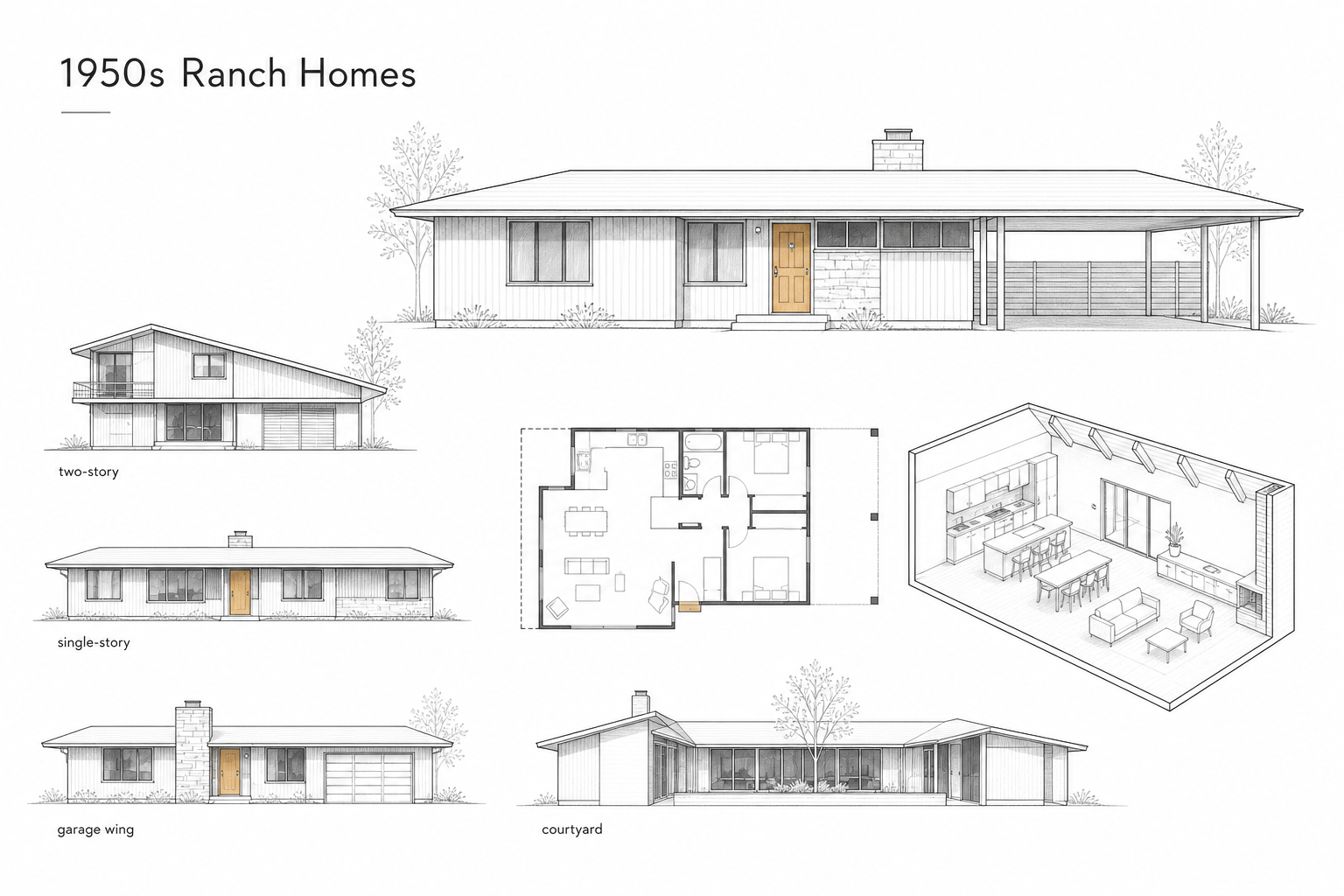
Illustration by ArchitectureCourses.org. This 1950s ranch house study shows the long low elevation, simple floor plan, carport edge, and open kitchen-living area that shaped many mid-century suburban homes.
A small ranch works when it stays clear.
Clear roofline. Clear plan. Clear link to the yard.
That is why the type still holds up. It does not need height, drama, or a lot of tricks. It works through ease.
The problem starts when people try to make it into something else. They add busy roofs, fake stone, awkward additions, and trendy updates that fight the low, simple shape that made the house good in the first place.
A small ranch does not need more noise. It needs better judgment.
This guide is about that. Not trends. Not mood boards. Just the design moves that make a small ranch work better.
The Three Lines That Decide Whether a Small Ranch Works
You can judge most small ranch houses by three things.
The roofline
A good ranch roof is calm. Low. Simple. Once the roof gets too broken up, the house starts to feel nervous.
The sightline
A small ranch should let your eye travel. From the entry to the living room. From the kitchen to the yard. From one end of the house to a window that gives the plan some depth.
The yard line
Ranch houses are strongest when the main rooms reach outside easily. That might be a patio, a deck, a side court, or just a good sliding door and a quiet backyard edge. If the house turns its back on the yard, it loses one of its best strengths.
What a Small Ranch Does Better Than Most Houses
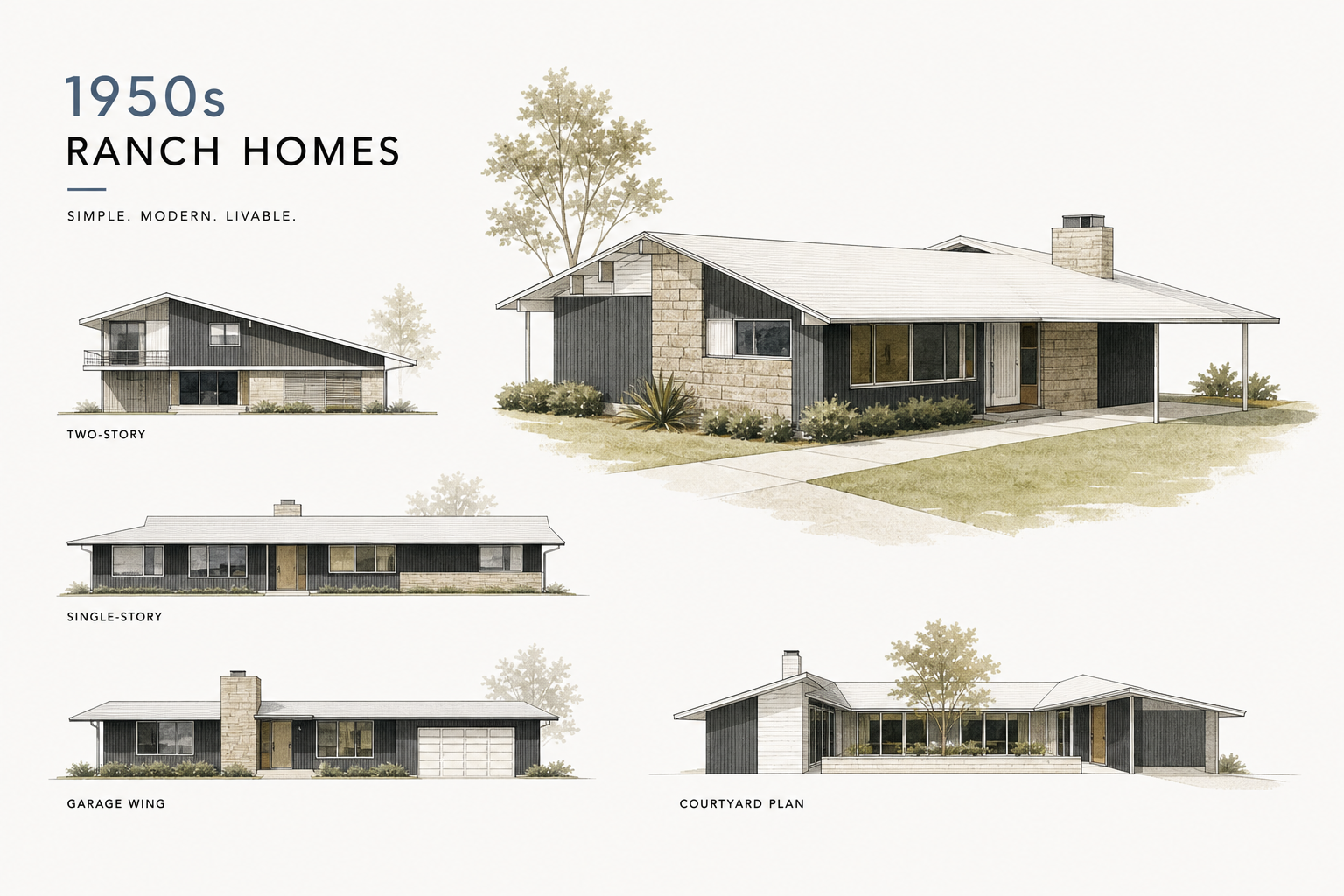
Illustration by ArchitectureCourses.org. 1950s ranch homes were often sold through simple variations: single-story plans, garage wings, courtyard layouts, and occasional two-story versions.
A small ranch is not trying to impress you with height or complexity. It works through ease.
- one-floor living
- simple movement from room to room
- easy indoor-outdoor connection
- lower, quieter massing
- a plan that can often be improved without tearing the whole house apart
That is why these houses still make sense. When the plan is good, they feel direct and easy to live in.
Where Small Ranch Houses Usually Go Wrong
The weak spots are not random. They show up again and again.
| Common problem | What it does to the house | Better move |
|---|---|---|
| Dark middle rooms | Makes the house feel smaller and flatter | Pull more light through the plan, not just at the front |
| Weak entry | Makes arrival feel abrupt and unfinished | Give the front door a clearer threshold and better relation to the living room |
| Bad storage | Turns a small house into a cluttered one | Use built-ins, wall storage, and cleaner room edges |
| Overdone exterior remodel | Makes the house look fake or too busy | Keep materials and roof moves simple |
| Bulky addition | Breaks the original massing | Add at the rear or side and keep the old front readable |
Design the Plan Before You Touch the Style
This is the part people skip.
They jump to finishes, siding, lighting, front doors, and kitchen colors before they fix the plan. A small ranch cannot hide a weak plan behind finishes.
Start with the living core
The living room, dining area, and kitchen should read as the center of daily life. That does not mean tearing out every wall. It means making sure the main spaces connect clearly and borrow light from each other where they can.
Keep the kitchen tied to the yard
One of the easiest ways to improve a small ranch is to make the kitchen and dining area work better with the backyard. That might mean a better door, better window placement, or a cleaner path to a patio.
Protect the quiet side
Bedrooms should not feel like leftover rooms hanging off the public part of the plan. Keep sleeping spaces quieter and more protected, even if the house is small.
This is where house planning matters more than decor. A small ranch gets better when room relationships get better.
The One Fix That Helps Most
If you can only fix one thing, fix the connection between the main living space and the yard.
That is where a small ranch often changes the fastest.
A better door, a wider opening, a stronger patio edge, or a window wall aimed at the right part of the yard can make the house feel brighter, deeper, and easier to live in. It also makes the living room work harder without adding square footage.
This is one reason ranch houses still beat a lot of more complicated homes. When the yard side works, the whole house feels larger than it is.
How to Make a Small Ranch Feel Bigger Without Faking It
A small ranch does not feel bigger because everything is painted white and stripped bare.
It feels bigger when the house has:
- one or two longer sightlines
- better daylight in the center
- less visual clutter
- better built-in storage
- one room that feels generous instead of every room feeling tight
Let one room breathe
Not every room needs to be large. But one room should feel open enough that the whole house benefits from it. In many small ranch houses, that room is the living area facing the yard.
Use storage to calm the plan
A small house gets crowded fast when storage is an afterthought. A long low cabinet, built-in bookshelves, a bench with drawers, or a better closet wall can do more for the house than another decorative upgrade.
Frame one strong view
One good window aimed at the right part of the yard can do more than several badly placed windows. A ranch often works best when the house opens hard in one or two smart places instead of trying to open everywhere.
For tighter footprints, small house design is one of the few related pages that fits naturally here.
What to Keep Simple on the Outside
A small ranch should look settled, not overdesigned.
Keep the roof calm
Do not add fake gables, random pitch changes, or decorative roof bumps just to make the house look more custom. Most of the time that makes the house worse.
If the roof needs redesign work, the safer direction is a simpler one. That is why simple roof design for a small house fits better here than flashy roof inspiration.
Respect the low horizontal shape
Long windows, quiet siding runs, low porch lines, and clean trim all help the house read properly. Tall front pieces and stacked materials usually fight the type.
Do not turn the front into a stage set
A ranch front does not need fake stone everywhere, oversized columns, or decorative shutters that do nothing. A better front usually comes from proportion, entry clarity, lighting, planting, and one or two good materials.
Home exterior design is worth linking here because the outside of a ranch improves most when the work stays calm and consistent.
What to Leave Alone
Not every part of a ranch needs saving, but some parts usually do.
- the low overall roof shape
- window rhythm that still works
- good brick or wood that has aged well
- the basic width-over-height massing
- the easiest path from living space to yard
This is where a lot of remodels go bad. People remove the parts that already work because those parts look too plain. Then they spend money trying to rebuild character the house already had.
What Not to Modernize Too Hard
This is where a lot of ranch remodels go bad.
People see a simple house and think it needs more drama. More materials. More contrast. More glass. More shape. That often ruins the house.
- Do not replace long clean window lines with smaller fussy windows.
- Do not cover decent brick or wood with fake upgrade materials just to look newer.
- Do not force a trendy facade package onto a house that depends on restraint.
- Do not make the front more complicated while the plan inside stays weak.
Improve the weak parts. Leave the clear parts alone.
When an Addition Makes Sense
A small ranch can take an addition well, but only if the addition respects the original house.
The best additions usually go to the rear or to a quiet side wing. They let the main front mass stay readable. They also give you a chance to fix circulation, light, and yard access instead of just adding square footage.
The worst additions sit too high, push too far forward, or bring in a roof shape that has nothing to do with the original house.
If that is the direction, the right related page is modern addition to a ranch house. That topic fits this reader much better than broad custom-home material.
What to Upgrade First
If money is tight, do not spread it thin across the whole house.
Start with the parts that change daily life most.
- Windows and light: especially if the center of the house feels dull.
- Kitchen layout: not just finishes, but connection, storage, and movement.
- Entry and circulation: make the house easier to move through.
- Built-in storage: remove clutter pressure from the main rooms.
- Envelope fixes: insulation, air sealing, and better materials where they matter.
For older postwar versions, 1950s ranch home remodel guide is the right related page because many of the same problems repeat there.
Materials That Earn Their Cost
A small ranch responds well to straightforward materials.
Brick, wood, and simple stucco often age better than the fake-upgrade mix people use when they want the house to look expensive fast.
One good example is original brick that still has decent color and joints. Cleaning it, repairing mortar where needed, and pairing it with better windows often looks stronger than covering it with thin stone or mixed cladding. The same goes for wood siding that can be repaired and repainted instead of replaced with something busier.
A ranch does not need luxury signals. It needs materials that look solid, quiet, and well chosen.
If you are making bigger finish decisions, sustainable house materials is a better support page than generic trend content because it pushes the question toward durability as well as appearance.
Who This House Fits — And Who Should Skip It
A small ranch is a good fit for people who want:
- one-floor living
- a strong yard connection
- simple rooflines and direct plans
- a house that can improve a lot with smart, calm updates
It is a weaker fit for people who want formal room separation, dramatic height, or a highly ornamental street presence. That is not where the type is strongest.
Quick Checklist Before You Start
- Does the design keep the roofline calm?
- Does it improve light in the middle of the house?
- Does it strengthen the link to the yard?
- Does it add real storage?
- Does it make movement easier instead of just changing finishes?
- Does the house still read as one low, simple shape?
If the answer to most of those is no, the design still needs work.
Final Take
A small ranch does not need to be turned into something louder.
It needs to be made clearer.
That is the real design lesson here. The good versions are not trying hard. They are just well judged. Better light. Better flow. Better storage. Better relation to the yard. A roof that stays calm. Materials that do not pretend to be more than they are.
That is enough to make a small ranch live far better than a bigger house with a worse plan.