
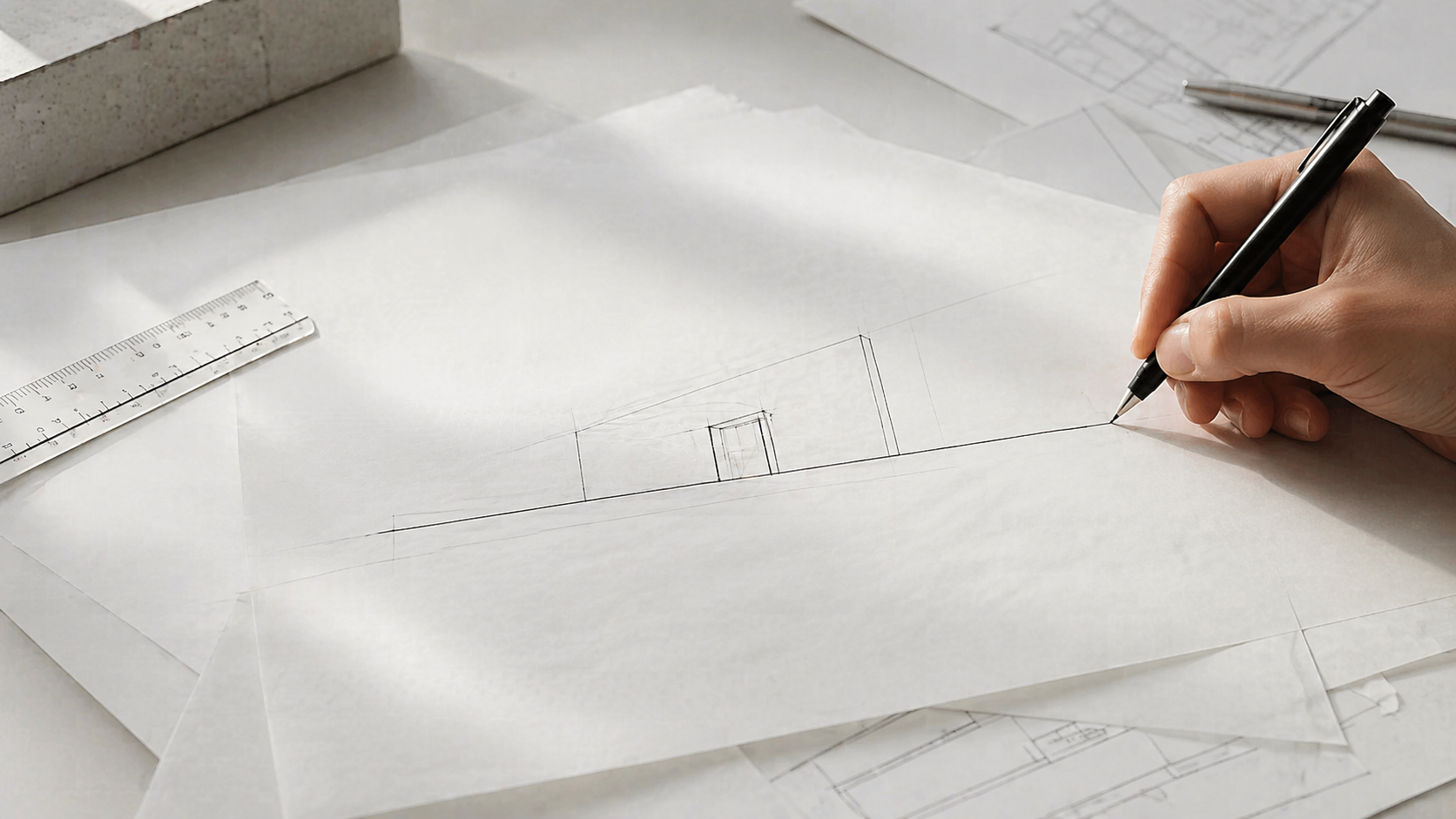
A good sketch does not start with shading.
It starts with one line that lands where you meant it to land.
That sounds basic, but it is the skill under almost everything else. If your lines are weak, the sketch feels weak. If your lines are clear, even a simple sketch starts to feel solid.
This is where a lot of beginners get stuck. They think they need fancy perspective, expensive pens, or a dramatic style. Most of the time, they just need better line control.
Think of line weight like speaking volume. If every word is loud, nothing stands out. If every line is dark, the drawing gets flat and messy. A sketch reads better when some lines stay quiet and a few do the heavy work.
If you are just getting started, read Architectural Sketching for Beginners first. If you want a broader base after this page, go next to Basic Techniques and Principles of Architectural Drawing.
Why one simple line matters
In architectural sketching, a line does four main jobs:
- it shows where one thing ends and another begins
- it gives shape to walls, windows, roofs, stairs, and furniture
- it helps show depth
- it tells the eye what matters most
That last part matters a lot. A sketch is not a photocopy. You are choosing what to push forward and what to leave quiet.
| Line Type | What It Does | Common Mistake |
|---|---|---|
| Light guide line | Helps place the drawing | Pressing too hard so it will not disappear later |
| Main outline | Shows the main edges and form | Drawing it too slowly and making it shaky |
| Heavy line | Adds emphasis, depth, or shadow edge | Making every line heavy |
| Hatching | Adds shade and texture | Using it too early before the form is clear |
A clean sketch is not the one with the most lines. It is the one where each line has a reason.
How to draw a straighter line
Most shaky lines come from two things: moving too slowly and drawing from the wrist when the line is long.
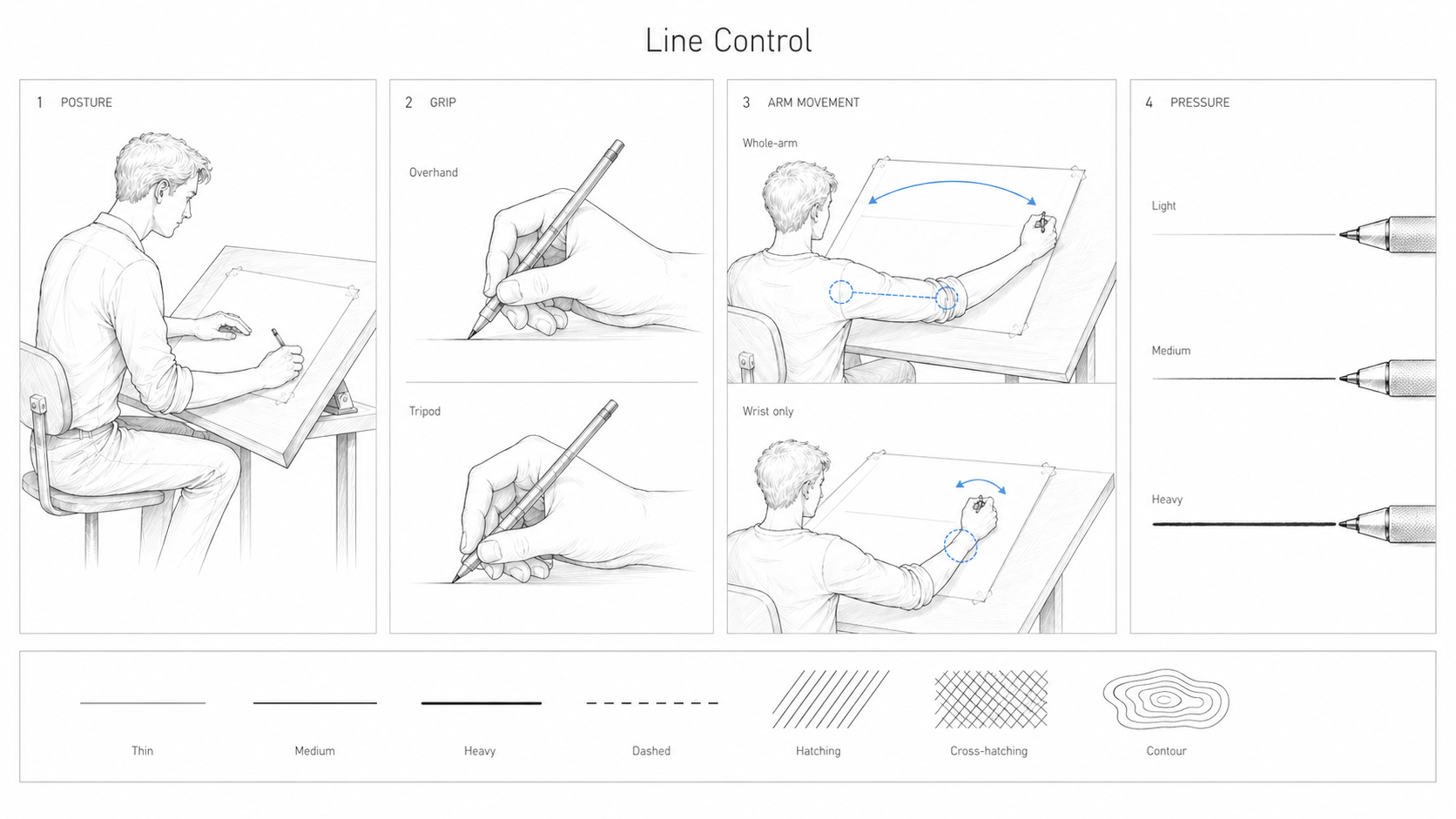
Line control starts with posture, grip, arm movement, pressure, and repeated practice with basic architectural line types. Illustration by ArchitectureCourses.org.
Here is the simple method.
- Mark the start and end. Put a tiny dot where the line begins and where it should stop.
- Ghost the motion first. Move your hand over the page without touching it. Do that once or twice.
- Look at the end point, not your pencil tip. Your hand will follow your eye better.
- Use your shoulder for long lines. Use your fingers and wrist for short details.
- Draw it in one pass. Do not scratch over it five times trying to rescue it.
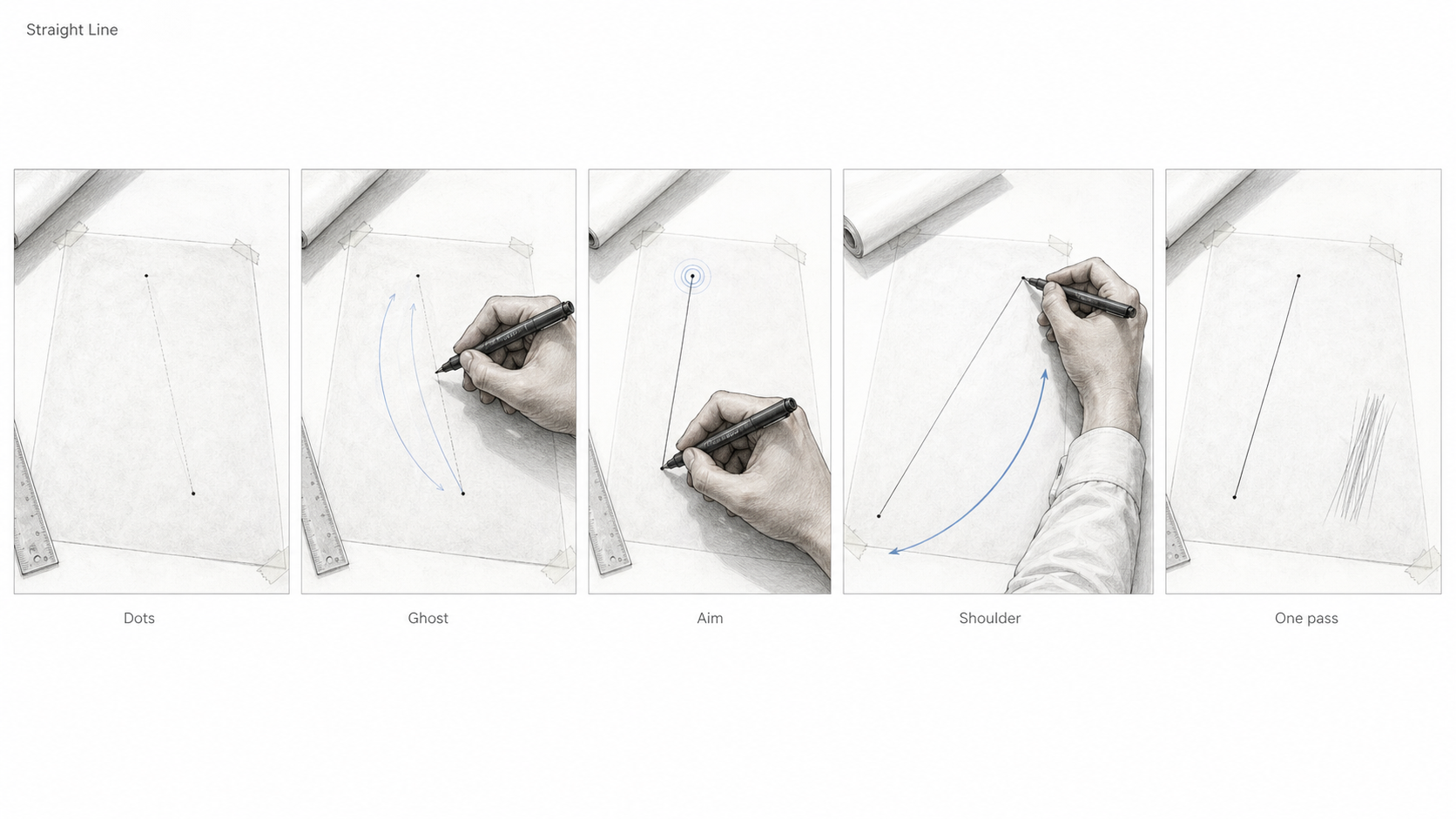
A straighter architectural line starts with two dots, a rehearsed motion, and one confident pass. Illustration by ArchitectureCourses.org.
That is the whole thing. It is like tossing a ball to a point, not dragging the ball across the ground.
If the line misses a little, that is fine. One confident line that is slightly off often looks better than six nervous lines piled on top of each other.
Grip and pressure made simple
You do not need a complicated hand position.
You need one grip for control and one looser grip for flow.
For small details
Use a normal writing grip. This is good for windows, door frames, furniture edges, and fine notes.
For longer sketch lines
Hold the pencil or pen a bit farther back. That gives your hand more range and stops you from pressing too hard.
For pressure
- Light pressure for guide lines
- Medium pressure for most of the drawing
- Heavy pressure only for emphasis
Beginners often press hard because they want the line to look certain. It does the opposite. It slows the hand down and makes the line stiff.
Line weight without overthinking it
Line weight is one of the easiest ways to make a sketch feel more architectural.
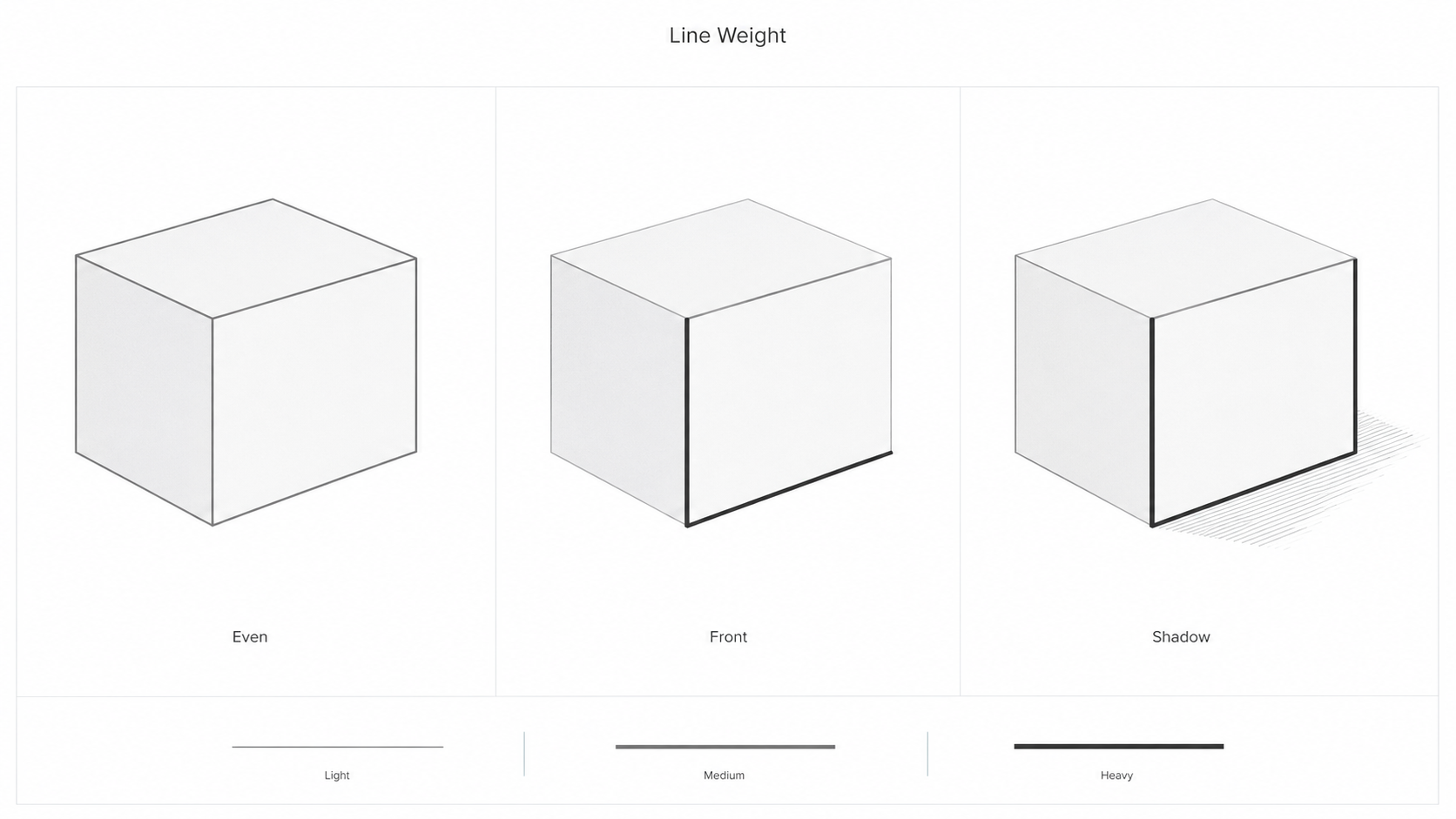
A simple box shows how line weight changes clarity, emphasis, and depth in an architectural sketch. Illustration by ArchitectureCourses.org.
Keep it simple:
- light lines for guides and background edges
- medium lines for most visible edges
- darker lines for what is closest, cut, or more important
Again, think of speaking volume. Not every word needs the same force. Not every edge needs the same darkness.
A good first exercise is to draw one simple box three times:
- once with all lines the same
- once with the front edges darker
- once with a darker shadow edge and a little hatching
You will see fast how much line weight changes the drawing.
If you want a broader drawing page after this one, see Drawing for Architects and Architectural Drawings.
How lines help show depth
You do not need advanced theory to start showing depth.
You need three habits:
- lines that head toward the same vanishing point
- overlap, so one thing clearly sits in front of another
- lighter background lines and stronger foreground lines
Train tracks are a good simple analogy. They seem to come together in the distance even though they stay parallel in life. Perspective lines work the same way in a sketch.
Try this with a hallway, a street corner, or a simple room. Draw the main box first. Then add openings. Then darken only the parts that matter most.
The best tools for practicing lines
Keep this part simple too.
Pencils
An HB pencil is enough to start. A 2H is good for light guide lines. A 2B is useful when you want darker accents or rougher texture.
Mechanical pencils
These are good for clean thin lines. They help if your graphite pencil keeps getting too blunt.
Pens
A fineliner is useful when you want to commit. It stops you from hiding behind erasing. A 0.3 or 0.5 tip is enough for most sketch work.
Digital tools
An iPad or tablet is fine if you already use one. Pressure sensitivity helps. But digital sketching does not fix weak line habits. The same hand control still matters.
Do not waste time thinking the tool is the problem when the real issue is repetition and control.
Five line drills that help fast
These are simple, but they work.
1. Start-stop lines
Fill a page with straight lines between two dots. Keep them clean and single-pass.
2. Parallel lines
Draw groups of parallel lines without a ruler. This builds spacing control.
3. Box drill
Draw simple cubes and room corners. This trains straight lines and perspective at the same time.
4. Window grid drill
Sketch rows of windows on a simple facade. This helps rhythm and spacing.
5. Shadow hatch drill
Draw one wall or box and add hatching only where the shadow falls. This teaches restraint.
Ten focused minutes on these drills helps more than one long session of random sketching.
A step-by-step way to practice on a building
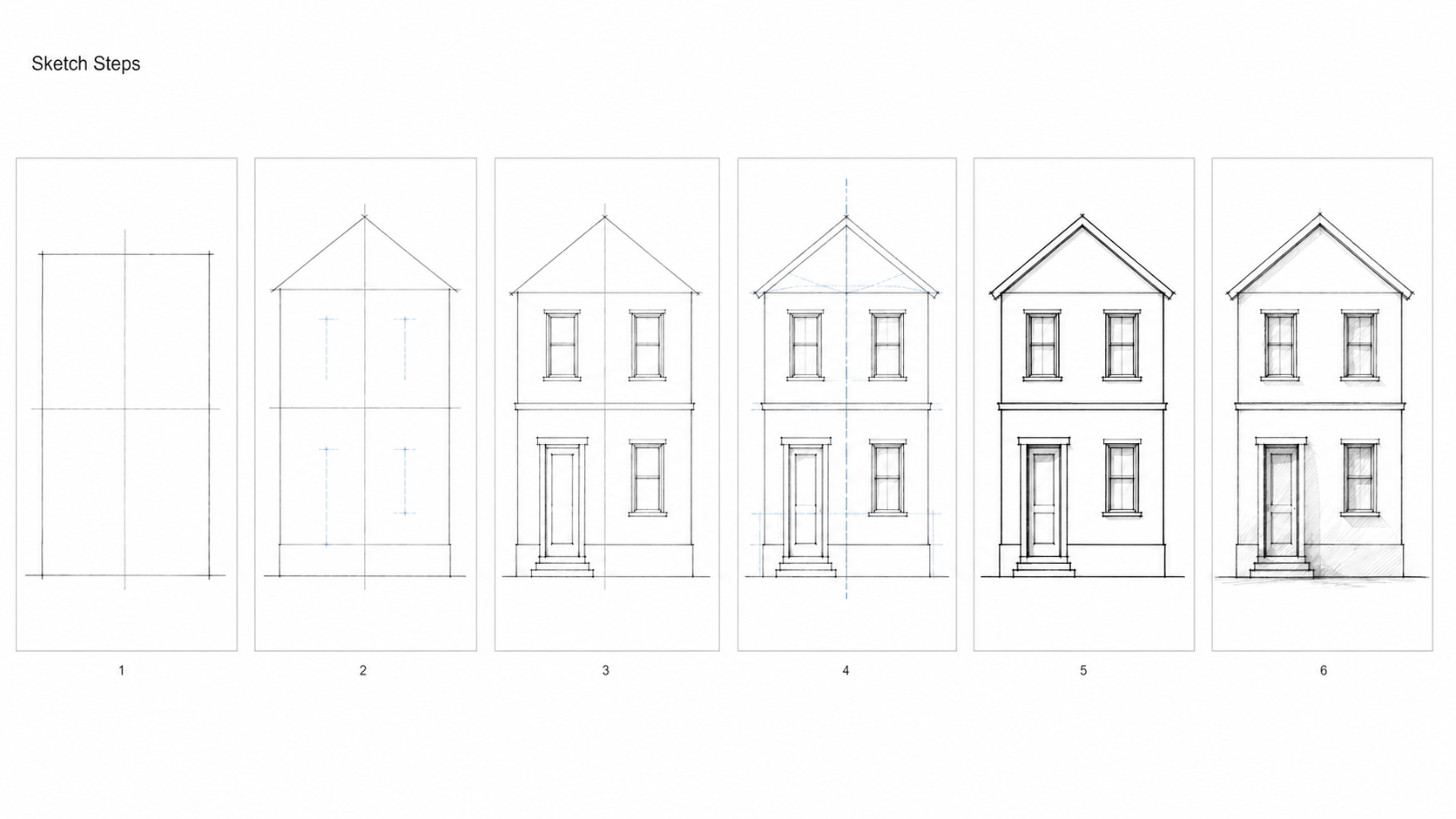
A clear architectural sketch usually develops in stages: outline, placement, openings, proportion checks, stronger line weight, and only a small amount of shading. Illustration by ArchitectureCourses.org.
Pick something simple. A door. A window. A small house front. A corner of a room.
- Start with the big shape. Draw the outer box first.
- Add the main divisions. Roof line, window openings, floor line, or door position.
- Check the angles. Make sure the major lines agree before adding detail.
- Darken the important edges. Do not darken everything.
- Add a little shadow. Use hatching or one darker side to give form.
- Stop. Do not keep decorating the sketch after it has said enough.
That last step matters. Many sketches die from overworking, not from starting badly.
If you want another useful practice page, go to Easy Architecture Drawing.
Common mistakes
- Chicken-scratch lines. Too many little corrections instead of one clear move.
- Drawing too small. Tiny sketches make control harder, not easier.
- Pressing too hard too early. It locks the drawing before you have placed it well.
- Giving every line the same weight. The sketch reads flat.
- Adding texture before the form is clear. Shade cannot fix a weak structure.
A simple drawing with clean structure beats a busy drawing with bad control every time.
One original way to think about line
A line in architecture is not decoration. It is a decision.
It says, “this edge matters,” or “this plane turns here,” or “look here first.”
That is why better lines make a sketch feel smarter even before the drawing gets detailed. The sketch starts reading like a clear thought instead of a pile of marks.
FAQ
Why are my lines shaky?
Most of the time it is because you are drawing too slowly, gripping too hard, or trying to steer the line from the wrist when the line is long.
Should I use a ruler?
Use one when the drawing needs precision. But for sketch practice, do a lot by hand first. That is how control improves.
What is the best pencil for architectural sketching?
An HB pencil is a good all-around start. Add a 2H for guides and a 2B for darker accents if you want more range.
How long does it take to improve?
Faster than most people think if you practice short drills often. Better line control can show up within a week or two of steady practice.