
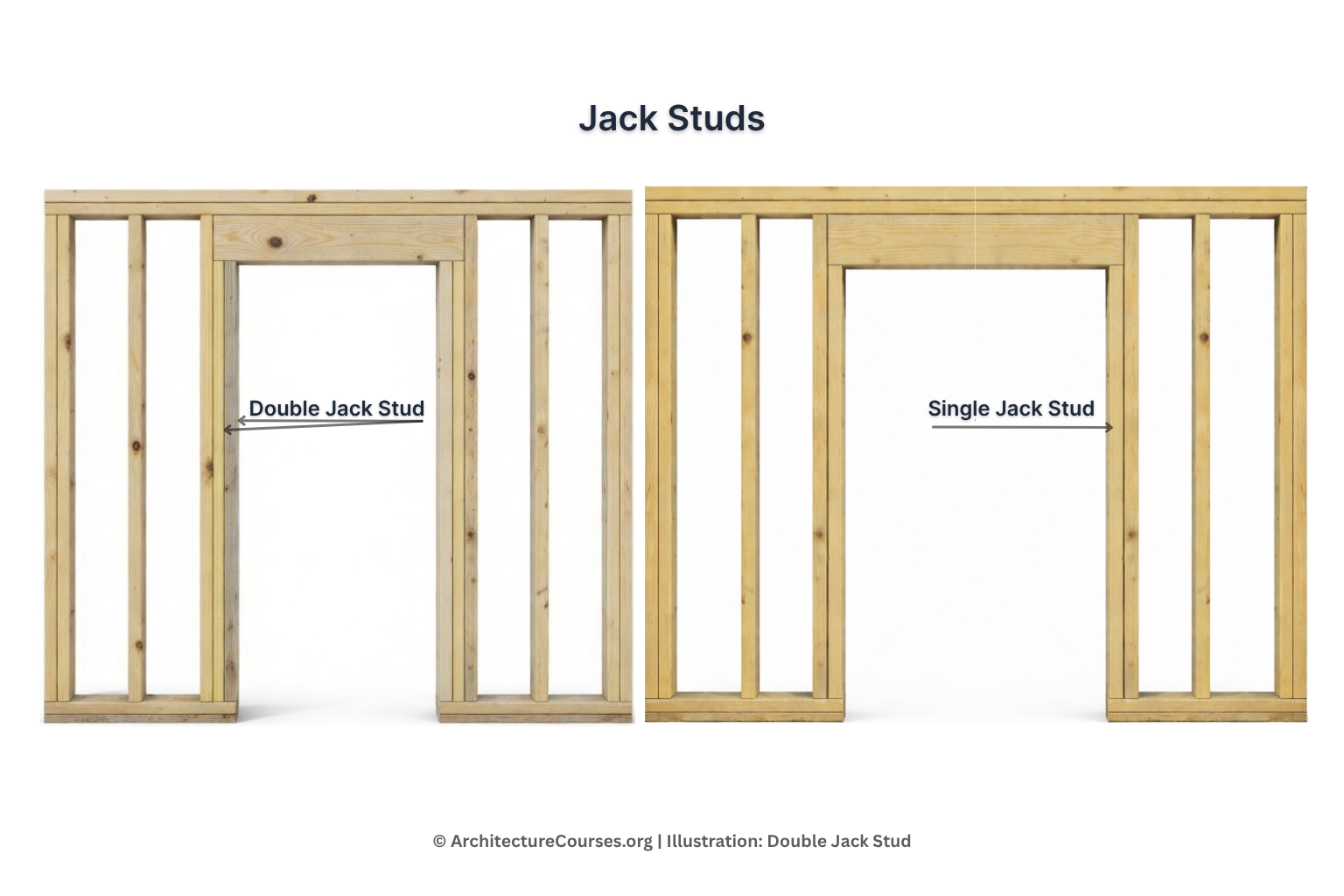
One jack stud on each side is enough for a lot of ordinary openings. Two jacks on each side can be the right move too. But they are not automatically better. The real call depends on the header, the load above, the span, the wall, and how much bearing the header actually needs.
Single vs Double Jack Stud
| Setup | Usually Makes Sense For | What It Gives You | Where It Starts Going Wrong |
|---|---|---|---|
| Single jack stud each side | Smaller openings, lighter loads, many ordinary doors and windows | Cleaner framing, less lumber, enough support when the header and bearing are right | Not enough bearing for wider spans or heavier headers |
| Double jack studs each side | Wider openings, heavier loads, thicker headers, garage doors, patio doors, some engineered setups | More bearing, better support under heavier header ends, more margin where loads build up | Wasted lumber if the opening and header never needed it |
The short version is this: double jacks are worth it when the header load and bearing demand them. They are not worth it just because the opening looks big or important.
When One Jack Is Enough
One jack stud on each side is common on many ordinary framed openings. That includes a lot of basic doors and windows where the span is modest, the load is light, and the header is sized correctly.
A single jack makes sense when:
- the opening is not especially wide
- the load above is light
- the header does not need extra bearing
- the wall is framed to a normal simple condition
- the plans, tables, or engineer do not call for more
This is where a lot of simple house framing lives. One jack is not weak by default. It is just the smaller support detail.
A basic bedroom window is one thing. A short interior door in a simple wall is one thing too. Those are not the openings that usually get people in trouble.
If you need the broader opening layout before getting lost in this decision, read Jack Studs Framing.
When Double Jacks Are Worth It
Double jacks start making sense when the header gets heavier or the opening gets wider.
That often includes:
- wider patio doors
- garage door openings
- larger window walls
- thick LVL or built-up headers
- floor load or point load above
- heavier roof loads
- plans that call for more bearing under the header ends
The key word here is bearing. The jack studs support the ends of the header. When the header is carrying more load, or when it needs more bearing area, a second jack starts earning its place.
This is also where habits from smaller openings stop working. A setup that was fine on a small bedroom window may be a bad call on a 6-foot patio door, a wide mulled opening, or a garage header carrying real weight.
Thick LVLs are another giveaway. Once the header starts looking and feeling like a real beam, the support detail under it needs more respect too.
Where It Is Just Extra Lumber
This is the part that gets skipped.
Some crews double the jacks on almost everything because it feels safer. Sometimes that is harmless. Sometimes it is just waste.
Double jacks are often unnecessary when:
- the opening is modest
- the header is light
- the wall is not carrying much load
- one jack already gives the header the bearing it needs
- the plans or span guidance do not call for more support
More lumber does not always mean better framing. A properly sized header with clean bearing on a single jack can be the correct detail. Doubling it just because “more is stronger” is not smart framing. It is just habit.
This is one reason framing should follow the real load, not the last job, not the crew preference, and not what looks beefy in a photo.
What Changes the Call
The single-vs-double jack stud decision is not random. These are the things that actually move it.
Opening width
As the opening gets wider, the header works harder. Wider openings are where double jacks start showing up more often.
Load above
Roof only is one thing. Roof plus ceiling joists is more. Roof plus floor load is more again. Add a point load and the decision changes fast.
Header size and type
A small built-up header is one condition. A thick LVL or heavy built-up member is another. Bigger headers often want more bearing.
Bearing length
This is the quiet detail people miss. The header does not just need support. It needs enough support at the ends. That is where an extra jack can matter.
Wall type
Interior non-bearing walls, simple bearing walls, garage side walls, and big exterior openings are not the same framing problem.
Plans, tables, and engineering
The final call comes from the actual framing condition, the plans, the span tables, and the engineer when the job has moved beyond simple rule-of-thumb framing.
That is why this page is a guide, not permission to guess. A patio door under a simple roof is one thing. A garage opening under floor and roof load is another. Same studs. Different job.
If your next question is support count under a specific header, go to How Many Jack Studs for a Header?.
Common Mistakes
- Using jobsite habit instead of the real load. “We always do double jacks” is not a structural rule.
- Trying to fix a weak header with extra jacks. More jacks do not rescue an undersized header.
- Ignoring bearing length. The question is not only how many jacks, but how much real support the header end gets.
- Using one detail on every opening. A small window and a wide patio door are not the same job.
- Cutting jacks badly. Loose bearing, bad cuts, and sloppy shims make even the right jack count work worse.
- Forgetting the king and jack work together. The jack supports the header, but the full opening detail still depends on the king stud and the rest of the wall framing being right.
One more thing: a double jack is not a trophy. It is just a support detail. Use it when it solves a real structural need.
FAQ
Is one jack stud enough for a door opening?
Often yes, especially on smaller ordinary openings with light loads and a correctly sized header. But not always. A plain interior door is one thing. A wider exterior door with more load above is not.
Do patio doors usually need double jacks?
Very often, yes. Wider spans and heavier headers are where double jacks make more sense. This is one of the first places where single-jack thinking starts getting shaky.
Do garage doors need double jacks?
In many wood-framed conditions, yes as a starting point. Garage openings are usually not where you want to guess light.
Does a bigger header always mean double jacks?
Not automatically, but heavier headers often need more bearing. That is where double jacks start becoming the better call.
Are double jacks required on every load-bearing wall opening?
No. Load-bearing does not automatically mean double jacks everywhere. The opening, header, span, and load still decide the detail.
Can double jacks be overkill?
Yes. On some modest openings, they are just extra lumber with no real structural benefit.
What matters more: the header or the jack count?
The header comes first. The jack count supports the header. A bad header is still a bad header even if you stack more studs under it.
Read This Next
If you want the wider opening detail first, read Jack Studs Framing. If you are trying to size support under a specific opening, go to How Many Jack Studs for a Header?. If you need the full wall-framing picture around openings, read House Framing 101: Everything You Need to Know.