
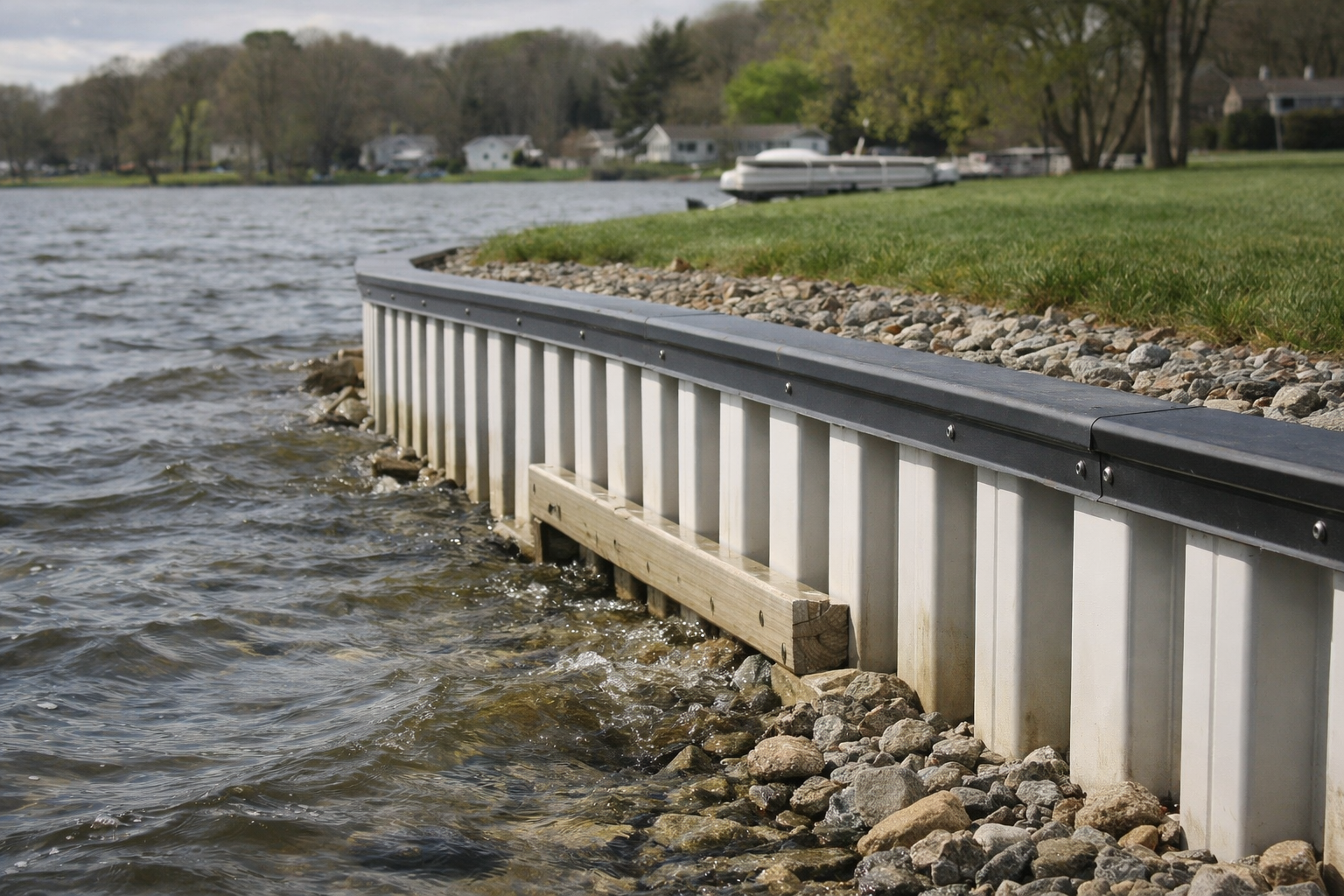
The ugly parts? Access, tiebacks, caps, dewatering, disposal, permitting, and the first surprise below grade. This is where you lose money. But you don’t have to.
Most homeowners start by asking “cost per square foot.” Most contractors price it per linear foot, because height, embedment, and soil drive the job. If you don’t translate the numbers correctly, you’ll compare quotes that aren’t even the same scope.
What this covers:
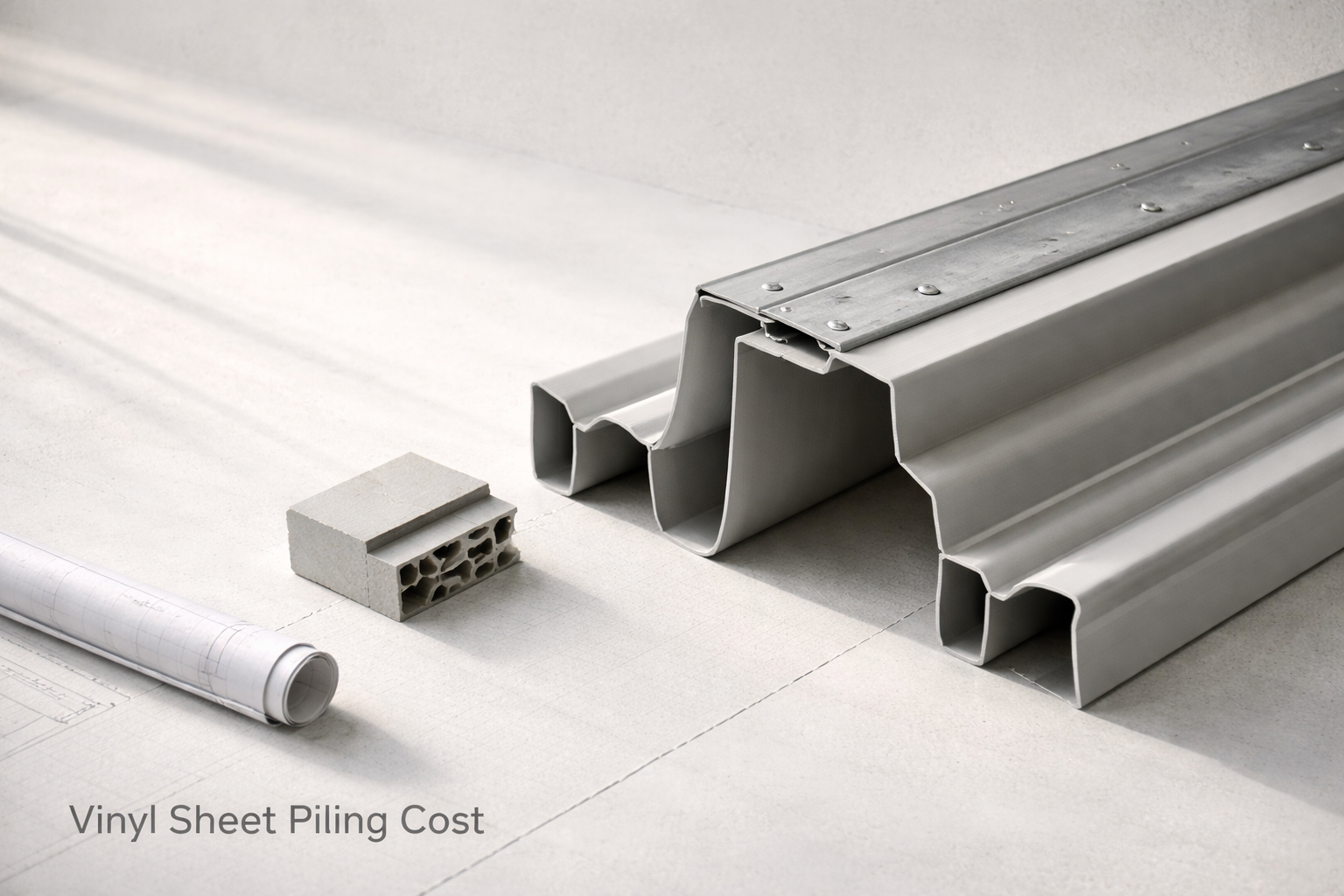
- How vinyl sheet piling is priced in 2025–2026 (linear foot first, then square foot conversions).
- What’s usually included in real bids (and what’s quietly excluded).
- The 3–7 decisions that swing the price the most.
- Red flags that predict change orders and callbacks.
- A tight checklist and FAQ based on the questions people repeat.
Pricing Math
Start with this: vinyl sheet piling work is usually quoted as $ per linear foot (LF) of wall. Height changes material, equipment, and design. Soil changes embedment and installation method. Access changes everything.
Convert linear foot to square foot (SF):
Cost per SF of wall face = (Cost per LF) / (Exposed height in feet)
Typical installed ranges (U.S., 2025–2026 pricing):
- Smaller residential vinyl bulkheads/seawalls: commonly land in the ballpark of $200–$600 per LF when the site is straightforward and the wall height is in the typical residential range.
- Hard sites / tall walls / engineered waterfront: it’s not unusual to see $700–$1,500+ per LF once you add difficult access, deep embedment, tiebacks, king piles, heavy caps, or regulatory constraints.
What that means per square foot (quick conversion):
- 5 ft exposed wall: $200–$600 per LF ≈ $40–$120 per SF of wall face.
- 8 ft exposed wall: the LF price usually climbs (more embedment, heavier sections, more bracing). In practice, you can still end up around $75–$200+ per SF depending on design and access.
Important scope note: some quotes are “panel install only.” Others include excavation, backfill, cap, anchors/tiebacks, drainage fabric, haul-off, and permit drawings. If you don’t force scope alignment, the cheapest number wins on paper and loses in the field.
What Drives Cost
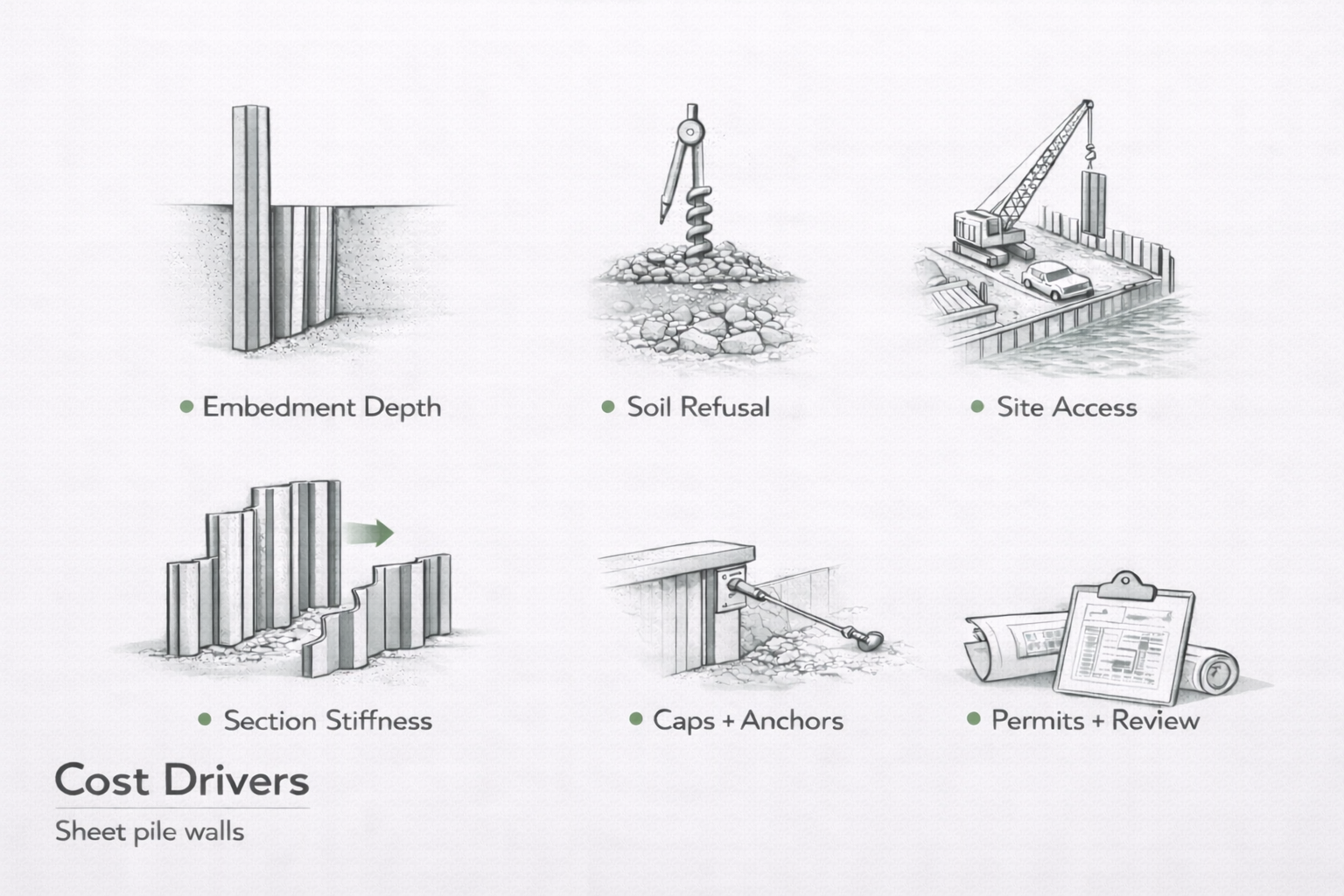
1) Height and Embedment
People fixate on exposed height. Contractors worry about embedment. The wall doesn’t work unless enough sheet is below grade to resist overturning and sliding.
Cost effect: taller walls don’t scale linearly. You usually need thicker sections, deeper embedment, and sometimes anchors. That adds crew time, equipment time, and engineering time.
2) Soil and Refusal Risk
Soft sand drives easy. Clay can fight you. Mixed fill with rubble can stop you dead. Refusal is where “simple install” turns into a change order.
Cost effect: vibration/driving method changes, pre-drilling becomes necessary, or the design shifts (king piles, different wall system). That’s hours and mobilization.
3) Access and Mobilization
Can the crew get equipment to the line? Is there room to stage sheets? Is it a tight urban canal lot, a backyard with fences, or a site that needs barge access?
Cost effect: access is a multiplier. Limited access can cost more than “better vinyl.”
4) Wall Type and Stiffness
Vinyl sheet piling comes in different profiles and stiffness. The stronger profiles cost more, but they also reduce deflection and performance risk.
Cost effect: upgrading to a stiffer section can raise material cost but prevent expensive bracing, repairs, or early failure when the site load is higher than the homeowner assumed.
5) Caps, Tiebacks, and Deadmen
A lot of “vinyl wall” cost lives in what’s not vinyl: concrete caps, steel hardware, tiebacks/deadmen, and the excavation/backfill to install them.
Cost effect: the moment you add anchors, you add excavation, materials, and inspection sensitivity. It can be the difference between a small job and a designed system.
6) Permits and Jurisdiction
Waterfront work is rarely “just build it.” In many U.S. locations you’re dealing with U.S. Army Corps of Engineers review plus state and local requirements.
Cost effect: time and documentation cost money. Engineering drawings, environmental constraints, and review cycles can move the schedule and the bid.
Cost Breakdown
These are the buckets that show up repeatedly in real quotes. The exact numbers swing by region and site, but the categories don’t.
| Cost Component | How It’s Usually Priced | What It Covers |
|---|---|---|
| Vinyl sheets | Per LF (sometimes bundled) | Panels, corners, connectors, manufacturer-specific hardware |
| Driving / installation | Included in LF bid or day-rate | Crew, vibratory driver/hammer time, alignment and bracing |
| Excavation and backfill | Per job or per LF | Dig line, remove spoil, backfill, compaction, grading |
| Cap (often concrete) | Per LF | Forms, rebar, pour, finish, curing protection |
| Anchors / tiebacks | Per tieback or per LF | Deadmen, rods, walers, hardware, excavation to install |
| Permits and drawings | Fixed fee | Applications, engineered plans when required, inspections |
| Mobilization | Fixed fee | Trucking, equipment delivery, barge access if needed |
Bid Comparison Rules
If you want quotes you can compare, force these questions up front. This is where homeowners get burned.
Scope Questions
- Is the quote panel install only or turnkey (excavate, backfill, cap, anchors, cleanup)?
- What is the exposed height and the embedment depth assumed?
- Are tiebacks/deadmen included? How many, and at what spacing?
- What cap is included (concrete, composite, timber)? Thickness and reinforcement?
- Is debris/old wall removal included, including haul-off fees?
Site and Risk Questions
- What happens if the installer hits refusal or buried debris?
- Who owns dewatering if groundwater shows up?
- What access assumptions are priced in (equipment path, staging area, barge use)?
- What warranty applies, and what voids it (settlement, storm events, third-party damage)?
Red Flags
- The quote gives a clean $/SF number but does not state wall height, embedment, or whether anchors are included.
- “No permit needed” is stated casually for a shoreline job without jurisdiction confirmation.
- No mention of cap design, tieback details, or how alignment is maintained during driving.
- The bid excludes excavation/backfill but the salesperson talks like it’s turnkey.
- No plan for disposal of the old structure (or “we’ll see what we find” with no allowance).
The One Detail People Miss
They budget the wall and forget the land-side system.
What people do wrong: install a new wall, then backfill with whatever came out of the hole, no separation fabric, no drainage layer, no compaction plan.
The correct move: treat backfill as part of the structure. Use separation fabric where appropriate, place backfill in lifts, compact, and keep fines from washing out through the wall line.
What it prevents: settlement behind the wall and the “it looked fine for six months” failure where the yard drops and the cap cracks or the line bows.
Limit: details vary by site and wall design. If the project is near water with regulatory oversight, confirm what backfill and stabilization methods are allowed.
Ways to Save Money
Not gimmicks. The moves that reduce total cost without sabotaging performance.
Plan access first
If you can create a clean equipment path and staging area, you can save more than any “material swap.” Access is time.
Align wall height with need
Overbuilding height drives embedment and design costs. Underbuilding height drives overtopping and erosion. Match height to real site conditions and flood exposure.
Do demolition and clearing correctly
If you’re allowed to handle non-specialty site work (clearing, removing small obstructions), do it cleanly and safely. But don’t DIY the structural parts. A bad install is not a learning experience. It’s a rebuild.
Lock scope before bids
Most “high quotes” are really “complete scope quotes.” Most “low quotes” are missing scope. Make every bidder price the same system.
Common Misunderstandings
- “Cost per square foot is the standard.”
Most real bids are per linear foot because height and embedment drive the job. - “Vinyl means no engineering.”
Loads still exist. Soil still matters. Water pressure still wins if the design is wrong. - “If it’s straight, it’s fine.”
Alignment today doesn’t guarantee performance next year if the backfill and anchoring are weak. - “Permits are just paperwork.”
On waterfront work, permits can change what you’re allowed to build and how you build it.
Checklist
- Define exposed height, length, and what you’re protecting (erosion, grade change, wave action).
- Confirm who the permitting authorities are for your shoreline.
- Get at least two quotes that state embedment assumptions and whether anchors are included.
- Confirm access plan and staging area before signing anything.
- Require the bid to state cap type and details (material, thickness, reinforcement where applicable).
- Clarify demolition/disposal scope if an old wall exists.
- Clarify backfill approach (fabric, drainage, compaction expectations).
- Put refusal/obstruction handling in writing (unit prices or allowances).
FAQ
Why does vinyl sheet piling get quoted per linear foot?
Because the height, embedment, soil, and access drive install time and design. Linear foot pricing ties to the wall line where those variables show up.
What’s a normal cost per square foot in 2025–2026?
If you convert common residential vinyl wall pricing, a lot of real projects land somewhere around $40–$150 per square foot of wall face for typical heights, with difficult sites and engineered waterfront work pushing higher. The only trustworthy number is the one that matches your wall height and scope.
What’s usually missing from the cheapest quote?
Excavation/backfill, cap work, anchors/tiebacks, disposal, permit drawings, and refusal risk.
Can I DIY vinyl sheet piling?
Small, non-critical erosion control in soft soil sometimes gets DIY attempts, but true retaining/bulkhead/seawall work depends on alignment, embedment, and lateral resistance. If failure would drop your yard, damage structures, or trigger regulatory issues, DIY is the wrong bet.
Do I need a permit?
Often, yes, especially near navigable waters or regulated shorelines. Requirements vary by jurisdiction and can include U.S. Army Corps of Engineers review plus state and local approvals.
How do I compare vinyl vs wood vs steel costs?
Compare total installed scope and expected service life under your exposure. Vinyl avoids corrosion and rot issues common to steel/wood, but stiffness and load capacity vary by section and application. The “cheapest” material rarely stays cheapest if it needs earlier repair.
Why do costs jump so much above 8–10 ft walls?
Taller walls usually require deeper embedment, stronger sections, and often anchors. Equipment time increases and engineering becomes less optional.
What should I ask a contractor before signing?
Ask for embedment assumptions, anchor details, cap details, refusal/obstruction plan, backfill method, and what permits are included in their scope.
Final Notes
Vinyl sheet piling is a solid option when the design matches the loads and the install is done like a structural job, not a fence. If you want one number to remember: price and performance are decided by height, soil, access, and what’s behind the wall. Nail those, and the bids start making sense.
Official sources (click to expand)
- U.S. Army Corps of Engineers: Dock and Bulkhead Requirements (PDF)
- U.S. Army Corps of Engineers: Guide for Permit Applicants (PDF)
- 33 CFR Part 320: USACE General Regulatory Policies (PDF)
- Calvert County, Maryland: Residential Bulkhead Permitting (example of local requirements)
- USACE EM 1110-2-1614: Coastal Revetments, Seawalls, and Bulkheads (PDF)