
This job starts before the first pour, before mobilization, before the schedule gets blamed for everything.
It lives in the stretch where the drawings are still moving, the owner wants a number, the trades want clearer scope, and the team is trying to make decisions before the job hardens into something expensive to fix.
That is where a preconstruction project manager earns the title. The work is part budgeting, part scope control, part coordination, part risk management. A good one helps the team price the right job, not just produce a polished number.
If you want the broader phase first, preconstruction planning is the right companion page. This article stays with the role itself: what the job covers, where it gets difficult, and why weak handoff from precon to operations can damage a project before sitework even starts.
What the Job Is
A preconstruction project manager leads contractor-side work before construction starts.
That usually includes budgeting, estimating coordination, scope review, trade outreach, bid package planning, schedule input, constructability review, value engineering, procurement thinking, and turnover into operations.
In some firms, estimating owns most of the numbers and the precon PM owns process, scope alignment, and client communication. In others, the precon PM is part estimator, part strategist, part operations translator. The title stays the same. The seat changes by company.
This role usually sits inside a larger project development process, which is why the strongest precon managers understand far more than spreadsheets.
What They Do All Day

The daily work is not glamorous. It is a steady sequence of clarifying scope, updating budgets, reviewing drawing changes, leveling trade numbers, flagging gaps, and keeping decisions documented before the project team starts building on assumptions.
A typical week can include:
- reviewing drawing revisions and addenda
- updating budgets at schematic, design development, and permit-set stages
- writing bid scopes so trades are pricing the same package
- leveling subcontractor bids instead of just chasing the low number
- working with the design team on alternates and value engineering
- checking long-lead items and early procurement risks
- building schedule assumptions with operations input
- tracking owner decisions that affect cost, sequence, or scope
- preparing the handoff into buyout and construction
If the team is not disciplined here, the project starts drifting before the field crew ever sees it.
Where the Job Sits
Preconstruction project managers usually sit between estimating, operations, and the client-facing side of the company.
That middle position is why the job gets misunderstood. It is not pure estimating. It is not field management. It is not business development. It borrows from all three and gets judged by all three.
| Role | Main Question | Main Risk |
|---|---|---|
| Estimator | What should this cost? | Missing scope or pricing the wrong assumption |
| Preconstruction Project Manager | Are budget, scope, schedule, and design still moving together? | Letting the project look aligned when it is not |
| Construction Project Manager | How do we deliver the job we sold? | Inheriting bad assumptions and a weak handoff |
If you want the wider framework around that handoff, project management workflow helps explain where precon ends and operations starts taking the hit.
What Strong Precon Managers Do Differently
The strong ones are rarely the smoothest talkers in the room. They are usually the ones asking the question nobody wanted to slow down for.
They read for scope, not just quantities. They catch what is missing, delegated, still undecided, or quietly being pushed into another trade package.
They do not trust a low number until they understand it. Bid leveling is not a clerical task. It is scope control. A cheap number with weak exclusions is not savings. It is deferred cost.
They bring operations in early. Good field input can expose phasing, crane access, site logistics, sequencing, and labor assumptions long before those issues become change-order fuel.
They document decisions. Alternates, allowances, VE ideas, design assumptions, owner decisions, long-lead concerns, and scope transfers should not live in memory.
What the Work Feels Like

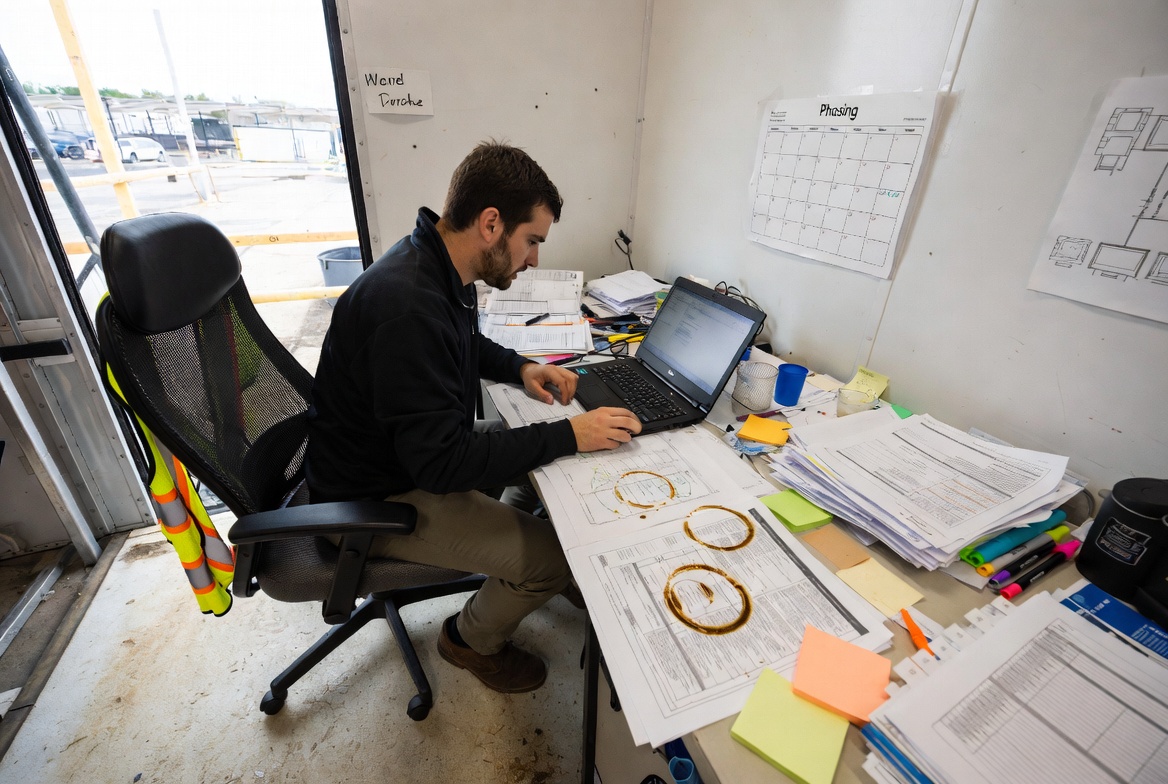
Pre-construction project manager working late into dusk, reviewing permit drawings and schedule impacts in a modest contractor office.
The pressure in preconstruction is different from field pressure.
In the field, the problem is visible. In precon, the problem is usually buried in an unclear spec section, a loose allowance, an optimistic schedule assumption, or a trade scope that sounds complete until the leveling sheet opens it up.
That is why the job can feel invisible when it is done well. The steel package does not blow up. The mechanical number does not arrive half-covered in exclusions. The owner is not hearing about a major budget miss after permit pricing. The operations team inherits a job that makes sense.
That is the win. Quiet work. Fewer downstream surprises.
Where the Job Gets Difficult
The hardest part of the role is not building a budget. It is handling uncertainty without hiding it.
Owners want firm numbers early. Designers want time. Executives want momentum. Trade pricing depends on documents that may still be moving. Materials can shift. Lead times can change. The schedule may still be more aspiration than logic.
A weak precon PM smooths that over to keep the room comfortable.
A strong one puts structure around it. This is what is priced. This is what is carried as allowance. This is what is excluded. This is what needs a design decision by the next milestone. This is what will move the number if it changes.
That kind of clarity is not always welcome. It is still the job.
Where Projects Start Going Sideways
Preconstruction failures usually start in the same places.
Scope gaps between trades. Blocking, penetrations, temporary protection, patching, startup, testing, utility fees, delegated design, permit support. These are the quiet places where budgets split open later.
Design decisions delayed too long. The estimate keeps getting updated, but the things driving the number never get settled.
Value engineering treated like panic pricing. Good VE is structured and documented. Bad VE is late-stage cost cutting with no memory.
Operations brought in late. The budget may look clean, but the project may still be awkward to build.
Weak bid strategy. If the wrong bidders are carried, the bid packages are sloppy, or the scope letters are thin, the numbers come back noisy and the estimate starts looking more certain than it should.
The procurement side is its own discipline. Construction bid process and construction tendering strategy are worth reading if that part of the role is still fuzzy.
The Budget Is Not the Whole Job
This is one of the more common misunderstandings around preconstruction.
A budget is not just a number. It is a summary of scope, assumptions, sequencing, market conditions, and risk. Two budgets can land on the same total and still carry very different project exposure.
That is why precon PMs who understand cost planning and later cost control tend to be more useful than people who treat the estimate as a static deliverable.
The Handoff Is Where the Job Gets Exposed
Many firms talk about turnover like it is a meeting. It is not. It is a transfer of risk.
If preconstruction did its job well, the operations team gets a clear estimate, leveled bids, scope notes, VE history, schedule basis, long-lead concerns, and major unresolved decisions called out plainly.
If preconstruction did it badly, the construction PM starts by reverse-engineering the budget while buyout is already underway.
That is why strong precon managers think past award. They are not just trying to help win the job. They are trying to keep the field team from inheriting a problem dressed up as a project.
Do You Need a Degree?
Usually, yes for larger firms. Not always, but usually.
Construction management, engineering, architecture, and related degrees are common entry points. So are assistant PM paths, estimating roles, project engineer roles, and trade-side backgrounds with strong scope and document experience.
The degree helps open the door. The judgment comes from repetition.
If you are building toward this role, construction and engineering courses, construction management bachelor’s, and architecture and construction careers are the most useful next reads.
What New Hires Usually Underestimate
Newer staff often assume the role is mostly takeoffs, meetings, and updating numbers.
The harder part is judgment. Knowing when the documents are not ready for certainty. Knowing when a scope letter is too vague. Knowing when a bidder is low for the wrong reason. Knowing when a schedule looks complete but still has no field logic behind it.
Software matters, but not in the way people expect. Tools help. Judgment carries the role.
If you need the bigger process first, preconstruction checklist and planning and scheduling fill in the broader sequence around the role.
If You Are Hiring One
Do not stop at polished interview language.
Ask how they level bids. Ask how they write trade scopes. Ask how they carry allowances in early budgets. Ask how they involve operations. Ask how they handle owner pressure when the drawings are still loose. Ask how they run turnover. Ask where they have been burned.
Good answers will sound specific. They will mention scope gaps, long-lead items, sequencing, bid coverage, design drift, logistics, and the kind of missing information that causes late budget pain.
Weak answers usually stay at the level of communication, organization, and attention to detail.
If You Want to Become One
Start by getting good at three things.
- reading drawings and specs for scope, not just symbols
- understanding how budgets are built, qualified, and revised
- learning how field conditions change pricing, sequence, and procurement
Then get close to turnover, buyout, and operations handoff. That is where the role stops being abstract.
You do not need to know everything on day one. You do need to get comfortable with incomplete information, because a lot of preconstruction lives there.
FAQ
Is a preconstruction project manager the same as an estimator?
No. Estimating is central to the role, but the job is broader. A precon PM also manages scope alignment, trade coverage, schedule input, design-phase coordination, client communication, and handoff into operations.
What is the difference between a preconstruction PM and a project manager?
The precon PM works before construction starts and focuses on budgeting, scope, pricing, design coordination, and turnover. The construction PM takes over delivery, buyout, cost control, subcontract execution, and project administration during the build.
Is this mostly an office job?
Mostly, yes. But strong precon managers still visit sites, review existing conditions, and pull in field input early. Staying at the desk too much is one way to miss expensive site problems.
What is the biggest mistake in the role?
Passing uncertainty downstream without naming it. That is how operations inherits a job that looked settled but was not.
Bottom Line
A preconstruction project manager is there to keep the project honest before construction starts testing every loose assumption.
The role sits where cost, scope, schedule, design, trades, and risk start colliding. Done well, it protects the owner, the contractor, and the operations team at the same time. Done poorly, it produces a clean-looking estimate and a rough project.