
What Equipment Is Used in Bored Piling?
The equipment you put on a bored piling site is determined by what is in the ground, not by what is available on the yard. Get that sequence wrong and you will spend the first week fighting the rig instead of advancing the bore. Soil reports exist for this reason. Read them before you specify equipment.
Bored piling covers a range of methods — rotary, CFA, percussion, bucket — and each one performs well in specific conditions and badly in others. The job of this page is to explain what each rig actually does, where it belongs, and what breaks down when you use the wrong one.
Rotary drilling rigs
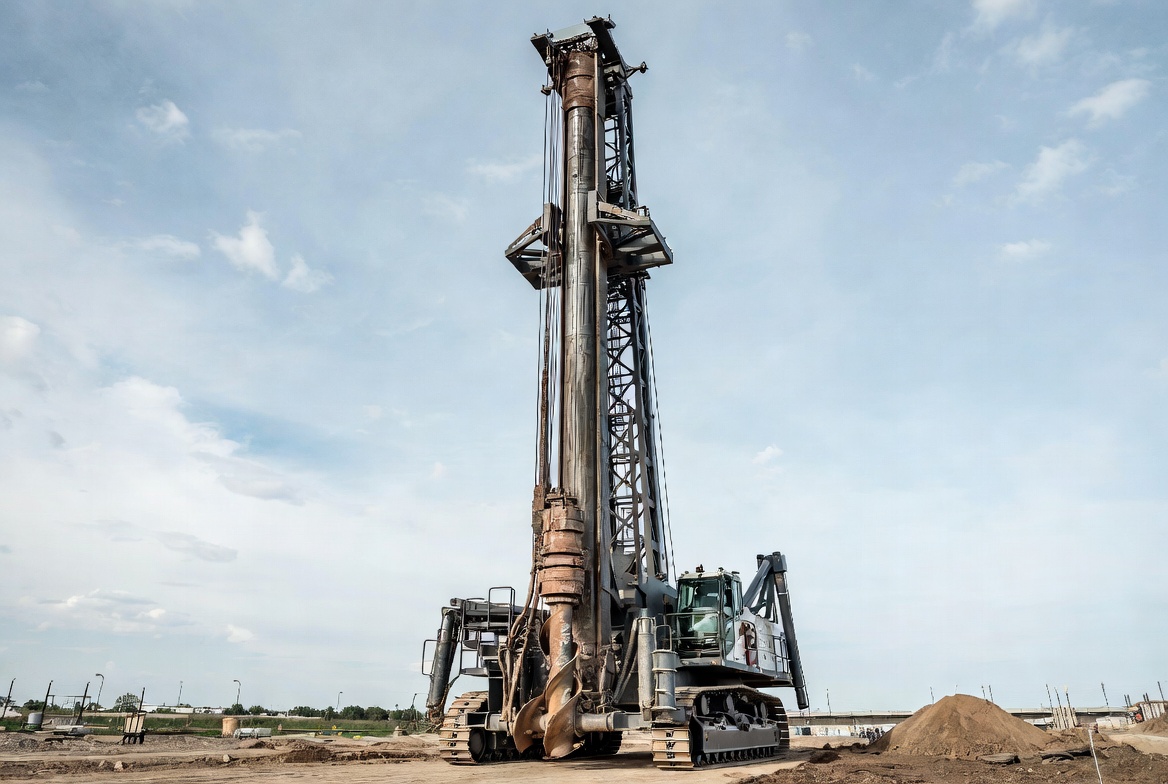
Rotary rigs are the default for large-diameter bored piles on commercial and infrastructure work. A kelly bar transfers torque from the rotary head down to the cutting tool — auger, bucket, or core barrel — depending on what the ground requires. The rig screws a temporary steel casing into the ground as it advances, which stabilizes the hole and keeps water and unstable soil out of the bore. Once it hits design depth, a reinforcement cage goes in and concrete follows through a tremie pipe. The casing comes back out as the concrete fills the void.
The advantage over CFA is that the reinforcement cage can run the full depth of the pile, because you are placing it into an open bore rather than pushing it into wet concrete. That matters on heavily loaded piles where you need full structural continuity. Rotary bored piles also handle obstructions — boulders, old foundations, mixed ground — better than any auger-based method.
The cost is speed and site footprint. Rotary rigs are large, slow to set up, and expensive to run. On constrained urban sites or projects where ground conditions are straightforward, there are faster options.
Continuous Flight Auger (CFA) rigs
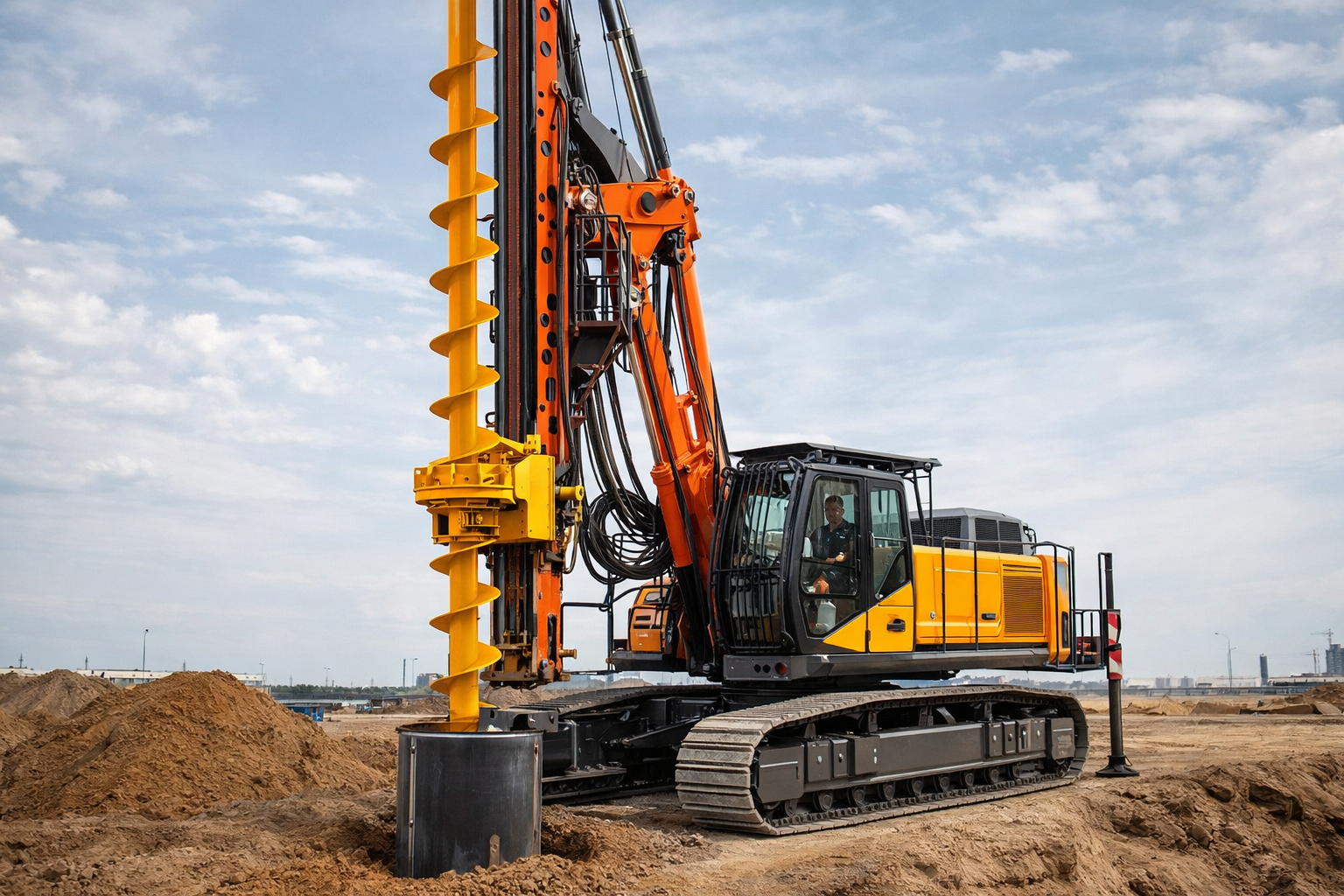
Image by ArchitectureCourses.org.
CFA is fast, quiet, and well-suited to urban work. The rig rotates a continuous hollow-stem auger into the ground in a single pass. No casing. No spoil removal between passes. When it hits depth, concrete is pumped down through the hollow stem under pressure as the auger is slowly withdrawn, filling the bore from the bottom up. The reinforcement cage goes in immediately after, pushed into the fresh concrete before it stiffens.
That sequence — concrete first, cage second — is why CFA piles have a practical depth limit on their reinforcement. You cannot physically push a steel cage more than about ten to twelve meters into concrete that is already beginning to set. For most urban mid-rise work that is not a problem. For deep, heavily loaded structural piles it is.
CFA works in soft to medium soils: alluvial clay, silty ground, soft sand. It struggles in gravels with cobbles, hard rock, or ground with significant obstructions because the auger cannot clear material efficiently and the hole can collapse before concrete is placed. The monitoring systems on modern CFA rigs — tracking auger rotation, penetration rate, and concrete pressure in real time — exist precisely because the method leaves no opportunity to inspect the bore before it is filled.
For inner-city residential and commercial foundations in clay-dominant ground, CFA is usually the right call. It produces low noise, minimal vibration, and minimal spoil — three things that matter on sites with neighbors.
Percussion rigs
Percussion rigs — cable tool rigs — work by repeatedly lifting and dropping a heavy drill bit to break material at the bottom of the bore. Slow by modern standards, but effective in hard rock and boulder-heavy ground where rotary tools take a beating and CFA cannot function at all.
They are not a first choice for speed. On the right ground conditions they are the only choice that works reliably without burning through tooling. Offshore and marine piling still uses percussion methods where hard seabed geology makes rotary impractical.
Bucket rigs
Bucket rigs attach a rotating bucket to the kelly bar in place of an auger. The bucket scoops cohesive material — stiff clay, soft rock — and lifts it out of the bore cleanly. They are common on large-diameter pile work where the diameter makes auger extraction impractical and where the soil is stiff enough to hold the bore walls open between passes.
In loose or granular ground, bucket rigs need casing support or drilling fluid to keep the hole from collapsing. They are slower than auger-based methods on the right soil but produce cleaner bases, which matters when end-bearing capacity is part of the design.
Choosing between them
| Method | Best ground conditions | Pile diameter range | Reinforcement depth | Urban suitability |
|---|---|---|---|---|
| Rotary bored | Mixed ground, hard soils, obstructions, rock | 300mm–3000mm+ | Full depth | Moderate — large rig, some noise and vibration |
| CFA | Soft to medium soils, clay, alluvial | 300mm–900mm typically | Limited by cage insertion into wet concrete | High — low noise, low vibration, fast cycle |
| Percussion | Hard rock, boulders, difficult geology | Varies | Full depth | Low — slow, noisy, best for difficult ground |
| Bucket rig | Stiff cohesive soils, large diameters | Large diameter specialist work | Full depth | Moderate — depends on site access and diameter |
The cutting tools
The rig is the carrier. The cutting tool is what actually does the work, and matching the tool to the ground matters as much as matching the rig type.
Spiral augers are standard on CFA rigs and on rotary rigs in soft to medium soils. The helix geometry pulls material up and out of the bore as it rotates. In granular or loose ground they can lose material back into the bore, which is why CFA monitoring tracks penetration rate — a sudden drop often means the auger is losing ground rather than advancing.
Drilling buckets replace the auger on rotary rigs when the material is too stiff or large-diameter for auger extraction. The bucket cuts and captures material in a single rotation, then lifts clear for disposal. Slower per cycle but cleaner extraction in the right conditions.
Core barrels are used in rock. A ring-shaped cutting tool cores out a cylinder of rock rather than grinding through it, which is faster in competent rock than using a drag bit or tricone.
Tricone bits crush hard material by rolling three toothed cones against the rock face. Effective in very hard geology but expensive, and they wear faster than most contractors expect. Rotating them out and inspecting after every shift keeps costs from compounding.
Drag bits cut soft material efficiently and cheaply. Wrong choice in anything with gravel, cobbles, or rock — the teeth wear fast and the bit loses geometry quickly.
Kelly bars
The kelly bar is the telescopic drill rod that transmits torque from the rotary head down to the cutting tool. It extends as the bore deepens and retracts to bring the tool back to surface.
Interlocking kelly bars transmit higher torque through mechanical locking between sections. They are used for deeper work and harder ground where friction-type bars would slip under load. Friction kelly bars are simpler, cheaper, and adequate for shallower depths in softer soils. Using a friction bar in conditions that need an interlocking bar is a slow way to discover the difference — the bar slips under load and the drill head spins without advancing the bore.
Casing
Temporary casings stabilize the bore in unstable ground and prevent water ingress from collapsing the hole before concrete is placed. They screw into the ground ahead of the bore and are extracted by the rig as concrete fills the pile. On rotary bored piles through made ground, soft alluvium, or high water table conditions, they are usually not optional.
Permanent casings stay in place. Used where ground conditions are too aggressive for the pile to maintain integrity without ongoing support — contaminated ground, aggressive groundwater, or very loose running sands. The cost is higher and the pile design has to account for the casing as a structural element.
The decision between temporary and permanent casing is a geotechnical one. The rig operator does not make it. The soil report and the structural engineer make it before the rig arrives on site.
Where things go wrong
Most bored piling problems trace back to three sources.
Wrong rig for the ground. CFA in ground with cobbles loses material into the bore and produces inconsistent pile geometry. Rotary in soft urban ground when CFA would have been adequate costs money and time for no structural benefit. The ground investigation drives the equipment selection. If the ground investigation is thin, the equipment selection is a guess.
Water ingress without casing. An uncased bore in high water table conditions can lose the hole before concrete is placed. Dewatering — sump pumps, drainage ditches — reduces pressure on the bore, but in severe conditions temporary casing is the only reliable answer. Concrete placed into a flooded bore does not behave as designed.
Verticality drift. A pile that drifts off vertical during drilling misses its design position at depth and can conflict with adjacent piles or compromise load transfer. Laser levels and inclinometers on modern rigs track deviation in real time. Checking and correcting early costs less than identifying a deviated pile after concrete is placed.
FAQ
What is the difference between CFA piling and rotary bored piling?
CFA drills in a single continuous pass and places concrete through the hollow auger stem as it withdraws. Rotary bored piles use temporary casing, place the reinforcement cage into an open bore, and pour concrete through a tremie pipe. Rotary is slower but handles harder ground and allows full-depth reinforcement. CFA is faster and quieter but limited to softer soils and has practical depth limits on the reinforcement cage.
What soil conditions suit CFA piling?
Soft to medium cohesive soils — clay, alluvial deposits, soft silt. CFA struggles in granular ground with cobbles, hard rock, or significant obstructions. The auger cannot clear those materials efficiently and the open bore can collapse before concrete is placed.
When do you need permanent casing?
When ground conditions are aggressive enough that a concrete pile without ongoing support would deteriorate — contaminated ground, very aggressive groundwater chemistry, or running sands that cannot be stabilized temporarily. It is a geotechnical decision made before the rig arrives, not on the day.
What causes a pile to go off vertical?
Obstructions that deflect the cutting tool, uneven ground resistance, or inadequate monitoring during drilling. Modern rigs track deviation in real time. The correction is made during drilling. After concrete is placed there is no correction — the pile is where it is.
How do you choose between a tricone bit and a drag bit?
Ground hardness. Drag bits cut soft material efficiently and wear fast in anything harder. Tricone bits crush hard rock by rolling rather than scraping, which handles harder geology without destroying the tool on the first pass. Using a drag bit in rock and a tricone in soft clay are both expensive mistakes in opposite directions.
What is a kelly bar and why does the type matter?
A kelly bar is the telescopic rod that transmits torque from the rotary head to the cutting tool. Interlocking bars lock mechanically between sections and handle higher torque for deeper or harder work. Friction bars rely on friction between sections and slip under high load. Using a friction bar in conditions that need an interlocking bar means the head spins without advancing the bore.