
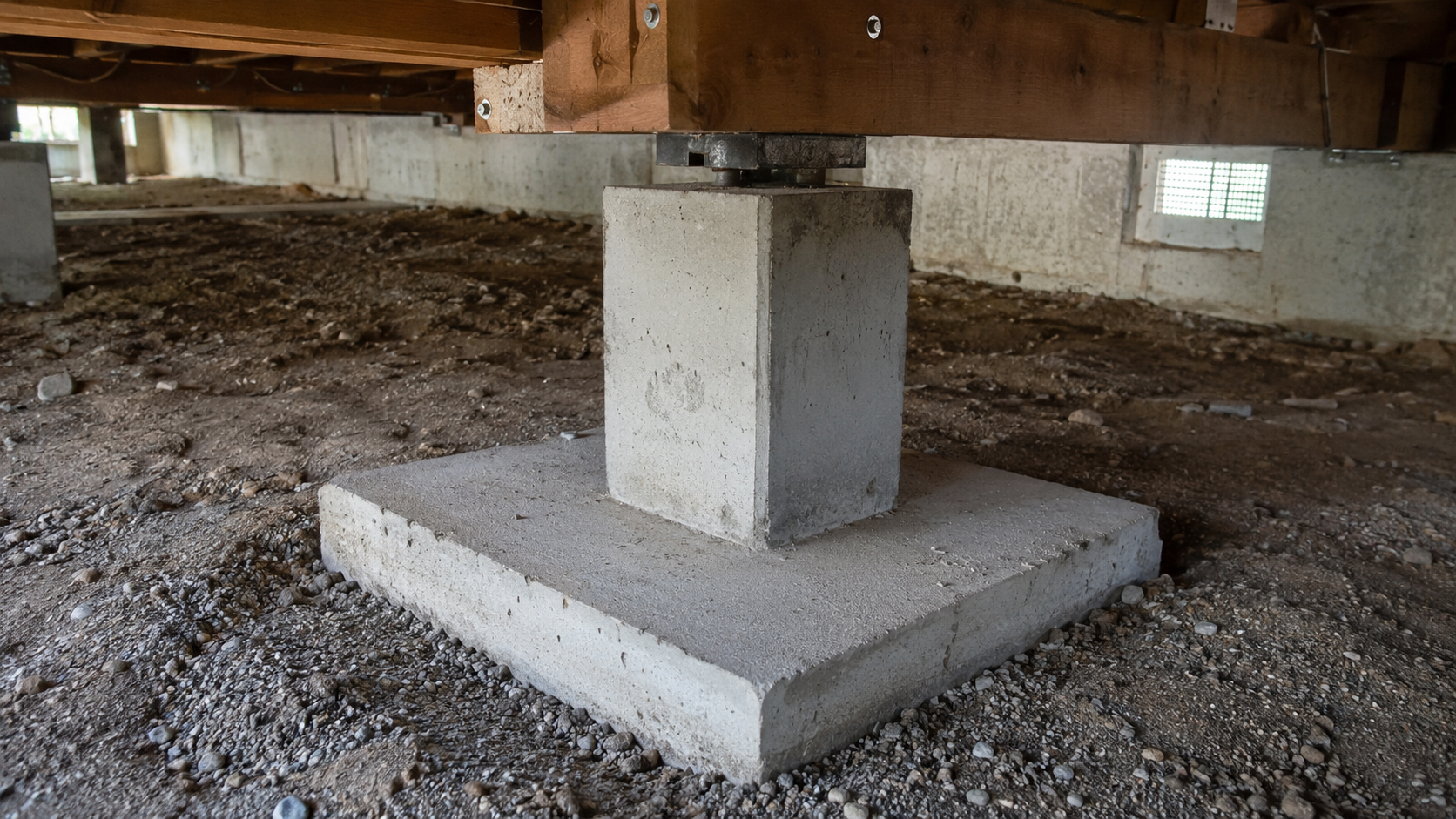
Foundation pillars fail when the load has nowhere solid to go.
The pillar is only the visible part. The footing, soil, spacing, drainage, reinforcement, and connection above matter just as much. If one of those is wrong, the pillar can settle, crack, lean, or leave the floor above uneven.
A good foundation pillar carries weight straight down into stable support. A bad one interrupts the load path. That is when a porch sags, a crawl-space beam drops, a raised structure moves, or a repair crew starts adding temporary posts that should never become permanent.
What a foundation pillar does
A foundation pillar is a vertical support that transfers load from a beam, floor, porch, deck, raised house, or other structure down to a footing or bearing point below. The exact name changes by region and project. People may call it a pillar, pier, post, column, support, or pedestal.
The basic job stays the same: collect load from above and move it safely into the ground below.
That sounds simple, but the pillar cannot do that job alone. It needs the right footing, stable soil, correct spacing, proper alignment, enough bearing area, and a sound connection to the beam or structure above.
Pillar, pier, post, or column
These words often get mixed together. That can create confusion during repairs and estimates.
| Term | Common meaning | What matters most |
|---|---|---|
| Pillar | A vertical foundation support, often concrete, masonry, stone, steel, or timber | Load path, footing size, soil bearing, and connection above |
| Pier | A support below a beam, crawl space, porch, deck, or raised structure | Depth, spacing, bearing, moisture exposure, and settlement risk |
| Post | A vertical wood or steel support, sometimes temporary and sometimes permanent | Whether it is rated, protected, braced, and supported correctly |
| Column | A vertical structural member carrying compressive load | Material strength, buckling, base connection, and load transfer |
| Footing or pad | The support below the pillar or pier | Bearing area, soil capacity, frost, drainage, and settlement |
The label matters less than the support system. A strong-looking pillar can still fail if it sits on weak soil, an undersized pad, or a wet crawl-space floor.
Where foundation pillars are used
Foundation pillars appear in many building conditions. They may support a crawl-space beam, a porch, a deck, a raised house, a small outbuilding, an addition, or part of a foundation system where continuous walls are not used.
In a crawl space, pillars or piers often carry beams that support the floor above. In a raised building, they may lift the structure above grade, flood risk, or poor surface conditions. In some construction, they work with grade beams, perimeter walls, or other foundations to spread loads.
The mistake is treating all pillars the same. A decorative porch post, a crawl-space support pier, a raised-house concrete pier, and a structural column base do not have the same job.
What makes a pillar stable
A stable foundation pillar depends on four things: load, footing, soil, and connection.
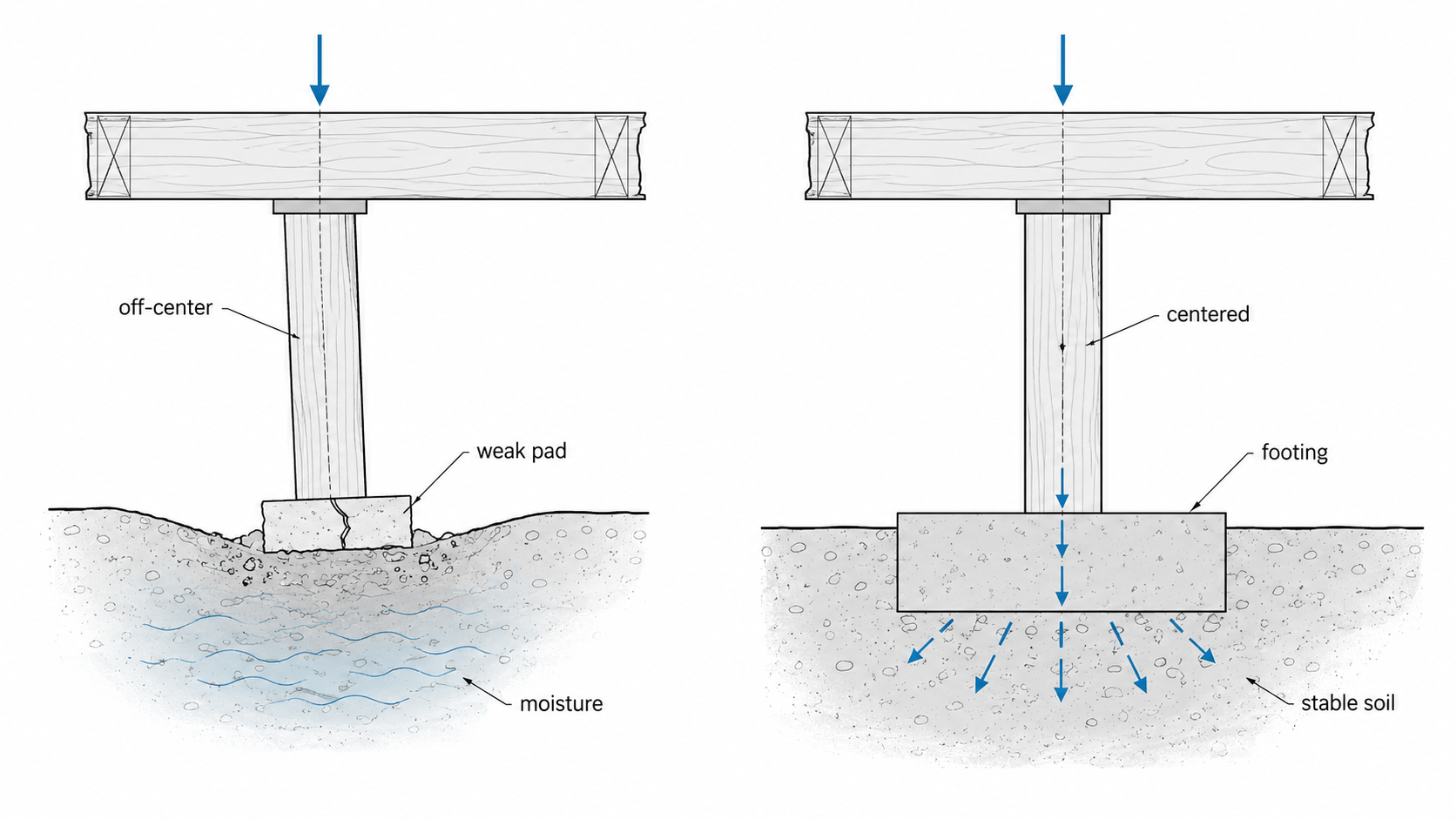
The load must come down through the pillar without twisting, leaning, or landing off-center. The footing or pad must be wide and strong enough to spread that load. The soil below must be capable of carrying it without settling. The connection above must keep the beam or structure properly supported.
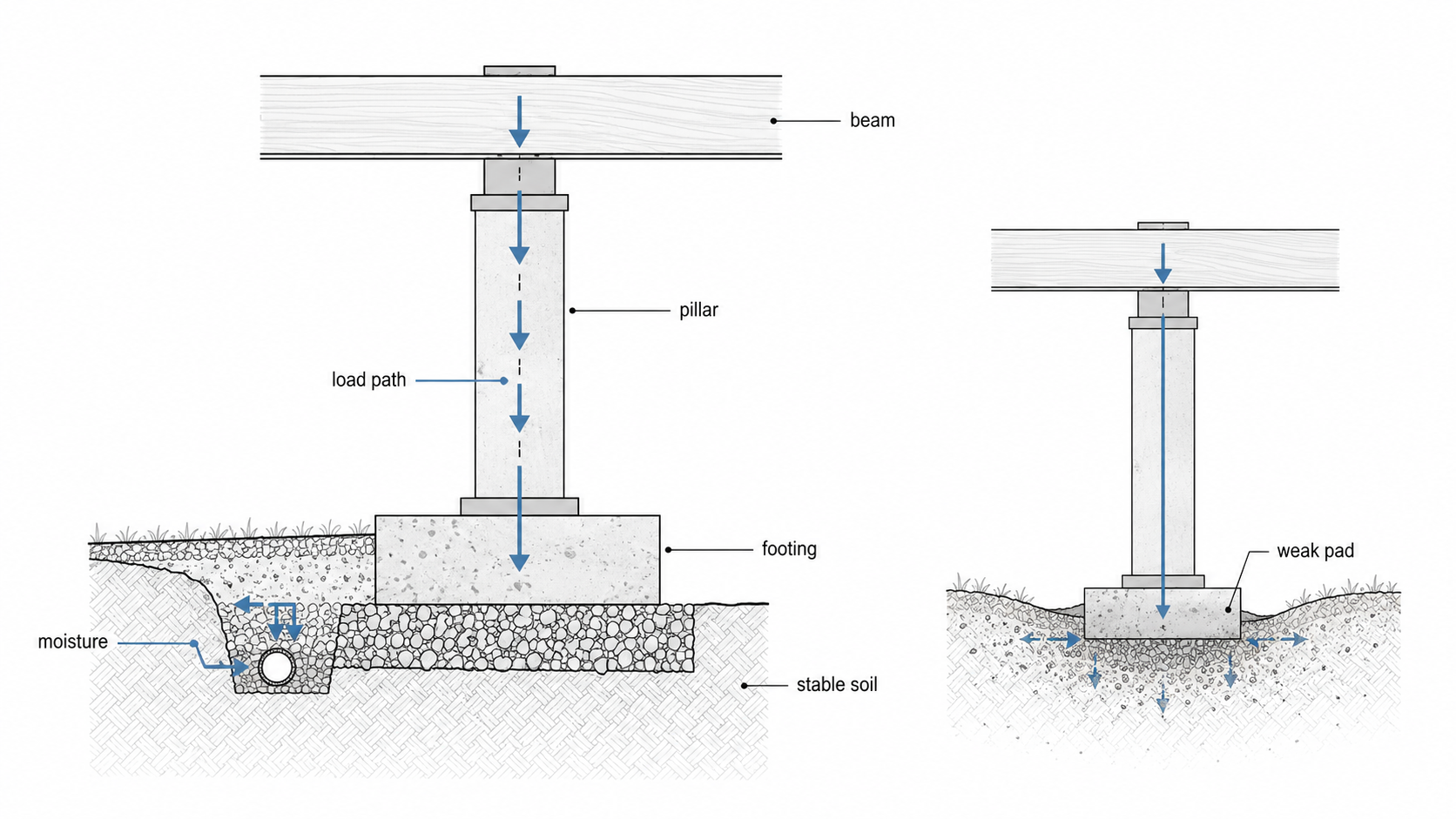
If one part is weak, the whole support can fail.
- A good pillar on a weak footing can settle.
- A good footing on soft soil can sink.
- A good pillar with a bad beam connection can shift or leave gaps.
- A strong post used as a temporary jack can become dangerous if treated as permanent support.
- A pier in a wet crawl space can fail because the surrounding moisture damages wood, soil, or bearing conditions.
Soil and footing come first
The footing below the pillar matters more than the pillar above it. That footing spreads the load into the soil. If it is too small, too shallow, placed on soft fill, or exposed to water, the pillar may crack, sink, or lean.
Good construction starts with the bearing surface. The bottom of the excavation should reach soil that can support the load. Loose fill, organic material, wet mud, roots, construction debris, and disturbed soil are warning signs.
For deeper excavation questions, foundation excavation depth is useful because pillar supports still depend on soil, depth, frost, water, and excavation safety.
Alignment matters as much as strength
A pillar can be strong and still be wrong. If it does not line up with the beam above, the footing below, or the actual load point, the support may twist, shift, or create a point-load problem instead of solving one.
That is why “add another post” is not automatically a good repair. The new support has to land in the right place and bear on something capable of carrying the load.
A simple torpedo level can help with basic plumb checks, but it does not prove the footing, soil, or load path is correct.
Concrete, masonry, steel, and timber pillars
Foundation pillars can be built from different materials. The right material depends on load, exposure, soil, moisture, building type, and local code.
| Material | Where it is often used | Main risk |
|---|---|---|
| Concrete | Crawl-space piers, raised supports, porches, small buildings, heavier loads | Cracking, poor reinforcement, bad curing, weak footing, or poor bearing |
| Concrete block or masonry | Crawl spaces, older support systems, small raised structures | Stacking errors, mortar failure, moisture, displacement, and poor footing support |
| Steel | Adjustable posts, columns, retrofit supports, some engineered conditions | Corrosion, buckling, bad base plates, temporary posts left in place |
| Timber | Porches, older crawl spaces, decks, light structures | Rot, insects, ground contact, moisture, and undersized members |
| Stone or older masonry | Older houses, historic crawl spaces, older support piers | Loose units, weak mortar, settlement, and moisture damage |
The material is only one decision. A concrete pillar can still fail if it is poured on the wrong base. A steel post can still fail if it is temporary, corroded, or poorly connected. A timber support can still fail if it touches damp soil or has no proper footing.
Common foundation pillar failures
Pillar problems usually show up as movement above or damage at the support.
- the pillar leans or is out of plumb
- the footing or pad cracks
- the beam above pulls away or leaves a gap
- floors above sag or slope
- doors stick near the supported area
- masonry joints crack or open
- steel posts rust at the base
- wood posts rot near moisture
- temporary jack posts are carrying permanent load
- multiple supports settle in the same crawl-space area
When several of these signs appear together, the problem may be larger than one bad pillar. It may involve drainage, soil support, beam sizing, poor spacing, or a larger foundation movement issue.
Crawl-space pillars and sagging floors
Crawl-space pillars are easy to underestimate because they are hidden under the house. A floor can sag for years before the owner sees the support problem below.
Common crawl-space issues include weak piers, poor shimming, rotten beams, temporary posts, soft soil, missing pads, moisture damage, and posts that do not line up with the load above. A support that looks close to the beam may not be carrying load correctly.
If the floor above is uneven, the repair should start below the floor, not with surface leveling upstairs. Crawl space foundation repair is the better next step when piers, beams, moisture, and sagging floors are part of the same problem.
Temporary posts are not a foundation repair
Adjustable steel posts and jack posts are often used during repair work, but that does not make them a permanent foundation system. Some are intended for temporary support. Others may be rated for permanent use only when installed correctly with proper footing, connection, bracing, and corrosion protection.
A temporary post placed on a thin slab, loose block, wood scrap, or wet soil can create a false sense of safety. It may lift the floor slightly while the real support problem stays below it.
Do not judge a crawl-space repair by whether the floor looks better for a week. Judge it by whether the load path, footing, soil, beam, and moisture problem were corrected.
When water is part of the failure
Water can damage foundation pillars in several ways. It can soften the soil below a footing, rot wood posts, corrode steel, weaken masonry joints, and keep crawl-space conditions damp enough to damage beams above.
Drainage matters even when the pillar itself is concrete. If water keeps moving through the crawl space or collecting around a support pad, settlement and deterioration can continue after the visible repair is finished.
Before replacing or adding supports, check outside grade, roof runoff, downspouts, crawl-space moisture, plumbing leaks, and whether water collects around the pillar base.
In damp crawl spaces, a basic pin-type moisture meter can help separate surface dampness from a deeper moisture problem in wood posts, beams, and nearby framing.
Spacing changes how the beam behaves
Foundation pillars need to line up with the loads above, but spacing matters too. If pillars are too far apart, the beam above can deflect. If one support is added without understanding the surrounding structure, the load can shift instead of being solved.
This is why pillar work should not be treated as a random “add more posts” repair. The spacing, beam size, footing size, and load path have to work together.
Foundation pillar repair vs replacement
Some pillar problems can be corrected with repair. Others need replacement or redesign.
| Condition | Possible repair | When replacement may be needed |
|---|---|---|
| Minor surface cracking in concrete | Monitor, seal, or repair surface damage | If the crack is widening, structural, or tied to settlement |
| Rusting steel post | Clean, protect, or replace hardware if minor | If the post is losing section, poorly anchored, or temporary |
| Rotten wood post | Moisture correction and limited repair if minor | If decay affects bearing or the post contacts damp soil |
| Sinking pier or pillar | Re-level only after cause is understood | If the footing, soil, or pad is inadequate |
| Poor spacing or wrong load path | Add or adjust supports under a proper plan | If the support system needs redesign |
Repair should not hide the cause. A new post on the same weak soil can fail the same way the old one did.
What to check before building a foundation pillar
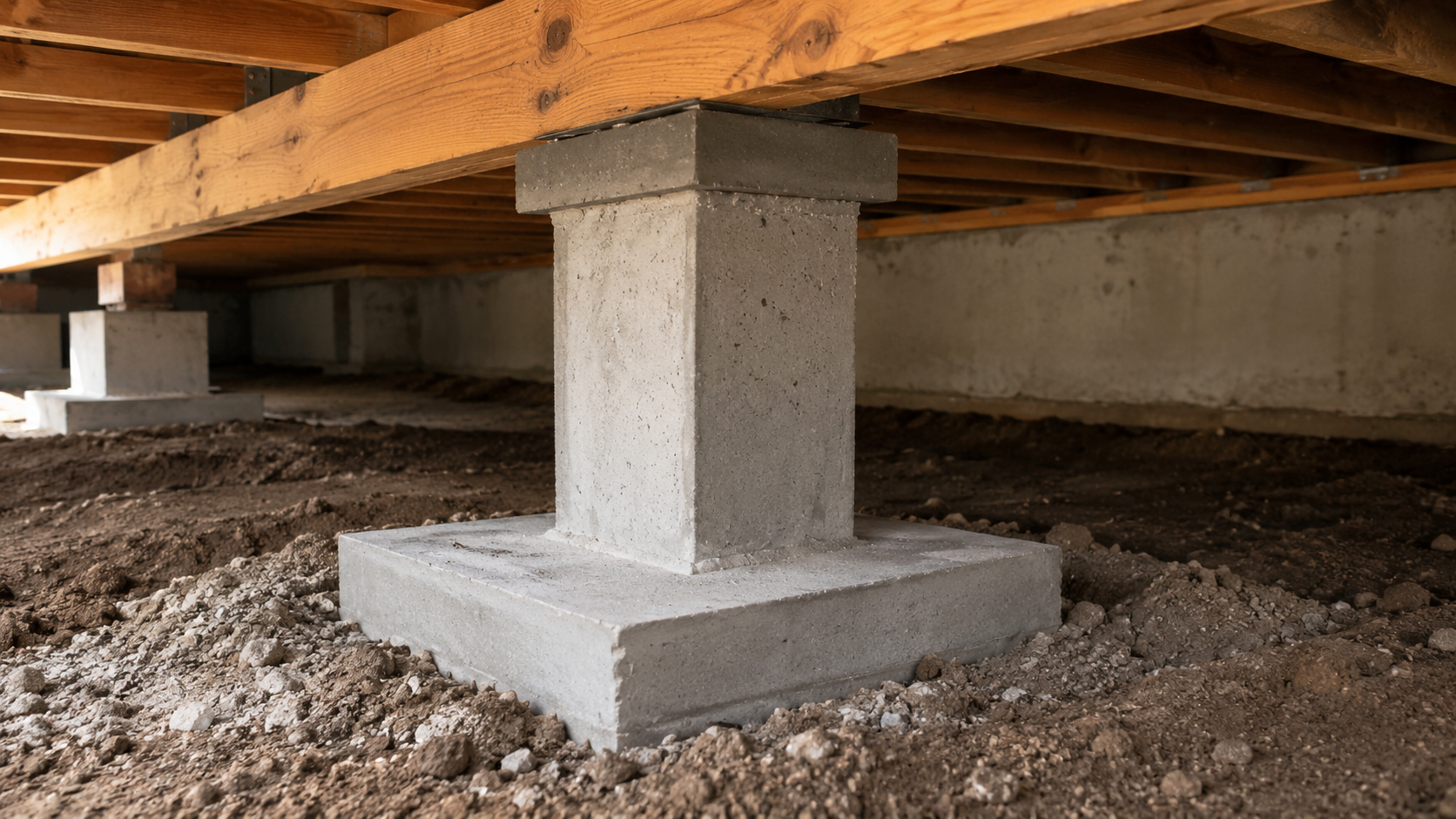
- where the load is coming from above
- whether the pillar lines up with the beam or support point
- footing size, thickness, depth, and bearing soil
- frost or local depth requirements where they apply
- drainage and moisture around the support
- reinforcement, forms, concrete placement, and curing if concrete is used
- base plate, bracket, anchor, or beam connection details
- whether the support is temporary or permanent
- whether permits, inspection, or engineering are required
If the pillar is supporting a house, a structural beam, or a floor system, do not treat it like a decorative post. The load path should be clear before construction starts.
Bad pillar repairs
Bad pillar repairs usually have one thing in common: they make the symptom look better without fixing support.
Do not treat sagging floors, leaning pillars, temporary jack posts, or load-bearing supports as casual DIY work. A floor that lifts slightly after a jack is added may still be sitting on weak soil, a thin slab, wet wood, bad shims, or a support that does not line up with the beam above.
- placing a new post on a thin slab instead of a proper footing
- using wood blocks or loose masonry as permanent shims
- jacking a sagging beam too fast and cracking finishes above
- installing adjustable posts without proper bearing or anchorage
- ignoring wet crawl-space soil around the support
- adding supports that do not line up with the load above
- covering rust, rot, or cracked masonry instead of replacing failed support
A support that looks stronger is not automatically safer. It has to land on something that can carry the load.
When house lifting or underpinning becomes part of the job
Some pillar repairs are small. Others are part of a larger structural correction. If several supports have settled, if the house is out of level, or if the floor system needs to be raised before repairs can happen, the work may move into house lifting, foundation raising, or underpinning.
When the structure itself has to be lifted or held while support work happens, the repair moves closer to house lifting and foundation raising. If the existing support needs deeper or stronger bearing below it, foundation underpinning may be the more relevant repair path.
What to fix first
Start below the pillar.
If the soil is soft, fix the bearing problem. If water is collecting around the base, fix the drainage. If the footing is undersized, the pillar may need a better pad or redesign. If the beam above is damaged, replacing the support below will not solve everything.
A foundation pillar only works when the load, pillar, footing, and soil act as one system.
FAQ
What is a foundation pillar?
A foundation pillar is a vertical support that transfers load from a beam, floor, porch, raised structure, or building frame down to a footing or bearing point below.
Is a foundation pillar the same as a pier?
The terms overlap. In many residential settings, people use pier and pillar to describe vertical foundation supports. The important issue is not the name but the footing, soil, load path, and connection above.
Why do foundation pillars crack?
Cracks can come from shrinkage, poor concrete, overload, soil movement, water, reinforcement problems, or settlement below the footing. A crack should be judged by movement, width, location, and whether the pillar is still carrying load correctly.
Can I add a support post under a sagging floor?
Not casually. A post needs proper bearing below and correct load transfer above. Adding a post on a thin slab, loose block, or soft soil can create a new problem instead of fixing the floor.
What causes crawl-space pillars to fail?
Common causes include moisture, weak soil, undersized pads, poor shimming, wood rot, cracked masonry, bad spacing, and posts that do not line up with beams above.
When should a foundation pillar be replaced?
Replacement may be needed when the pillar is badly cracked, leaning, sinking, rotted, corroded, poorly supported, or sitting on an inadequate footing. The cause should be corrected before a new support is installed.
Do foundation pillars need footings?
Yes, structural pillars usually need some form of footing, pad, pier base, or engineered support below them. The support below the pillar spreads the load into soil.
References
For residential foundation requirements, footing support, drainage, soil conditions, and foundation wall provisions, see ICC’s Chapter 4: Foundations. Local code adoption and inspection requirements still control the project.
For concrete repair preparation and repair application guidance, see the American Concrete Institute’s Field Guide to Concrete Repair Application Procedures.
For crawl-space moisture and wood-framing risk, see the USDA Forest Products Laboratory paper Moisture Control in Crawl Spaces.