
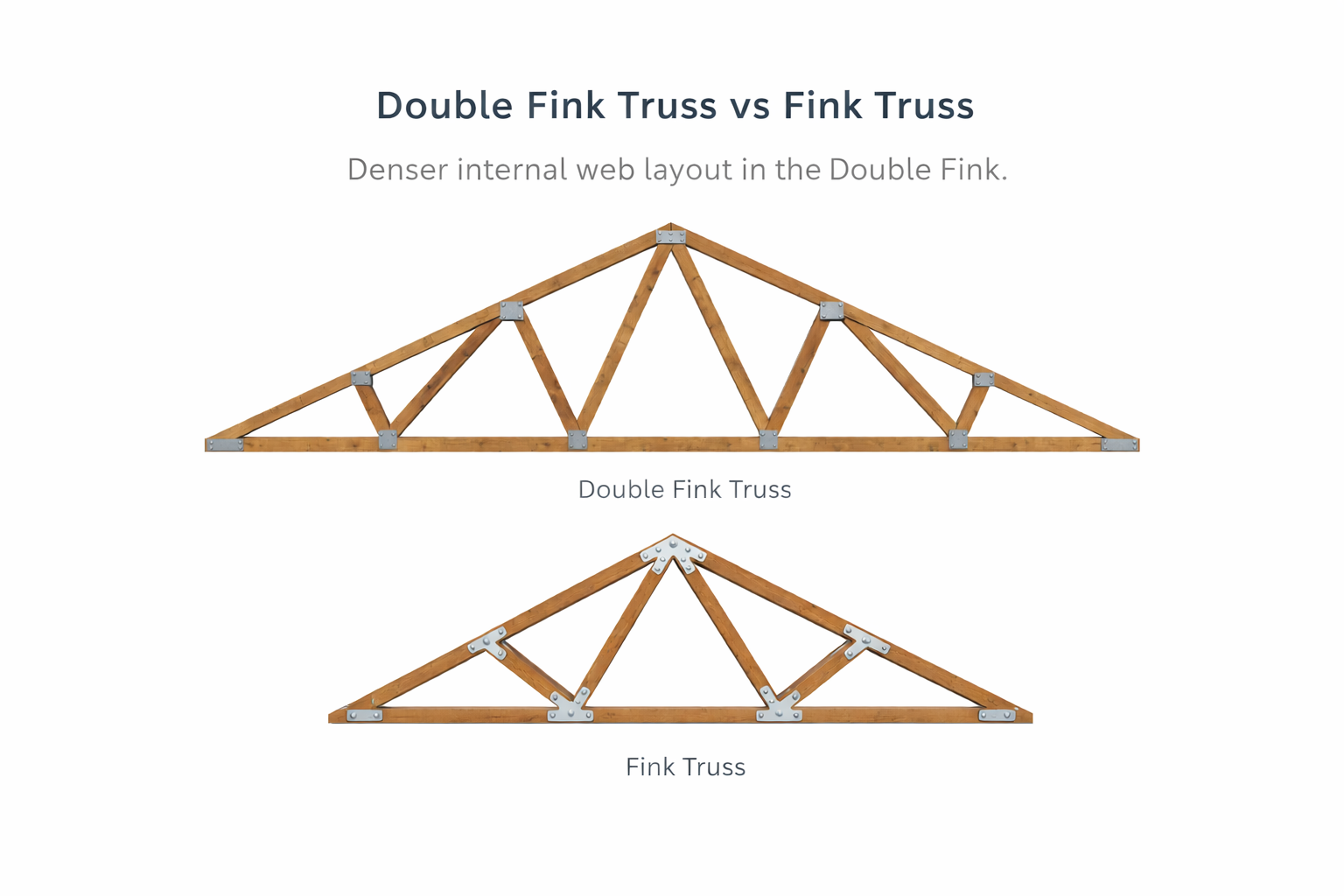
Illustration by ArchitectureCourses.org. Double Fink and Fink trusses compared by overall form and internal web pattern.
Double Fink Truss Span and Use
A double Fink truss comes in when a standard Fink truss is no longer enough for the span or roof load.
It keeps the same basic truss logic but adds more web members to carry longer spans more efficiently. That makes it common in larger roof structures where open floor area matters and intermediate supports start getting in the way. It is not just a bigger version of the same truss. It is a different layout used for a different range of spans and loads.
If you need the base type first, start with Fink Trusses. If you want the broader family, use Types of Trusses and Roof Trusses. This page stays focused on the double Fink specifically.
What a Double Fink Truss Is

Illustration by ArchitectureCourses.org. Double Fink truss shown as a standalone roof truss form.
A double Fink truss builds on the ordinary Fink pattern by adding more internal webbing. Instead of one simple W-shaped web layout, the truss uses a denser internal pattern to shorten load paths and spread forces more evenly across the member network.
That extra webbing is the whole point. It helps the truss do more work over a bigger roof area without leaning as hard on interior support lines.
| Truss type | Best fit | Main strength | Main limitation |
|---|---|---|---|
| Standard Fink | Typical residential roofs | Efficient and economical for common house spans | Limited for larger clear spans or heavier roof demands |
| Double Fink | Larger roofs needing more span or more load capacity | Better load distribution and stronger performance over wider areas | More material, more complexity, and usually higher cost |
If the question is just what changes from one to the other, the answer is simple: more web structure, more span flexibility, and more capacity to carry demanding roof loads.
Why Builders Use Double Fink Trusses
Double Fink trusses get used when open floor area matters and the roof still has to work hard. The extra web pattern helps in three places at once:
- Longer spans: useful where columns or bearing walls would get in the way.
- Heavier loads: better suited to demanding roof systems, snow regions, or equipment-heavy roofs.
- More flexibility below: better for gym floors, barn interiors, event halls, warehouse layouts, and other open-use spaces.
This is why double Fink trusses show up more often in commercial, agricultural, and larger public-space roofs than in ordinary small house roofs.
Where Double Fink Trusses Make Sense

Image by ArchitectureCourses.org. A small truss model and connection sketches show how truss geometry and joints get worked out before fabrication.
| Building type | Why it works here | What to watch |
|---|---|---|
| Warehouses | Open floor area matters more than attic space | Coordinate truss depth with lighting, ducts, and sprinklers |
| Barns and agricultural buildings | Clear spans help equipment movement and storage | Moisture, corrosion, and load assumptions need care |
| Gymnasiums and event halls | Large open interiors need fewer interruptions below | Long spans raise the stakes for bracing and installation sequencing |
| Larger residential or mixed-use roofs | Useful when roof area or load demand pushes past a simple Fink | May still be the wrong choice if the owner wants attic room or vaulted openness |
A double Fink is not automatically the best truss just because the building is bigger. It is the right choice when the span, loading, and layout needs all point toward a stronger webbed truss rather than a simpler residential layout.
Parts That Matter in a Double Fink Truss
The same basic truss parts are still there, but they do more work because the layout is denser.
- Top chords form the roof slope and carry compression.
- Bottom chord ties the truss together and resists tension.
- Additional web members divide loads into more paths than a simple Fink.
- Heel joints still matter at the wall line because that is where bearing and insulation decisions start getting real.
- Connection plates or gussets become more important because there are more member intersections to resolve cleanly.
If you want the basic terminology first, use Fink Truss Parts. The member names carry over. What changes here is the scale and structural demand.
Span, Load, and Roof Use

Most people end up on this page because of span or weight. That is the right instinct. Double Fink trusses are usually not chosen for appearance first. They are chosen because the roof has more to do.
| Project condition | What it pushes you toward |
|---|---|
| The roof needs to span farther without interior columns | Double Fink becomes more attractive than a simple Fink |
| The roof has heavier dead load or stronger live load demands | Extra webbing helps distribute load more evenly |
| The building needs open floor use below | Double Fink often fits better than layouts needing more support interruption |
| The owner wants usable attic room or a very open vaulted ceiling | A different truss type may fit better |
This is where projects go wrong: someone sees “bigger truss” and assumes that solves every roof problem. It does not. A double Fink helps with span and load. It does not magically create attic space, easy service routing, or design freedom in every direction.
Timber, Steel, or Engineered Wood?
Double Fink trusses can be timber, steel, or engineered wood. The geometry is the concept. The material choice changes durability, fabrication, cost, and how the truss behaves in the building environment.
| Material | Best use | Main advantage | Main trade-off |
|---|---|---|---|
| Timber | Residential, barns, many agricultural projects | Cost-effective and familiar | More sensitive to moisture, pests, and long-term movement |
| Steel | Industrial, commercial, high-load, coastal, or long-span work | High strength and long service life | Higher cost and more specialized erection/detailing |
| Engineered wood | Projects balancing visual quality, strength, and prefabrication control | Good structural consistency with a cleaner architectural finish | Still needs careful detailing and usually costs more than basic timber framing |
If you are comparing systems more broadly, use Timber Trusses Explained and Steel Truss Design.
What to Check Before Ordering
This is the part that saves money. Most truss mistakes start before the trusses arrive.
- Confirm the exact span and pitch. Late changes here can throw off the whole package.
- Confirm the loads. Roofing weight, snow, wind exposure, rooftop units, and future upgrades all matter.
- Check interior-use expectations. If the owner wants storage, mezzanine conditions, or service space, that has to be known early.
- Check bearing points and wall layout. The structure below needs to match the truss design.
- Coordinate HVAC, lighting, sprinkler, and duct routes. Truss webs are not places to improvise later.
- Confirm delivery and crane access. A large truss is only useful if the site can receive and set it cleanly.
Prefabrication helps a lot here. It shortens site time and reduces guesswork, especially on repetitive roof bays. If that is the angle you need next, see Prefabricated Timber Trusses.
Installation and Bracing
Double Fink trusses are not forgiving during installation. Their span and complexity make temporary stability a serious issue until the full bracing system is in place.
- Use a clear erection sequence.
- Brace early, not after the line is already drifting.
- Check alignment with real tools, not by eye.
- Do not remove temporary bracing too soon.
- Protect timber trusses from unnecessary moisture before installation.
If the bracing side is what you need, go next to Truss Bracing and Roof Support Systems, Types of Truss Bracing, and Truss Lateral Bracing.
Cost Factors
Double Fink trusses usually cost more than simple Fink trusses. That is expected. There is more webbing, more fabrication, and often more lifting and coordination involved.
| Cost driver | Why it pushes cost up |
|---|---|
| More members | Extra webbing means more material and more fabrication time |
| Longer spans | Larger roof areas usually need more design control and heavier handling |
| Material choice | Steel and engineered wood often raise the initial price |
| Crane and access needs | Larger trusses can increase delivery and lifting costs |
| Custom detailing | Special roof slopes, exposed finishes, and integrated systems take more coordination |
The counterpoint is simple: a stronger truss that reduces interior supports can save money elsewhere. Fewer columns, fewer wall interruptions, and more usable floor space can justify the higher truss cost on the right building.
Where It Usually Goes Wrong
- Using a double Fink where the project really needed an attic truss or another open-interior solution.
- Underestimating the roof loads and assuming the extra webbing covers everything.
- Ignoring service coordination and then trying to cut around webs later.
- Rushing installation without a serious bracing plan.
- Picking timber or steel by habit instead of by environment and span demand.
- Assuming a bigger truss removes the need for careful bearing and layout below.
A double Fink is strong, but it is not casual. Once the truss design is set, field improvisation becomes expensive fast.
Double Fink vs Other Truss Choices

Illustration by ArchitectureCourses.org. Side-by-side comparison of common bridge trusses and residential roof truss types, including Pratt, Howe, Warren, Baltimore, K, king post, Fink, double Fink, and Belfast forms.
| Truss type | Best when | Main limitation |
|---|---|---|
| Standard Fink | You need an efficient common roof truss for ordinary spans | Runs out of room sooner on bigger spans and heavier roof demands |
| Double Fink | You need more span and more capacity without cluttering the floor below | Costs more and takes more coordination |
| King Post Truss | The roof is smaller and the structure is simpler | Not the right answer for larger routine roof spans |
| Gable End Trusses | You are resolving the roof end condition, not the full field truss strategy | Not a substitute for a main span truss choice |
For the bigger family picture, use Truss Design 101 and Roof Truss Details.
FAQ
What is a double Fink truss used for?
It is used for larger roofs that need more span or more load capacity than a standard Fink truss handles comfortably.
What is the main difference between a Fink truss and a double Fink truss?
The double Fink uses more internal web members, which improves load distribution and makes the truss better suited to larger roof work.
Are double Fink trusses only for commercial buildings?
No. They are common in commercial and agricultural buildings, but they can also make sense in larger residential projects.
Can a double Fink truss create usable attic room?
Not usually in the way people hope. If open attic room is the goal, another truss type often fits better.
Are timber double Fink trusses good enough for heavy work?
Sometimes, yes. It depends on span, loading, moisture exposure, and detailing. Some projects push that decision toward steel or engineered wood instead.
Do double Fink trusses need more bracing attention than smaller trusses?
Yes. The larger the truss and the roof area, the more careful the temporary and permanent bracing strategy needs to be.
Can you cut or drill a double Fink truss after installation?
Not without proper engineering. Altering members casually can damage the load path and weaken the whole system.