

What Keeps Roof Trusses Stable During Installation and After
Trusses can go unstable fast once they are set and before the roof system is fully tied together.
That is when bracing matters most. Until the truss line is restrained, individual trusses can lean, roll, or drift out of plane even if they were built and set correctly. The risky part is not just lifting them. It is the period right after placement, when the line is standing but the system still is not locked in.
If you need the broader picture first, start with Roof Trusses. If you are comparing the full bracing family, use Types of Truss Bracing and Truss Bracing and Roof Support Systems.
What Diagonal Truss Bracing Does

Diagonal bracing ties the truss line together and helps stop lateral movement while the roof system is being stabilized.
Diagonal truss bracing helps stop the truss line from moving sideways or rolling out of alignment. It is one of the pieces that turns a row of individual trusses into a more stable roof system.
- It limits lateral movement.
- It helps control truss roll and lean during erection.
- It connects multiple trusses so they act together instead of individually.
- It supports the bracing strategy until the roof system is fully restrained.
That does not mean diagonal bracing works alone. It is part of a larger system that can include temporary bracing, permanent bracing, lateral restraint, roof sheathing, and the connection details that tie everything back into the structure below.
Temporary Stability and Permanent Bracing Are Different Jobs

Illustration by ArchitectureCourses.org. A diagonal brace runs across the top chords of roof trusses to help stabilize the truss line and prevent lateral movement during framing.
A lot of site problems start when those two jobs get blurred together.
| Stage | What diagonal bracing is doing | What crews get wrong |
|---|---|---|
| During erection | Holding the truss line stable while the roof is still vulnerable | Treating temporary braces like an optional extra |
| After the system is complete | Working as part of the permanent bracing layout required by the truss design and bracing documents | Assuming the temporary braces that happened to be used on site are enough for the finished roof |
Temporary diagonal bracing is about surviving erection. Permanent diagonal bracing belongs to the finished structural system. Those are not the same decision, and they should not be improvised the same way.
On a serious truss job, the permanent bracing layout is not something the crew invents after lunch. It should follow the truss package, the permanent restraint requirements, and the roof bracing plan that goes with that design. Temporary braces may help you get there, but they are not automatically the final answer.
Where Diagonal Bracing Usually Goes
The exact layout depends on the truss design, span, roof shape, and the bracing instructions that come with the truss package. But in ordinary roof work, diagonal bracing is usually used to tie the truss line together across the run and help restrain the top-chord or web-bracing lines from wandering.
- Along the truss run to connect multiple trusses into one restrained line.
- At braced member lines where lateral restraint has to be tied back into something more stable.
- In longer or more exposed roofs where erection stability is less forgiving.
- At locations identified by the truss engineer or bracing documents, not wherever it seems convenient in the field.
This is why diagonal bracing should never be treated like random scrap lumber nailed in after the fact. It has to connect to the right line, in the right direction, for the right reason.
Sheathing Does Not Replace Early Bracing
This is one of the most common bad assumptions on residential sites.
Finished roof sheathing can help stiffen the roof system once enough of it is installed and fastened properly. But during erection, before the roof diaphragm is complete, sheathing is not a substitute for a real temporary bracing sequence.
That is where crews get into trouble. They set trusses, assume the next few sheets of sheathing will solve the stability problem, and leave the line under-braced while the roof is still vulnerable to wind, movement, or handling error.
Bracing first. Sheathing after. Not the other way around.
What the Brace Has to Connect To
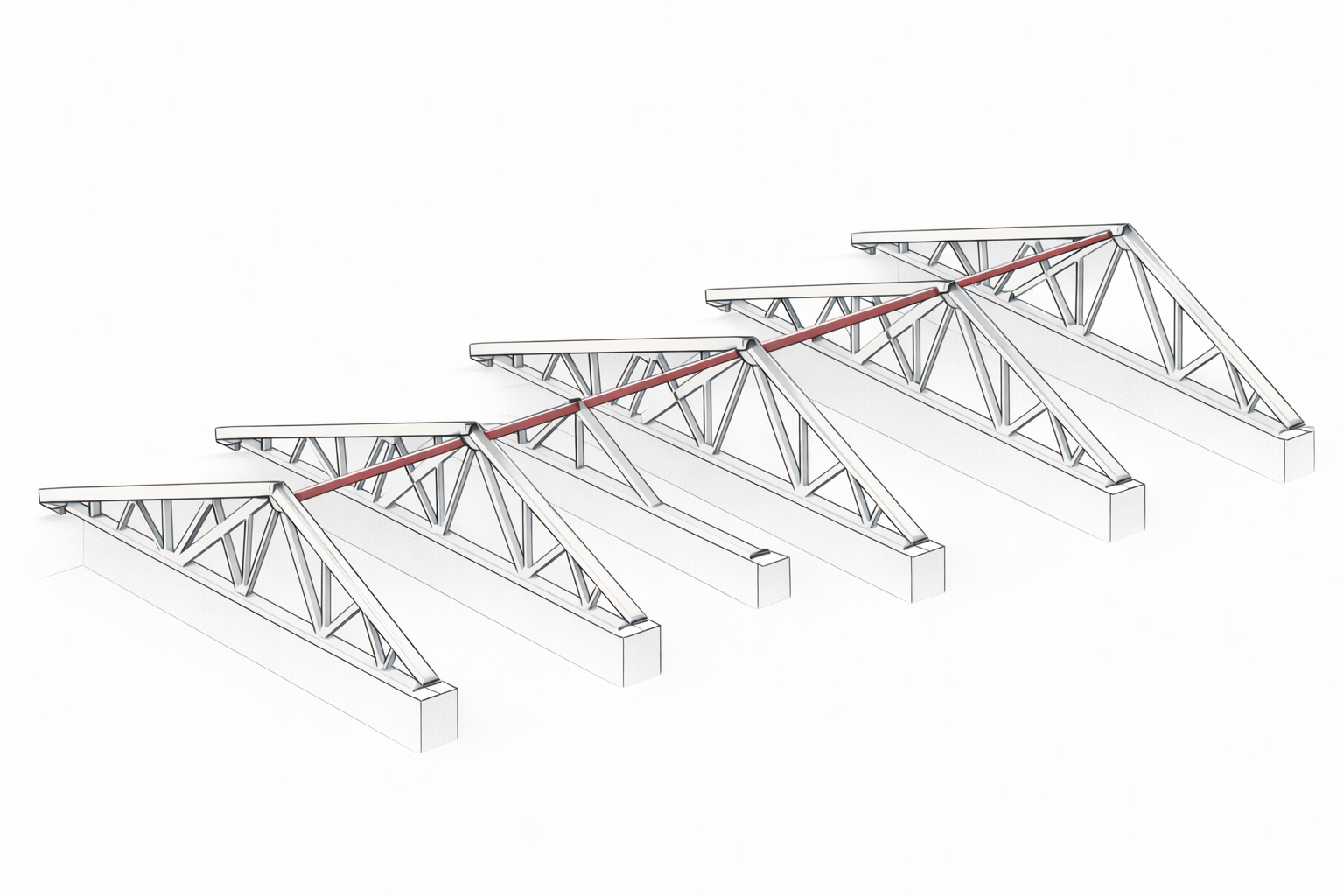
Diagonal truss bracing runs across adjacent roof trusses to help stabilize the truss line.
A diagonal brace only works if it ties into something that can resist the force it is collecting.
That sounds obvious, but this is where sloppy installations fail. A brace nailed into weak framing, loose members, or the wrong part of the truss line does not magically become useful just because it is diagonal.
- It needs a real anchor path.
- It needs to tie into the intended braced line, not a random nearby member.
- It needs to stay continuous enough to do its job across the run.
- It needs fastening that matches the detail, not just whatever was in the pouch.
That is also why diagonal bracing is not just extra support. It is part of load control. If the connection is weak, the brace becomes decoration.
How the Installation Sequence Usually Goes Wrong
Most diagonal-bracing failures are sequence failures, not material failures.
| What crews do wrong | What works better |
|---|---|
| Set a long run of trusses before stabilizing the early ones | Lock the first trusses into a controlled line before expanding the run |
| Rely on a few end braces only | Brace the line as a system, not just at the edges |
| Wait for sheathing to fix alignment | Use bracing to create alignment before sheathing begins |
| Brace to weak or unintended members | Follow the bracing plan and connect into the intended restrained lines |
| Remove temporary braces too early | Keep temporary restraint in place until the permanent system is ready |
The bad version of this job looks familiar: the first few trusses go up fast, the line starts drifting, someone tries to pull it back with a loose brace, and the whole system becomes harder to trust with every additional truss.
Connection Detail Matters More Than People Think

Illustration by ArchitectureCourses.org. Connection detail at a diagonal truss brace shows why angle, fastening, and attachment point all matter to the bracing system.
The brace angle matters. The attachment point matters. The fastener choice matters. The member you are bracing matters.
That is why close connection details deserve more attention than they usually get. A brace that looks present on site can still be doing very little if the end connection is weak, eccentric, or tied into the wrong part of the assembly.
Good bracing details do not just look tidy. They make the restraint path obvious.
Where Problems Usually Start
- Assuming the trusses are stable once they are standing.
- Installing too little diagonal bracing for the length of the run.
- Using diagonal bracing without a clear anchoring strategy.
- Relying on roof sheathing before enough of it is installed and fastened.
- Ignoring the truss package or bracing instructions and improvising in the field.
- Removing temporary bracing before the permanent system is doing its job.
Most of these failures do not look dramatic at first. The line just leans a little. A few trusses start rolling. The spacing goes off. Then the roof becomes harder to recover, and the crew starts fighting geometry that should have been controlled at the beginning.
FAQ
Is diagonal truss bracing always required?
Diagonal bracing is commonly part of the bracing strategy for truss systems, but the exact need and layout depend on the truss design, span, roof form, and the bracing instructions that come with the package.
Can plywood or OSB replace diagonal bracing?
Not during the vulnerable early erection stage. Once the roof sheathing is fully installed and fastened as part of the complete system, it can contribute to stability. Before that, it is not a shortcut for proper temporary bracing.
Can metal straps be used instead of wood bracing?
Sometimes, yes. The right bracing material depends on the detail, the system, and the design requirements. The important part is that the restraint path is correct and the installation matches the plan.
What is the biggest mistake during installation?
Moving too far ahead with truss setting before the early trusses are properly stabilized and the bracing sequence is under control.
Does diagonal bracing work by itself?
No. It works as part of a larger bracing and restraint system that includes alignment, lateral restraint, connections, and the completed roof structure.