

Demo is a stack of small risks that turn into big money the second you touch the wrong thing: hidden asbestos, live services, party walls, water damage, noise limits, access rules, disposal rules, and a schedule that assumes nothing goes wrong.
Most tender losses happen the same way: you price visible demo… but you didn’t price the make-safe, the unknowns, and the constraints. Then the job starts and every “oh by the way” becomes your problem.
- What this covers: the few things that blow demo bids up in real life, what to carry as line items, and how to write clean assumptions that don’t get you laughed out of the room.
- What this is not: a “demo basics” page or a pretend cost list with fake numbers.
The 6 things that actually decide whether your demo price is real
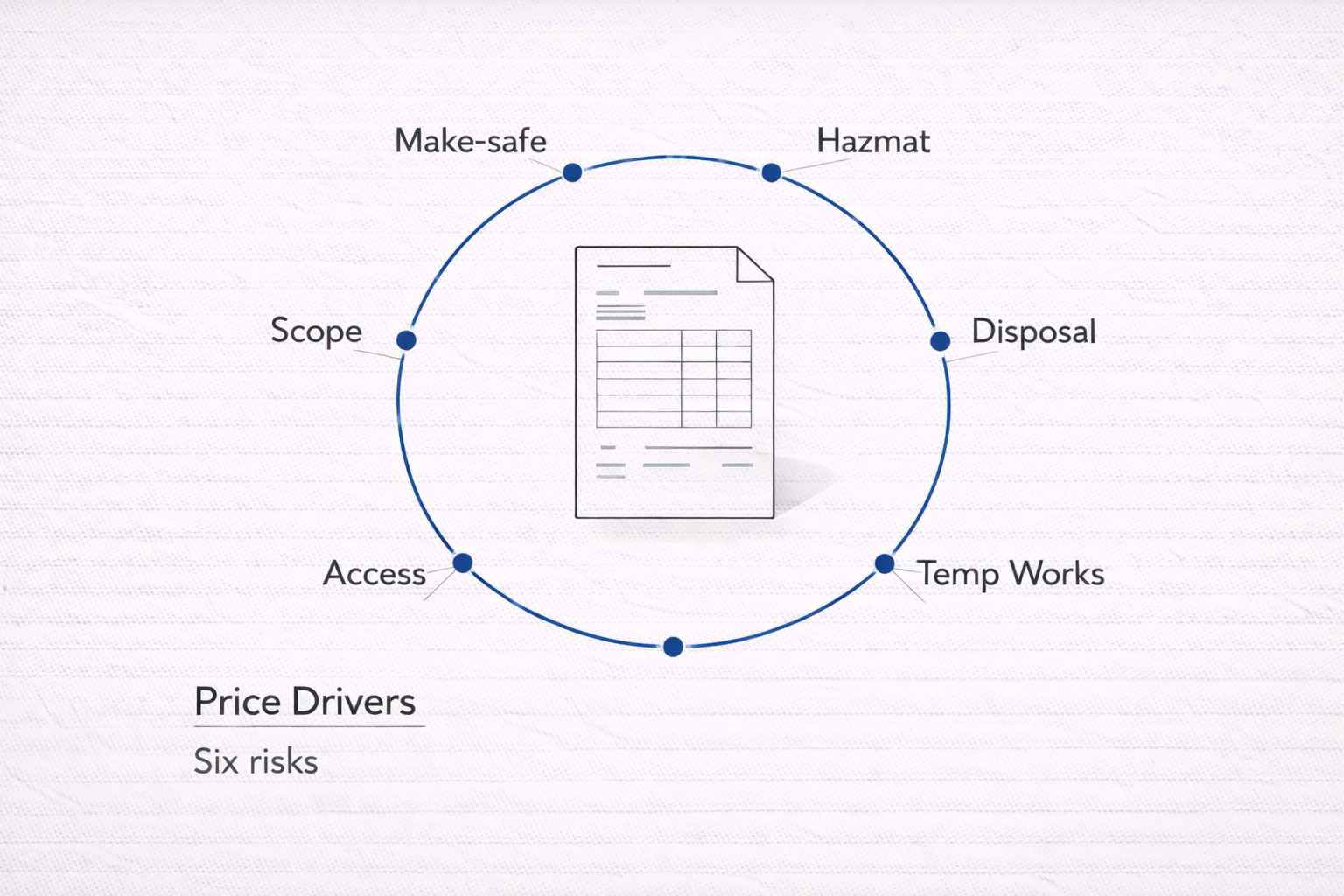
1) Make-safe and isolations (utilities, fire, life safety)
This is where people get burned because it feels like “GC stuff.” It isn’t. If you’re the demo contractor, you need to be crystal-clear on who isolates what and when.
- Live services: power, gas, water, steam, data. Don’t assume “they’ll disconnect it.” Put it in writing: by owner / by GC / by you.
- Temporary fire protection: if you’re taking out ceilings/walls, what happens to sprinkler coverage, alarms, exits, fire separations?
- Engineering survey / stability checks: demo standards require planning and safe sequencing, not “figure it out while tearing.” OSHA’s demolition requirements live under Subpart T. OSHA 1926.850 (Demolition).
2) Hazardous materials (the bid killer if you pretend it’s not there)
If the building is older, assume there’s a real chance of asbestos and lead showing up somewhere annoying: pipe insulation, floor tile/mastic, drywall joint compound, roofing, fireproofing, old duct wrap.
- Asbestos: you need clarity on surveys, notifications, containment, and waste handling. The regulatory framework for demolition/renovation asbestos is typically under NESHAP in the U.S. (and similar elsewhere). If you want a practical official reference that ties the rules to real operations, this EPA guidance is one example used by regulators and owners. EPA asbestos guidance (PDF).
- Lead paint: if you’re disturbing painted surfaces in pre-1978 U.S. housing/child-occupied facilities, the RRP rule can trigger training/work practice requirements. EPA Renovation, Repair and Painting (RRP).
Pricing move that saves you: separate abatement from general demo. If the tender doesn’t include a confirmed hazmat survey, write the assumption like an adult: “price excludes abatement; work based on survey dated ___; unknown ACM/lead to be addressed by owner’s abatement contractor or via approved change.”
3) Selective demo vs “full gut” (scope creep lives here)
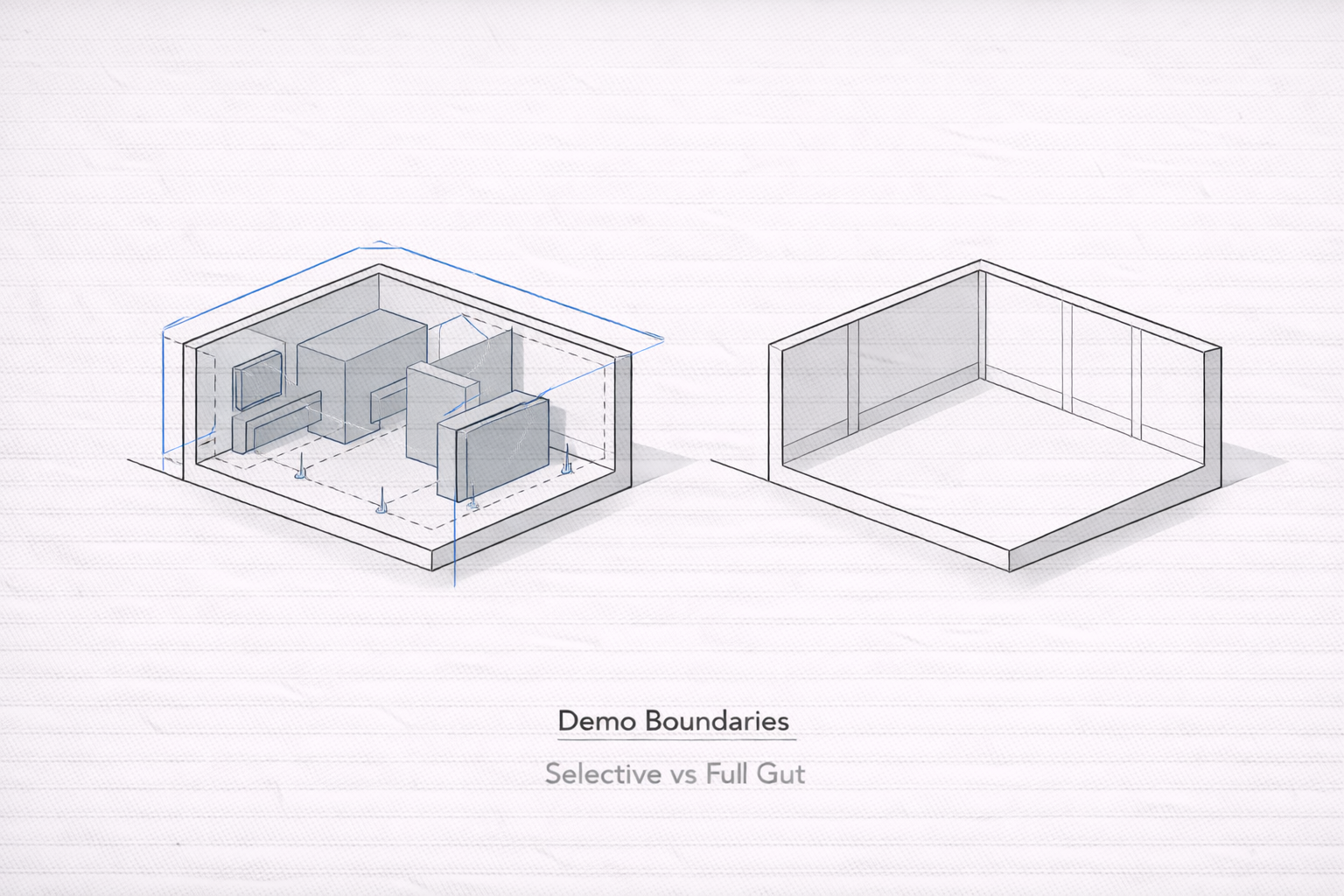
Selective demo is slower, louder (politically), and more fragile. You’re protecting what stays: structure, MEP, finishes, adjacent tenants, heritage elements, elevators, lobbies, storefronts, whatever.
- Protection: hoarding, dust barriers, floor protection, negative air, clean routes, daily housekeeping.
- Scanning and cut rules: concrete scanning, sawcut limits, vibration limits, no-hammer zones.
- “Temporary” supports: shoring, bracing, needle beams, protection of party walls and shared structures.
If the drawings are vague, don’t “assume typical.” Put a simple line in your tender clarifications: “selective demo boundaries by grid/room; work excludes removals not shown; concealed conditions and undocumented assemblies by change.”
4) Access, logistics, and hours (demo is a trucking business with a tool belt)
This is where bids die quietly. If you’re stuck with one loading bay, elevator-only haul routes, or night-only work, your production rate is not your “normal” rate.
- Access: laydown, loading dock rules, street occupancy, traffic control, escorts, elevator bookings, tenant coordination.
- Hours: noise bylaws, weekend restrictions, “no jackhammer 9–5,” school zones, hospital zones.
- Equipment limits: interior work may force electric minis, small skid steers, hand demo, smaller bins, more labor.
5) Disposal and recycling (the line item people undercook)
“Haul-off included” is not enough. You want the tender to reflect how the waste actually behaves.
- Waste streams: mixed C&D vs segregated (metal, concrete, clean wood, gypsum). Segregation can save tipping fees but costs labor and space.
- Weight risk: heavy materials (concrete, plaster, brick) blow bin assumptions fast.
- Documentation: some owners want weight tickets, diversion rates, chain-of-custody.
6) Temporary works and weather (even indoors, water shows up)
Demo creates openings. Roofs get punctured, walls get opened, drains get blocked, sprinkler leaks happen, rain gets in, freeze-thaw eats you alive.
- Temporary waterproofing: tarps, poly, temporary caps, temporary roof patches.
- Drain protection: “don’t fill the stack with rubble” sounds obvious until it’s 6pm Friday.
- Heat and drying: if you open the building in winter, you can create a moisture mess that becomes your blame.
Free PDF: Demolition Tender Checklist (Stop-the-Job Checks)
Common misunderstandings (the traps)
“Demo is simple.” Only if it’s an empty site with no neighbors, no services, no hazmat, and no schedule pressure. That’s not most jobs.
“The GC will handle it.” If you didn’t put it in your price or your exclusions, you’re volunteering.
“We’ll figure it out on site.” That’s how you end up with stop-work orders, angry owners, and crews standing around while someone argues responsibility.
The not-obvious move that makes demo tenders easier
Do a 15-minute “make-safe map” before you even sharpen your pencil.
One page. No fancy software. Draw the floor/area and label: live services, egress, fire protection impacts, shared walls, haul routes, drop zones, noise-sensitive edges.
Then write one line beside each: who owns it (owner/GC/demo/electrical/gas/abatement). If you can’t assign an owner, it’s a tender risk item. Price it, qualify it, or both.
Stop-the-job checklist (pre-submit)

- Scope boundary is real: you can point to what’s out, what’s in, and what stays protected.
- Make-safe is assigned: who disconnects/isolates power, gas, water, sprinklers, alarms, data.
- Hazmat is addressed: survey exists and is dated, or you’ve written a clean assumption/exclusion.
- Selective demo is priced like selective: protection, dust control, hand work, slower production.
- Access is priced: haul routes, elevator rules, loading dock rules, hours, traffic control.
- Disposal is not vibes: waste streams, heavy material risk, tickets/diversion requirements.
- Temporary works are included: shoring/bracing/waterproofing/drain protection as required by your sequence.
- Paperwork reality: permits, notifications, inspections, and closeout docs are assigned (and priced if they’re yours).
Last-hour save: write a one-page bid summary for yourself before you hit submit: price, inclusions, exclusions, assumptions, hazmat basis, access basis, disposal basis, and the one or two risks you refuse to own.
FAQ
Is demolition “lump sum” supposed to cover unknowns?
Not magically. You either (1) get a proper survey and clear scope, (2) carry a visible risk allowance, or (3) write a clear qualification for concealed conditions and regulated materials. If none of those exist, you’re basically gambling.
What’s the most common demo tender miss?
Constraints. Access, hours, neighbors/tenants, protection, and the “keep it running” requirements. The work might be simple. The site rules aren’t.
How do I price selective demolition without getting murdered?
Treat it like surgery, not like a gut. Protection and labor are the job. If the tender documents don’t show protection requirements, you need to write your own scope notes.
What should I do when drawings are unclear?
Ask one blunt question in writing before closing: “confirm demo limits and what stays.” If you can’t get answers, qualify the gap. If you “assume,” you own the assumption.
What’s a red flag that I should walk away?
No hazmat clarity on an older building, no plan for make-safe, and access that’s obviously impossible (but everyone’s pretending it’s fine). Those jobs turn into blame games.
A good demo tender is boring on purpose. Clear scope. Clear make-safe. Clear hazmat basis. Clear constraints. Clear waste plan. If you can’t make it boring on paper, it won’t be boring on site.
External references (official)
- OSHA 1926.850 (Demolition) — baseline U.S. demolition safety requirements (engineering survey, utilities, sequencing). Useful when you need to shut down “we’ll wing it.”
- EPA Renovation, Repair and Painting (RRP) — lead-safe requirements that can trigger on older housing/child-occupied facilities in the U.S. (training/work practices).
- EPA asbestos demolition/renovation guidance (PDF) — a practical, regulator-facing summary of how asbestos rules connect to demo operations, waste handling, and disposal.
- UK HSE: “Could asbestos be present?” — quick reality check for older buildings (UK context), useful for owner conversations when nobody wants to talk about surveys.