

What Bowing Walls Actually Mean
A bowing basement wall is when the wall curves or leans inward under pressure. It usually happens in block walls, though poured concrete can shift too. Once movement starts, the outside pressure almost never eases up. If you ignore it, the wall will crack, leak, or even fail completely.
What It Means for You
If your basement wall is bowing in, you have a structural problem. It isn’t cosmetic. Soil pressure keeps building until the wall splits or collapses. Every season you wait makes the repair more expensive.
One Ohio homeowner ignored a 2-inch bow. Two winters later, with wet clay soil pressing harder each time it froze and thawed, the wall split. Anchors that would have cost $12,000 weren’t enough anymore. The repair ballooned to $38,000 for a partial rebuild.
A straight, solid basement wall keeps your entire house stable. Once it bends, every floor above is under stress. A bowing wall also invites water intrusion, mold, and safety risks.
The good news is bowing walls give early warning signs: step cracks, walls that look slightly curved, water seepage, or basement doors and windows sticking. Catching it early saves money.
Below, we cover the 7 main causes and 3 repair options. Each section includes cost ranges, regional notes, and real examples, so you see what causes the damage and what it takes to fix.
MUST READ
Foundations & Concrete Work — A practical, photo-rich guide from Fine Homebuilding, this book breaks down real-world techniques for sustainable foundation and concrete repairs (walls, slabs, waterproofing). Ideal for homeowners or contractors facing bowing walls.
Signs of Bowing Walls

You can often spot trouble before it turns critical. Look for:
● Horizontal cracks through the middle of a block wall
● A visible inward curve, usually most obvious in the center
● Stair-step cracks along mortar joints near corners
● Basement doors or windows beginning to stick
● Damp spots or water leaks forming through cracks
A healthy basement wall should be straight, with at most a few hairline shrinkage cracks. Anything beyond that means the structure is under stress.
Is bowing always dangerous?
Yes. Even 1 inch means soil pressure is winning.
How Bad Can It Get?
A bowing wall is one of the clearest warnings that the ground outside is winning against your house.
Engineers measure bowing in inches compared to a plumb line:
● Hairline stage (½ inch): Small cracks spread from corners. Easy to dismiss as cosmetic.
● Warning stage (1–2 inches): Mortar joints shear, windows stick, water seeps in. Repairs usually cost $10–15k.
● Failure stage (3+ inches): Wall loses bearing strength. Anchors may not hold. Repairs often climb to $25–40k with partial rebuilds.
● Collapse stage (4+ inches): Sections cave in, often after freeze-thaw or flooding. House may be unsafe until excavation and a full rebuild.
Quick test: Place a 6-foot level vertically against the wall. Measure the gap at mid-height. Record it each season. If the gap grows, the wall is failing.
A Michigan contractor recalled a 1950s block wall that went from 2 inches bowed to a total breach after a January thaw. The repair cost more than the family had originally paid for the house.
Lesson: Bowing walls never stabilize. They only get worse. Repair costs multiply with every inch of movement.
Can I finish a basement with bowed walls?
Not safely. Structure comes first, then finishing.
See also:
Basement Walls Leak When It Rains? Here’s How to Fix It
Practical guide for identifying leaks in basement walls and fixing them.
7 Causes of Bowing Basement Walls

1. Hydrostatic Pressure from Water
When rainwater or groundwater pushes against a basement wall, it builds hydrostatic pressure. This is the number one reason walls bow.
Clay soils are especially bad since they hold water. After heavy rain, soil swells, pressing hard against concrete or block walls. Over years, the wall starts to bend inward.
● Visual signs: Horizontal cracks mid-wall, wet basement floor, or musty smell.
● Case example: A 1970s house in Ohio saw walls bow in after a wet season. The clay soil soaked up water, pushing the wall nearly 2 inches in.
● Cost if ignored: Repairing a collapsed wall can exceed $50,000. Waterproofing and bracing early may cost $5,000–$15,000.
2. Poor Drainage Around the Foundation
Even without heavy rains, bad grading and clogged gutters dump water around your basement. This builds pressure and keeps soil saturated.
If water isn’t carried away, it sits against the wall. Over years, it weakens masonry, erodes mortar joints, and adds lateral stress.
● Visual signs: Standing water near foundation after storms, soil erosion around downspouts.
● Case example: A Chicago homeowner had gutter downspouts dumping water 1 foot from the basement wall. Within 10 years, bricks started bowing. Extending downspouts to 10 feet solved the water but not the bowed wall.
● Prevention cost: Downspout extensions ($20–$200), regrading ($1,000–$5,000).
3. Expansive Clay Soil
Clay expands when wet and shrinks when dry. This repeated swelling and shrinking acts like a jackhammer on foundation walls.
In wet months, the soil pushes in. In dry months, the soil pulls back, creating cracks that weaken walls further. This cycle makes bowing worse over decades.
● Visual signs: Step cracks at corners, foundation gaps visible in dry months.
● Cost impact: Homes in clay-heavy regions like Texas and parts of the Midwest see higher repair bills. Reinforcing walls here often runs $10,000–$20,000.
4. Frost Heave
In cold climates, water in soil freezes and expands. Frozen soil can push against foundation walls with surprising force.
This is especially damaging if the home wasn’t built with deep enough footings or frost protection.
● Visual signs: Bowing or cracking that appears after winter, uneven basement floor.
● Case example: A Minnesota homeowner noticed cracks after two back-to-back severe winters. Engineers confirmed frost heave had shifted the soil.
● Repair note: Insulating and waterproofing exterior walls helps prevent this.
5. Heavy Surface Loads Near the Foundation
Sometimes the problem isn’t underground. A driveway, patio, or even a large parked vehicle can add weight near the foundation. That weight transfers pressure to the soil and then to the wall.
● Visual signs: Cracks on the wall nearest the driveway or garage.
● Case example: In Pennsylvania, a wall bowed inward because the homeowner installed a heavy concrete pad directly against the basement wall for an RV.
● Prevention: Keep heavy loads at least 5–10 feet away from exterior basement walls.
6. Poor Construction and Weak Materials
Older homes or poorly built basements often used thin block walls, unreinforced concrete, or cheap mortar. These simply can’t withstand decades of soil pressure.
Even modern builds sometimes cut corners with backfill or reinforcement. That leads to premature bowing.
● Visual signs: Wide horizontal cracks, mortar flaking, walls less than 8 inches thick.
● Cost note: Rebuilding weak walls may run $20,000–$40,000. Bracing can be a cheaper temporary fix.
7. Tree Roots and Vegetation
Large tree roots grow toward moisture, often right into foundation walls. They can push soil aside, weaken it, or directly press against masonry.
Shrubs and poorly placed landscaping also trap water near foundations, adding to the problem.
● Visual signs: Bowing wall with roots visible in cracks or soil.
● Case example: A New Jersey homeowner’s basement wall bowed after a large oak tree planted 5 feet from the house sent roots against the wall. Removal plus bracing cost $15,000.
Does insurance cover repairs?
Most policies don’t. It’s considered structural wear, not sudden damage.
See also:
Basement Water Issues: Causes, Fixes, and Waterproofing Solutions
Explains why basements get water problems and how to properly waterproof them.
3 Fixes for Basement Walls Bowing In
1. Wall Anchors and Braces
Wall anchors are steel plates installed inside and outside the wall, connected by a rod. They pull the wall back and hold it in place. Braces, like I-beams or carbon fiber strips, add reinforcement without excavation.
● Best for: Walls bowing less than 3 inches.
● Cost: $8,000–$15,000 for an average basement. Carbon fiber is cheaper ($4,000–$10,000).
● Pro tip: Anchors work best in yards with space for outside plates.
FIELD PICK
● Bosch Rotary Hammer Drill with SDS-Plus – Heavy-duty tool for breaking through old foundation concrete or drilling anchor bolts. Used by pros for foundation repair.
2. Excavation and Waterproofing
When hydrostatic pressure and water are the main issues, the fix is to dig out around the foundation, install drainage, and waterproof the wall.
● Best for: Severe water issues, walls at risk of collapse.
● Cost: $15,000–$30,000 depending on depth and wall condition.
● Extra step: Adding exterior insulation can prevent frost heave.
3. Full Wall Replacement
If a basement wall is severely bowed (more than 4–5 inches), cracked through, or collapsing, replacement is the only option.
● Process: Temporary shoring, demolition, new reinforced wall poured or built.
● Cost: $30,000–$60,000+.
● Case example: A Michigan home replaced two basement walls after they caved inward 6 inches. Insurance did not cover the cost.
MUST GET TOOL
● DeWalt Cordless Concrete Nailer – Lets you fasten framing to concrete foundations without a compressor or powder loads. Expensive but a huge time saver.
How long do repairs last?
Anchors, beams, and straps can last for decades if drainage is fixed.
See also:
Basement Foundations 101: What They Are and How They Work
Introductory guide to basement foundations and their structural role.
Stem Wall Foundation Repair Kit
What It Is
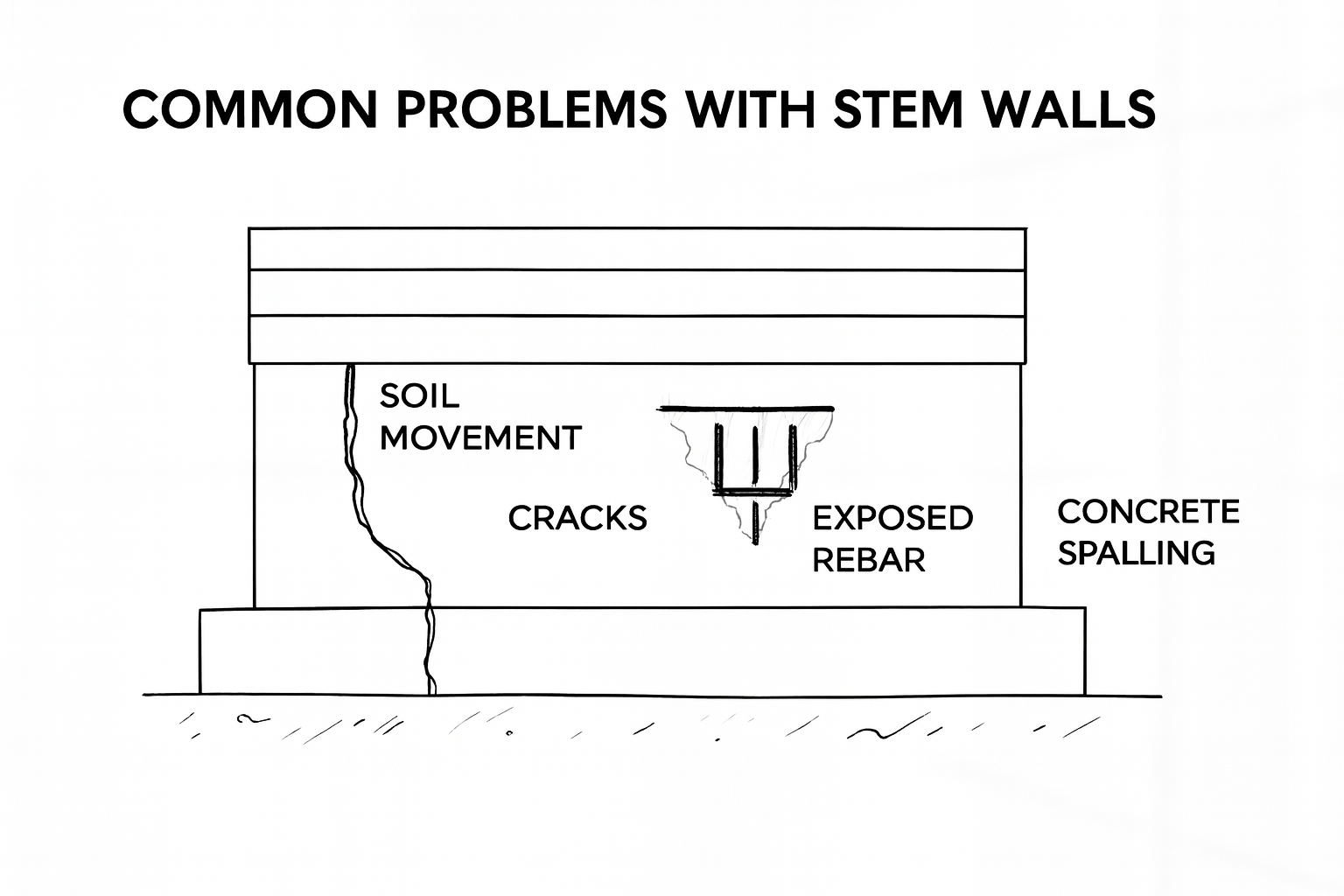
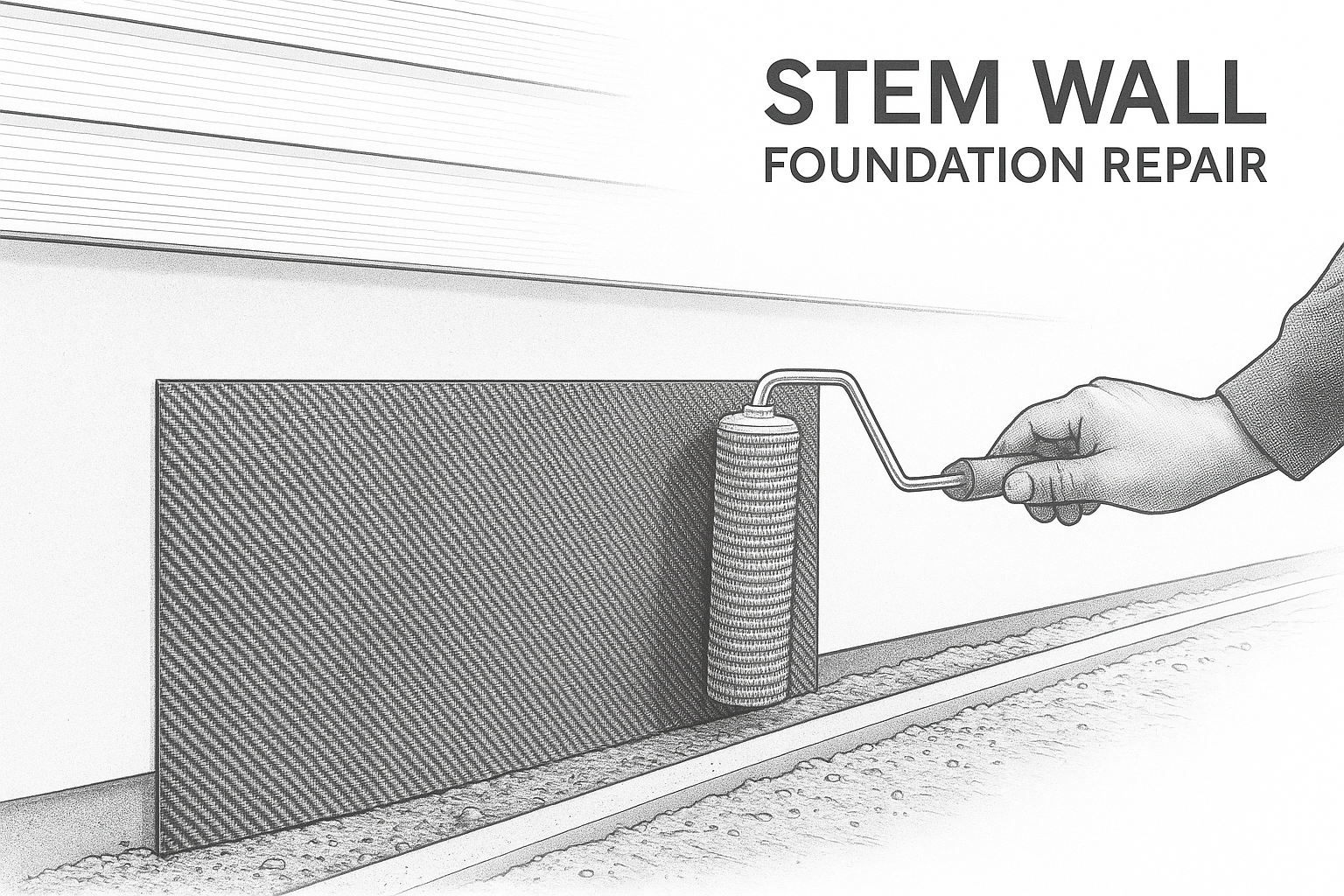
A stem wall repair kit usually includes epoxy resins, carbon fiber straps, concrete patch, anchor bolts, and sometimes waterproof coatings. The idea is to stop spalling, cracks, or rebar rust in concrete stem walls without full replacement.
When It Works
-
Hairline cracks
-
Small spalls around rebar
-
Minor rebar corrosion if cleaned first
-
Waterproofing after patching
When It Does Not Work
-
Major horizontal cracks (soil pressure problem)
-
Large sections of crumbling concrete
-
Missing reinforcement
-
Active settlement or sinking
Pro Insight
Most pros use a mix of epoxy injection and patching, not just one kit. A real contractor I’ve worked with said: “We use kits only as a stop-gap. If the rusting rebar isn’t treated, you’ll be back in 5 years.” That means grinding out corroded steel, applying rust inhibitor, then rebuilding with high-strength mortar.
Common Mistakes
-
Just painting over cracks with waterproofing paint. It hides the problem but doesn’t fix it.
-
Skipping rebar prep. If you don’t clean and treat exposed steel, the repair will fail.
-
Using the wrong epoxy. Thin epoxies for hairline cracks vs. paste-like for wide cracks.
Amazon Field Pick
Carbon Fiber Crack Repair for Foundation Walls
Carbon fiber kits like the 100 ft Bounce Generation system are used when foundation walls develop vertical or diagonal cracks from soil pressure, settlement, or hydrostatic load. Instead of replacing the wall, carbon fiber straps bond directly to the concrete with epoxy. Once cured, they lock the wall in place and prevent further movement.
● Where it applies: Basement walls, stem walls, and concrete block foundations showing cracks but not total collapse.
● What it fixes: Bowing walls, stress cracks, shear cracks near corners.
● Why carbon fiber: It’s thin, non-invasive, doesn’t reduce interior space, and is stronger than steel in tension.
● Limits: It won’t lift or re-level a sinking foundation. It’s reinforcement, not structural jacking.
FIELD PICK
100 ft Carbon Fiber-Basement Wall Crack Repair Kit
Price: ~$547 + shipping. Includes 100 ft fabric, epoxy resin, and hardener.
✓ Good for DIY crack stabilization.
✓ Much cheaper than hiring a contractor ($4k–$10k).
How to Apply This
-
Clean and wire-brush the cracked area.
-
Remove all loose concrete.
-
Treat rebar with rust inhibitor.
-
Inject epoxy into deep cracks.
-
Patch with high-strength repair mortar.
-
Apply waterproof sealer.
See:
Basement Groundwater Leaks: Causes and Solutions
Covers issues from groundwater intrusion and methods to prevent leaks.
Cost Breakdown at a Glance
● Minor reinforcement (carbon fiber strips): $4,000–$10,000
Best for early-stage bowing (under 2 inches). Strips are epoxied to the wall to hold it from moving further.
● Wall anchors or steel I-beams: $8,000–$15,000
Anchors tie the wall back into stable soil outside. I-beams brace walls inside. Both are common mid-level fixes for bowing of 2–4 inches.
● Excavation and waterproofing: $15,000–$30,000
The yard is dug out, soil pressure is relieved, and a drainage system is installed with waterproof coatings. This stops future pressure but is disruptive.
● Full wall rebuild: $30,000–$60,000+
If a wall has cracked beyond repair (often 4+ inches of bowing), it may need full demolition and rebuild. Expensive but sometimes unavoidable.
PRO PICK
● Spectra Precision Laser Level Kit – High-end self-leveling laser for checking foundation slope and settlement. Essential for spotting uneven slabs.
Will my wall collapse suddenly?
Usually not overnight, but if cracks grow quickly or water floods in, risk rises.
Related
Cost to Build Foundation and Basement: What to Expect
Overview of typical costs and factors when building a foundation and basement.
Regional Cost Notes
USA
-
Midwest (Ohio, Michigan, Indiana): High clay soils swell when wet and shrink when dry. Costs trend mid-range. Carbon fiber ~ $5k–$8k, anchors ~$10k–$14k.
-
Northeast (New York, Pennsylvania, Massachusetts): Freeze-thaw cycles push walls in winter. Excavation here often runs higher: $20k–$35k.
-
South: Less frost heave, but water table problems exist. Reinforcement is usually cheaper: $4k–$7k for carbon fiber.
Canada
-
Ontario (Toronto, Ottawa): Frost heave and poor drainage push walls hard. Anchors often $12k–$18k, rebuilds easily $40k+.
-
Quebec: Old stone or block basements add cost. Excavation can run $25k–$40k.
-
Western provinces (Alberta, BC): Bowing is less common, but reinforcement prices are similar to Ontario.
UK
-
England (London, Manchester, Leeds): Many Victorian and Edwardian homes have cellar walls of brick or stone. Reinforcement jobs are smaller in scale but tricky: £3k–£8k for anchors, £15k–£25k for excavation.
-
Scotland & Wales: Wetter soil adds waterproofing needs, driving costs to the high end.
Australia
-
Melbourne & Sydney: Expansive clay and tree roots cause wall pressure. Anchors usually AUD $12k–$20k. Waterproofing/excavation ~ AUD $25k–$40k.
-
Queensland: Sandy soils mean less bowing but water intrusion is still an issue. Reinforcement AUD $6k–$10k.
New Zealand
-
Auckland & Wellington: High rainfall and hillside homes create hydrostatic pressure. Costs align with Australia. Anchors: NZD $15k–$22k. Excavation/waterproofing: NZD $30k+.
Common Mistakes Homeowners Make
● Ignoring small cracks until they widen.
● Trying DIY epoxy patching without addressing pressure.
● Planting trees too close to the house.
● Regrading the yard but skipping gutter extensions.
● Waiting until doors jam or floors slope before calling a pro.
How to Apply This Knowledge
✓ Inspect basement walls twice a year, especially after wet seasons.
✓ Extend downspouts and check grading immediately.
✓ Budget realistically: small fixes start under $10,000, full rebuilds exceed $50,000.
✓ Call a structural engineer if the wall bows more than 2 inches.
✓ Treat bowing as urgent. Repairs never get cheaper with time.
FIELD ESSENTIAL
● Bosch Professional Digital Level – Expensive but precise electronic level for foundation inspection. Reads slope, pitch, and alignment digitally.
→ Buy on Amazon
Real Homeowner Cases
-
Michigan ranch (1964): 2.5-inch bow on two walls. Installed 14 steel beams at $650 each. Total cost: $9,100. Also regraded yard.
-
Pennsylvania split-level: 4-inch bow plus cracks. Anchors failed. Crew excavated, rebuilt 28 feet of wall, and added drain tile. Total: $42,000.
-
Wisconsin home: 1-inch bow stabilized with 8 carbon fiber straps. Total cost: $4,000. Homeowner later finished basement with no issues.
Prevention Tips
-
Keep gutters clear and downspouts extended 10 feet away.
-
Slope soil so it drops 6 inches over 10 feet away from the house.
-
Don’t plant large trees within 15 feet of the foundation.
-
Maintain sump pumps and drain systems.
-
Inspect basement walls every spring and fall.
The Hidden Life Beneath Your House
Most people think of a foundation as dead concrete. In reality, it’s a living system under constant stress. Soil swells when wet, shrinks when dry. Water creeps through hairline cracks. Frost heaves push up from below. Even tree roots press from the sides. Your house is sitting on top of a shifting battlefield you rarely see.
This hidden life explains why two homes built the same year can age completely differently. One sits on stable gravel and barely moves in fifty years. The other rests on clay that expands and contracts like a sponge, tearing its basement walls in a decade.
What surprises most homeowners is that movement never stops. Even after repair, your house keeps adjusting season by season. Smart builders plan for this with flexible joints, drainage layers, and structural reinforcements that allow tiny shifts without visible damage.
Architects and engineers call this “tolerances”. A good foundation isn’t built to stay still forever. It’s built to move just enough without failing. That’s the real secret: strength and flexibility working together.
MISTAKE TO AVOID
Too many people chase the idea of “permanent” fixes. They pour more concrete, add thicker beams, or push in more steel. But if the soil under it still moves, the problem just returns in a new place. The real fix is to manage the environment—control water, control soil, allow movement.
FIELD PICK
📘 The Family Handyman Whole House Repair Guide – Covers drainage, foundation inspection, and repair methods with photos. Straightforward enough for homeowners, detailed enough for pros.
Stem Wall vs Foundation Wall
What is a Stem Wall?
A stem wall is a short wall sitting on top of a concrete footing, usually raising the house above grade. It’s common in crawl space and basement foundations. Stem walls keep wood framing off the ground, protect against moisture, and allow for vents or access points.
What is a Foundation Wall?
A foundation wall is the full vertical wall that transfers loads from the building down into the footing. In basements, it’s the concrete or block wall that holds back soil and creates usable interior space.
Key Differences
-
Height: Stem walls are short (1–3 ft above grade). Foundation walls can be full-height basement walls (8–10 ft).
-
Function: Stem walls lift the structure. Foundation walls resist soil pressure and support the entire building vertically and laterally.
-
Materials: Both are usually concrete or CMU blocks, but stem walls may include rebar dowels connecting to footings, while foundation walls often need heavier reinforcement for soil loads.
-
Use Cases: Stem walls = crawl space or raised floor homes. Foundation walls = basements or retaining conditions.
Real Mistakes Homeowners Make
-
Confusing stem walls with footings and thinking they don’t need reinforcement.
-
Treating a stem wall like a retaining wall and backfilling against it without waterproofing.
-
Forgetting anchor bolts or straps to tie framing into stem walls.
How to Apply This
If you’re building in a flood-prone or termite-heavy area, a stem wall is usually required. If you want a basement, you’ll need full foundation walls. Always ask your engineer about lateral loads—many DIY builders ignore that until cracks show up.
Stem Wall vs Monolithic Slab
What They Are
-
Stem Wall Foundation: Perimeter concrete wall with a footing under it. The house floor (slab or wood framing) sits on top.
-
Monolithic Slab: One continuous pour. The slab and footing are the same piece of concrete.
Where They’re Used
-
Stem walls are common in uneven or sloped lots because you can vary wall height.
-
Monolithic slabs are typical in flat lots where speed and cost matter.
Cost and Speed
-
Stem wall: Slower, more labor, usually higher cost.
-
Monolithic: Faster, fewer steps, cheaper overall.
Durability
-
Stem wall: Strong against soil pressure, easier to repair if footing cracks.
-
Monolithic: No joints between slab and footing, but if it cracks, the whole system is affected.
Moisture and Soil Issues
-
Stem wall: Keeps wood framing off the ground, better for moisture-prone areas.
-
Monolithic: Vulnerable to soil shifts (expansive clay) since it’s one piece.
Mistakes People Make
-
Building monolithic slabs on bad soil without testing first. Leads to slab cracks that are nearly impossible to fix without major cost.
-
Assuming stem walls are always better. They need good drainage and waterproofing or rebar rusts out.
Real Example
A contractor in Arizona told me: “We pour monolithic slabs all day because it’s fast and the soil here is stable. Try that in coastal Florida and you’ll be tearing it up in ten years.”
How to Decide
-
Pick stem wall if: your lot is sloped, soil is unpredictable, or you want crawl space access.
-
Pick monolithic slab if: your lot is flat, soil is stable, and you want to save money.
Final Word
Bowing basement walls are serious but not hopeless. Most start with water pressure, soil movement, or poor construction. Caught early, reinforcement and waterproofing can save tens of thousands of dollars. Ignored, the only option may be rebuilding the wall.
Knowing the 7 causes and 3 fixes helps you spot warning signs early and plan the right response before the house itself is at risk.
FAQs
General Foundation Basics
Q1. What is the most common type of foundation in North America?
Concrete slab-on-grade is the most common because it’s fast and cheap. In colder climates, basements and crawl spaces are more common due to frost depth.
Q2. How long should a house foundation last?
A properly built concrete foundation can last 80–100 years. Poor drainage, soil issues, or tree roots can cut that down to 30–40 years.
Q3. Do all houses eventually crack?
Yes. Every foundation develops hairline cracks. The difference is whether they stay cosmetic or grow into structural problems.
Q4. What is the biggest mistake homeowners make with foundations?
Ignoring water. Most failures start with uncontrolled drainage, not weak concrete.
Q5. Can you build a foundation in winter?
Yes, but it costs more. Concrete must be heated and protected from freezing, which raises labor and material costs.
Signs of Trouble
Q6. What cracks should I worry about?
Vertical hairline cracks are common. Horizontal cracks wider than ¼ inch mean soil pressure is pushing in and need urgent repair.
Q7. Do sloping floors always mean foundation failure?
Not always. Older homes can settle unevenly, but if doors and windows stick too, it’s usually a sign of shifting.
Q8. How do you know if water damage is serious?
White powder (efflorescence) is cosmetic. Active leaks, damp walls, or mold mean drainage has failed.
Q9. Why does my basement smell musty?
Moisture is seeping through the walls or floor. Even if you don’t see water, the vapor can feed mold.
Q10. Should I panic if one corner of my house is sinking?
No, but act fast. Localized settlement can often be corrected with underpinning before it spreads.
Causes of Damage
Q11. What soil is worst for foundations?
Expansive clay. It swells when wet and shrinks when dry, shifting houses inches each season.
Q12. Can tree roots crack concrete?
Yes. Roots don’t “pierce” concrete, but they displace soil and add pressure that leads to cracks.
Q13. Does frost damage foundations?
Yes. Frost heave lifts and shifts shallow footings if they’re not below frost depth.
Q14. Why do older houses seem stronger?
Many were overbuilt with thicker walls and better stone or block. But they’re not immune—drainage still ruins them.
Q15. Can plumbing leaks cause foundation failure?
Yes. A leaking pipe under a slab can wash out soil, causing voids and settlement.
Inspection and Diagnosis
Q16. How much does a foundation inspection cost?
$300–$800 for a structural engineer’s written report. Worth it before buying or selling a house.
Q17. Can I check my own foundation?
Yes. Walk around, look for cracks wider than a pencil, check doors, windows, and sloping floors. But hire a pro for confirmation.
Q18. Should I get an engineer or a contractor first?
Get the engineer. Contractors fix problems, but an engineer tells you what’s actually wrong.
Q19. How often should I check my basement walls?
At least once a year, ideally in spring after the thaw or after heavy rains.
Q20. Can thermal imaging detect leaks?
Yes, some inspectors use it to spot hidden moisture in walls.
Fixes and Repairs
Q21. How much does foundation repair cost?
Minor crack injection: $500–$1,500. Major underpinning: $10,000–$40,000. Full rebuild: $80,000+.
Q22. Can you fix foundation cracks yourself?
Hairline cracks? Yes, with epoxy kits ($75–$150). Structural cracks? No—call a pro.
Q23. Is underpinning permanent?
Yes, if done right with steel piers. The house is now supported by stable soil or bedrock.
Q24. What’s the cheapest waterproofing method?
Grading and gutters. Direct water away from your house for under $1,000. Interior drains cost $3,000–$10,000. Exterior excavation $10,000–$25,000.
Q25. Can foam injection lift a slab?
Yes. Polyurethane foam (slabjacking) costs $2,000–$7,000 and is faster than concrete piers.
Maintenance and Prevention
Q26. How do I prevent settlement?
Keep soil moisture consistent. Avoid letting it dry out completely in summer and flood in winter.
Q27. Are sump pumps reliable?
Yes, if maintained. Replace every 7–10 years. Add a battery backup if your power goes out often.
Q28. Should I water my foundation in summer?
In clay-heavy areas, yes. A soaker hose prevents extreme soil shrinkage.
Q29. How do I keep tree roots away?
Plant trees at least 20 feet from the house. Root barriers cost $1,000–$3,000.
Q30. Do gutters really matter?
Yes. A $300 gutter system can prevent a $30,000 foundation repair.
Real-World Cases
Q31. What happens if I ignore cracks for 10 years?
They grow. One homeowner in Toronto ignored a crack until it bowed in 4 inches. Repair cost jumped from $2,000 to $28,000.
Q32. Can a house collapse from foundation failure?
Rare, but it happens. Abandoned homes with rotted sills and shifted walls can cave in.
Q33. Why did my neighbor’s foundation fail but mine is fine?
Soil conditions vary house to house. Drainage patterns, tree placement, and construction quality all differ.
Q34. Can DIY waterproofing last?
Surface patching usually fails in 2–5 years. Professional membranes and drains last 20–50 years.
Q35. Have foundations improved in modern homes?
Yes, but not always. Modern codes require deeper footings and rebar, but speed-focused builders sometimes cut corners.
Money and Resale
Q36. How much does foundation repair add to home value?
It doesn’t “add”—it protects. A $20,000 repair may prevent $100,000 in lost value during sale.
Q37. Should I buy a house with foundation issues?
Yes, if the discount is larger than the repair cost and you budget for it immediately.
Q38. Will insurance cover foundation repairs?
Rarely. Most policies exclude “settlement” and “ground movement.” Sudden events (like burst pipes) may be covered.
Q39. Do buyers get scared off by past repairs?
Not if you show receipts and engineer reports. In fact, repaired foundations with warranty can be safer than untouched ones.
Q40. What’s the single smartest investment for protecting a foundation?
Proper drainage. $1,000–$5,000 in grading, gutters, and downspout extensions can save six figures later.