
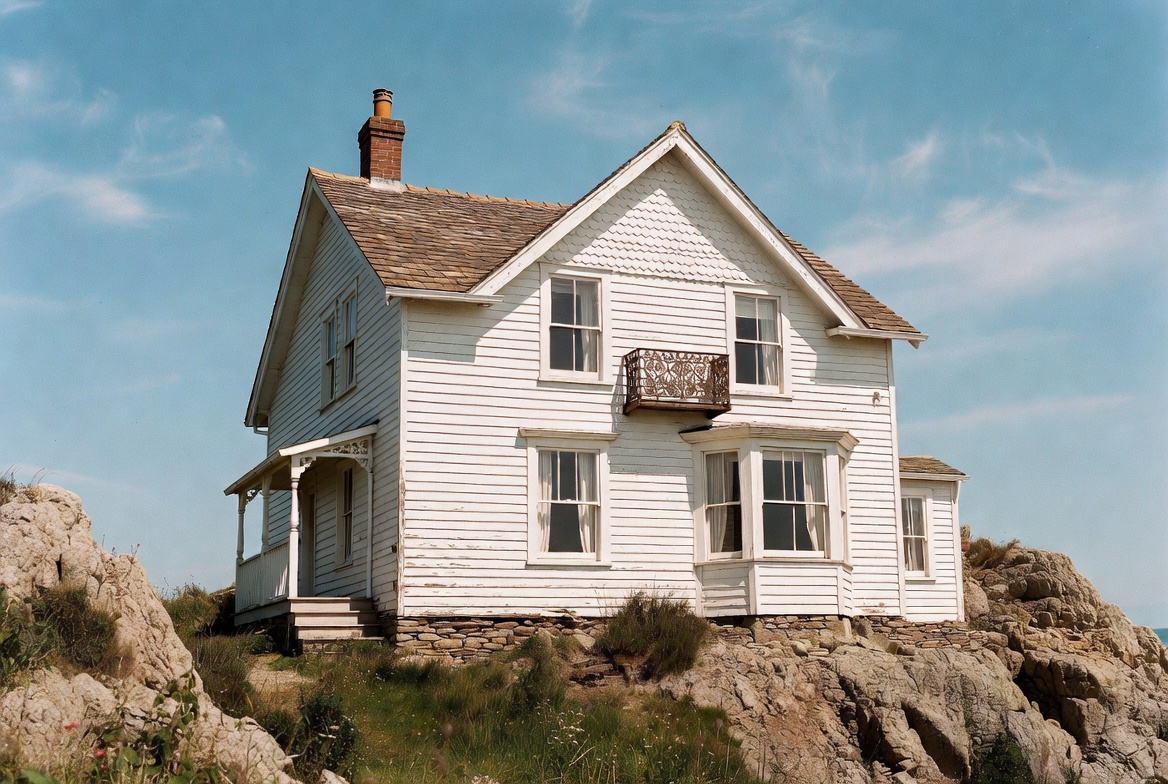
What Fails First and What Costs More Later
A 1910s house can feel great to live in. The rooms usually make sense. The trim has weight. The porch often still works better than what came later. The trouble is that surface condition and structural condition are different things, and these houses can hold them apart for a long time.
If you want the design side first, start with 1900 house styles and the bungalow lane — the American bungalow and the Craftsman bungalow especially. This page covers what goes wrong and what it costs.
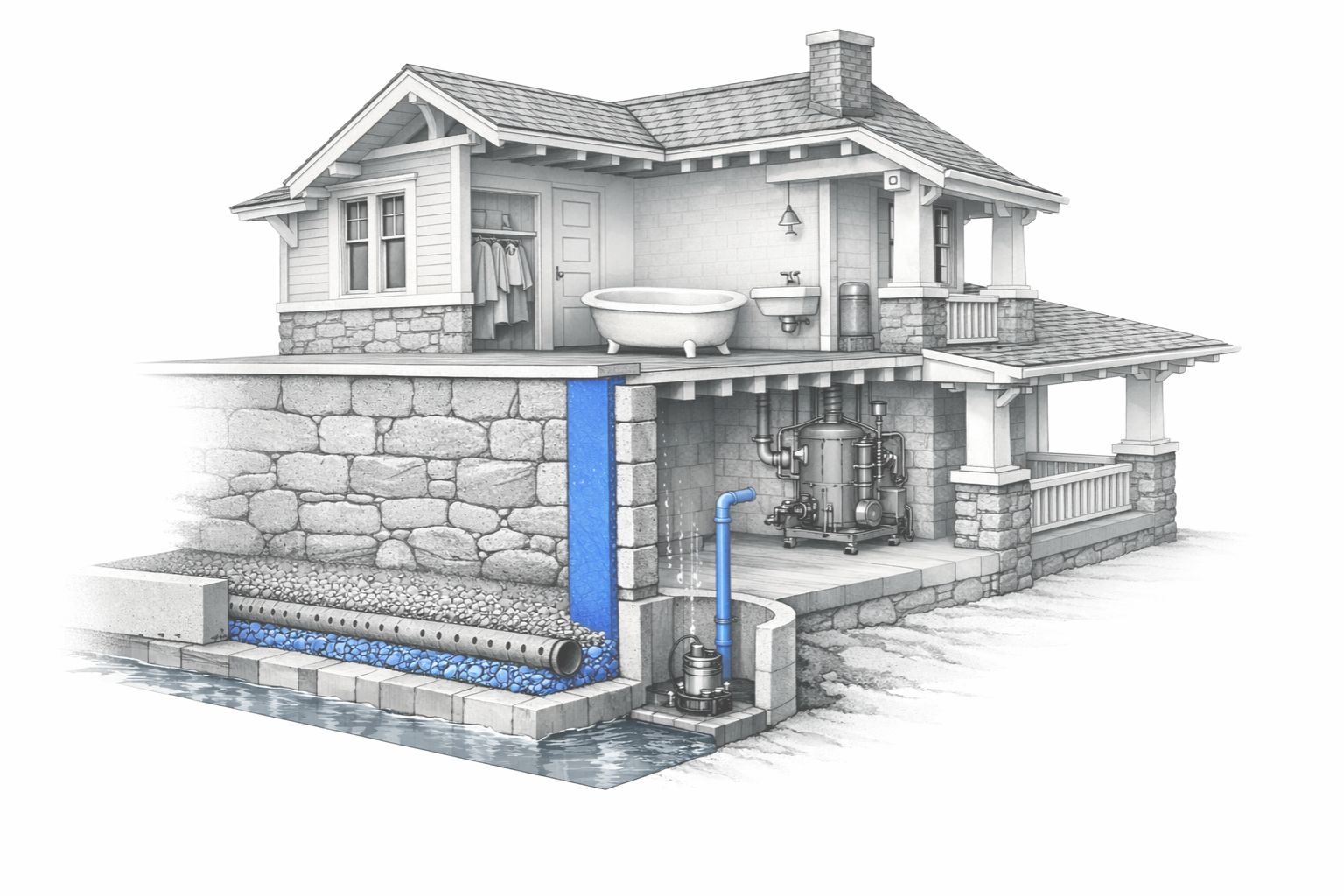
Image by ArchitectureCourses.org. Cutaway of a 1910s American house showing where wet walls, service areas, and basement moisture problems often cluster.
Where the money usually goes
| Problem area | First sign | What it usually means | Why it gets expensive |
|---|---|---|---|
| Roof edges, porches, exterior trim | Soft wood, staining, peeling paint | Water has been getting past the surface for a while | Rot spreads into framing before it shows |
| Wiring | Two-prong outlets, warm switch plates, tripping breakers | Original or layered circuits, no complete system | Finished walls come back open |
| Windows | Drafts, rattles, high heating bills | Failing seals, weight pocket leaks, wrong replacements | Common place to spend wrong |
| Plumbing | Weak pressure, slow drains, patched tile | Old lines, partial replacements, hidden leaks | Kitchens and bathrooms get opened twice |
| Floors and plaster | Cracks, slopes, sticking doors | Old settled movement or active movement | Wrong read costs money fast |
| Hazardous materials | Nothing visible until demo starts | Lead paint, asbestos mastic, pipe wrap | Testing and containment change the whole schedule |
A) Water
Start outside. Roof edges, porch roofs, gutter lines, window heads, brick-to-wood transitions, chimney base, porch column bottoms. These are where slow failure starts, and where it stays invisible longest.
A porch can look fine from the street while the post bases are already soft, the decking edge is compromised, and the framing underneath has been wet for years. Fresh paint doesn't tell you anything useful. Hard wood, stable joints, real flashing, and dry framing do.
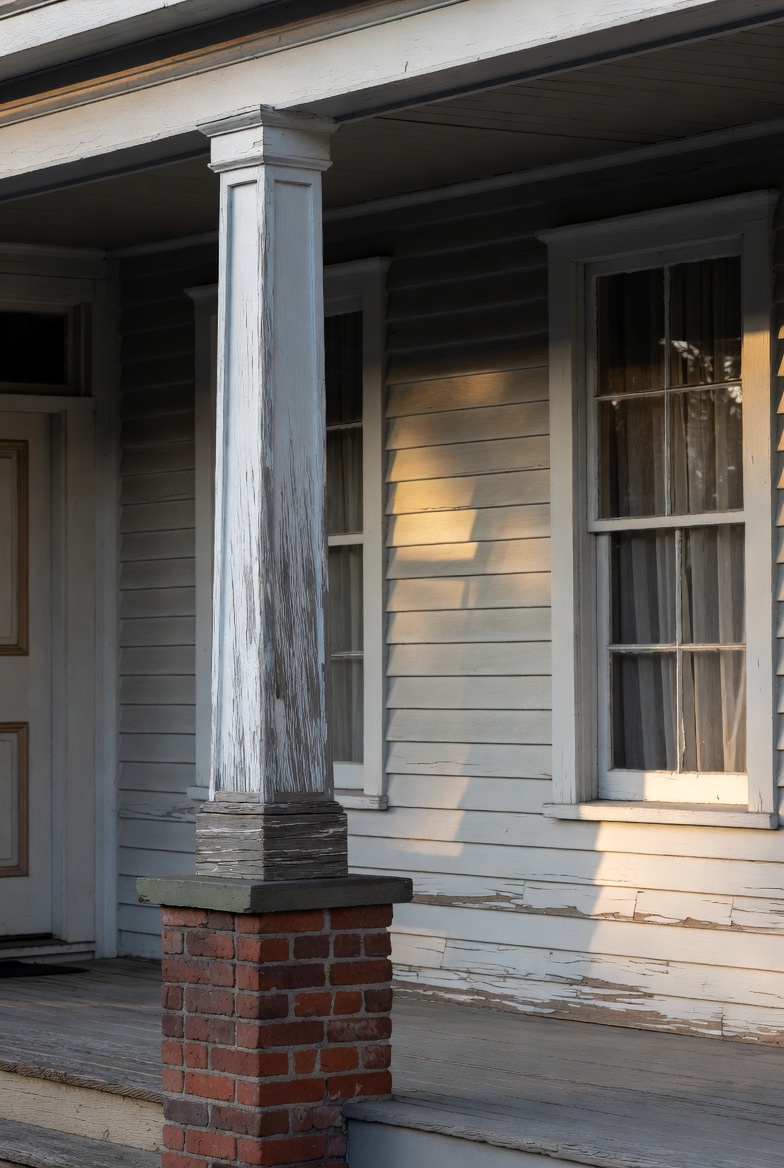
Image by ArchitectureCourses.org. This is the kind of porch wear that matters in old houses because it points to maintenance, exposure, and repair cost.
The basement edge is the other place people talk themselves out of worrying about. Musty smell, powdering masonry, and a section of lower wall that gets repainted every few years aren't old-house personality. That's water entering on a reliable schedule.
A lot of 1910s houses also inherited assemblies from the decades before that were already moisture-vulnerable when maintenance slipped — that transition is visible in 1890s house styles and carries into 1900 house styles.
B) Wiring
The issue isn't only that some of it is old. It's that most of these houses have been touched by several decades of partial updates — some circuits replaced, some bypassed, some rooms still running off original work that nobody has mapped. A house with a complete documented rewiring is a known quantity. A house where the kitchen was updated in one decade and the back bedroom still ties into something from forty years earlier is a different problem entirely.
Signs that show up quietly: lights dimming when the refrigerator cycles on, a switch plate that's always slightly warm, extension cords that have become permanent fixtures, breaker trips the owner explains away. None of that is the house being old. That's the system telling you it's undersized or compromised somewhere.
The sequence mistake is spending on floors, paint, and a cosmetic kitchen before mapping the electrical. When the walls have to come back open, you pay for the finish work twice.
Once a wall is open in one of these houses, the framing doesn't always match what contractors expect. That's part of why balloon framing vs platform framing matters more in old-house work than most owners realize until they're already into it.
C) Windows
Two mistakes, roughly equal in frequency.
The first is holding onto failing windows because the owner wants to save everything original. The sash is soft, the glass is loose, the weathersealing is gone — but replacing them feels wrong, so nothing happens.
The second is replacing decent originals on reflex because they're cold or ugly under old paint. A lot of original wood windows in 1910s houses can still be repaired, reglazed, weatherstripped, and paired with storms for less than replacement costs — and the result usually holds the facade better. The wrong insert window shrinks the glass area, flattens the profile, and makes the house read cheaper from the street. That's not recoverable.
The question isn't old versus new. It's what the actual condition is, and what replacement does to the opening. That matters whether the house leans Colonial Revival or bungalow — the proportions are load-bearing in a different sense.
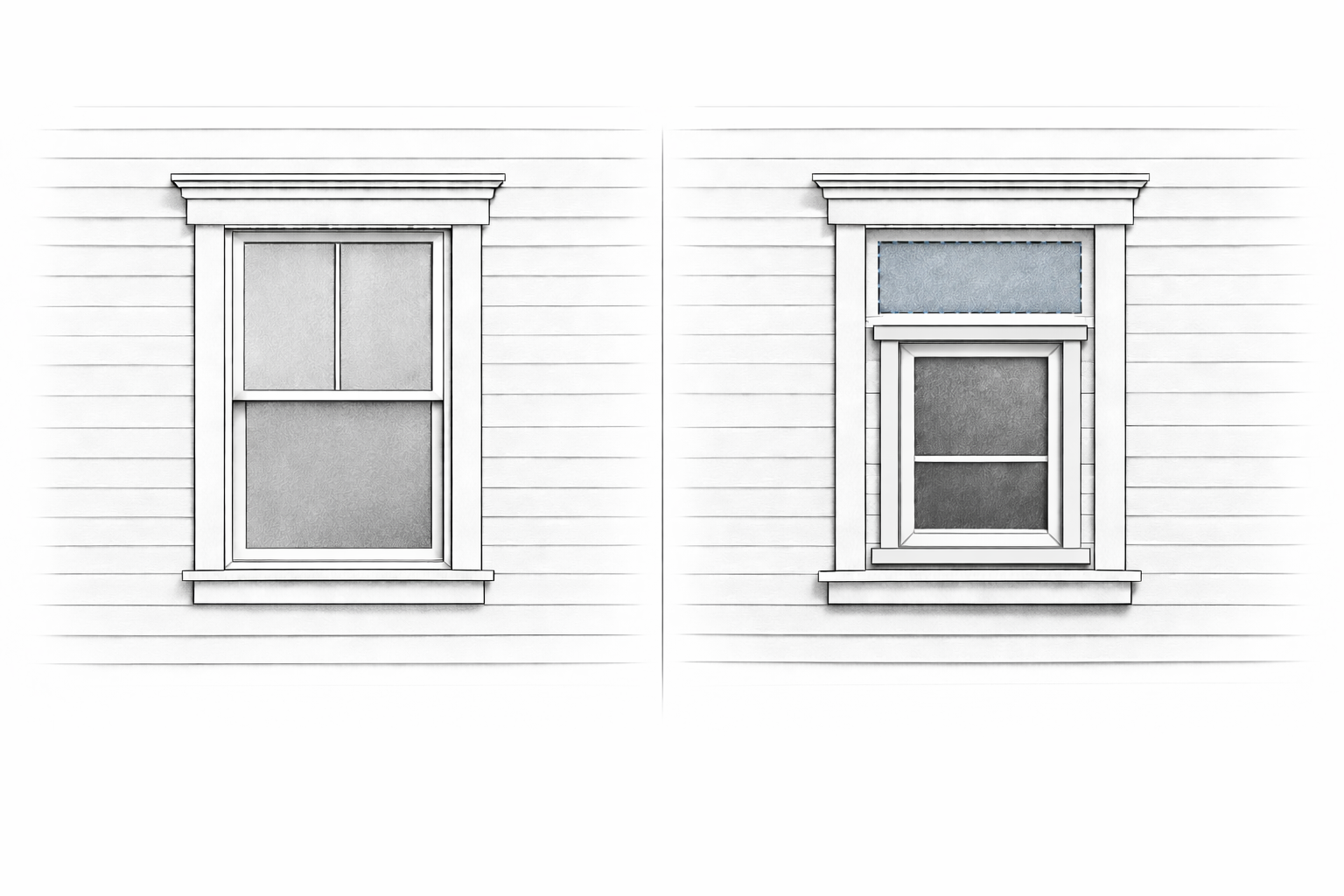
Illustration by ArchitectureCourses.org comparing a respectful replacement window with a common insert-window mistake in an older facade.
One more thing: draft complaints are often attributed to windows when the air is actually moving through trim gaps, weight pockets, attic bypasses, and rim joists. Replacing windows without addressing those paths is a reliable way to spend a lot and still feel cold.
D) Plumbing
Look at the kitchen and bathroom — not the finishes, the logic. Fixtures in odd positions, cabinets with strange cutouts, tile patched across multiple decades, shutoffs that look much newer than everything around them. These are signs the plumbing story has been rewritten more than once, not always cleanly.
Galvanized supply lines show up often in partial updates. One section gets new copper, the rest stays. The result is low pressure in certain rooms, sediment in the lines, sections that corrode from the inside while looking intact outside.
Kitchens in these houses were work rooms before anyone cared about kitchen design. Four or five rounds of updates have layered on top of that original logic — one owner moved the sink, another added cabinets around it, another updated the flooring without touching the drain. What you end up with is a room that doesn't quite make sense from any direction.
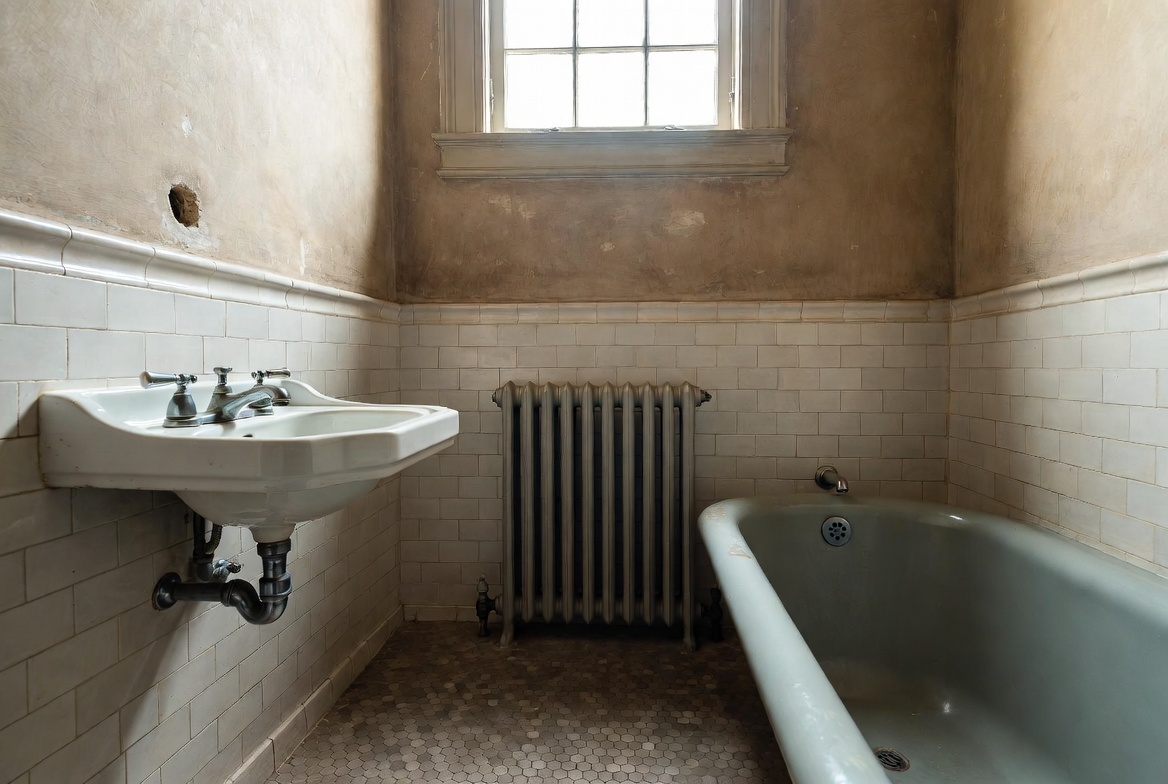
Image by ArchitectureCourses.org. A compact bathroom like this shows the tight fixture layout, old tile logic, and practical plumbing-era scale common in 1910s houses.
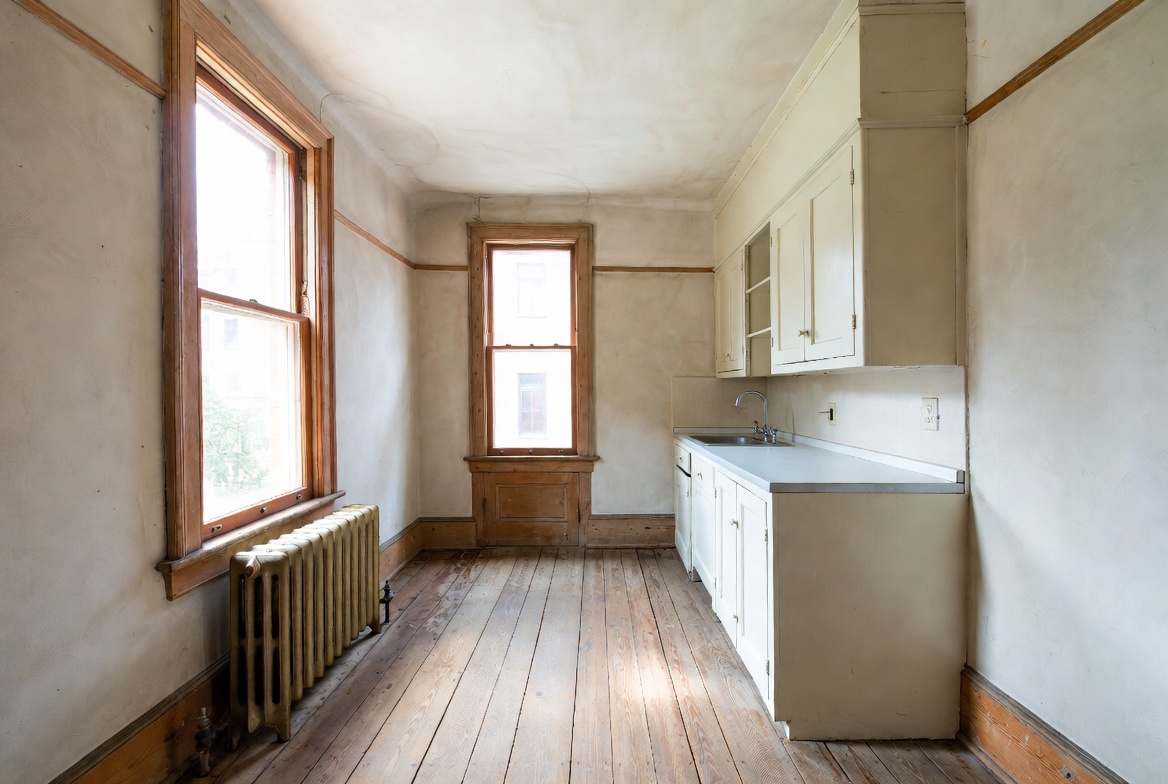
Image by ArchitectureCourses.org. The room shell reads old, but the later cabinets show the piecemeal updates many 1910s houses picked up over time.
If the visible finishes look like patchwork, budget for more patchwork behind the wall. That's why bathroom and kitchen scopes in old houses drift upward after demo starts almost every time.
E) Floors, plaster, and doors
These cause more unnecessary panic — and more dangerous complacency — than almost anything else in a 1910s house.
A floor that settled in 1945 and hasn't moved since is not the same problem as a floor that's been moving this year. Plaster cracks from seasonal humidity shifts, from vibration, from bad patches, from movement that finished decades ago. The slope or the crack by itself doesn't tell you much.
What matters:
- are the cracks fresh and clean, or old and dirty?
- Do doors suddenly bind, or have they always been that way?
- Is the floor slope localized near one exterior wall, or does it run through the house?
- Is there moisture nearby?
- Is the foundation showing corresponding movement below?
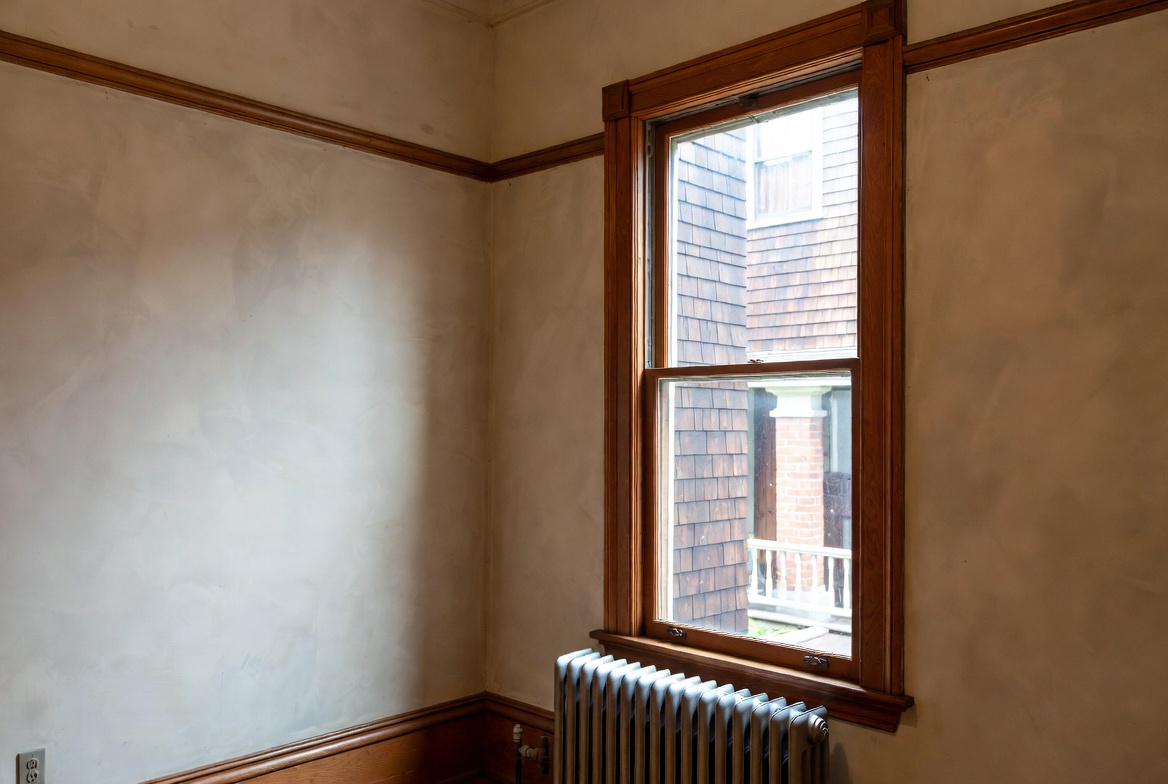
Image by ArchitectureCourses.org. Original plaster, heavier trim, older window proportions, and a cast-iron radiator help this room read as authentically early twentieth century.
Plaster also tends to show symptoms of problems that originate somewhere else — roof leaks, window flashing failures, foundation movement, air infiltration. Patching it without finding the source buys one more round of the same cracks, usually within a year or two.
F) Insulation
Cold floors, hot upper rooms, and drafts that seem to come from inside the wall are real complaints in these houses, and they almost always have more than one cause.
Common sources in combination:
- open attic bypasses
- weak or missing roof insulation
- uninsulated wall cavities
- air paths through the basement rim
- service penetrations that were never closed
Fixing one often still leaves the others.
The wrong response is forcing insulation into every available cavity without thinking about how the wall manages moisture. These walls weren't designed for dense-pack insulation, and trapping vapor in an assembly that needs to dry can cause rot. The fix becomes the problem. Whether the house reads as a simple bungalow or something more formal, the comfort complaints usually trace back through the same routes.
G) Hazardous materials
Lead paint in trim layers. Asbestos floor tile mastic. Pipe insulation. Old patch compounds. None of it makes the house unworkable. All of it changes how demo has to happen.
The mistake isn't being unaware these materials exist — most people know they might. It's starting demo without testing, then finding out mid-project. At that point you're dealing with containment, disposal, project delays, and a contractor conversation that wasn't in the budget.
Test before you open anything significant. It costs less than finding out afterward.
Do this, not this
| Do this | Instead of this | Why |
|---|---|---|
| Trace every water entry point before touching finishes | Repaint the damaged trim | Water keeps moving behind what you just painted |
| Map the electrical before spending on cosmetics | Finish the rooms, deal with circuits later | Walls come back open |
| Judge each window on actual condition | Replace everything on reflex | You can spend more and end up with a worse facade |
| Open one wall early to see what you're dealing with | Assume the framing is standard | Wrong assumptions in old houses are expensive fast |
| Budget real contingency | Price only what you can see | That's how these projects double |
Before you buy or start work
- Start outside. Roof edges, gutters, porch structure, grading, chimney joints, window heads, lower wall moisture. More information here than anywhere inside.
- Ask what was upgraded and when — roof, wiring, plumbing, furnace, windows, drainage, insulation, foundation. Get years, not "recently."
- Partial work is harder to price than untouched original systems. If someone started a rewiring job or a replumbing job and didn't finish, you don't always know where they stopped or why.
- Kitchens, bathrooms, basements, and attics tell the truth faster than the front rooms. Spend real time there.
- Fresh finishes over old systems usually mean money was spent in the wrong order. The real work is still waiting.
- Hold contingency. In a genuine 1910s house, the visible scope and the actual scope are rarely the same number.
Common questions
Are sloped floors structural?
Not necessarily. Some are old and stable. Pattern, location, and what else is happening nearby matter more than the slope on its own.
Should original windows be replaced?
Not as a blanket decision. Evaluate each one on condition and on what replacement does to the opening. Many can still be repaired.
Is knob-and-tube a deal breaker?
Not automatically. What matters is how much is still active, how cleanly the rest was updated, and whether upgrading requires reopening finished work.
What's the most expensive first mistake?
Cosmetic spending before understanding water, wiring, plumbing, and structure. It gets paid for twice.
Lead and asbestos — is it always present?
Not always. But often enough that you shouldn't assume demo is clean until you've tested.
A long problem list doesn't mean walk away. It means read the house honestly. The proportions, the room logic, the trim weight — those are real, and harder to find in later housing stock. That's why the 1910s lane still holds up well against 1930s house style and what came before it. The case for buying one just has to survive the real repair sequence, not only the front porch.