
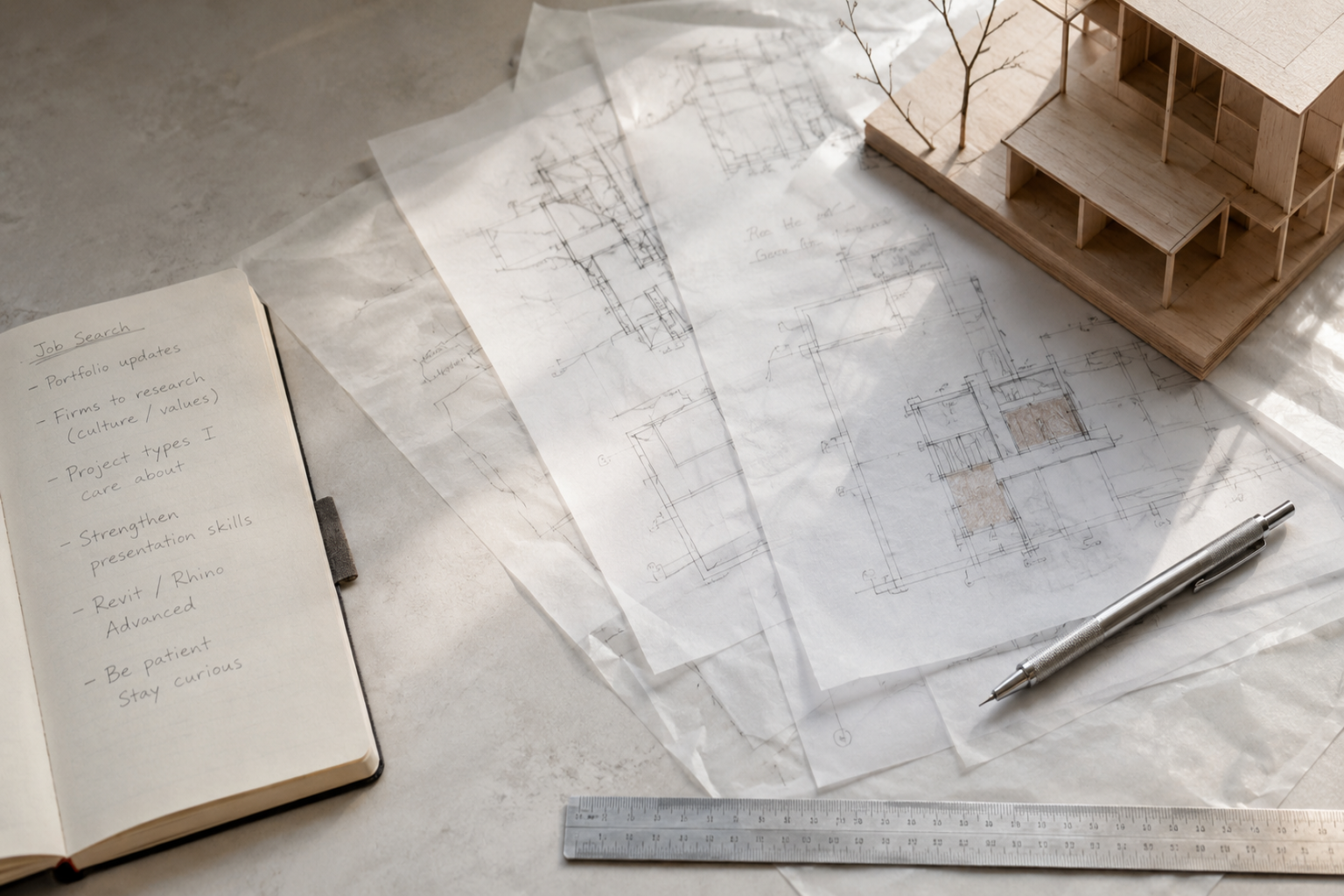
An architectural career can look exciting from the outside and feel very different once the work starts.
People imagine sketches, models, beautiful buildings, and creative freedom. Some of that is real. But the daily job also includes software, redlines, codes, budgets, consultant emails, client changes, planning problems, site questions, and deadlines that do not care how inspired you feel.
That does not make architecture a bad career. It means you need to understand the work before you commit years of school, money, energy, and patience to it.
What an architectural career really means
An architectural career is not one job. It is a field with several paths.
Some people become licensed architects. Some become architectural designers, BIM specialists, drafters, visualization artists, project managers, construction coordinators, interior designers, specification writers, or development-side design managers. Some stay close to design. Others move toward technical work, code, construction, management, or business.
The mistake is thinking every architecture career leads to the same desk, title, salary, and lifestyle. It does not.
A student who loves concept design may hate construction administration. A strong Revit technician may make a good living without wanting licensure. A licensed architect may spend more time coordinating people than drawing. A designer with great taste may struggle if they cannot handle revisions, budgets, or technical details.
The career works best when the path matches the person, not when someone chases the word “architect” without understanding the job behind it.
Architecture jobs are not all the same

Architecture offices use many titles, and the titles are not always clean. One firm may call someone an architectural designer. Another may call the same kind of person a junior designer, design staff, project designer, intern architect, or architectural assistant.
Licensure also changes the language. In the United States, the exact rules depend on the jurisdiction. In many places, only licensed professionals can legally call themselves architects or offer architectural services independently. That is why the difference between “architect,” “architectural designer,” and “designer” matters.
| Role | What the work often includes | What to watch for |
|---|---|---|
| Architecture student | Studio projects, drawing, models, design theory, precedent research, critiques, and software basics. | School rewards ideas and presentation more than office coordination. |
| Entry-level architectural designer | Drafting, modeling, renderings, diagrams, redlines, drawing cleanup, and project support. | The work can feel less creative than school. |
| Architectural designer | Design development, presentations, Revit work, documentation, consultant coordination, and client support. | The title may or may not mean licensure progress. |
| Architectural technician or drafter | Technical drawings, BIM models, details, documentation, standards, and production support. | This can be a strong career path, but it is not the same as licensed practice. |
| Licensed architect | Professional responsibility, code judgment, client communication, project coordination, and construction-phase decisions. | Licensure should raise responsibility and eventually pay, not just add pressure. |
| Project architect | Drawing coordination, consultant management, schedules, technical review, code issues, RFIs, and staff coordination. | This role can carry heavy responsibility without enough authority if the firm is weak. |
| Senior architect | Project leadership, client trust, staff mentoring, technical judgment, quality control, and firm-level responsibility. | A senior title can hide burnout if the person becomes the office rescue worker. |
| Principal or owner | Clients, fees, staffing, business development, liability, hiring, strategy, and firm direction. | This is business ownership as much as architecture. |
The same degree can lead to very different lives. That is why career planning in architecture should start with the work, not the title.
The main architectural career paths
Most people picture the licensed architect path first. It is important, but it is not the only path.
The licensed path usually means professional education, supervised experience, exams, and registration. In the United States, NCARB explains the licensure process as a combination of education, experience, examination, and jurisdiction-specific requirements. Many candidates complete the Architectural Experience Program, pass the Architect Registration Examination, and apply through a state licensing board.
That path fits people who want professional responsibility. It also fits people who can tolerate a long training route before the title, pay, and authority catch up.
Other paths can be just as practical:
| Path | Good fit for | Risk |
|---|---|---|
| Licensed architect | People who want legal responsibility, client trust, project leadership, and long-term professional authority. | Long path, exams, pressure, liability, and slow early pay. |
| Architectural designer | People who like design work, modeling, presentations, planning, and early project development. | Can hit a ceiling without licensure or technical depth. |
| BIM specialist | People who like systems, Revit, coordination, standards, clash prevention, and model management. | Can become tool-support work if not tied to project authority. |
| Architectural technician | People who like technical drawings, details, building logic, and practical documentation. | May be undervalued in design-heavy offices. |
| Visualization artist | People who like images, mood, 3D modeling, rendering, animation, and presentation work. | Can be deadline-heavy and trend-sensitive. |
| Construction-side role | People who like site problems, sequencing, buildability, coordination, and real-world constraints. | Less pure design, more pressure from cost and schedule. |
| Interior architecture or interiors | People who like human scale, layouts, finishes, furniture, lighting, and spatial experience. | Can be confused with decoration unless the technical scope is clear. |
| Development or owner-side design management | People who understand design but also like budgets, approvals, consultants, and real estate decisions. | Less authorship, more negotiation. |
The right path is not always the most prestigious one. It is the one where your strengths survive the real work.
Architect vs architectural designer vs architectural technician
These titles get mixed up constantly.
An architect is usually someone who has met the legal requirements to practise architecture in a jurisdiction. In the United States, that usually means education, documented experience, passing the ARE, and registration through a licensing board. Rules vary by state, so no one should assume the title is casual.
An architectural designer may work on architecture projects but may not be licensed. Some are early-career. Some are experienced designers who never pursued licensure. Some are very talented. The issue is not talent. The issue is legal role and responsibility.
An architectural technician or drafter often focuses on drawing production, details, BIM models, documentation, and technical coordination. This work is not lower value just because it is less glamorous. Bad drawings can create permit problems, construction confusion, change orders, leaks, failed details, and expensive field corrections.
The title matters because employers sometimes use vague titles to pay less. A person doing consultant coordination, code review, client meetings, and construction-phase support should not be treated like basic drafting support.
What architects actually do at work
Architects do design, but design is only part of the job.
A typical architecture office may include concept design, feasibility studies, zoning checks, site analysis, space planning, client meetings, consultant coordination, code research, construction drawings, details, specifications, permit responses, bidding support, site visits, RFIs, submittals, and change coordination.
Some days feel creative. Some days feel like email management with drawings attached.
| Work type | What it looks like | Why it matters |
|---|---|---|
| Design thinking | Plans, sections, massing, sketches, models, options, and presentations. | Shapes the idea and gives the project direction. |
| Technical documentation | Construction drawings, details, schedules, notes, wall sections, and specifications. | Turns an idea into something builders can price, permit, and construct. |
| Code and zoning work | Occupancy, egress, accessibility, fire separation, setbacks, height limits, and approvals. | Prevents failed permits, unsafe buildings, and redesigns. |
| Coordination | Working with structural, mechanical, electrical, civil, landscape, cost, and specialty consultants. | Buildings fail on coordination when disciplines do not line up. |
| Client communication | Meetings, scope decisions, budget conversations, presentations, and expectation control. | Protects trust, schedule, and fee. |
| Construction support | RFIs, submittals, site observations, field questions, and change reviews. | Deals with the gap between drawings and construction reality. |
The job is not only making buildings look good. It is making decisions hold up under money, law, weather, structure, clients, contractors, and time.
What students discover after starting work
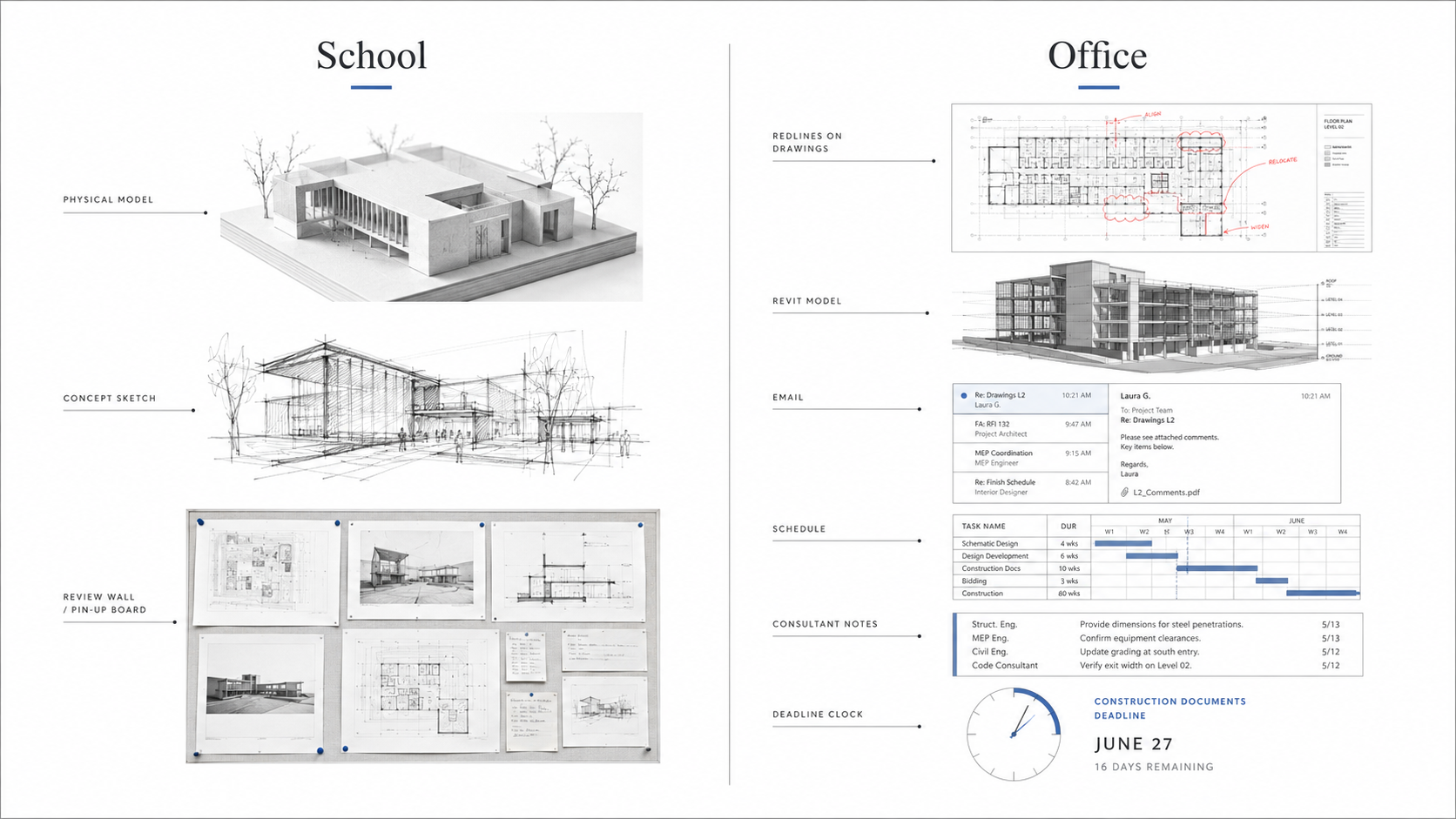
The first shock is that school and office work reward different things.
Architecture school often rewards strong ideas, critique language, presentation boards, models, theory, and visual control. Office work still needs design judgment, but it also demands speed, accuracy, coordination, revision discipline, and the ability to work inside limits.
In school, a beautiful section can win the room. In practice, a beautiful section that ignores structure, mechanical space, cost, waterproofing, accessibility, or code can create a real problem.
Many graduates discover that their first job is not full of concept design. It may involve redlines, door schedules, bathroom layouts, drawing cleanup, Revit families, wall types, consultant backgrounds, and small fixes that feel far from the studio dream.
That work is not pointless. It teaches how buildings are actually put together. But nobody should pretend it feels glamorous every day.
The students who adjust fastest are usually the ones who can learn without ego. They ask why a detail failed, why a wall moved, why a permit comment matters, why the mechanical room grew, why the client changed direction, and why the contractor cannot build the thing exactly as drawn.
Skills that matter more than people expect
Talent helps, but talent is not enough.
Architecture rewards people who can think visually, technically, socially, and practically at the same time. A brilliant designer who cannot finish drawings can become a burden. A strong technician who cannot communicate can get stuck. A smooth presenter who ignores details can create risk.
| Skill | Why it matters |
|---|---|
| Drawing clearly | Bad drawings waste time and create confusion. |
| Software discipline | Revit, BIM, modeling, rendering, and documentation tools are part of modern practice. |
| Technical curiosity | You need to care how walls, roofs, stairs, windows, structure, and services actually work. |
| Writing and email clarity | Many decisions happen in writing. Vague communication creates scope and liability problems. |
| Listening | Clients, consultants, contractors, reviewers, and senior staff often reveal the real problem if you listen carefully. |
| Revision tolerance | Architecture changes constantly. You cannot fall apart every time a plan is marked up. |
| Time judgment | Knowing what deserves polish and what needs a fast, clean answer is a career skill. |
| Budget awareness | Design that cannot survive cost pressure will often be redesigned. |
The hidden skill is stamina. Not fake hustle. Real stamina: the ability to keep thinking clearly after revisions, meetings, mistakes, and deadlines.
The hard parts of an architectural career
Architecture has real problems. Pretending otherwise helps no one.
The path is long. School can be expensive. Early pay can feel low compared with the training required. Deadlines can be heavy. Some firms still treat long hours like a personality test. Clients change their minds. Contractors find problems. Consultants miss things. Principals delay decisions. Younger staff can spend years doing support work before they get meaningful responsibility.
There is also a gap between prestige and pay. A famous firm can look good on a resume while paying modestly and demanding long hours. A smaller firm may give better learning but less name recognition. A public-sector job may offer stability but less design glamour. A technical role may pay well but feel less creative.
The hard part is not only the workload. It is the mismatch between expectation and reality.
If someone enters architecture expecting constant creativity, they may feel cheated. If they enter expecting a disciplined, complex profession that mixes design with law, construction, negotiation, and problem solving, they have a better chance.
Salary reality and why titles matter
Architect pay can be good, but the early years can be frustrating.
The U.S. Bureau of Labor Statistics lists the median annual wage for architects at $96,690 in May 2024. That number is useful, but it does not describe every person in an architecture office. It does not mean an entry-level designer earns that. It does not tell you what rent, debt, healthcare, or overtime do to the paycheck.
Salary depends on title, licensure, location, firm type, building sector, software skill, technical depth, and whether the person can manage clients or projects without constant rescue.
| Career stage | Salary reality | What changes the number |
|---|---|---|
| Student or intern | Often low or temporary pay. | School status, internship type, location, and firm size. |
| Entry-level designer | Usually below licensed architect pay. | Software ability, portfolio, city, and production usefulness. |
| Intermediate designer | Better pay if the person can carry real work. | Revit/BIM, detailing, coordination, and reduced supervision. |
| Licensed architect | Can improve, but not always instantly. | Licensure plus responsibility, not licensure alone. |
| Project architect | Stronger pay when the person manages risk and coordination. | Consultants, code, clients, construction support, and team leadership. |
| Senior or associate | Can be strong, but workload can be heavy. | Client trust, staffing authority, business development, technical judgment. |
For location-specific salary reality, compare the broad New York salary page with the senior NYC salary page. A city can make a good salary feel much smaller once rent, taxes, debt, and family costs are counted.
Remote, freelance, and part-time architecture jobs
Remote architecture jobs exist, but they are not as simple as remote writing or remote coding.
Architecture depends on teams, drawings, models, client meetings, codes, site conditions, consultant coordination, and construction questions. Some work can be remote: BIM production, drafting, rendering, visualization, research, specifications, permit drafting, design support, and some project management. Other work is harder to separate from office or site access.
Freelance architecture work can also be useful, but it carries risk. A freelancer needs clients, scope control, contracts, insurance awareness, payment discipline, and a clear understanding of what they are legally allowed to offer. Freelance drafting is not the same as offering architectural services as a licensed architect.
Part-time architecture jobs are possible, especially in drafting, visualization, admin-supported design work, teaching, consulting, or flexible small-office roles. But the profession is deadline-driven, so part-time work can still become stressful if the scope is not controlled.
| Work type | Remote potential | Main risk |
|---|---|---|
| Drafting and BIM support | High if standards and communication are clear. | Scope creep and unclear redlines. |
| Visualization | High. | Fast revisions and subjective feedback. |
| Design support | Medium. | Harder collaboration if the team is not organized. |
| Project management | Medium. | Meetings multiply, and site issues may still need local presence. |
| Construction administration | Lower unless paired with local site support. | Field conditions and contractor questions need fast, informed answers. |
| Licensed professional services | Depends on jurisdiction and scope. | Legal responsibility, insurance, stamping rules, and client expectations. |
Remote work is a tool, not a magic fix. A bad office can still be bad remotely. A good office can make hybrid work feel sane.
Alternative careers for architects
Some people leave traditional practice and still use their architecture training well.
This is not failure. Architecture teaches spatial thinking, systems thinking, visual communication, coordination, and problem solving. Those skills can transfer.
| Alternative path | Why architecture training helps |
|---|---|
| Urban planning | Understanding buildings, land use, public space, and development constraints. |
| Construction management | Reading drawings, understanding sequencing, and coordinating trades. |
| Real estate development | Seeing how design, approvals, costs, and market value connect. |
| Owner’s representative | Managing architects, contractors, budgets, schedules, and client goals. |
| BIM management | Using model standards, coordination, workflows, and technical systems. |
| Product design or furniture design | Applying spatial judgment, materials, proportion, and fabrication thinking. |
| Set design, game environments, or visualization | Using space, mood, modeling, lighting, and storytelling. |
| Building-code consulting | Turning technical rules into practical design guidance. |
| Facilities planning | Managing space needs, building performance, maintenance, and future growth. |
The best alternative path usually keeps the part of architecture you like and removes the part that keeps damaging you.
How to know if architecture fits you
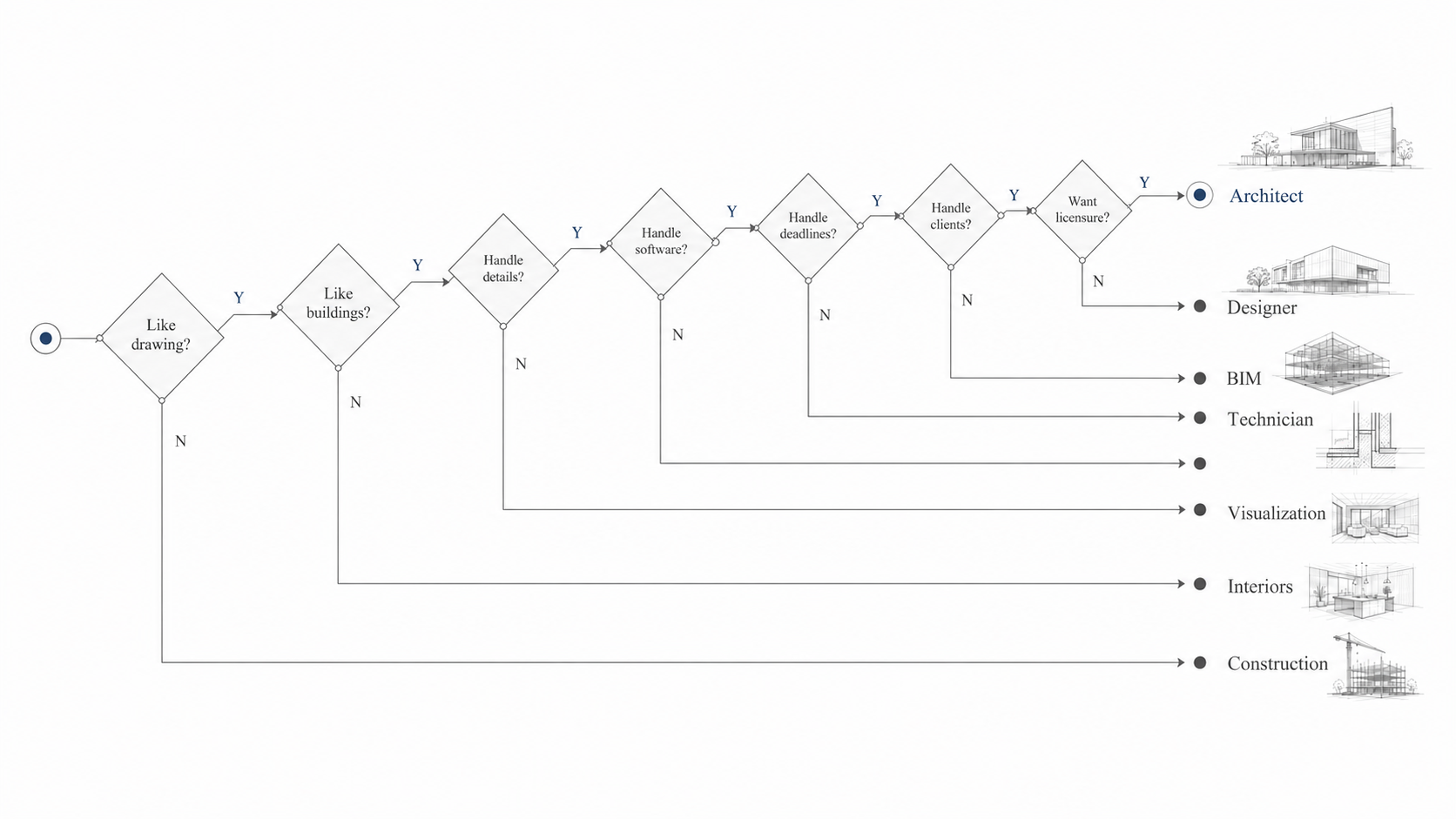
Liking buildings is not enough.
Architecture may fit you if you like solving messy problems, not only making pretty drawings. You need some tolerance for detail, feedback, software, deadlines, technical limits, and people changing their minds.
It may fit if you can handle a long path. School, experience, exams, licensure, portfolio building, and career growth take time. If you need fast financial reward, architecture may frustrate you.
It may fit if you care how things are built. If you only enjoy the image of design and hate structure, weather, codes, budgets, and construction logic, the job may wear you down.
It may fit if you can take criticism without collapsing. Architecture is full of markups. A redline is not always an insult. Sometimes it is the job teaching you.
It may not fit if you need total creative control every day. Most architecture work is collaborative. Clients, codes, budgets, consultants, contractors, and owners all shape the result.
It may not fit if you hate uncertainty. Projects change. Fees shrink. Schedules move. Permits stall. Revisions come back. A calm architect is often someone who learned to keep working through imperfect information.
What to do next if you still want this career
Do not start by asking, “Is architecture worth it?” That question is too broad.
Ask better questions:
- Do I want licensure, or do I mainly want design-adjacent work?
- Can I afford the education path without creating dangerous debt?
- Do I like technical details, or only visual design?
- Do I want office work, site work, client work, software work, or business work?
- Can I handle slow early pay if the long-term path is strong?
- What kind of firm would teach me without burning me out?
- What would I do if traditional practice does not fit?
Then get close to the real work. Talk to working architects. Shadow a firm if possible. Look at construction drawings, not only portfolio images. Learn Revit or another serious production tool. Visit buildings under construction. Read job ads carefully. Compare salary with rent and debt before choosing a school or city.
An architectural career can be rewarding, but it should be chosen with clear eyes. The field needs thoughtful people. It does not need more students sold a fantasy and then shocked by the office.
FAQ
Is architecture a good career?
Architecture can be a good career for people who like buildings, design, technical problem solving, coordination, and long-term skill building. It is a poor fit for people who want quick money, constant creative freedom, or a short path to authority.
What does an architect actually do?
Architects design buildings and help turn design ideas into coordinated, code-aware, buildable documents. The work can include client meetings, drawings, BIM models, planning, details, consultant coordination, permits, site questions, and construction support.
How long does it take to become an architect?
In the United States, the path usually includes professional education, documented experience, the Architect Registration Examination, and state licensure. The timeline depends on degree path, jurisdiction, experience hours, exam progress, and personal pace.
Do you need a degree to work in architecture?
You usually need a professional architecture degree for the standard licensure path in many U.S. jurisdictions, but some people work in architecture-related roles without becoming licensed architects. Drafting, BIM, visualization, construction coordination, and design support can have different requirements.
What is the difference between an architect and an architectural designer?
An architect is usually licensed to practise architecture in a jurisdiction. An architectural designer may work on architecture projects but may not be licensed. The designer can still be skilled, but the legal role and responsibility are different.
Are architecture jobs hard to get?
Entry-level jobs can be competitive, especially in popular cities or famous firms. Strong software skills, clear drawings, a focused portfolio, internship experience, and realistic salary expectations help. The market also changes with construction cycles.
Can architects work remotely?
Some architecture work can be remote, especially BIM support, drafting, rendering, visualization, research, and some project coordination. Site work, client meetings, construction administration, and team-heavy deadlines may still require in-person work.
What are good alternative careers for architects?
Common alternatives include BIM management, construction management, real estate development, urban planning, owner’s representative work, visualization, product design, facilities planning, building-code consulting, and design technology.
Is architecture stressful?
It can be. Deadlines, client changes, budgets, technical risk, coordination problems, and long hours can create pressure. The stress is much worse in firms with poor staffing, vague scope, weak management, or a culture that treats burnout as normal.
What should I learn before choosing architecture?
Learn what the office work looks like, not only what school projects look like. Study drawing, software, building systems, basic construction, communication, and time management. Also learn the salary path before taking on heavy education debt.
References
Sources used for this article
- U.S. Bureau of Labor Statistics: Architects, Occupational Outlook Handbook
- O*NET OnLine: Architects, Except Landscape and Naval
- NCARB: How to Earn Your Architecture License
- NCARB: AXP Experience Requirements
- NCARB: NAAB-Accredited Programs
- National Architectural Accrediting Board: Accredited Programs
- NCARB: Become an Architect